




When a person lets a photo print app access pictures stored in a personal cloud account, sharing raw passwords creates severe risks. Learning how oauth 2.0 works reveals an access framework built on delegated rights, where an independent server issues scoped tokens rather than permanent logins [7]. Published in October 2012 by the Internet Engineering Task Force (IETF) as Request for Comments RFC 6749, the specification replaces older methods that forced outside tools to store passwords [1]. The framework separates the account owner from the client app, preventing third-party tools from gaining unchecked control over personal files and private services [5].
- Origins of Delegated Web Authorization
- Core Roles in the OAuth 2.0 Framework
- How the Authorization Code Flow Works
- Alternative Grant Types for Different Clients
- How OAuth 2.0 Protects Bearer Tokens
- What Is the Difference Between OAuth and OpenID Connect?
- Vulnerabilities and Security Considerations in RFC 6819
- Why Modern Applications Adopt OAuth 2.0
Origins of Delegated Web Authorization
Before open standards emerged, web tools relied on brittle techniques to link user accounts between web services. Applications routinely asked users to type their primary account passwords into third-party forms, creating severe vulnerabilities across the web [5]. Credential sharing gave external software full account control, leaving account owners without any mechanism to set time limits or restrict specific actions cleanly [1].
The push to solve this problem started in November 2006 when Blaine Cook built an OpenID tool for Twitter [13]. Cook met with Chris Messina, Larry Halff of Ma.gnolia, and David Recordon at a CitizenSpace OpenID meeting to discuss delegating API access without leaking user identity [5]. They realized that the web lacked an open standard for API access delegation [13]. Early proprietary systems like Google AuthSub, AOL OpenAuth, Yahoo BBAuth, Amazon Web Services, and the Flickr API already exchanged logins for tokens, but each used separate rules [5]. In the older RFC 5849 standard, the host was named the Service Provider, the client app was called the Consumer, and the workflow relied on an intermediate Request Token [3].
In April 2007, an implementer group formed to draft a common specification, drawing support from DeWitt Clinton at Google [5]. Eran Hammer joined to guide the work, leading to the OAuth Core 1.0 draft on October 3, 2007 [13]. Security challenges soon appeared. On 23 April 2009, the group released OAuth Security Advisory: 2009.1 to fix a session fixation bug in Section 6 of that draft [18]. Later, the Internet Engineering Task Force (IETF) published RFC 5849 in April 2010 to document version 1.0 formally under editor Eran Hammer-Lahav [3].
Core Roles in the OAuth 2.0 Framework
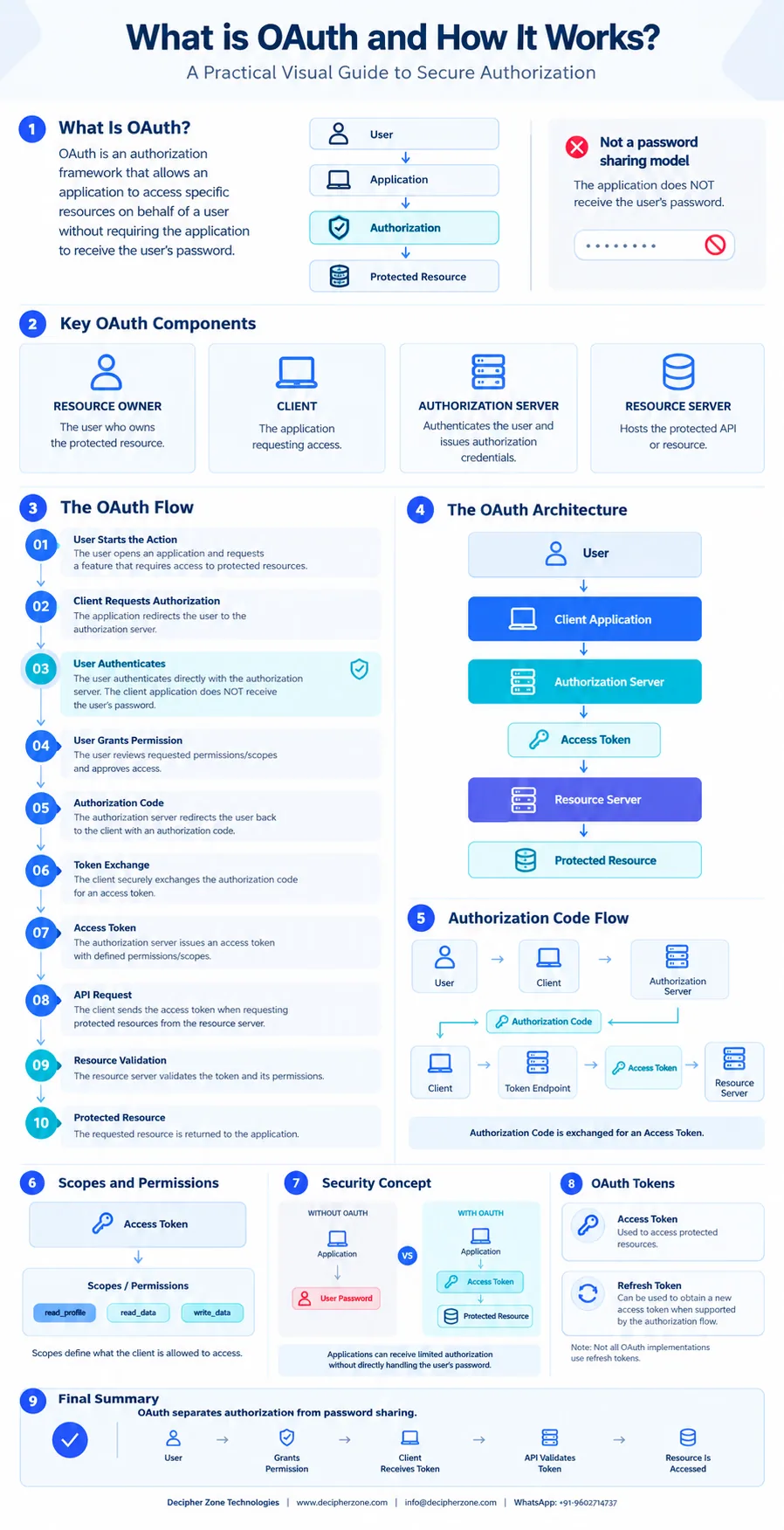
Section 1.1 of RFC 6749 establishes four core roles to separate resource access from permission management rather than relying on a simple two-party connection. The resource owner is an entity capable of granting access to protected data, usually an end-user sitting at a computer or phone. The resource server hosts those guarded files, accepting requests that carry valid tokens [1].
The third role is the client, representing any software application that makes protected resource requests on behalf of the owner [1]. Client apps run on web servers, desktop computers, or mobile phones [8]. The fourth role is the authorization server, which authenticates the user, checks consent, and issues access tokens [1]. Examining how OAuth 2.0 works in production shows how role separation protects user assets. According to survey data from the IBM Institute for Business Value, 52% of corporate leaders cite system complexity as their top cybersecurity challenge [7]. Detailed analysis of OAuth 2.0 authorization and delegated access shows how separating these responsibilities prevents software components from overstepping their operational boundaries.
Role interactions depend on scopes, which define exact boundaries for granted rights [7]. When an app starts an authorization request, it states the specific scopes it needs, such as read-only access to calendar entries or contacts [8]. The user reviews these requested scopes on a consent screen before approving the connection, and the issued token strictly reflects those limits to prevent tools from touching email or billing records [1, 7]. Tokens act like a valet key [5].
How the Authorization Code Flow Works
The authorization code grant is the core flow in RFC 6749, built for confidential clients that can protect secrets on a private web server [1]. Understanding how OAuth 2.0 works during code exchanges explains why secret keys never touch web browsers. First, the client redirects the user to the authorization server endpoint with query parameters including the registered client ID, requested scopes, a redirect Uniform Resource Identifier (URI), and a state parameter. Guidance from the Microsoft identity platform confirms that the state parameter links the authorization request to the user’s browser session, which directly prevents cross-site request forgery attacks [14]. After verifying credentials, the authorization server prompts the account holder to approve the requested permissions on an explicit consent dialog [9].
When the user grants consent, the authorization server redirects the browser back to the registered redirect URI with an authorization code. Codes expire rapidly. Typically expiring in about one minute, the authorization code acts as a short-lived claim voucher rather than a permanent token [14].
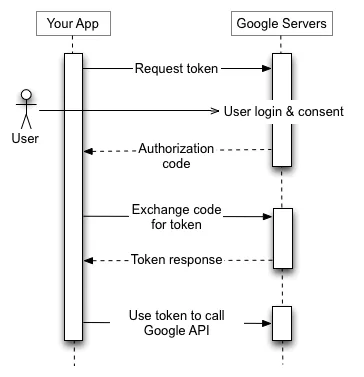
Next, the client backend makes an HTTP POST call to the token endpoint, presenting the short-lived authorization code with its confidential client secret over an encrypted TLS channel. The server checks these values and returns an access token [1]. Google API guidance recommends requesting scopes incrementally when users trigger specific actions, preventing excessive permission requests. When an access token expires during daily use, the app uses its refresh token to obtain a replacement without prompting the person again [9].
Alternative Grant Types for Different Clients
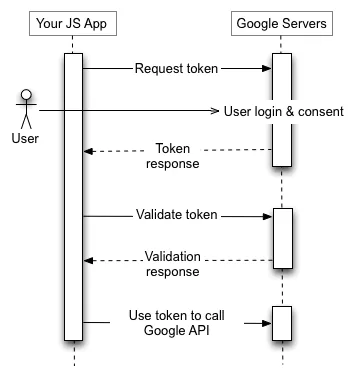
Beyond the authorization code flow, RFC 6749 defines three other grant types for different app setups, and analyzing how OAuth 2.0 works across alternative client architectures highlights the role of specialized grant types. The implicit grant serves client-side JavaScript apps [1]. It skips the authorization code exchange entirely to return an access token directly in the redirect URI fragment, but leaving tokens in browser history created real security hazards for early single-page web applications [4, 9].
For automated tasks where no human user is present, the protocol provides the client credentials grant [1]. Background jobs, microservices, and system monitoring tools use this method to authenticate directly with their own client credentials. The app sends its client ID and secret to the token endpoint to receive an access token scoped for system data, such as a weather feed or server metric API [7]. Because no resource owner is involved, the authorization server skips user consent screens completely [1]. Cloud platforms use this pattern to manage machine communications cleanly, allowing automated tools to access target APIs without user intervention [6].
A fourth option, the resource owner password credentials grant, allowed apps to accept usernames directly [1]. Security experts in RFC 6819 strongly discouraged this method [4]. Today, native and browser tools adopt Proof Key for Code Exchange (PKCE) under RFC 7636, creating dynamic cryptographic verifiers that protect code exchanges across mobile operating systems [13].


How OAuth 2.0 Protects Bearer Tokens
After an authorization server creates an access token, client tools must send it to protected APIs under clear rules. Published in October 2012 by the IETF, RFC 6750 details how to handle bearer tokens. Any party holding a bearer token can use it without proving possession of a cryptographic secret key [2].
The way OAuth 2.0 works with bearer tokens requires Transport Layer Security on every connection to stop eavesdropping. Published as RFC 6750 by the IETF, the bearer specification defines three distinct methods for transmitting tokens in HTTP calls: header fields, form bodies, and query strings. The header approach using the Bearer scheme is the main method, and resource servers must support it. For example, a client sends Authorization: Bearer mF_9.B5f-4.1JqM to fetch user data. Sending credentials in headers keeps tokens out of browser bookmarks and prevents exposure through referer headers [2].
In contrast, sending tokens in URI queries is discouraged by RFC 6750 and Google API documentation [2, 9]. Query strings often leak into server logs, web proxies, and browser histories [4]. Many production systems encode bearer tokens as signed JSON Web Tokens (JWT) that include expiration times, issuing endpoints, and target audiences [7]. Self-contained tokens allow resource servers to verify permissions quickly without making database queries for each API request [8].
What Is the Difference Between OAuth and OpenID Connect?
Developers often confuse authorization with authentication when setting up social login buttons [8]. Authentication confirms who a user is by checking passwords, biometrics, or hardware keys [7]. In contrast, authorization decides what data or tools an authenticated entity can reach [8]. OAuth was built for authorization alone; treating an access token as proof of personal identity is called pseudo-authentication and can create serious security gaps [13].
To address this gap, the community created OpenID Connect (OIDC) as an identity layer on top of OAuth 2.0 to support federated Single Sign-On (SSO) across distributed web environments [7, 12]. When a person clicks “Sign in with Google” or logs in through Microsoft Entra, OIDC verifies the user and returns an id_token together with the access token [14]. The ID token is a signed JWT built for the client app to read user profile details [7]. Meanwhile, the access token is presented to resource server APIs [8]. Pairing both protocols lets apps know who logged in while keeping API permissions strictly scoped [7].
How do large firms control access rules? Many organizations pair OAuth with XACML to enforce fine-grained corporate policies. While OAuth handles user consent and token delegation, XACML evaluates attributes like job titles, document states, and business hours to decide access [13].
Vulnerabilities and Security Considerations in RFC 6819
In January 2013, the IETF published a detailed threat model in RFC 6819 to help developers secure OAuth systems. The memo reviews threats across authorization endpoints, token issuance pipelines, and redirect destinations. Security reviews of how OAuth 2.0 works uncover configuration traps like unvalidated redirect URIs [4].
In May 2014, Wang Jing, a doctoral student in mathematics at Nanyang Technological University in Singapore, reported a flaw called Covert Redirect affecting major web platforms like Facebook and Google [10, 11]. The bug exploited client apps that failed to enforce strict whitelist rules for their redirect URL parameters. As CNET reported, LinkedIn engineer Shikha Sehgal had warned developers to register exact redirect URLs before public disclosure. PayPal CTO James Barrese stated that engineering defenses kept PayPal accounts safe. Security experts including Veracode CTO Chris Wysopal and WhiteHat Security founder Jeremiah Grossman observed that unvalidated redirect parameters created severe phishing hazards [10]. Analysis of real-world infrastructure shows that flaws in BIG-IP APM OAuth servers demonstrate how critical strict validation remains when appliances handle enterprise token validation.
Researchers have also used formal models to evaluate the protocol. In a 2016 preprint paper on arXiv, Daniel Fett, Ralf Küsters, and Guido Schmitz published the first extensive formal security analysis of OAuth 2.0 across all four core grant types. Although that preprint was not peer-reviewed, the authors found practical vulnerabilities like authorization server mix-up attacks [12]. Real attacks also occurred: in May 2017, an OAuth phishing campaign tricked under 0.1% of Gmail users with a rogue app named “Google Apps”, proving that providers must monitor third-party app access carefully [13].
Why Modern Applications Adopt OAuth 2.0
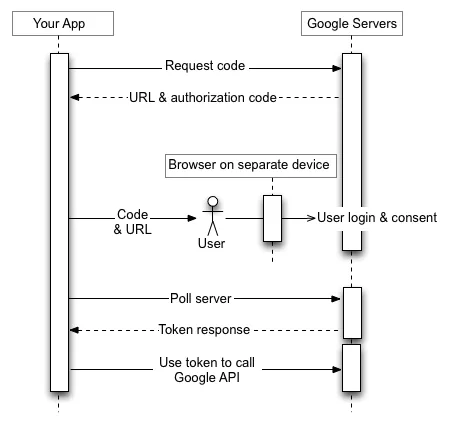
Beyond web browsers, the protocol now protects connected hardware and specialized networks. Cirani and fellow researchers developed IoT-OAS, adapting OAuth mechanisms to smart sensors running the Constrained Application Protocol [16]. Network teams have also introduced EAP-OAUTH, allowing enterprise wireless local area networks using IEEE 802.1X to link with cloud identity providers for streamlined user authentication and roaming [17]. Devices with limited input, such as smart televisions, game consoles, and printers, use the device authorization grant. The device displays a short code and web link, allowing the user to approve the login from a phone or computer [9].
A major new frontier involves autonomous artificial intelligence agents. Seeing how OAuth 2.0 works with artificial intelligence agents illustrates the reach of scoped access, especially under the Model Context Protocol (MCP) where autonomous models query calendars, search documentation, and retrieve customer records on behalf of human users. The agent acts as an OAuth client and completes an authorization code flow with PKCE to obtain short-lived tokens. This setup creates an auditable record of actions while preventing autonomous software from storing master passwords [8].
As the IETF finishes the OAuth 2.1 specification under BCP 78 and BCP 79 guidelines, the protocol consolidates lessons from fifteen years of production use [13]. By retiring the implicit grant and requiring PKCE, the standard hardens access for every client [8]. Exchanging scoped tokens instead of passwords remains the foundation of web security [7].
- REPORT Hardt, D. (Ed.). (2012). The OAuth 2.0 Authorization Framework (RFC 6749). Internet Engineering Task Force. [Article Link]
- REPORT Jones, M., & Hardt, D. (2012). The OAuth 2.0 Authorization Framework: Bearer Token Usage (RFC 6750). Internet Engineering Task Force. [Article Link]
- REPORT Hammer-Lahav, E. (Ed.). (2010). The OAuth 1.0 Protocol (RFC 5849). Internet Engineering Task Force. [Article Link]
- REPORT Lodderstedt, T., McGloin, M., & Hunt, P. (2013). OAuth 2.0 Threat Model and Security Considerations (RFC 6819). Internet Engineering Task Force. [Article Link]
- WEBSITE Hammer-Lahav, E. (2007). Introduction to OAuth. OAuth.net. [Article Link]
- ACADEMIC JOURNAL Leiba, B. (2012). OAuth Web Authorization Protocol. IEEE Internet Computing, 16(1), 74-77. [Article Link]
- WEBSITE Lindemulder, G., & Kosinski, M. (2024). What Is OAuth (Open Authorization) and How Does It Work? IBM. [Article Link]
- WEBSITE Nehra, M. (2019). What is OAuth and How it works? Decipher Zone. [Article Link]
- WEBSITE Google for Developers. (2026). Using OAuth 2.0 to Access Google APIs. Google. [Article Link]
- ONLINE NEWS Low, A. (2014). Serious security flaw in OAuth, OpenID discovered. CNET. [Article Link]
- ONLINE NEWS Owano, N. (2014). Math student detects OAuth, OpenID security vulnerability. Tech Xplore. [Article Link]
- PREPRINT Fett, D., Küsters, R., & Schmitz, G. (2016). A Comprehensive Formal Security Analysis of OAuth 2.0. arXiv. [Article Link]
- WEBSITE Wikipedia contributors. (2024). OAuth. Wikipedia. [Article Link]
- WEBSITE Microsoft Learn. (2026). Microsoft identity platform and OAuth 2.0 authorization code flow. Microsoft. [Article Link]
- ACADEMIC JOURNAL Ferry, E., Raw, J. O., & Curran, K. (2015). Security evaluation of the OAuth 2.0 framework. Information and Computer Security, 23(1), 73-101. [Article Link]
- ACADEMIC JOURNAL Cirani, S., Picone, M., Gonizzi, P., Veltri, L., & Ferrari, G. (2014). IoT-OAS: An OAuth-Based Authorization Service Architecture for Secure Services in IoT Scenarios. IEEE Sensors Journal, 15(2), 1224-1234. [Article Link]
- ACADEMIC JOURNAL Mortágua, D., Zúquete, A., & Salvador, P. (2024). Enhancing 802.1X authentication with identity providers using EAP-OAUTH and OAuth 2.0. Computer Networks, 244, 110337. [Article Link]
- WEBSITE OAuth Security Advisory: 2009.1. (2009). OAuth.net. [Article Link]


