






Apple announced its redesigned MacBook Pro PROLED laptop during an October 28 event in Los Angeles [4]. Chief executive John Ternus presented the notebook at CBS Columbia Square, and the reveal ended years of corporate skepticism toward touch computers [5]. The new machine pairs custom tandem OLED displays with Apple M5 Pro and M5 Max silicon, with base pricing set at $2,899 for the 14.2-inch build and $3,399 for the 16.3-inch chassis [1]. Deliveries start November 6, 2026 [4]. The debut follows launch events earlier that week for the OLED iPad mini and M6 iMac desktops [5].
MacBook Pro PROLED Touch Controls
The laptop embeds a touch sensor directly within the display panel rather than sandwiching a separate digitizer layer above the pixels, which Apple says minimizes input latency [2]. Tapping icons feels immediate. Users can scroll web pages with one finger, pinch to zoom inside documents, and sketch freehand notes on screen [3].
Apple spent nearly two decades resisting touch on personal computers, with former leaders claiming that reaching across a keyboard caused shoulder fatigue. Steve Jobs famously branded vertical touchscreens “ergonomically terrible,” and Tim Cook once joked that merging a tablet with a Mac was akin to combining a toaster with a refrigerator [2]. In an interview with Steven Levy of Wired, Ternus said the Mac is still “first and foremost” built around a trackpad and keyboard, but noted that “it’s comfortable and handy to have touch” for creative workflows [5]. Earlier reporting showed that Apple readied a touchscreen MacBook Pro for late October to test professional interest in touch manipulation. The company expects designers to inspect 3D assets in Blender and test mobile software right on the display [3].
Desktop controls in macOS 27 adapt automatically whenever fingers make contact with the screen surface, so menus present larger touch targets and smoother gesture animations for creative apps [1]. Context menus widen their spacing so fingers do not misclick nearby commands [2]. A downward swipe hides the dock. Developers can double-tap window title bars to fill the screen or flick windows into split-view tiles [4].

Tandem OLED Display Panels
Apple retired Mini-LED backlighting in this machine, switching to a tandem OLED display that layers two light-emitting surfaces together to reach 2,000 nits of peak brightness. Apple measures contrast at 10,000,000:1. The screen covers both P3 and Adobe RGB color spaces, which gives digital colorists accurate reference modes for print publications and broadcast mastering in DaVinci Resolve Studio. A 12MP Center Stage camera adds advanced video stabilization so finger taps do not shake video calls in FaceTime [1]. Desk View lets remote workers share physical workspaces alongside digital sketches [3].
Screen sizes measure 14.2 inches on the compact model and 16.3 inches on the larger option. The 16.3-inch panel expands slightly beyond the older 16.2-inch chassis [1]. Customers can pick standard glossy glass or pay extra for a matte nano-texture coating that scatters ambient glare [4].
Apple eliminated the camera notch on the new screen, adopting the Dynamic Island pill from the iPhone lineup [4]. The island houses the front camera while displaying live timers, background music tracks, and Siri AI notifications [1]. Sustained brightness holds at 1,000 nits across the entire display surface for daily office software [3]. The screen lacks Apple Pencil support. Lance Ulanoff of TechRadar reported from Los Angeles that several attendees questioned that omission, as they doubted whether touch without a precision stylus offers enough utility for professional illustrators [5]. Apple executives counter that finger interactions serve as a companion to the trackpad rather than a complete tablet replacement [2].


Lighter Chassis and Hinge Design
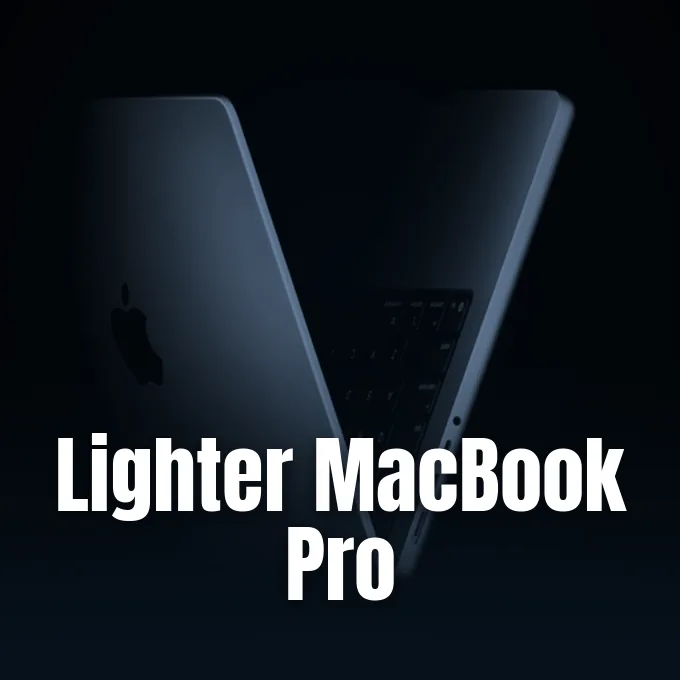
The aluminum unibody delivers Apple’s first full exterior chassis redesign since 2021, and the 14-inch model weighs 3.0 pounds to shed half a pound compared to standard notebooks [1]. The 16-inch version weighs 4.0 pounds, dropping 0.7 pounds from earlier builds. Lighter materials ease travel burdens [4].
Engineers rebuilt the notebook hinge to keep the screen upright under direct hand pressure, and this mechanism keeps the panel completely stable during stylus-free sketching, web navigation, and document markup. The lid also restores the illuminated Apple logo, bringing back a visual trademark that vanished when the company updated its pro laptops in 2016 [4]. The lighter build follows earlier reports that Apple planned to redesign the MacBook Pro with an OLED display and a lighter chassis to modernize pro workflows. The 14-inch casing measures 0.59 inches thick, while the 16-inch model measures 0.63 inches [1].
Internal speakers rely on six drivers with revamped woofers that generate 50 percent deeper bass. Apple added closed-lid audio calibration for people using external studio monitors. Port options remain extensive, featuring an SDXC card slot, an HDMI output, a 3.5mm headphone jack, and MagSafe 3 charging [1].

M5 Pro Processing Options
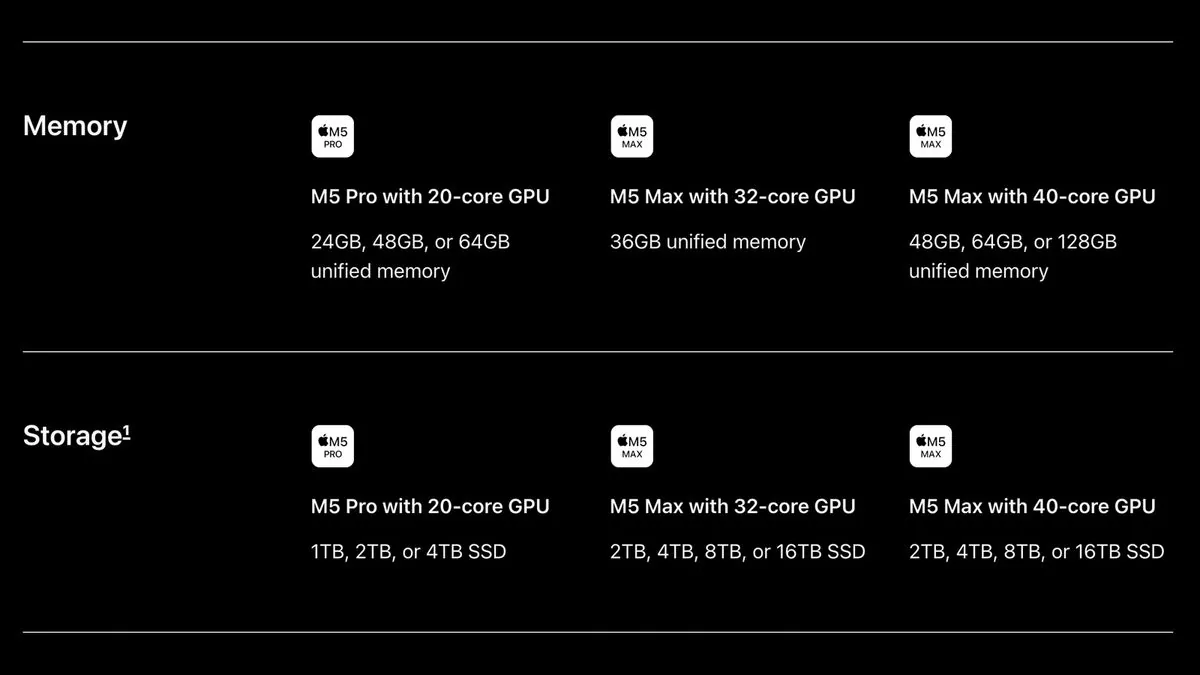
Apple chose M5 Pro and M5 Max processors for these laptops rather than the entry-level M6 chip introduced in new iMac computers [4]. The M5 Pro features an 18-core CPU and up to a 20-core GPU, while the M5 Max scales up to 40 GPU cores for heavy 3D rendering in Maxon Cinema 4D and Nuke by Foundry. Both chips incorporate a Neural Accelerator within each graphics core to accelerate local artificial intelligence models in LM Studio and Topaz Video [3]. Base configurations offer 24GB of unified RAM on M5 Pro builds and 36GB on M5 Max models, topping out at 128GB of memory. A new 16TB solid-state storage tier on M5 Max models doubles the previous 8TB ceiling [1].
Mark Gurman of Bloomberg reported that Apple skipped M6 Pro and M6 Max processors to focus engineering teams on the upcoming M7 processor family slated for release in late 2027. The company plans to introduce M7 Pro and M7 Max silicon in late 2027 [5]. This roadmap leaves raw computing power on par with earlier M5 Pro laptops [1].
Battery endurance holds steady despite the brighter OLED screen: the 16-inch M5 Pro edition runs for up to 24 hours, while the 14-inch model provides 22 hours. Fast charging replenishes roughly 50 percent of the cell in 30 minutes with MagSafe. Apple integrated its proprietary N1 wireless chip for Wi-Fi 7 and Bluetooth 6, while three Thunderbolt 5 ports deliver transfer speeds up to 120Gb/s with new Genlock camera synchronization [1]. The M5 Pro drives up to three external displays, while the M5 Max operates four external panels simultaneously [3].
MacBook Pro PROLED Pricing and Launch
The 14.2-inch MacBook Pro PROLED enters the market at $2,899, which represents a $400 increase over the standard Mini-LED model. The 16.3-inch version starts at $3,399 [1]. In overseas markets, base 14-inch units cost £2,899 in the United Kingdom and AU$4,599 in Australia [5].
Fully customized hardware configurations carry substantial costs for studio buyers. A maxed-out 16-inch model packed with the M5 Max chip, 128GB of unified RAM, and 16TB of storage reaches $14,549 in the United States and £14,549 in Britain [5]. Online preorders began on October 28 through Apple’s online store, with customer shipments and retail store arrivals starting on November 6, 2026 [4]. The launch follows a busy release schedule in California that started with the OLED iPad mini on Monday and the M6 desktop announcement on Tuesday [5]. Customers who prefer standard screens can still buy Mini-LED MacBook Pro configurations from March without touch controls starting at $2,499 [1].
Buyers can select between Silver and Space Black aluminum finishes across both sizes, while Apple offers hardware trade-in credits and monthly installment options through Apple Card [3]. Whether pro creators adopt touch on macOS will depend on developer software, but the machine delivers an ambitious display alternative for workstation users [1].
- ONLINE NEWS Christoffel, R. (2026, October 28). MacBook Pro with PROLED XDR vs MacBook Pro: Here’s every difference. 9to5Mac. [Article Link]
- ONLINE NEWS Bonifacic, I. (2026, October 28). Here’s how the touchscreen on the MacBook Pro with PROLED display works. Engadget. [Article Link]
- PRESS RELEASE Apple. (2026, October 28). MacBook Pro with PROLED XDR Display. Apple Newsroom. [Article Link]
- ONLINE NEWS Hall, Z. (2026, October 28). Apple announces all-new MacBook Pro with PROLED XDR display, its first touchscreen Mac. 9to5Mac. [Article Link]
- ONLINE NEWS Wilson, M. (2026, October 28). Apple event live — the MacBook Pro with PROLED XDR Display is official and we’re in LA to try it. TechRadar. [Article Link]


