




Northwestern University physicists trapped a single subatomic particle of antimatter for months inside a cryogenic vacuum apparatus [2]. The particle, a positron, is the positively charged counterpart to the electron [3]. Matter and antimatter cancel each other out upon contact, turning into energy and making physical storage difficult. To overcome this barrier, Northwestern researchers led by Gerald Gabrielse developed a wall-free antimatter trap that keeps the positron suspended in space using electric and magnetic fields. The experiment reported by Clara Moskowitz opens a path toward testing why the cosmos consists of matter [2, 3].
Relativistic Positrons from Sodium-22
The Northwestern University experiment begins with radioactive sodium-22, an unstable isotope with a half-life of about two and a half years [2]. As sodium-22 decays, its nuclei spit out positrons with kinetic energies reaching up to 546 kiloelectronvolts. Particles flying out at these energies travel at about 88 percent of the speed of light. That velocity is relativistic. Northwestern physicist Gerald Gabrielse and his team faced the difficult task of slowing down these fast antiparticles before they struck ordinary electrons. If an ejected positron collides with an electron in the laboratory hardware, the pair annihilates in a burst of gamma-ray energy [2, 3].
Physicists have observed positrons since 1932, when Carl D. Anderson photographed their tracks in a cloud chamber. Anderson identified the antiparticles by tracking how their positive charge curved under a magnetic field [3]. Yet holding a single particle in place needs conditions far more controlled than a brief track in a detection chamber [2]. Most positrons emitted by the sodium-22 source never reach a storage cell. They smack into atoms in surrounding hardware and vanish [3].
Stopping this particle loss called for an efficient way to drain kinetic energy from the flying positrons [2]. Building a working antimatter trap required an intermediate material that could absorb velocity while letting antiparticles survive [3]. “The big challenge is to persuade these positrons to slow down and then capture them,” Gabrielse said to Scientific American. Most antiparticles strike nearby atoms and disintegrate [2].
Tungsten Moderation and Positronium
The Northwestern team directed the high-speed positrons into a sliver of cold tungsten crystal [2]. As positrons travel through the tungsten lattice, their positive charge interacts with the electron clouds of the metal atoms. These electrostatic interactions transfer kinetic energy into the crystal, slowing the antiparticles down [3]. Gabrielse compared this passage to pinballing through matter. “Every time they bang into something, there’s a chance of annihilation, but it doesn’t always happen,” Gabrielse said [2]. “If they make it to the end, they get popped out.”
A small fraction of positrons make it through the cold tungsten and emerge hitched to an electron. This bound two-particle state is known as positronium (an atom-like pairing between an electron and an antiparticle). In this arrangement, the two components enter an excited quantum level that spaces them out, postponing mutual destruction long enough for delivery into the apparatus. This spatial separation delays inevitable annihilation just long enough for the pair to travel toward the capture chamber. The pair moves intact across the vacuum [3].
Northwestern physicist Tom Myers spearheaded the design of this moderation stage during his doctoral research. By using positronium as a vehicle, Myers guided antiparticles into the apparatus without triggering prompt annihilation on the container walls. Gabrielse praised Myers in ScienceAlert for turning the concept into a working system. “It was also great to see Tom’s PhD thesis work culminating in a great success,” Gabrielse said [3].

Inside the Wall-Free Antimatter Trap
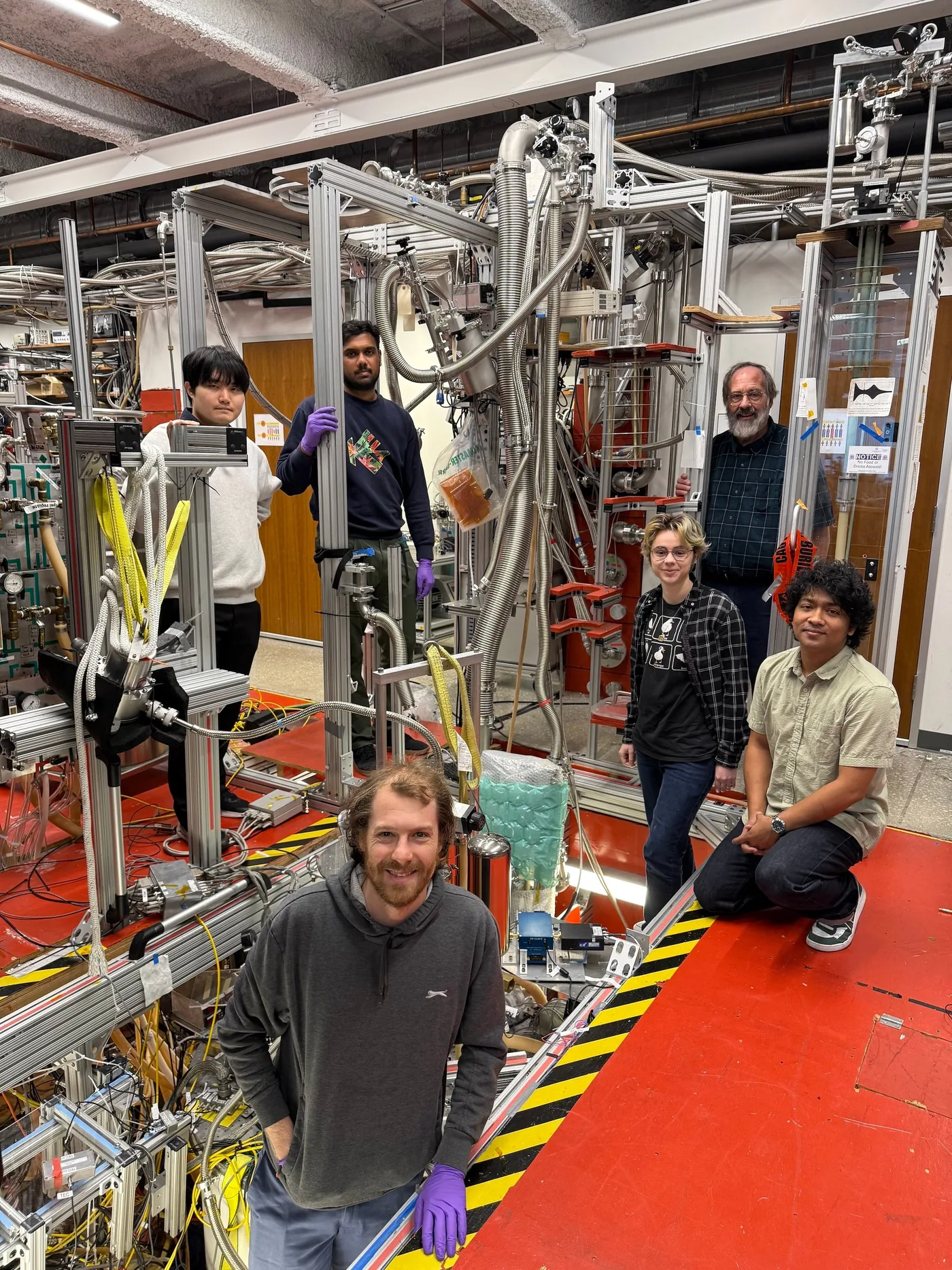
At the center of the apparatus sits a Penning trap that uses a combination of static electric and magnetic fields to hold charged particles. The entrance features a tiny opening measuring just 640 micrometers across. That pinhole is narrow. As positronium drifts through this opening, an electric field strips away the bound electron, leaving the solitary positron behind inside the trap [3]. Because solid walls would cause annihilation upon contact, electromagnetic fields keep the particle suspended in empty space. “If you want to hold on to antimatter, you have to hold it in a container without walls,” Gabrielse said [2].
The antimatter trap operates under cryogenic conditions to protect the particle from thermal disturbances. A dilution refrigerator and a superconducting magnet cool the vacuum volume down to 300 millikelvins, which is just three tenths of a degree Celsius above absolute zero [2, 3]. At this low temperature, stray gas molecules freeze out, creating a clean vacuum where the positron can survive for months without colliding with stray matter [2]. Electric fields on the top and bottom plates restrict vertical escape, while the surrounding magnetic field prevents the particle from drifting sideways.
Once detectors confirm a capture, the Northwestern physicists pull the radioactive sodium-22 source away from the trap to keep additional positrons from entering. “We turn on our detector and wait,” Gabrielse said of the loading process. “Eventually we see the electrical signal from a captured positron.” With the sodium-22 source removed, the single positron stays isolated [3].



Quantum Cyclotron Motion
Inside the antimatter trap, the positron circles in a tight orbit known as cyclotron motion. By cooling the system close to absolute zero, researchers force this orbital movement into its lowest quantum energy state, called the ground state [2, 3]. The particle no longer behaves like a classical spinning object. It occupies discrete energy levels governed by quantum mechanics [1]. In this quiet state, Gabrielse and Myers can probe the particle without disturbing its delicate alignment [3].
How do physicists manipulate a single antimatter particle without destroying it? The Northwestern team uses carefully tuned microwaves to nudge the positron between discrete energy levels, one quantum at a time. Detectors register when the particle absorbs energy and jumps to its first excited state [2, 3]. Sensors can also detect when the positron flips the direction of its spin without disturbing the measured quantum states. The ability to observe these discrete quantum jumps confirms that the particle is fully under experimental control [3].
Achieving this degree of control realizes a one-positron quantum cyclotron, an experimental goal Gabrielse pursued over decades of laboratory work at Northwestern [1, 3]. “I and my research group have been pursuing a one-positron quantum cyclotron for many years, so observing a positron making one-quantum energy jumps was extremely satisfying,” Gabrielse said [3]. Authors Tom Myers, L. Soucy, B. A. D. Sukra, B. Sinha, and Gerald Gabrielse reported their findings in Physical Review Letters [1].

How the Antimatter Trap Tests CPT Symmetry
Northwestern physicists want to hold a solitary positron to measure its magnetic moment, which describes the strength and orientation of its intrinsic magnetic field. In previous experiments, Gabrielse and his collaborators evaluated how an electron acts like a tiny bar magnet, fixing its magnetic value down to one part in 10 trillion. Now, the Northwestern group intends to measure the positron’s magnetic properties with matching precision using this antimatter trap [1, 2]. Comparing these two measurements offers a rigorous test of the Standard Model [1].
The comparison evaluates a foundational rule known as CPT symmetry (charge conjugation, parity inversion, and time reversal). Under CPT invariance, physical laws must remain unchanged if every particle swaps with its antiparticle, spatial coordinates flip in a mirror, and the flow of time reverses [2, 3]. Theoretical physicist Roni Harnik from Fermi National Accelerator Laboratory in Batavia, Illinois, who was not involved in the project, explained the significance of this symmetry to Scientific American. “Turn every particle to its antiparticle, look at physics through a mirror (flipping left and right) and press the ‘rewind button’ to reverse the flow of time,” Harnik said [2]. “Our most basic theories say that physics stays the same.”
If CPT symmetry holds in the lepton sector, an electron and a positron must share identical mass and have exactly opposite magnetic moments [1, 2]. “We’re looking to see if they have an exactly opposite magnetic moment,” Gabrielse said of the test. If measurements reveal even a tiny difference between the electron and positron values, the discrepancy would point toward undiscovered processes beyond the Standard Model. Fermilab theorist Harnik described the experiment as an exciting step that allows scientists to test this basic symmetry [2].

The Cosmic Matter Asymmetry
Testing CPT symmetry could help address one of the greatest mysteries in cosmology: why does the universe contain so much matter and almost no antimatter? Standard cosmology suggests that the Big Bang produced equal quantities of matter and antimatter [2]. Matter met antimatter in the early cosmos. When those opposite particles collided, they should have annihilated completely into photons [3]. Yet a small excess of matter survived that early destruction, forming all the stars, planets, and galaxies observed today [2].
Could an undiscovered property of the positron explain how matter won out over antimatter? Standard Model calculations predict identical behavior, leaving researchers without an explanation for the cosmic imbalance [2, 3]. Even if the new positron measurements match theoretical predictions, the broader puzzle is still unsolved. “It would deepen the mystery of how the Standard Model can make such precise predictions of what we measure, while being inconsistent with basic features of the Universe,” Gabrielse said to ScienceAlert writer Michelle Starr [3].
The antimatter trap gives the Northwestern group months to gather data before reporting their first magnetic moment measurements early next year [3]. Because the positron stays suspended in the vacuum trap indefinitely, researchers have ample time to conduct repeated quantum measurements without losing their fragile sample. The tabletop apparatus provides an unusually sharp window into fundamental laws of nature [1].
- ACADEMIC JOURNAL Myers, T. G., Soucy, L., Sukra, B. A. D., Sinha, B., & Gabrielse, G. (2026). One-Positron Quantum Cyclotron. Physical Review Letters, 137(17). [Article Link]
- ONLINE NEWS Moskowitz, C. (2026, October 21). Physicists trap a single antimatter particle for a month. Scientific American. [Article Link]
- ONLINE NEWS Starr, M. (2026, October 21). Physicists Trapped a Particle of Antimatter And Kept It Caged For Months. ScienceAlert. [Article Link]
APA 7: PerEXP Teamworks. (2026, October 22). Northwestern Physicists Trap Antimatter Particle for Months. PerEXP Teamworks. https://perexpteamworks.com/en/antimatter-trap-holds-single-positron/


