



Can ordinary space enthusiasts secure front-row access to one of the most demanding orbital maneuvers in modern planetary science? The European Space Agency and the Japan Aerospace Exploration Agency have entered the final operational stretch of their joint interplanetary voyage, celebrating the upcoming BepiColombo Mercury arrival milestone. After spending eight years navigating the inner solar system, the mission team has launched a public outreach initiative titled Welcome to Mercury to engage creators across Europe and partner nations. Under this initiative, one grand prize winner will travel directly to the European Space Operations Centre in Darmstadt, Germany, to observe spacecraft separation on 9 December 2026 [1].
Milestones Leading to the BepiColombo Mercury Arrival
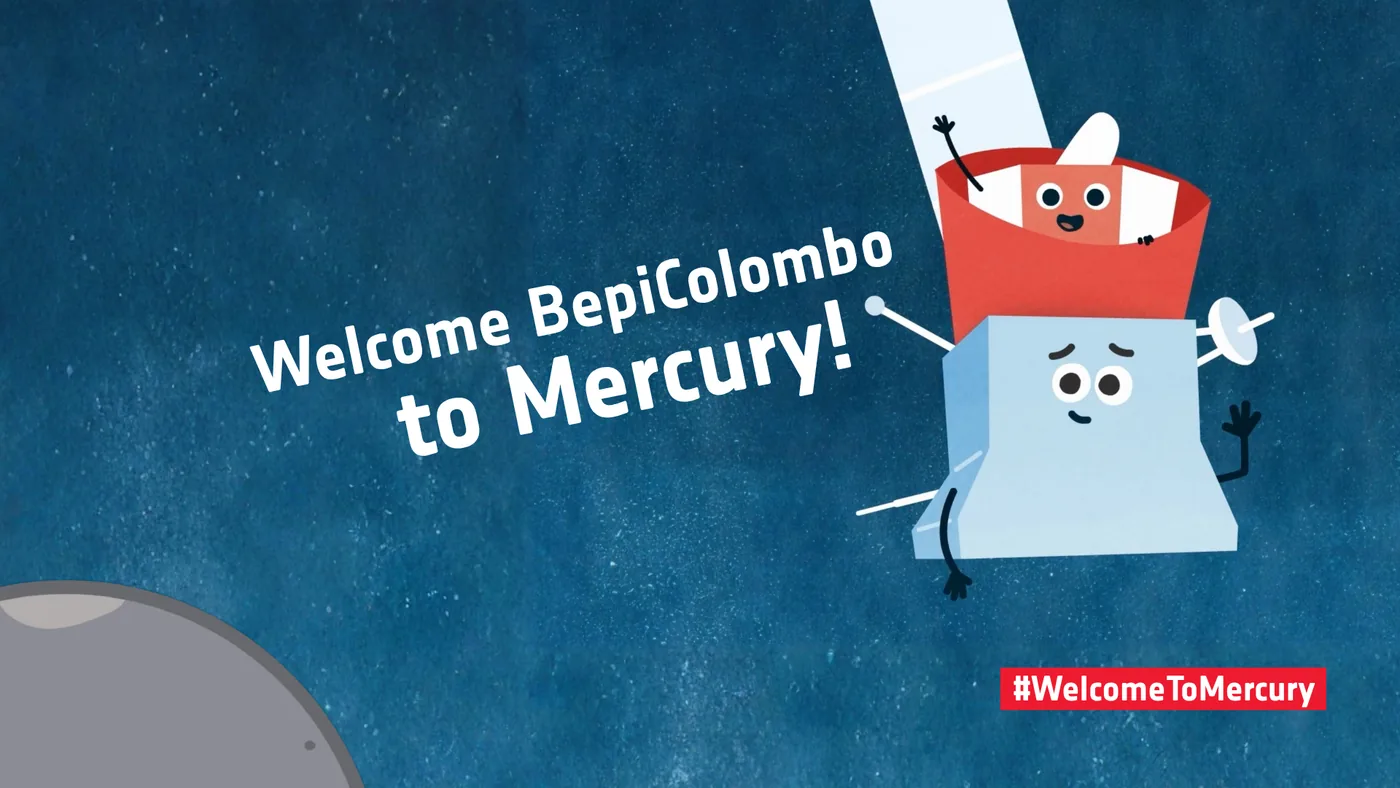
Entering orbit around the innermost planet requires immense navigation precision and a deliberate reduction of orbital momentum. Three distinct spacecraft elements—the European Space Agency’s Mercury Planetary Orbiter (MPO), JAXA’s Mercury Magnetospheric Orbiter (Mio), and the robotic Mercury Transfer Module (MTM)—spent nearly a decade cruising together in a stacked configuration. In outreach materials, MPO is affectionately known as the cartoon character Bepi, traveling alongside Mio and their robot companion MTM throughout the cruise phase. The composite structure traveled through severe thermal conditions close to the Sun. On 3 September 2026, the propulsion module that powered and steered the stack officially finished its journey and released the two scientific orbiters [2].
The next major milestone occurs on 21 November 2026, when the joined orbiters will be captured by the gravitational pull of the planet. Ground controllers will monitor trajectory telemetry as the spacecraft lines up for its crucial separation maneuvers in December. The journey lasted eight years. Following separation, Mio will have entered its science operation orbit, while MPO continues trajectory adjustments until reaching its final science orbit on 19 March 2027 [1].
How Far Is Mercury from the Sun?
Mercury orbits as the closest planet to the Sun at an average distance of roughly dozens of millions of kilometres, compelling incoming spacecraft to navigate an intense solar gravitational well. Reaching this destination requires complex celestial mechanics rather than a direct linear flight path from Earth. Spacecraft must repeatedly brake against the immense gravitational pull of the Sun. Because Mercury sits so deep inside the inner solar gravity well, direct orbital insertion would demand an impossible volume of propellant without repeated gravitational assists [2].
To shed excessive velocity, flight dynamics specialists designed an intricate multi-year trajectory involving nine planetary flybys. The spacecraft performed one initial flyby past Earth, two flybys past Venus, and six successive flybys past Mercury itself. Nine planetary flybys steered the craft. These gravitational encounters gradually lowered orbital energy, aligning the stacked composite with the orbital velocity of the target world without exhausting onboard chemical fuel reserves [1].
Mission specialists tracked each flyby from mission control in Germany. Every close encounter returned vital calibration data while accelerating towards the decisive BepiColombo Mercury arrival timeframe [2].
What Separation Marks BepiColombo Arrival at Mercury?
The spacecraft separation scheduled for 9–10 December 2026 officially marks BepiColombo’s arrival at Mercury. Throughout their joint transit, MPO and Mio traveled bolted together while receiving electrical propulsion and attitude orientation from their transport companion. When the two scientific orbiters finally disengage from one another, they will begin pursuing independent observation paths tailored to their distinct scientific sensor suites. The separation maneuver requires flawless timing from flight dynamics teams operating through deep-space radio antennas. Once Mio separates, the Japanese orbiter immediately achieves its dedicated science orbit, while ground stations listen intently for the faint telemetry transmissions that confirm autonomous stabilization in the hostile radiation environment surrounding the planet [1].
Meanwhile, the European probe will undertake a series of additional propulsion burns to lower its orbital altitude over several months. Detailed planetary research from both probes will expand scientific knowledge regarding the geological features and surface composition of Mercury, providing insights into ancient volcanic activity. Orbital insertion demands steady operational oversight because solar heating intensifies substantially in this planetary corridor. Flight controllers anticipate high atmospheric and thermal stress on protective multi-layer insulation blankets during this separation sequence [2].


Winning a Mission Control Trip to Darmstadt
To celebrate this historic milestone, the European Space Agency is inviting the public to welcome Bepi and Mio during the historic BepiColombo Mercury arrival window. The top prize offers an exclusive trip to the European Space Operations Centre (ESOC) in Darmstadt, Germany. The Darmstadt event begins at 22:00 CET. Attendees will experience the tense operational moment of waiting for the first radio signal from the spacecraft once separation has finished successfully. The selected guest will enter mission control on the night of 9 December 2026 and remain through the midnight hours as flight controllers await initial radio contact from the separated spacecraft [1].
Visiting mission control during an active planetary arrival provides an extraordinary look at high-stakes aerospace engineering. The winner will meet the scientists and operations engineers responsible for guiding the mission through its eight-year transit. Space activities inherently carry operational uncertainties. As ESA highlighted in the campaign announcement, “space activities are dynamic and may change even at the last minute.” The agency recommends making flexible travel arrangements for the Darmstadt excursion [1].
Under the competition terms, the grand prize recipient must book their own transport and lodging, with ESA reimbursing verified travel expenses up to €1000 after the gathering upon presentation of receipts. The top travel reimbursement reaches €1000. Reimbursed funds will be transferred directly to the winner’s bank account following presentation of booking receipts and formal account verification documents. Up to nine runners up will also receive curated gift bags filled with official agency merchandise [1].
Competition Guidelines for the BepiColombo Mercury Mission
Entering the competition requires participants to create an original artistic greeting welcoming the orbiters to Mercury. Entries may take diverse expressive forms, including drawings, poems, musical songs, or other creative media submitted through photographs or video recordings. Creative submissions must be published on a public social media platform such as Bluesky, LinkedIn, or X using the dedicated hashtag #WelcomeToMercury accompanied by an explanatory statement. Entrants must accompany their post with a message explaining what the voyage means to their community [1].
After posting publicly, creators must complete their submission by filling out the official European Space Agency entry form before midnight CET on 25 October 2026. Only adult participants may win. The contest is open to legal residents of ESA Member, Cooperating, and Associate States who have reached at least 18 years of age at the time of entry. Submissions will be evaluated by the ESA BepiColombo Social Media working group and editors specialising in science communication scheduled during the BepiColombo Mercury arrival operations [1].
Family and group entries are permitted under the regulations, but the individual registering the project must be an adult over 18 years of age. Anyone appearing in submitted photos or video clips must be at least 18 years old and must provide explicit consent for their appearance [1].
Ten public winners will be selected. The review panel will notify the grand prize winner and up to nine runners up during the second week of November 2026. All judging decisions remain final and non-negotiable, with no alternative cash options provided for any awarded recognition. Prospective participants must hold a valid passport to secure physical admission to the ESOC technical establishment in Germany [1].
Is Mercury the Smallest Planet?
Mercury stands as the smallest recognized planet in the solar system, measuring only slightly larger than Earth’s Moon while possessing an unusually dense metallic core. Its compact volume and proximity to the Sun create an extreme thermal setting that complicates long-term spacecraft tracking. Further exploration into the orbital proximity and solar distance of Mercury highlights why capturing an artificial satellite requires delicate deceleration maneuvers within the Sun’s powerful gravitational field. Planetary scientists seek to uncover how such a compact world preserved volatile substances despite continuous solar bombardment [2].
The arrival of both orbiters will inaugurate a new era of multi-point planetary observation. By collecting simultaneous measurements across two complementary orbits, European and Japanese teams aim to decipher the magnetic structure, exospheric composition, and interior density of this enigmatic world [1]. The BepiColombo Mercury arrival represents both an operational triumph and an inspiring milestone for space exploration communities worldwide.
- PRESS RELEASE European Space Agency. (2026, September 24). Win a trip to ESA to witness BepiColombo arrive at Mercury. ESA Science & Exploration. [Article Link]
- WEBSITE European Space Agency. (2026). BepiColombo mission overview and Mercury arrival schedule. ESA Operations. [Article Link]
APA 7: TWs Editor. (2026, September 25). ESA Invites Public to Witness BepiColombo Mercury Arrival. PerEXP Teamworks.


1 comment