




Can a billion tons of polar ice catch particles that pass through whole worlds without a trace? On October 6, 2026, the Royal Swedish Academy of Sciences awarded the Nobel Prize in Physics to Francis Halzen from the University of Wisconsin-Madison [7]. Halzen took the full prize of 12 million Swedish kronor [8, 11]. His work proved that cosmic neutrinos can uncover violent deep-space events [6].
What Are Cosmic Neutrinos and Ghost Particles?
Cosmic neutrinos are tiny elementary particles with almost no mass and zero electrical charge [5, 8]. Because they rarely hit ordinary matter, physicists often call them ghost particles [7]. Every second, more than a billion solar neutrinos stream through a human hand unnoticed [5, 10]. The standard model includes 17 fundamental particles [5]. Yet the particles that draw astrophysicists carry far higher energy than anything made inside our Sun [6]. Because cosmic rays carry an electrical charge, interstellar magnetic fields bend their trajectories across deep space, preventing astronomers from tracing those particles back to their original stellar nurseries [7, 12]. Cosmic neutrinos, by contrast, travel in straight lines across billions of light-years directly to Earth [6, 12].
In a recent preprint that has not undergone peer review, astronomer Noelia Noël noted that these particles escape from dense cosmic engines where light itself is trapped or scattered [4]. Supermassive black holes and exploding stars accelerate particles to extreme speeds [6, 7]. While other laboratories run neutrino mass measurements in subterranean water tanks, Halzen realized that cosmic neutrinos could serve as astronomical messengers [11].
Francis Halzen and the Bold Antarctic Concept
Born in Tienen, Belgium, in 1944, Francis Halzen earned his master’s degree in physics at the University of Louvain in 1966 and completed his doctorate there in 1969. After working at the CERN particle physics laboratory near Geneva, he moved to the University of Wisconsin-Madison in 1972 [8, 11]. Halzen is the 23rd Nobel laureate connected to UW-Madison and the sixth physicist, following Howard Temin who won in 1975 for discovering reverse transcriptase [7]. He is also the first solo physics laureate since Georges Charpak in 1992, joining a select history of Nobel prize discoveries in physics [11, 12].
In 1988, Halzen proposed turning South Pole ice into an enormous particle detector [7, 11]. Most colleagues thought the concept was impossible. “When we started this project, everybody realised this was maybe a good idea, but very few thought it would work – including myself,” Halzen said [10]. AMANDA was finished in 2000 [11].
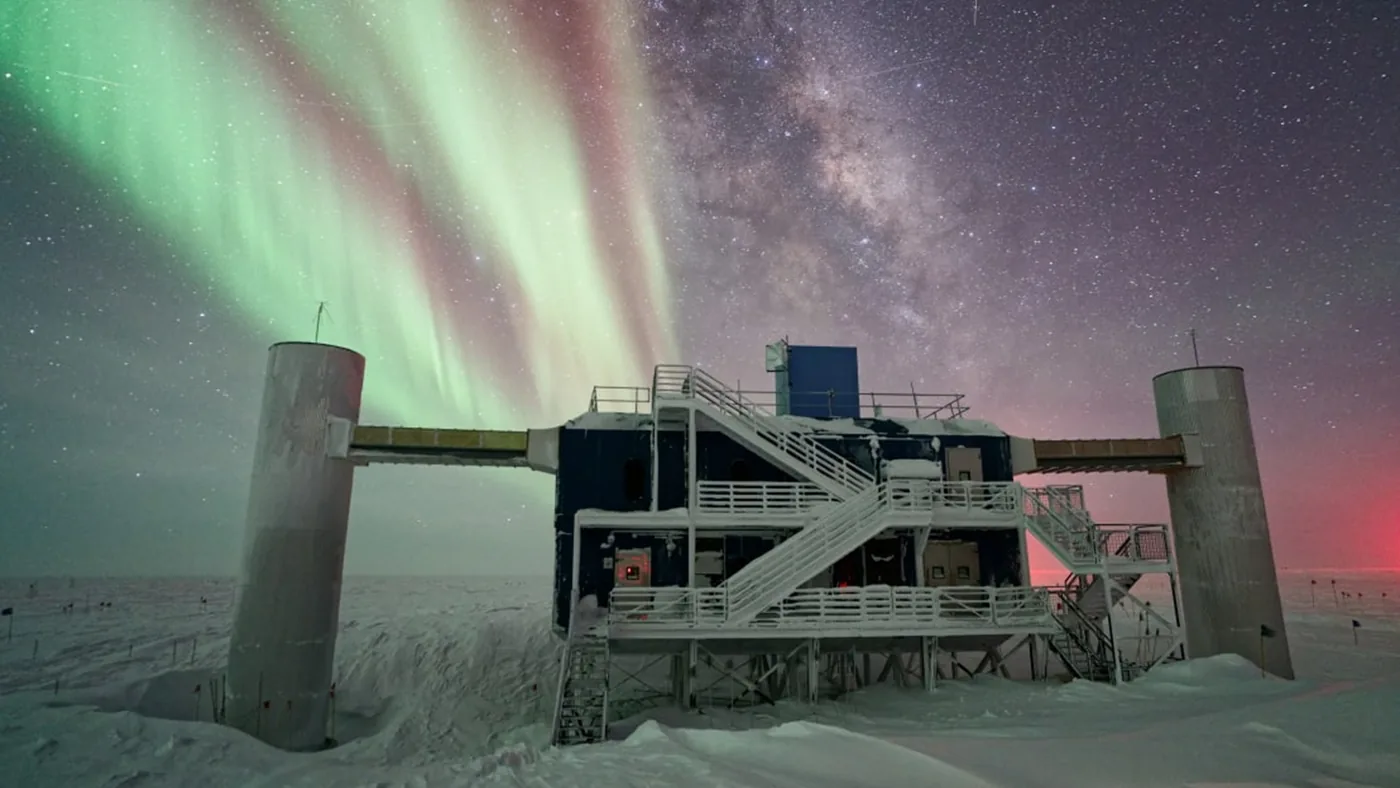
Construction began in 2004. IceCube cost 271 million dollars, funded by the U.S. National Science Foundation [6, 7]. The observatory spans an international collaboration of more than 450 researchers from 58 institutions in 14 countries [10, 11]. Eric M. Wilcots, interim chancellor at UW-Madison, said that Halzen’s plan to build a sensor array under nearly a mile of ice sparked a shift in how scientists study the cosmos [7]. “It was an adventure where success was not guaranteed, but we overcame many challenges,” Halzen said [10, 11].
How Do Neutrino Telescopes Work in Ice?
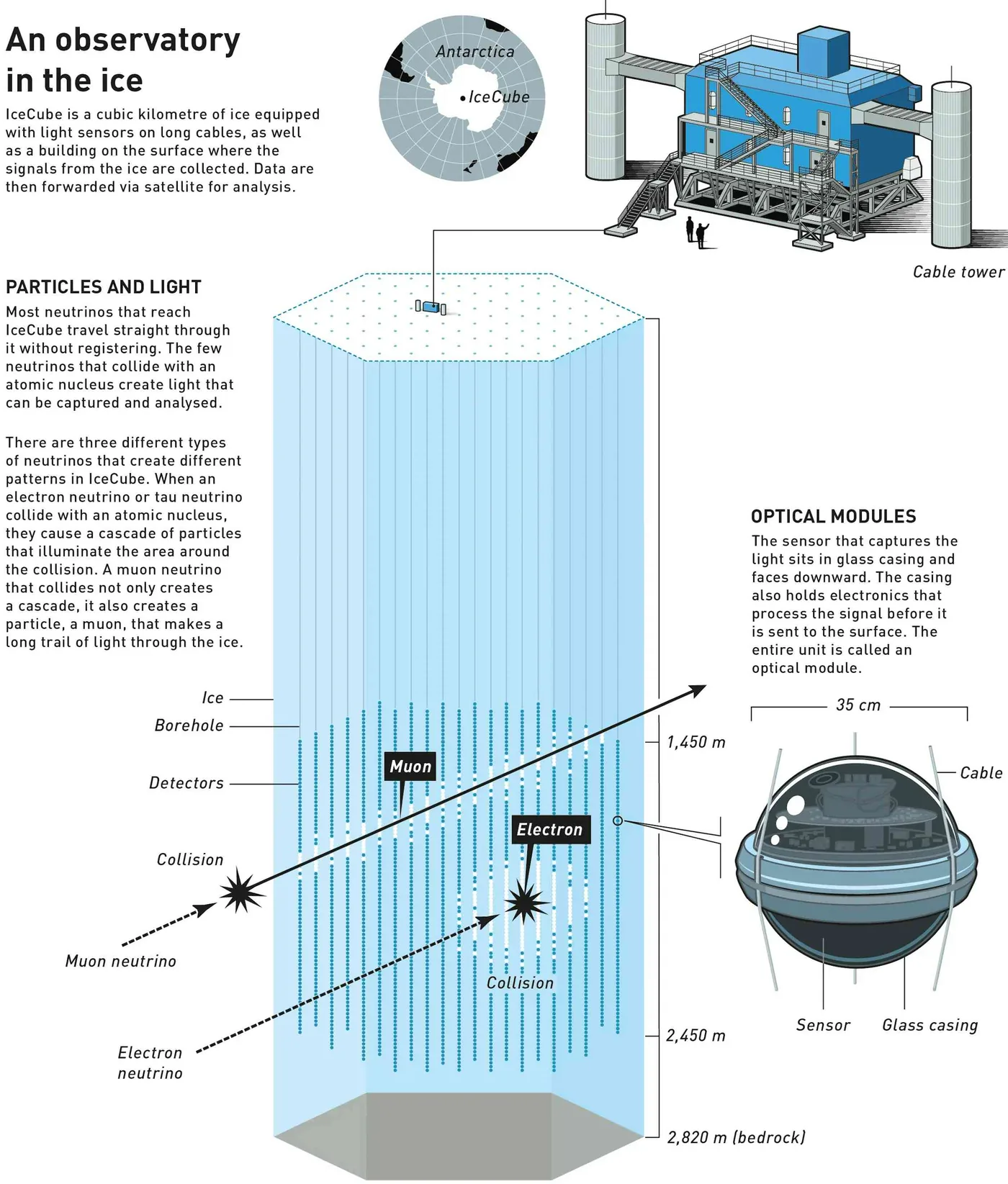
Neutrino telescopes in Antarctica work by using glacial ice as a natural interaction target rather than focusing light with mirrors. When an energetic neutrino strikes an atomic nucleus of oxygen or hydrogen within the polar ice, the collision unleashes a cascade of secondary subatomic particles that shoot through the frozen mass [7, 11]. As the muon speeds through the ice, it outpaces light waves in that medium and casts a subtle blue glow called Cherenkov radiation. This optical effect resembles a sonic boom in ice (a cone of light produced when a charged particle travels faster than the local phase speed of light in matter) [4, 7].
To record this blue glow, drilling teams used hot-water jets to bore 86 holes deep into the polar ice sheet [10, 11]. Technicians lowered strings of basketball-sized glass sensors into holes between 1.5 and 2.5 kilometers below the surface [6, 11]. Once the water refroze, 5,160 digital optical modules became locked inside one cubic kilometer of clear Antarctic ice [8, 11]. The sensors look downward through Earth [9, 11].

Each optical module holds a photomultiplier tube and digital electronics that record the exact arrival time and brightness of Cherenkov photons [1]. By measuring the exact fractions of a nanosecond when photons strike different sensors across the kilometer-wide grid, computers reconstruct the precise path and arrival angle of each incoming cosmic neutrino [4, 7]. Polar ice, compressed under immense weight for thousands of years, is pure enough for photons to travel dozens of meters [7]. In early 2026, researchers added 600 new sensors in five fresh holes near the center of the array [8, 11].

Hunting High-Energy Neutrinos Across Deep Space
IceCube began full operations in 2011 and took just two years to achieve its primary goal [8, 10]. In 2013, the collaboration reported 28 particle events with energies of at least 30 teraelectronvolts, providing the first solid evidence of high-energy neutrinos coming from beyond our solar system [3, 11]. Science and Physics World named the result a breakthrough of the year [7, 11]. These particles carried millions of times more energy than solar neutrinos, proving that cosmic particle accelerators were active in deep space [2, 7].
In 2014, the team found three events with energies above one petaelectronvolt, which researchers nicknamed Bert, Ernie, and Big Bird. These particles packed thousands of times more energy than any collision produced by human-made machines at the Large Hadron Collider [6]. A year later, IceCube confirmed the cosmic origin of the signal by studying muon neutrinos passing through Earth from the Northern Hemisphere. The planet blocked atmospheric muons, showing that more than half of the 21 neutrinos found above 100 teraelectronvolts came from deep space. The findings established that high-energy neutrinos populate the wider universe [11].
Another test arrived in 2021 when IceCube spotted a Glashow resonance. Sheldon Glashow predicted the interaction in 1959. The process occurs when a high-energy antineutrino collides with an electron to create an unstable W boson [11]. The 2021 detection matched the standard model [5]. Glashow made the prediction six decades earlier [11].
Milestones of the IceCube Neutrino Observatory
Finding the exact cosmic homes of these ghost particles was the next major hurdle for the IceCube Neutrino Observatory [6, 11]. In September 2017, IceCube detected a high-energy neutrino and sent an automated alert to observatories around the globe [6, 7]. Telescopes traced the particle to TXS 0506+056, an active galaxy with a supermassive black hole located about 4 billion light-years away in the constellation Orion [7, 11]. The galaxy, known as a blazar, shoots an energetic jet of plasma straight toward Earth [6, 7].
That observation in 2017 was the first time scientists traced a single high-energy neutrino back to its stellar source [6, 11]. In 2022, IceCube found evidence of neutrino emissions from NGC 1068, an active galaxy 47 million light-years away whose central black hole is hidden behind thick cosmic dust [7, 11]. In 2023, the collaboration built a neutrino image of our own Milky Way galaxy. Using ten years of data, the researchers showed that our home galaxy also emits high-energy neutrinos, giving astronomers a new map of the night sky drawn with matter rather than light [7, 8].
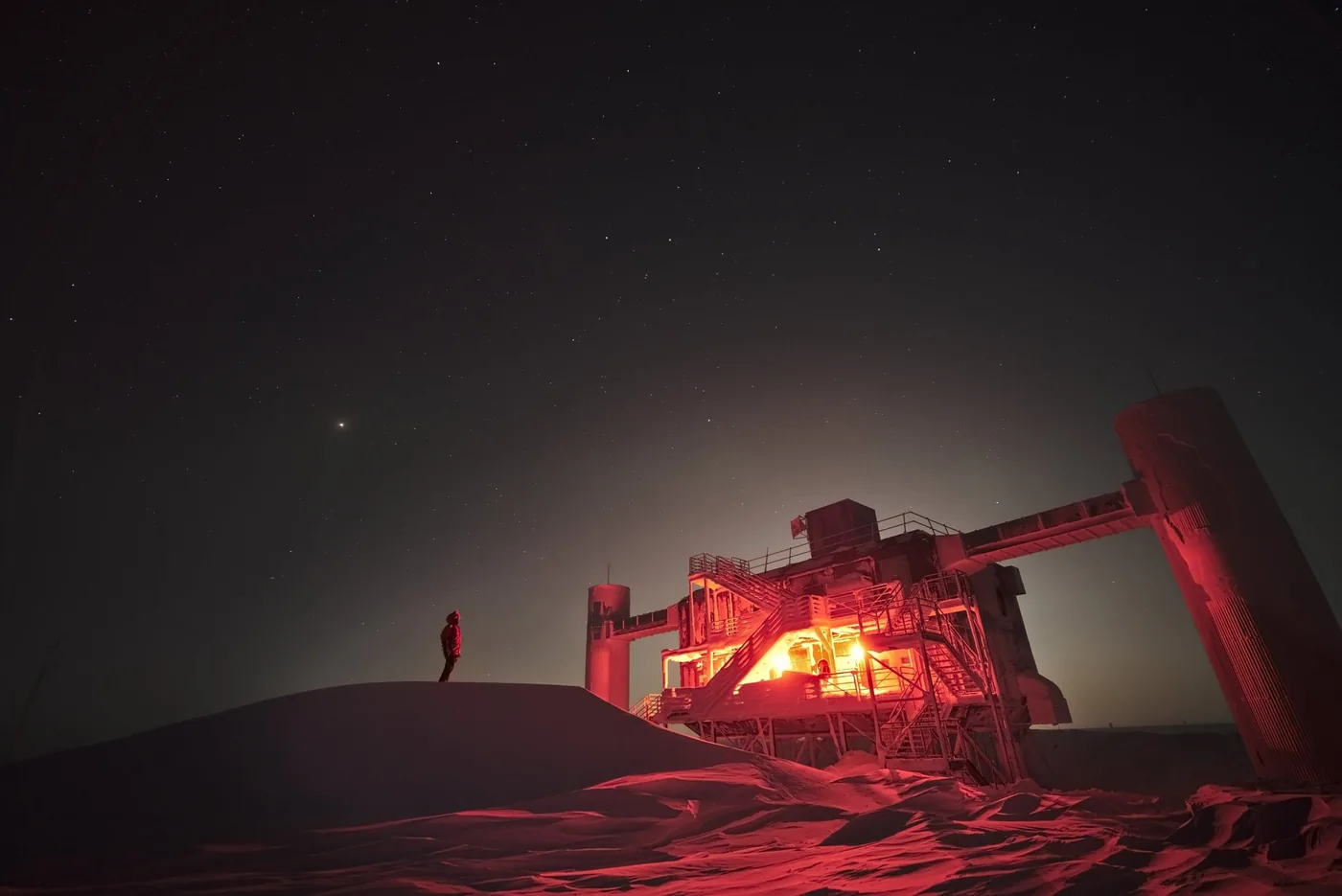
“Francis Halzen has led an international team of researchers and engineers who have provided us with a fantastic instrument,” Mark Pearce, chair of the Nobel Committee for Physics, said [8]. Karsten Heeger, a neutrino physicist at Yale University, said that seeing a project conceived over two decades ago come to fruition was an engineering triumph of international teamwork [5].
Opening a New Era of Multi-Messenger Astronomy
The success of IceCube has helped establish multi-messenger astronomy, which combines light, cosmic neutrinos, and gravitational waves to study the cosmos [7, 8]. For centuries, humans studied the sky using light alone, from optical telescopes to radio dishes and gamma-ray observatories. Neutrinos add a distinct sense to astronomy by letting scientists study particles of matter rather than rays of light [6, 9]. Dr Patrick Dunne at Imperial College London said that detecting cosmic neutrinos opens a lens comparable to when Galileo first turned a telescope toward the stars [9].
The physics prize followed the announcement of the Nobel prize in medicine for optogenetics, capping a busy week of science awards. Some observers had speculated about using neutrinos to send signals to distant alien worlds, but Halzen dismissed the idea with a laugh. “We have enough realistic problems to deal with right now to make neutrino astronomy a reality rather than worry about this,” Halzen said [9, 11]. After spending more than two decades designing detectors and drilling through thousands of feet of glacial ice, Halzen plans to keep expanding neutrino observatories at the South Pole and in the Mediterranean Sea to catch rarer particles from the deep cosmos [6, 9].
- ACADEMIC JOURNAL Aartsen, M., Ackermann, M., Adams, J., Aguilar, J., Ahlers, M., Ahrens, M., Altmann, D., Andeen, K., Anderson, T., Ansseau, I., Anton, G., Archinger, M., Argüelles, C., Auer, R., Auffenberg, J., Axani, S., Baccus, J., Bai, X., Barnet, S.,. Tjus, J. B. (2017). The IceCube Neutrino Observatory: instrumentation and online systems. Journal of Instrumentation, 12(03), P03012-P03012. [Article Link]
- ACADEMIC JOURNAL Aartsen, M. G., Abbasi, R., Abdou, Y., Ackermann, M., Adams, J., Aguilar, J. A., Ahlers, M., Altmann, D., Auffenberg, J., Bai, X., Baker, M., Barwick, S. W., Baum, V., Bay, R., Beatty, J. J., Bechet, S., Becker Tjus, J., Becker, K., Bell, M.,. Bernardini, E. (2013). First Observation of PeV-Energy Neutrinos with IceCube. Physical Review Letters, 111(2). [Article Link]
- ACADEMIC JOURNAL IceCube Collaboration. (2013). Evidence for High-Energy Extraterrestrial Neutrinos at the IceCube Detector. Science, 342(6161). [Article Link]
- PREPRINT Noël, N. (2026). Nobel physics prize awarded for discovery of ‘ghostly messengers’ from the cosmos. [Preprint]. [Article Link]
- ACADEMIC JOURNAL Palivela, A., Smith, S., & Georgescu, A. (2026). 2026 Nobel Prize in Physics awarded for investigations of neutrinos. Chemical & Engineering News. [Article Link]
- ACADEMIC JOURNAL Gibney, E., & Castelvecchi, D. (2026). Nobel physics prize awarded for detection of cosmic neutrinos. Nature. [Article Link]
- ONLINE NEWS Mendenhall, B. (2026). Francis Halzen wins the 2026 Nobel Prize in physics. Astronomy Magazine. [Article Link]
- ONLINE NEWS Jedikovska, G. (2026). World’s largest neutrino telescope creator wins 2026 Nobel Prize. Interesting Engineering. [Article Link]
- ONLINE NEWS Sample, I. (2026). Nobel prize in physics goes to Francis Halzen for south pole work on neutrinos. The Guardian. [Article Link]
- ONLINE NEWS Sparkes, M. (2026). Nobel prize in physics awarded for discovery of high-energy neutrinos. New Scientist. [Article Link]
- ONLINE NEWS Johnston, H. (2026). Francis Halzen wins Nobel Prize in Physics. Physics World. [Article Link]
- ONLINE NEWS Howlett, J. (2026). 2026 Nobel Prize in Physics awarded to Francis Halzen for discovery of high-energy neutrinos. Scientific American. [Article Link]
APA 7: PerEXP Teamworks. (2026). How Cosmic Neutrinos Earned Francis Halzen a Nobel Prize. PerEXP Teamworks Science.


