



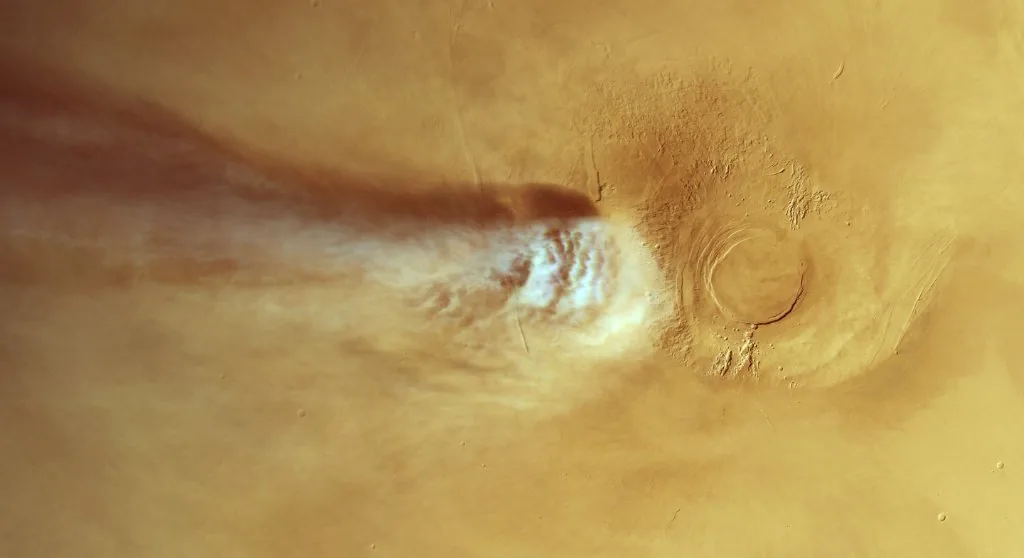
The Arsia Mons cloud, a towering plume of water ice that emerges downwind of the ancient Arsia Mons volcano, has challenged atmospheric scientists since the European Space Agency first documented its daily return. It returns each spring and summer to the Red Planet. During these southern seasons, the wisp forms quickly at dawn, expands into a bright trail, and evaporates before noon. Standard simulations could not explain this rapid cycle. New meteorological modelling published in Nature Geoscience reveals that instead of clinging to airborne dust, the vapor freezes spontaneously into ice crystals under extreme humidity conditions [3].
What Is the Arsia Mons Cloud?
The Arsia Mons cloud, known scientifically as the Arsia Mons Elongated Cloud (AMEC), is a recurring plume of frozen water that rises downwind of the 20-kilometer-tall Arsia Mons volcano on Mars. The European Space Agency orbiter Mars Express first spotted the feature in 2018. It remains the most visually striking cloud on the Red Planet. Rather than drifting across the equator, it stays anchored to Arsia Mons each morning, repeating its growth throughout the Martian dusty season [3].
Its size surprised planetary scientists. The cloud stretches out for up to 1,800 kilometers, making it nearly twice the length of the United Kingdom. It is an orographic cloud, which forms when ambient winds meet rugged mountain topography and are forced into higher, cooler layers of the atmosphere. Similar plumes form near mountain ranges on Earth. However, the cloud at Arsia Mons grows far larger than terrestrial counterparts while persisting in a thin atmosphere on the Red Planet [3].
Simulating this formation proved remarkably difficult for atmospheric modellers studying the Red Planet [3]. Standard climate models that predict Earth clouds failed to match orbital images from Mars Express. Something fundamental was missing from earlier equations [1].
Daily Rise and Fall of the Martian Plume
The daily cycle begins early each morning as brisk winds strike the towering bulk of Arsia Mons. Because the volcanic peak of Arsia Mons rises roughly 20 kilometers above the plains, it acts as a colossal obstacle to low-altitude winds, triggering a powerful atmospheric wave that lifts moist parcels of air several kilometers upward in just a few minutes [3]. This strong wave initiates the cooling process.
As the air parcel ascends over Arsia Mons, it expands and cools at an exceptional pace. Temperatures inside the rising air column plummet by about 30 degrees in just 10 minutes, causing relative humidity levels to spike sharply as the cold air loses its capacity to hold gaseous water. Very cold air retains little vapor. Because capacity drops so quickly, even modest moisture in the Martian atmosphere rapidly reaches saturation [1].
By mid-morning, the cloud attains its maximum length of 1,800 kilometers before warming air and changing winds cause it to evaporate completely. It vanishes by afternoon. This swift disappearance created an observational blind spot for spacecraft whose orbits carry them over the equator only during afternoon hours, making early morning monitoring by Mars Express essential to understand its life cycle [3].

How Does the Arsia Mons Cloud Form Without Dust?
The Arsia Mons cloud forms without dust because extreme cooling within the rising atmospheric wave forces water vapor to freeze directly into icy crystals, bypassing the solid surfaces normally required for cloud condensation [1]. On Earth, clouds condense through heterogeneous nucleation, a mechanism where moist air clings to tiny airborne specks such as dust, sea salt, soot, or pollen. Planetary scientists long assumed that clouds on the Red Planet also required dust grains to start freezing [3].
Yet simulations with dust grains failed to recreate the plume at Arsia Mons. When the team allowed water vapor to freeze without solid seeds, computer simulations matched spacecraft images from Mars Express for the first time [1]. “For the AMEC, it seems that cloud formation takes place without needing any of this ‘stuff’,” said lead author Jorge Hernández-Bernal of LMD/CNRS/Sorbonne Université in Paris [3]. “Water vapour turns directly into icy cloud particles without any middle step. It’s akin to droplets of condensation appearing in the middle of a room, rather than on a window. We call this homogeneous nucleation, and we’ve never seen it before in a planetary atmosphere. It’s wholly unexpected.”
This spontaneous freezing process is known as homogeneous nucleation. Because Arsia Mons lifts moist air so rapidly, temperatures drop before water molecules can find sparse dust grains. Water molecules bind directly to one another in empty air [1].


Homogeneous Nucleation in Martian Atmospheric Physics
Atmospheric physicists have long treated homogeneous nucleation as a textbook curiosity rather than an active planetary mechanism. While physics textbooks describe the theory, researchers rarely observe it in natural environments. “To create the AMEC in our modelling, we found that we needed to include some exotic physics… physics that, while included in textbooks, is treated as theoretical and usually thought not to happen in nature. It certainly hasn’t been seen in action before,” Hernández-Bernal explained [3]. “Once we included this physics in our simulations, the AMEC emerged just as we hoped.”
For vapor to freeze without seed particles, relative humidity must rise to staggering levels. In the new model for the Red Planet, relative humidity exceeds 100,000 times the levels typically found in everyday life on Earth [1]. “We’ve not seen these conditions on Mars before, but our finding now strongly suggests that the planet’s humidity can indeed reach these extreme levels,” Hernández-Bernal said [3]. Such figures do not mean Mars has humid air; rather, sub-zero air holds so little vapor that tiny amounts create enormous relative humidity values [1].
The team first shared an early version of the research as a preprint on arXiv (arXiv:2609.37259), which had not undergone peer review at that time [2]. The final paper was later peer-reviewed and published in Nature Geoscience. This confirms that theoretical equations can find practical expression in alien atmospheres across the Red Planet [1].
How Mars Express Tracked the Arsia Mons Elongated Cloud
The discovery relied on observations gathered by three scientific instruments aboard the European Space Agency orbiter Mars Express. Researchers paired data from the Visual Monitoring Camera, the High Resolution Stereo Camera, and the OMEGA spectrometer to track the cloud across multiple optical channels. This study marks the first European Space Agency release featuring high-resolution High Resolution Stereo Camera imagery of the plume at Arsia Mons [3].
Tracking morning weather on the Red Planet is notoriously difficult for orbital missions. Most orbiters follow sun-synchronous paths that fly over the equator only in the afternoon. Mars Express and the ExoMars Trace Gas Orbiter are among the few spacecraft capable of taking morning images when the plume develops. “Mars Express can also track how the cloud is changing on timescales of mere hours, which gives us an unrivalled view of short-lived phenomena on the planet,” said Colin Wilson, European Space Agency project scientist [3].
The simulation closely mirrors Mars Express images. Still, certain structural details diverge from observations, reminding researchers that atmospheric records for Mars remain limited compared with terrestrial data. Future orbital monitoring by Mars Express will test how accurately the model predicts cloud evolution across successive Martian years [1].
Broader Cosmic Lessons for Planetary Atmospheres
Before these observations at Arsia Mons, atmospheric scientists thought homogeneous nucleation might occur in the upper atmospheres of Earth or Venus, but probes had never observed it [3]. The Martian findings demonstrate that towering volcanic topography at Arsia Mons can induce localized thermodynamic conditions that trigger rare phase changes [1]. While orbital telescopes search for water vapor on tiny exoplanets, nearby planetary bodies demonstrate that atmospheric physics can produce unexpected behavior in extreme environments [3].
The findings prompt astronomers to re-evaluate cloud models for other planets. “While clouds on Earth and Mars seem to be governed by the same ‘rules’, understanding this exotic martian cloud required exotic physics – and this may be true elsewhere in the cosmos,” Wilson said [3]. Excluding homogeneous nucleation from models risks miscalculating cloud behavior across the solar system [1].
These findings also offer broader insight into the planetary evolution of Mars, where intermittent water flow in Martian valleys carved ancient surface landscapes over hundreds of millions of years [4]. Even in today’s dry climate on the Red Planet, the Martian atmosphere generates transient ice structures through complex physical processes [3]. As orbiters continue tracking seasonal weather, the Arsia Mons cloud will remain a crucial natural laboratory for studying atmospheric phase changes on other worlds [1].
- ACADEMIC JOURNAL Hernández-Bernal, J., Määttänen, A., Spiga, A., & Forget, F. (2026). Homogeneous ice nucleation from water vapour suggested by elongated clouds on Mars. Nature Geoscience, 19(10), 1213-1217. [Article Link]
- PREPRINT Hernandez-Bernal, J., Maattanen, A., Spiga, A., & Forget, F. (2026). Homogeneous Nucleation of Water Vapor Evidenced by Elongated Clouds on Mars. arXiv:2609.37259. [Article Link]
- PRESS RELEASE European Space Agency. (2026, October 7). Mars’s oddest cloud may be even odder than we thought. [Article Link]
- ONLINE NEWS Knowridge Science Report. (2026, October 8). Mars’ oddest cloud is even odder than we thought, study finds. [Article Link]
APA 7: TWs Editor. (2026, October 9). How Does the Arsia Mons Cloud Form on Mars Without Dust? PerEXP Teamworks. https://perexpteamworks.com/en/arsia-mons-cloud-ice-formation/


