





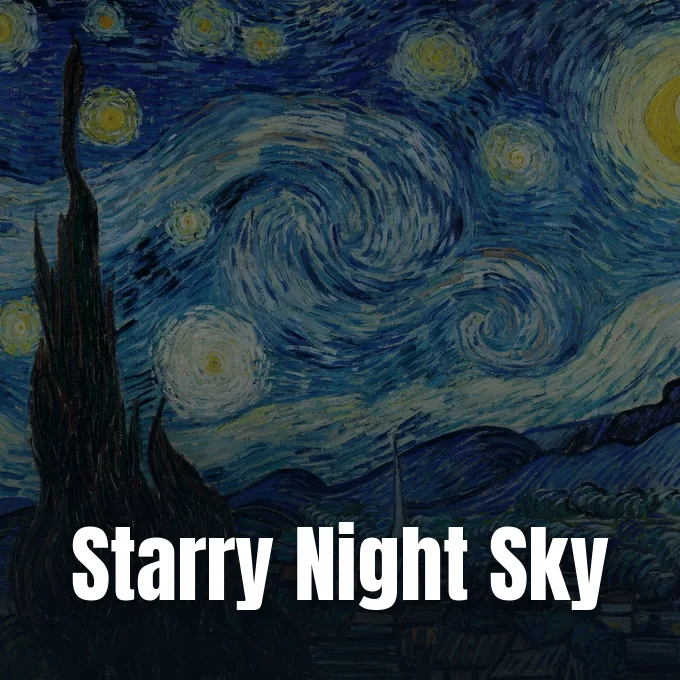
Vincent van Gogh created some of art history’s most studied canvases while living at the Saint-Paul-de-Mausole asylum in Saint-Rémy-de-Provence, France. His 1889 masterpiece, The Starry Night, has long been dated to mid-June based on letters to his brother Theo van Gogh. A multidisciplinary investigation published on October 22 in Scientific Reports suggests the canvas actually captures the predawn sky above Provence on July 22, 1889 [5]. Elijah Jeong-hyun Kim led the astronomical study [1].
Testing Starry Night Against Taurus Stars
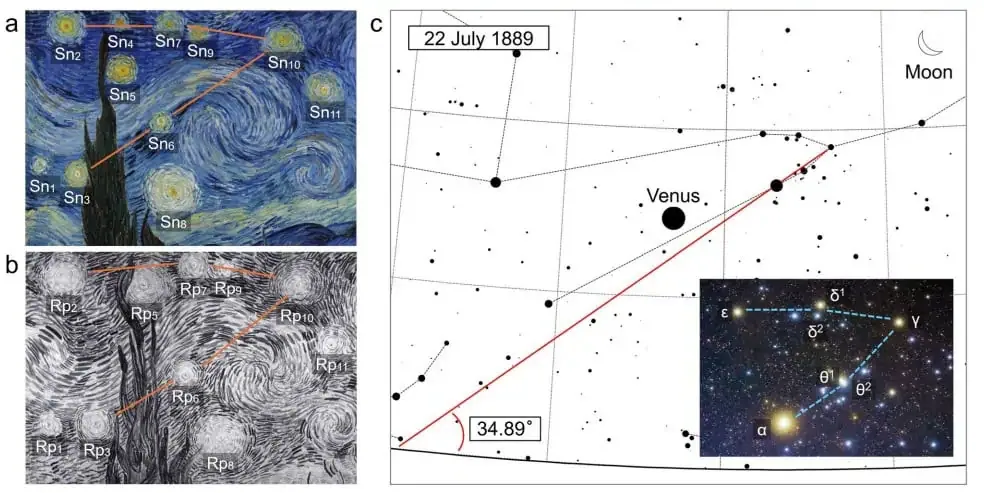
Art historians long debated whether the swirling celestial bodies depicted real objects. In the 1980s, UCLA art historian Albert Boime and Harvard University astrophysicist Charles Whitney evaluated the sky above Saint-Rémy and proposed that the painter drew the constellation Aries [4]. Elijah Kim doubted that conclusion [2]. Aries contains relatively faint stars that would hardly stand out before sunrise [3]. Kim suspected that the prominent V-shaped formation in Taurus represented the Hyades cluster instead [1].
To test the hypothesis without being misled by painterly distortions, Kim and his colleagues turned to a mathematical shape matching algorithm known as Procrustes analysis. The software evaluates geometric spacing between points while ignoring variations in scale, which allowed researchers to map five stars in Starry Night against star catalogs to identify the strongest statistical correlation with the Hyades [1]. The match was clear [2]. “To my eyes, the star cluster in The Starry Night was the Hyades in Taurus,” Kim said [1].
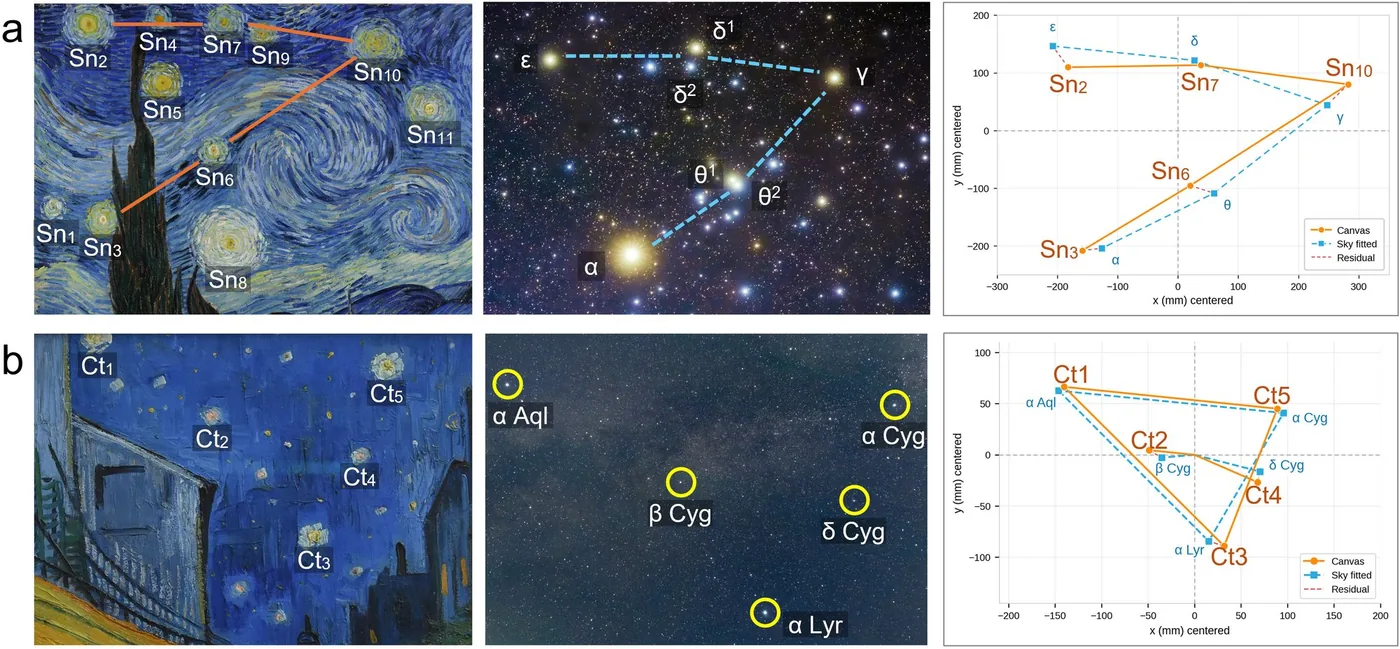
The research team tested their method against known benchmarks in nineteenth-century art [3]. In an earlier work titled Starry Night over the Rhône, painted in 1888, the artist clearly depicted the Big Dipper [2]. When Kim tested the software on that canvas, the mathematical match was comparably strong to the result found with the Hyades [1]. A later pen sketch showed even tighter alignment [3].
Moon Phases Challenge the June Date
Art historians traditionally dated the work using correspondence sent to Theo around June 18, 1889 [2]. In that letter, the painter mentioned having “a new study of a starry sky,” leading scholars at the Museum of Modern Art in New York City to date the work to mid-June. But the painted lunar cycle contradicts that timeline [1]. On June 19, 1889, the moon stood 63 percent illuminated in a waning gibbous phase [3].
In the painting, the moon appears as a slender crescent tucked into a glowing circle of yellow light. By contrast, astronomical simulations of the morning sky on July 22, 1889 show the moon was only 28 percent illuminated. On that July morning, the thin crescent rose with Venus in the eastern sky, with the Hyades cluster positioned between them in the predawn twilight. The three celestial bodies match the painted composition simultaneously [3].

Astronomer Donald Olson of Texas State University in San Marcos noted that historians prefer the June date because “van Gogh himself said so” in his letters [2]. But Kim argued that mentioning a study in mid-June does not prove the canvas was completed then [1]. Van Gogh reworked compositions over multiple sessions [4]. He observed the sky of Starry Night in July [3].
Reconstructing the Saint-Rémy Window Horizon
To check whether van Gogh could observe these stars together, researchers modeled the vantage point from Saint-Paul-de-Mausole. Van Gogh entered the hospital in May 1889 following crises in Arles. His window looked east toward the low Alpilles mountains [3]. James Beattie, a Hubble fellow at NASA, said the painter’s view of the sky was quite restricted by the window framing and stone architecture [1].
Kim traveled to Saint-Rémy in 2019. Standing where Vincent had worked 130 years earlier, he compared an early landscape sketch with site photographs and ran computer simulations to calculate the exact positions of celestial bodies down to the second for mornings in July 1889 [2]. The calculation matched [3]. The crescent moon, Venus, and the Taurus stars all fit inside that narrow window angle before sunrise on July 22 [2]. By measuring the precise angular breadth of the eastern horizon through the casement, Kim showed how hospital architecture framed the painter’s vista [3]. “I was standing where Vincent had stood 130 years earlier,” Kim said [2].

Donald Olson of Texas State University disputed that reconstruction [2]. The canvas depicts a sweeping panorama of rolling hills, cliffs, and an imagined village with a church spire recalling the Netherlands [3]. Olson argued that capturing those broad terrestrial features required a wider perspective than Kim’s compact window angle [2]. Hospital window bars alone cannot explain every element of creating Starry Night [4].

Mistral Winds and Historical Weather Records
Van Gogh’s medical history presents another obstacle to the July dating [3]. Biographers long believed the painter suffered a severe crisis in mid-July 1889 that left him incapacitated for six weeks [2]. Because letters to Theo in Paris stopped after July 16, historians assumed van Gogh could not observe the dawn sky on July 22. Kim and his team reexamined the correspondence to test that assumption [3].
A breakthrough came from the artist’s own letters. On August 22, van Gogh wrote to Theo about his breakdown: “This new crisis, my dear brother, came upon me in the fields, and when I was in the middle of painting on a windy day”. Meteorological logs from three southern French stations show that a strong mistral wind swept through Provence between July 27 and July 29. In a September letter, van Gogh recalled being confined for six weeks, placing the start of his illness around July 25 or 26 [3]. Regional weather logs confirmed clear predawn conditions on July 22 that allowed unobstructed astronomical observation [4].
Environmental clues also favor July. In letters from Saint-Rémy, van Gogh repeatedly mentioned buzzing cicadas in the hospital olive groves, which regional weather archives match to hot late July temperatures rather than milder mid-June conditions. Unclouded predawn skies over Provence on July 22 permitted direct viewing of Taurus. These atmospheric records support a late July timeline for the genesis of Starry Night [4].
Astronomers Debate the Starry Night Identification
Celestial sleuths remain divided [2]. Donald Olson, an astronomer at Texas State University who specializes in astronomical art history, raised several specific objections to the proposed Hyades identification in the new paper. He pointed out that the calculated position of Venus relative to the V shape of Taurus does not align with the canvas [1]. Olson also said that Aldebaran (the brightest star in the Hyades) should be recognizable at the tip of the V [2].
Kim identified Aldebaran left of the cypress. Olson argued that an experienced amateur astronomer would not identify either star as Aldebaran without being prompted by theoretical models. Other painted stars appear far more luminous than the red giant [2]. Olson suggested that overcoming van Gogh’s own statement from June 18 requires much stronger documentary evidence than statistical fits that could easily be coincidental [1].

Kim conceded that shape matching algorithms alone cannot prove artistic intent. “Procrustes analysis is by no means a cure-all; even a completely different constellation can sometimes show a high degree of fit,” Kim acknowledged. But he said that the Hyades cluster uniquely satisfies multiple independent criteria: geometric arrangement, celestial orientation, lunar illumination, and proximity to Venus. Van Gogh grounded his painting in the real sky [3].
Comparisons With Earlier Nocturnal Canvases
The debate over whether van Gogh painted real skies connects to his broader artistic philosophy in southern France. While working in Arles in 1888, van Gogh had intense discussions with Paul Gauguin, who urged him to paint from pure imagination rather than direct observation. Van Gogh struggled with that approach, consistently preferring to work from nature and tangible models [3]. In Café Terrace at Night, painted in Arles in September 1888, recent astronomical evaluations suggest the background stars represent the Summer Triangle [4].
Art history presents an inconsistency here. Scholars have long accepted the Big Dipper in Starry Night over the Rhône as real observation while dismissing other night canvases as ungrounded fantasy. “Of three night skies painted by the same artist, we have long accepted that one is real and the other two are imagined,” Kim said. He proposed that the artist combined observations from several mornings around July 22 to create his final composition [3]. Van Gogh transformed celestial reality into personal expression, maintaining a dialogue with the natural world that continued throughout his work on Starry Night [4]. Blending historical correspondence, weather logs, and computational astronomy reframes questions about his artistic process [1].
- ONLINE NEWS Gometz, E. (2026, October 22). Astronomers unlock a mystery hidden in van Gogh’s The Starry Night. Scientific American. [Article Link]
- ONLINE NEWS Grossman, L. (2026, October 22). Was van Gogh’s ‘The Starry Night’ a flight of fancy or a real sky? Science News. [Article Link]
- ONLINE NEWS Puiu, T. (2026, October 22). Van Gogh’s The Starry Night May Have Been Based on a Real Night Sky and Astronomers Found an Astonishing Match. ZME Science. [Article Link]
- ONLINE NEWS Baisas, L. (2026, October 22). What night is van Gogh’s ‘The Starry Night’? New analysis says it’s in July. Popular Science. [Article Link]
- ACADEMIC JOURNAL Kim, E. J., Kang, S., Song, J., & Jin, H. (2026). The actual sky of Van Gogh’s Starry Night: a multidisciplinary reconstruction. Scientific Reports, 16(1). [Article Link]
APA 7: PerEXP Teamworks. (2026, October 23). Astronomers Match Van Gogh Starry Night Sky to July 1889. PerEXP Teamworks. https://perexpteamworks.com/en/starry-night-sky-july-1889/


