





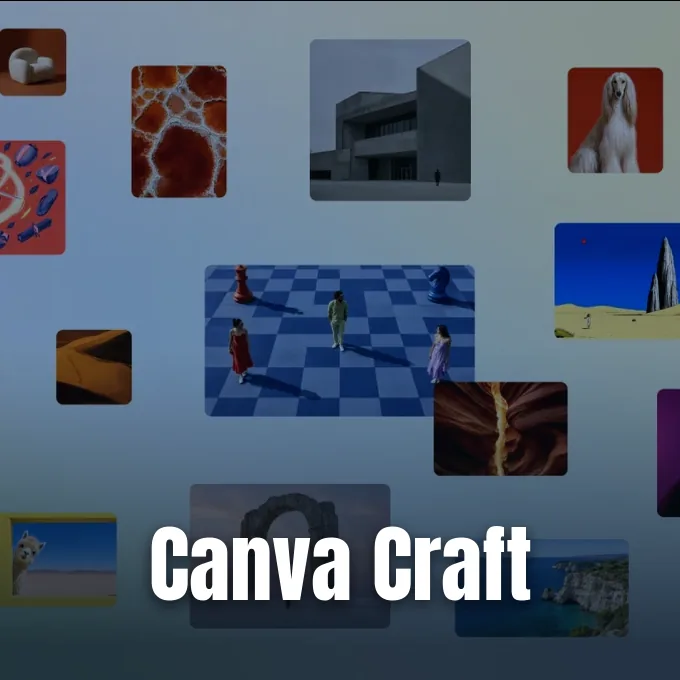
Australian creative studio Canva introduced Canva Craft as an in-house image model built to take on rival AI tools from Google, OpenAI, ByteDance, and Meta [1]. Built for visual publishing, the system trains on human template files from Canva’s graphic catalog instead of raw web photos [2]. TechCrunch tech writer Ivan Mehta reported that Canva Craft runs in two separate stages to balance page composition with clean text rendering [1].
How Canva Craft Generates Images in Two Stages
Canva structured the pipeline around two separate stages so users can guide layout elements before final pixels render. In this opening stage, Canva Craft interprets text prompts to map spatial relationships, element scale, and visual hierarchy. It also sketches placement boundaries for text so words stay legible [1].
Once that layout blueprint is complete, the second stage generates the image up to 2K resolution in 30 aspect ratios to match common social channels and print formats without requiring awkward manual crops. Standard diffusion systems often blur lettering. Canva said its two-stage method “allows it to create images with accurate details of objects and legible text” across every offered canvas size. Because Canva Craft renders pictures upon an organized plan, users can edit individual objects without touching the rest of the canvas. Layer separation stops edits from scrambling adjacent design blocks [1].
Creators do not need to re-render an entire poster just to swap a headline font or adjust an icon. Canva Craft isolates target layers. Modifying a caption leaves backdrop photos and brand colors intact, which solves a persistent problem found in conventional AI image tools [1].
Training on Human Templates for Layered Editing
Canva took a different path from competitors by training its system on human-designed templates instead of raw web photos. The training dataset pulled from Canva’s graphic library, assembling posters, social posts, presentations, infographics, menus, and typography layouts. Curated files teach Canva Craft how professional artists arrange typography and negative space [1].
Because Canva Craft learns from organized documents, output images convert into editable, layered files through Canva Magic, which acts as the company’s image-to-design transformer. When someone prompts Canva Craft for a flyer, the result is not a flat raster graphic that resists changes. Instead, Canva Magic breaks the output into distinct text boxes, shapes, photo frames, and base layers that users can drag across the canvas. Last year, Canva launched an internal model capable of reading layers and design hierarchies, and that earlier work lets Canva Craft outputs plug directly into existing workspace tools. Marketers can change pricing text or rebrand headers in seconds [1].
Document-focused training contrasts with the broader tech industry’s focus on raw photorealism. While other workplace suites expanded automated video creation after Google added Gemini Omni generation to Google Vids, Canva focused on static page design and flexible document editing. Training on real design layouts means Canva Craft understands how headings, body copy, and icons work together to communicate information clearly [1].


Access Through Dream Lab and External Bots
Canva rolled out Canva Craft to all users through the Dream Lab tab inside its main editor interface. Free members and paid subscribers can open Dream Lab to generate images, select aspect ratios, and move outputs directly onto active presentation slides or social templates without leaving their web browser [1].
For developers and automation, Canva Craft is accessible through the Canva API, allowing outside programs to produce custom assets programmatically. Furthermore, Canva plans to support image creation inside third-party chatbots like ChatGPT and Gemini through Canva’s implementation of the Model Context Protocol (MCP). Instead of forcing workers to switch browser tabs to build marketing assets, an employee chatting with ChatGPT or Gemini could generate a custom banner through Canva’s MCP link that saves directly to their design library. A worker can prompt the bot for a flyer, and the layered file appears in Canva ready for team review [1].

Techmeme reported that integrating via MCP expands Canva’s footprint into external conversational workspaces where millions of professionals spend their workdays [2]. It captures design demand directly within third-party chat assistants. Canva keeps its template ecosystem at the center of automated workplace content creation [1].
Leonardo Researchers and Canva Craft Speed Editions
To develop the underlying architecture, Canva drew on talent from Leonardo.ai, the generative media platform it acquired in 2024. Researchers from Leonardo joined Canva’s engineering teams to build the visual foundation and optimize generation speeds. Their background in media synthesis helped shape Canva Craft’s prompt comprehension and layout planning [1].
Canva previously relied on external models to power image creation across its site, but running its own software helps reduce heavy API licensing fees. API costs piled up quickly. Developing in-house technology also gives Canva direct control over generation speed and visual output quality, rather than remaining dependent on the roadmap and service availability of outside vendors. To make image creation faster, Canva is preparing two cost-effective editions called Craftfast and Craft-ultrafast. Both speed versions will launch soon. These lightweight models will provide quick image previews during live team brainstorming sessions where creators need fast concept mockups [1].
Fast generation speeds matter during live team meetings where collaborators share screens and iterate on graphics together. Offering lightweight options like Craftfast ensures users do not wait through long processing queues when drafting quick social posts or trying out different color palettes [1].
Shifting Valuations Amid Lower Growth Forecasts
The launch of Canva Craft comes as Canva navigates a changing financial landscape. Canva was on track for $4 billion in revenue last year, supported by steady subscription growth among workplace teams, educators, and enterprise clients. That financial scale gave Canva the resources to acquire Leonardo.ai and invest in proprietary machine learning [1].
Despite reaching that revenue pace, Canva recently lowered its growth projections for 2026, prompting independent analysts to recalculate its enterprise valuation. External analysts reported that Canva’s estimated valuation dropped from $42 billion down to $35 billion following the revised growth guidance [1]. Techmeme reported that the lowered forecast reflects a more competitive market for creative software as major tech firms like Google, OpenAI, ByteDance, and Meta pour engineering resources into generative tools [2]. By offering Canva Craft directly within its design tools, Canva aims to protect its profit margins and keep subscribers from switching to rival suites [1].
Lower third-party model bills help Canva defend its bottom line in a cooling investment climate. Developing its own models helps the company keep computing expenses manageable while delivering custom tools tailored specifically for graphic design. Canva Craft shows how application providers are building targeted models to retain users in an increasingly crowded artificial intelligence market [1].
- ONLINE NEWS Mehta, I. (2026, October 22). Canva releases its first image generation model. TechCrunch. [Article Link]
- WEBSITE Canva launches Craft, its first image generation model, trained on human-designed templates, available to all users, with plans to support third-party chatbots. (2026, October 22). Techmeme. [Article Link]


