





Induction cooktops heat cookware using high-frequency magnetic fields rather than open flames or glowing electric burners. When an electric current passes through a copper coil beneath the glass surface, it creates an oscillating magnetic field that penetrates the bottom of a compatible pan. The moving magnetic field produces swirling electric currents inside the metal base, transforming the pan into an independent heat source that delivers thermal energy straight to food. This method cuts energy loss and brings liquids to a boil much faster than older stoves [4].
- The Core Physics of Induction Cooktops
- How Eddy Currents Generate Thermal Energy
- Internal Components Beneath the Ceramic Glass
- Why Pan Ferromagnetism Determines Heating Success
- Energy Transfer Efficiency in Induction Stovetops
- How Modern Safety Controls Protect Home Cooks
- Installation Demands for Domestic Induction Hobs
- Practical Habits for Long Cooktop Lifespan
The Core Physics of Induction Cooktops
Archaeological records show humans have used controlled fire and open hearths to cook food for hundreds of thousands of years [8]. The scientific foundation of modern electromagnetic cooking, however, began with nineteenth-century physics discoveries. In 1820, Danish physicist Hans Christian Oersted discovered that an electric current flowing through a wire produced a surrounding magnetic field. French physicist Andre-Marie Ampere later showed that parallel wires carrying currents attracted or repelled one another [1].
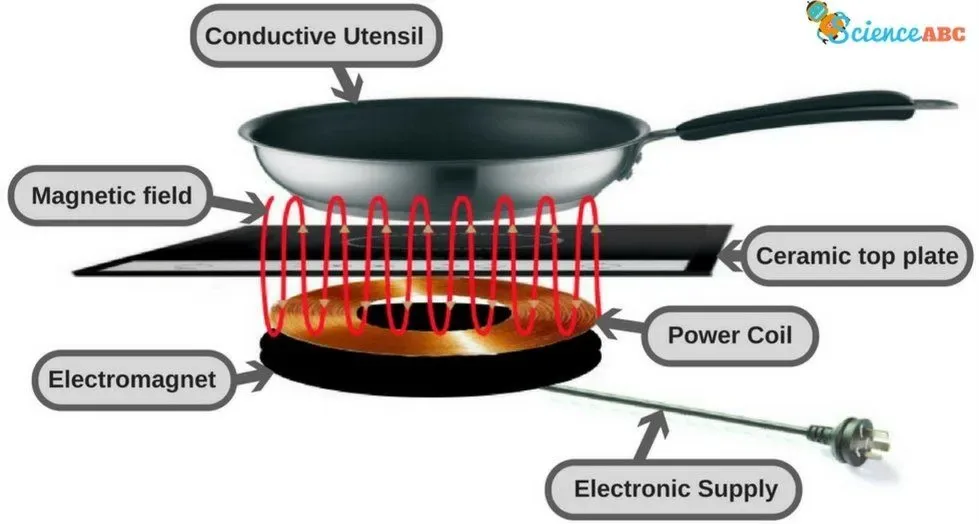
English scientist Michael Faraday took these observations further in 1831 when he discovered electromagnetic induction by moving a wire coil through a magnetic field to generate an electric current. Scottish physicist James Clerk Maxwell unified these discoveries in the 1860s through four mathematical statements known as Maxwell’s equations. When applied to cooking, an alternating current flows through a tightly wound coil underneath the ceramic cooktop, generating a fluctuating magnetic field directly above the active zone. Because this magnetic field oscillates at high frequencies, it passes through the ceramic cooktop without losing energy, entering the base of any resting ferromagnetic pan. The cooktop surface does not heat up on its own, which keeps the surrounding glass cool while transferring energy straight into the cookware [1].
Early inventors recognized the cooking potential of electromagnetic induction during the early twentieth century. Arthur Berry secured a British patent for an induction heating apparatus in 1906, and Simon Hohlfeld filed a German patent in 1909. Demonstration stoves later appeared at the 1933 Chicago world fair, but practical household appliances emerged in the 1970s. Westinghouse introduced its Cool Top 2 range in 1973, creating an early commercial model that sold for $1,500 (equivalent to about $11,900 in 2025) [4].

How Eddy Currents Generate Thermal Energy
When an induction coil produces an oscillating magnetic field, that field penetrates up to a quarter inch into the base of a resting metal pan. The changing magnetic flux forces free electrons inside the metal lattice to move in closed circular paths called eddy currents, which are also known as Foucault currents. Unlike standard electric currents that move along wires to power appliances, these swirling currents move within the metallic structure of the pan base and dissipate their kinetic energy across the atomic lattice. The rapid electron motion creates friction within the metal alloy, converting electrical energy into thermal energy that heats the cooking vessel quickly from the inside out [2].
This internal heating process relies on the physical principle of Joule heating. As circulating eddy currents encounter electrical resistance in the pan base, that resistance opposes electron movement. The resulting thermal energy conducts straight from the metal base into the food, while liquids circulate heat through natural convection without relying on external hot burner elements [4].
A secondary source of cooking heat comes from magnetic hysteresis. Ferromagnetic metals contain microscopic magnetic domains that align with external magnetic forces. Because the cooktop coil drives an alternating current that changes direction tens of thousands of times each second, these magnetic domains repeatedly reverse their orientation. Each reversal cycle dissipates a fraction of electromagnetic energy as heat into the metal lattice, providing extra warmth that works alongside eddy current resistance to raise pan temperatures rapidly without open flames or exposed elements [1].
Internal Components Beneath the Ceramic Glass
Inside domestic induction cooktops, copper coils rest just below the smooth cooking surface. Each cooking zone contains a flat, tightly wound coil built from twelve to eighteen turns of copper wire. When electrical current passes through the copper coil, it projects a magnetic field upward while an internal fan prevents thermal buildup beneath the cooktop [6].
The electronic core of the appliance is the high-frequency power inverter board. Standard household wall outlets deliver alternating current at 50 or 60 hertz, which is far too slow to generate efficient induction heating without producing audible humming sounds. The inverter uses fast semiconductor switches, including Insulated Gate Bipolar Transistors (IGBTs) or power MOSFETs, to lift the current frequency to between 20 to 100 kilohertz. This high operating frequency keeps magnetic oscillations well above human hearing limits, prevents magnetic forces from shifting pans across the smooth surface, and allows smooth power modulation from low simmer settings up to full boiling outputs without cycling the burner on and off like older radiant electric units [4].

The cooking surface itself consists of a smooth glass-ceramic sheet made from specialized materials like tempered Schott CERAN or NEG Pyroceram. This engineered glass-ceramic provides high mechanical strength, withstands thermal shocks up to 1,200 degrees Fahrenheit, and remains transparent to magnetic fields. Because magnetic lines pass through the glass without heating its non-metallic structure, the surface stays relatively cool during cooking, absorbing only small amounts of residual warmth conducted downward from the hot pan [6].
Why Pan Ferromagnetism Determines Heating Success
Because induction cooktops rely on magnetic coupling, the metal composition of the cookware base determines whether heating occurs. The process requires a ferromagnetic material that exhibits high magnetic permeability and moderate electrical resistance, allowing magnetic fields to concentrate inside the pan and induce substantial eddy currents. Traditional cast iron, enameled cast iron, carbon steel, and magnetic stainless steel alloys satisfy these physical requirements, making them ideal choices for cooks who want fast and reliable heating performance. When these metals enter the oscillating magnetic field, their atomic properties permit efficient energy conversion, heating the base uniformly while non-magnetic cookware remains cold and unresponsive on the very same burner zone [7].
Why do metals like copper and pure aluminum fail on standard induction burners? Both metals conduct electricity easily, but their low magnetic permeability prevents magnetic fields from coupling efficiently. Without sufficient magnetic resistance, eddy currents remain weak. Cooks who want to use non-magnetic cookware must place a separate ferromagnetic interface disk between the burner and the vessel [4].
Testing cookware compatibility at home requires nothing more than an ordinary refrigerator magnet. If the magnet clings firmly to the bottom of the pot, the pan will work on an induction stove. Modern engineering has also advanced pan detection on the appliance side. Research published in the IEEE Sensors Journal by Bono-Nuez and fellow researchers in 2018 demonstrated that domestic induction coils can act as smart sensors, measuring harmonic impedance across the coil to identify pan materials through embedded algorithms without adding external hardware [10].


Energy Transfer Efficiency in Induction Stovetops
Energy transfer efficiency represents a major advantage of induction stovetops over older kitchen appliances. Laboratory measurements indicate that induction units transfer between 84 to 90 percent of their consumed energy into the cooking vessel. In comparison, gas stoves deliver only 30 to 40 percent efficiency because open flames lose large amounts of heat to kitchen air [4].
This high transfer efficiency produces measurable reductions in household utility expenses and home energy demand. In a comprehensive analysis of residential utility data, electrical contractor Elena Vasquez calculated that a standard household induction unit consumes approximately 195 kilowatt-hours annually for regular family cooking, resulting in an estimated annual operating cost of about thirty-one dollars. That figure compares favorably against standard radiant electric stoves, which consume roughly 325 kilowatt-hours per year, and natural gas ranges, which consume about 280 therms annually at a cost exceeding one hundred thirty dollars. In addition to reducing electricity consumption by 40 percent compared to radiant stoves, induction appliances minimize waste heat in the kitchen, significantly lowering summer air conditioning loads and helping homeowners meet modern energy efficiency standards [6].
Direct heat generation also delivers substantial time savings during everyday meal preparation. Because thermal energy develops inside the cookware base without waiting for intermediate burner elements to warm up, induction stoves can bring two quarts of water to a rolling boil roughly fifty percent faster than gas or electric resistance units. Cooks can also reduce burner power instantly, dropping boiling sauces to a gentle simmer with the immediate response traditionally associated with gas flames [5].

How Modern Safety Controls Protect Home Cooks
Safety benefits form another key reason homeowners choose induction technology over gas or radiant electric cooktops. The smooth glass stays relatively cool throughout cooking, generally remaining below 140 degrees Fahrenheit while an active burner operates. In contrast, radiant electric stove surfaces routinely exceed 500 degrees Fahrenheit, creating serious contact burn risks [6].
Built-in pan detection sensors provide an additional layer of operational security in busy home kitchens. If a cook lifts a hot skillet off the active cooking surface, the system senses the loss of magnetic coupling and ceases power transmission immediately. Most modern units automatically shut down completely if no pan returns to the active cooking zone within sixty seconds, preventing unattended dry-heating hazards and lowering fire risks in households with curious young children or pets. Because the cooking surface itself remains unheated and requires a compatible ferromagnetic pot to complete the circuit, an empty cooktop will not activate even if a burner control is turned on accidentally [6].
Medical researchers have also examined potential electromagnetic exposure from induction cooktops to evaluate user safety. In an extensive clinical study published in Europace, researchers W. Irnich and A. D. Bernstein evaluated 244 cardiac pacemakers exposed to 24-kilohertz induction fields, concluding that maintaining a minimum distance of twelve inches (30 centimeters) between the implanted device and active cooktop coils prevents electromagnetic interference and ensures safe operation for patients with pacemakers [9].
Installation Demands for Domestic Induction Hobs
Switching to domestic induction hobs requires careful evaluation of home electrical capacity and circuit specifications. A standard full-size built-in induction cooktop typically requires a 240-volt dedicated circuit protected by a 40-amp or 50-amp dual-pole breaker, connected with 6 or 8 American Wire Gauge (AWG) copper conductors. Homeowners replacing an existing electric stove often already possess the necessary 240-volt wiring, while those replacing gas stoves will need an electrician to run a dedicated line from the main service panel. Portable single-burner countertop units offer an accessible alternative, operating on standard 120-volt household outlets and drawing around 1,800 watts, allowing renters and smaller households to enjoy induction cooking without electrical upgrades [6].
Proper cabinetry clearances and ventilation pathways are equally vital to guarantee appliance longevity and reliable cooling performance. Installers must maintain at least one and a half inches of vertical clearance below the cooktop housing and two inches of side clearance. These air channels allow internal cooling fans to prevent heat buildup around sensitive power components [6].

Prospective buyers should also anticipate the subtle acoustic profile of electromagnetic cooking appliances. Induction units often emit a low humming or buzzing sound that ranges between 42 and 48 decibels during high-power operation, caused by magnetic forces vibrating layered cookware bases and internal fans cooling the electronics. While this noise is quiet and comparable to a soft library murmur, using heavy, single-piece cast iron cookware helps dampen acoustic vibrations and keeps kitchen noise to a minimum [6].
Practical Habits for Long Cooktop Lifespan
Maintaining the sleek glass-ceramic surface requires simple, consistent cleaning habits after every meal. Home culinary guide My Kitchen Diaries recommends wiping the cooktop with a damp microfiber cloth once the cookware is removed and residual glass warmth dissipates. Food spills do not bake onto induction glass as aggressively as they do on radiant stoves [3].
Cooks should also adopt careful handling techniques when moving heavy cookware across the cooking surface. Dragging coarse cast iron pans or dented steel pots across smooth glass can cause visible surface scratches that weaken the ceramic structure over time. Making a habit of lifting pans rather than sliding them protects the glass from physical abrasion, while avoiding abrasive scouring pads or harsh alkaline cleaners ensures that the protective factory finish remains undamaged. If sugary liquids or sticky syrups boil over during cooking, wiping them up before they cool prevents micro-pitting on the glass surface, preserving both the aesthetic appearance and structural strength of the cooktop for years of daily use [3].
Finally, homeowners must keep the intake and exhaust vent openings beneath the cooktop completely clear of household obstructions. Over months of use, cooling fan intakes can collect airborne dust, pet fur, or loose paper stored in under-counter drawers. Inspecting and vacuuming these ventilation slots periodically maintains smooth airflow across the power inverter, preventing unexpected thermal throttling and ensuring that the induction cooktop delivers reliable culinary performance for well over a decade [3].
- WEBSITE Woodford, C. (2011). How do induction cooktops work?. Explain that Stuff. [Article Link]
- WEBSITE Ashish. (2016). How Does An Induction Cooktop Work? Electromagnetic Induction Cooking Explained. ScienceABC. [Article Link]
- WEBSITE Akshara. (2026). How Does An Induction Cooktop Work? Mechanism And Tips To Maintain Explained. My Kitchen Diaries. [Article Link]
- WEBSITE HowAtlas. (2026). How Induction Cooktops Work: A Complete Technical Guide to Electromagnetic Cooking. HowAtlas. [Article Link]
- REPORT Massachusetts Clean Energy Center. (2026). How Induction Cooking Works. Massachusetts Clean Energy Center. [Article Link]
- WEBSITE Vasquez, E. (2024). How Does an Induction Cooktop Work? A Contractor’s Guide. ConstructionFlux. [Article Link]
- WEBSITE Jones, G. S. (2023). Induction Cooktops — How They Work, Why They’re Faster, and What Cookware You Need. The Reluctant Gourmet. [Article Link]
- WEBSITE Wikipedia contributors. (n.d.). Cooking. Wikipedia, The Free Encyclopedia. [Article Link]
- ACADEMIC JOURNAL Irnich, W., & Bernstein, A. D. (2006). Do induction cooktops interfere with cardiac pacemakers?. Europace, 8(5), 377-384. [Article Link]
- ACADEMIC JOURNAL Bono-Nuez, A., Martín-del-Brío, B., Bernal-Ruíz, C., Perez-Cebolla, F. J., Martínez, A., & Sanz-Gorrachategui, I. (2018). The Inductor as a Smart Sensor for Material Identification in Domestic Induction Cooking. IEEE Sensors Journal, 18(6), 2462-2470. [Article Link]


