





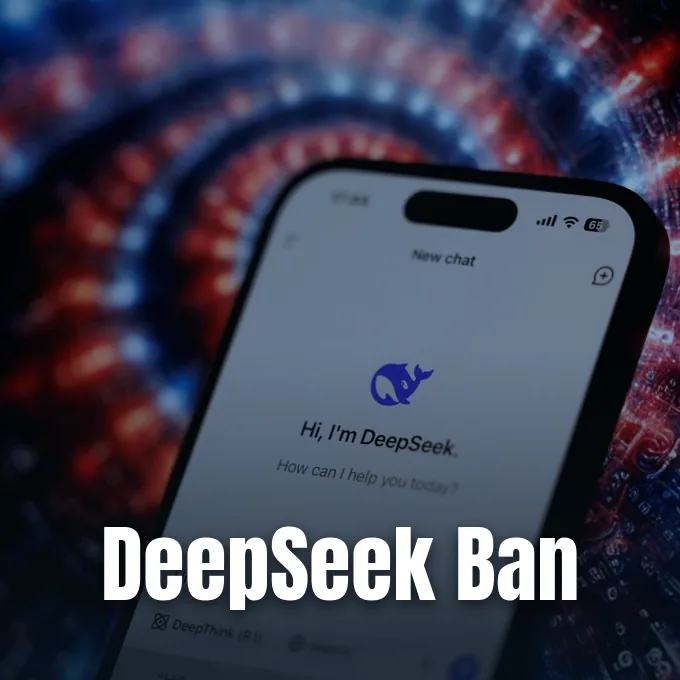
The Department of Homeland Security ordered federal civilian agencies on Monday to purge China DeepSeek AI tools from all government systems over data privacy and security concerns [1], [2]. The directive applies to civilian networks in Washington and bars future purchases of software developed by DeepSeek Ltd. in China [1], [2]. It covers third-party tools built with DeepSeek models, though offices with proven operational needs can request formal exceptions from DHS. While millions of Americans downloaded the free DeepSeek app in 2025, DHS warned that user data could reach Beijing under Chinese law [1], [2].
How the DeepSeek AI Ban Works
DHS published the order on the Federal Register website following a review by the Federal Acquisition Security Council in Washington. Regulators invoked powers under the 2018 Federal Acquisition Supply Chain Security Act to bar DeepSeek software from federal civilian procurement. Federal civilian staff can’t use DeepSeek tools for public tasks [2].
The ban targets both direct software from DeepSeek Ltd. and external services that incorporate DeepSeek code into larger commercial workflows [1], [2]. DHS warned that third-party tools running on DeepSeek algorithms carry the same security flaws as the standalone chatbot. Federal agencies can apply for waivers if they show a clear operational need, but managers must submit written justifications before running any related code on their systems [1]. DeepSeek didn’t rank among the top ten AI models in a recent federal survey, yet its popularity with the American public in 2025 alarmed DHS cybersecurity teams [2]. The directive closes potential backdoors into civilian networks [1], [2].
DHS warned that Chinese intelligence agencies could gain access to American IT infrastructure through hidden vulnerabilities in DeepSeek software, presenting multiple threat vectors that put sensitive American state data at risk [2]. Because the developer behind China DeepSeek AI operates under Chinese jurisdiction, records processed by its algorithms could be handed over to Beijing under Chinese law during state reviews. DHS ordered an immediate removal [1].
Security Worries and State Bans
DHS cybersecurity teams identified specific technical hazards during evaluations of DeepSeek code. In its official filing on the Federal Register, DHS warned that DeepSeek algorithms could track or digitally fingerprint users across civilian workstations, creating security flaws for personnel handling sensitive public files. Regulators also warned that query logs could reach China if workers use unvetted servers. One cybersecurity expert cautioned that the DeepSeek privacy policy was not “worth the paper it is written on” [2].
The civilian ban expands limits adopted across Washington over the past year [1],. The Commerce Department banned DeepSeek from official devices last year, while the U.S. Navy directed members not to touch the software over security concerns [2]. In December 2025, Congress passed a federal law prohibiting DeepSeek across national security systems run by the intelligence community, and New York State barred the app from state networks over data privacy and censorship worries [1], [2]. State and federal bans now align [1], [2].

China pushed back against the federal order and defended its domestic tech firms. Speaking at an official briefing in Beijing, Foreign Ministry spokesperson Mao Ning stated that Beijing opposes “overstretching the concept of national security and politicizing technology and trade issues”. Mao added that China will “resolutely safeguard the legitimate rights and interests of Chinese enterprises”. DeepSeek didn’t issue an official comment [1].


Distillation Disputes with Western Rivals
The regulatory move comes amid intense rivalry between American tech firms and Chinese AI teams building China DeepSeek AI systems. DeepSeek rattled global markets in January 2025 when its DeepSeek-R1 reasoning model triggered a sharp sell-off in Nvidia shares, proving that the Hangzhou lab could achieve top benchmark results using older chips and a fraction of the budget spent by Western rivals [1], [2]. That sudden rise challenged OpenAI and Meta in open-weight artificial intelligence [1].
American AI labs accused Chinese competitors of copying their leading models through distillation. Distillation uses outputs from an existing AI model to train another system at low cost. In September, a federal report accused DeepSeek alongside five other Chinese tech firms, including Alibaba and Moonshot AI, of running large-scale distillation on American AI tools. OpenAI told Congress earlier this year that it spotted suspected attempts by DeepSeek to distill its models. Anthropic said it caught unauthorized efforts by DeepSeek and other Chinese labs to pull training outputs from Claude, prompting U.S. labs to demand stronger protections for their intellectual property [1], [3]. Those disputes helped build support in Washington for federal bans on foreign AI [1].
Data feuds grew sharper when Anthropic made specific claims against the Hangzhou lab. In February 2026, Anthropic accused DeepSeek of deploying thousands of fraudulent accounts to generate millions of Claude conversations to train its models [3]. DeepSeek denied copying, arguing that its progress stems from mathematical optimization and algorithmic efficiency rather than data theft [1], [3]. The fight widened divisions between American AI leaders and Chinese labs [1].
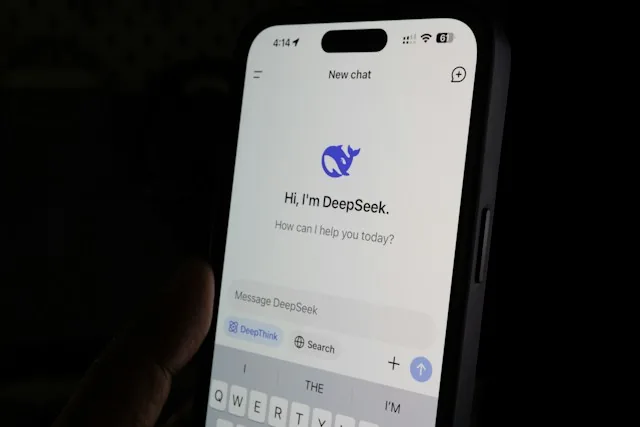
China DeepSeek AI Model Origins
DeepSeek is legally registered as Hangzhou DeepSeek Artificial Intelligence Basic Technology Research Co., Ltd. in Hangzhou, Zhejiang. Founded in July 2023 by chief executive Liang Wenfeng, the team began inside High-Flyer, a quantitative hedge fund Liang co-founded in June 2015. Liang bought processors early, securing 10,000 Nvidia A100 GPUs before the U.S. cut off chip sales to China. High-Flyer spun the lab off on July 17, 2023 as an independent firm. Liang held an 84% stake through two shell entities as of May 2024 [3].
DeepSeek built its reputation by releasing open-weight models that developers can run on their own hardware. It shares parameter weights under open-source licenses, but keeps training data private [3]. DeepSeek recently launched its V4.1 Flash-1017 model to challenge top American systems with faster processing and upgraded coding [2]. To push model capabilities, DeepSeek recruits researchers from top Chinese universities and hires outside traditional computer science, bringing in scholars in poetry and advanced mathematics to broaden system intelligence [3]. Model development remains active [2], [3].
At its Hangzhou headquarters, DeepSeek avoids the brutal 996 overtime culture common in the Chinese tech sector. Liang scrapped mandatory overtime and rigid performance metrics, giving researchers room for creative experiments during normal hours. This research posture lets DeepSeek avoid consumer rules in China while focusing on computing efficiency [3].
Defense Ties and Hardware Scale
Despite its academic image, DeepSeek faces scrutiny in Washington over ties to the Chinese military. The New York Times reported that dozens of DeepSeek researchers had past affiliations with People’s Liberation Army labs or Seven Sons of National Defence universities. Since March 2025, the People’s Liberation Army adopted DeepSeek chatbots for non-combat tasks, deploying them in military hospitals, the People’s Armed Police paramilitary, and mobilization offices [3]. Those ties convinced DHS that federal civilian networks cannot safely use the tools [1], [3].
DeepSeek’s computing footprint and funding grew rapidly despite U.S. sanctions. In April 2026, investors discussed a $300 million funding round valuing the startup at $10 billion. A month later in May 2026, the lab closed a Series A round of $7 billion, reaching a $52 billion post-money valuation. Financial reports in July from Bloomberg and the Financial Times said the firm was preparing an IPO for 2027 while eyeing a $70 billion valuation. To secure computing power without Western hardware, DeepSeek plans a major data center in Inner Mongolia equipped with 160,000 Huawei Ascend 950DT chips. That massive hardware cluster gives the Chinese lab domestic processing capacity independent of American chip suppliers [3].
The tech rivalry is splitting global software ecosystems as both powers protect their networks. Chinese trade regulators are weighing export limits on 23 AI technologies, including chip designs and advanced neural models, according to reports from Bloomberg [1]. DeepSeek is also expanding in Africa, offering cheap, low-power models with Huawei cloud tools to help startups in Nairobi [3]. As civilian agencies purge China DeepSeek AI from government devices, the digital rift between the two nations continues to widen [1], [3].
- ONLINE NEWS Park, K. (2026, October 20). US orders federal agencies to remove China’s DeepSeek AI from their systems. TechCrunch. [Article Link]
- ONLINE NEWS Farrell, J. (2026, October 19). Trump administration orders ban on DeepSeek in federal agencies. SiliconANGLE. [Article Link]
- WEBSITE Wikipedia contributors. (2026). DeepSeek. Wikipedia. [Article Link]


