




Can an empathetic supervisor truly alleviate severe physical suffering during daily office hours? Managing chronic pain at work—clinically defined as persistent or recurring bodily discomfort lasting longer than three months—forces millions of employees to balance relentless symptoms against demanding professional expectations. While corporate wellness initiatives frequently champion leadership training as a comprehensive solution, empirical data reveals a more nuanced reality. A multi-wave investigation indicates that supportive supervisors bolster employee psychological well-being but leave intense physical symptoms largely unmitigated.
The Hidden Burden and the Disclosure Dilemma
“I don’t want the pain to define me. I want me to define me.” This sentiment, documented in qualitative research conducted by Duygu Biricik Gulseren and Kevin Kelloway at Saint Mary’s University, illustrates the profound vulnerability employees navigate each morning. In their 2021 study published in Occupational Health Science, Gulseren and Kelloway examined 13 full-time employees managing severe chronic pain at work, identifying eight distinct operational themes. These dimensions encompassed individual pain variations, task disruption, pain communication, pain management, work modifications, managerial assistance, collegial support, and overarching organizational policies [7].
Disclosing persistent medical conditions remains fraught with acute professional anxiety across modern enterprises. Employees frequently worry that transparency will cause managers to perceive them as unreliable, jeopardize future promotions, or place their employment contracts at immediate risk [2]. Many workers consequently adopt defensive silence. Writing in Harvard Business Review, Gulseren detailed how an employee named James spent his initial waking moments lying motionless in darkness to assess symptom severity, weighing whether taking another sick day would prompt his termination [4]. James faced that stark choice. Masking chronic pain at work creates a relentless cognitive burden, leaving individuals unable to explain why routine duties suddenly seem insurmountable [2].
Persistent musculoskeletal discomfort severely disrupts daily work capacity, as Agaliotis and colleagues documented in Occupational and Environmental Medicine regarding chronic knee pain and substantial productivity loss [7].

Chronic Pain at Work and the Limits of Leadership
To evaluate whether managerial conduct directly mitigates physical difficulties, investigators tracked 195 full-time employees in the United Kingdom over three consecutive months [1]. All participants worked full time. The cohort spanned nursing, construction, educational administration, and information technology, completing monthly assessments regarding supervisory interactions and health. The research analyzed transformational leadership behaviors (actions defined by addressing individual employee needs, expressing authentic confidence, and encouraging collaborative problem-solving) in relation to reported symptom severity [2]. This scholarly work, co-authored by Nick Turner at the University of Calgary, Duygu Biricik Gulseren at York University, and Fırat K Sayın at Saint Mary’s University, is currently circulating as an academic preprint that has not undergone formal peer review [1].
Statistical modeling revealed an indirect psychological benefit rather than direct physical relief for personnel coping with chronic pain at work. Employees whose managers exhibited transformational leadership reported meaningful improvements in psychological well-being one month later, which subsequently predicted reduced pain interference at the study’s conclusion [1]. Supervisory support did not directly decrease physical impairment. Furthermore, this indirect benefit emerged solely among personnel reporting low or moderate pain intensity, vanishing entirely among employees experiencing severe physical pain [2]. Turner’s inquiry received institutional grant support from Cenovus Energy Inc., the Ken Croft Chair in Management, and the Social Sciences and Humanities Research Council of Canada (SSHRC), with additional backing from the Canadian Centre for Advanced Leadership in Business [3].
Empathetic managerial conduct fosters psychological resilience but cannot replace medical intervention or eliminate physical injury on the job [1].
Separating Pain Intensity From Daily Interference
Crafting effective accommodations requires distinguishing between symptom intensity and functional interference on the job. How can organizations measure physical suffering accurately? Pain intensity describes how acutely a bodily sensation hurts, while pain interference captures the degree to which discomfort impedes concentration, physical stamina, and social collaboration [2]. Workplace environments heavily influence interference levels even when baseline pain intensity remains completely unchanged. In qualitative interviews, employees experiencing chronic pain at work described altering daily pacing, rescheduling demanding meetings, and redistributing tasks to navigate acute flare-ups successfully [7].
Uniform accommodation policies fail because identical medical diagnoses generate completely distinct physical restrictions. For example, remaining seated for an hour aggravated one worker’s back discomfort, whereas standing for identical durations caused severe distress for a colleague with similar spinal issues [2]. Brianne Latthitham, career strategist and co-founder of the Chronically Iconic Club, emphasizes that chronic illness fluctuates across predictable baselines and sudden debilitating episodes, requiring ongoing communication rather than static assumptions. Symptoms fluctuate without warning. Survey findings published by Cara Hutto at InHerSight revealed that 86 percent of surveyed women suffer from regular migraines, underscoring how widespread invisible conditions are across corporate sectors [5]. Biological distinctions in gender-specific pain pathways further demonstrate why personalized modifications must replace generic corporate wellness frameworks.

Functional work capacity fluctuates unpredictably depending on specific environmental triggers and individual task demands [7].


Physical Demands Across Non-Office Workplaces
Workplace accommodation discussions frequently assume white-collar office environments where telecommuting and schedule adjustments are readily accessible. Yet remote arrangements offer no solution on active construction yards, hospital wards, and food production plants where physical tasks define daily labor [2]. In a 2025 study published in the Journal of Occupational Rehabilitation, Mette Jensen Stochkendahl, Charlotte Brøgger Bond, and Jan Hartvigsen explored how industrial employees and supervisors handle musculoskeletal pain. Their qualitative investigation examined three medium-sized Danish enterprises employing between 50 and 500 staff: a municipal facility cleaning crew, a wholesale distribution hub for non-food consumer goods, and a commercial abattoir [8].
Fieldwork entailed five semi-structured focus groups lasting approximately 1.5 hours each, coupled with two three-hour participatory workshops involving roughly 65 industrial workers. Stochkendahl and colleagues observed that Danish cleaning and construction sectors face up to 40 percent higher prevalence of back pain compared to office personnel and academic workers. Danish researchers documented sharp disparities. Under Denmark’s Flexicurity framework—a national model pairing employer dismissal flexibility with universal social welfare protections—workers voiced persistent fear that physical limitations would trigger sudden contract termination. As guidelines from the Organisation for Economic Co-operation and Development (OECD) emphasize, employers must implement early retention protocols before chronic physical strain leads to permanent labor market exclusion [8].
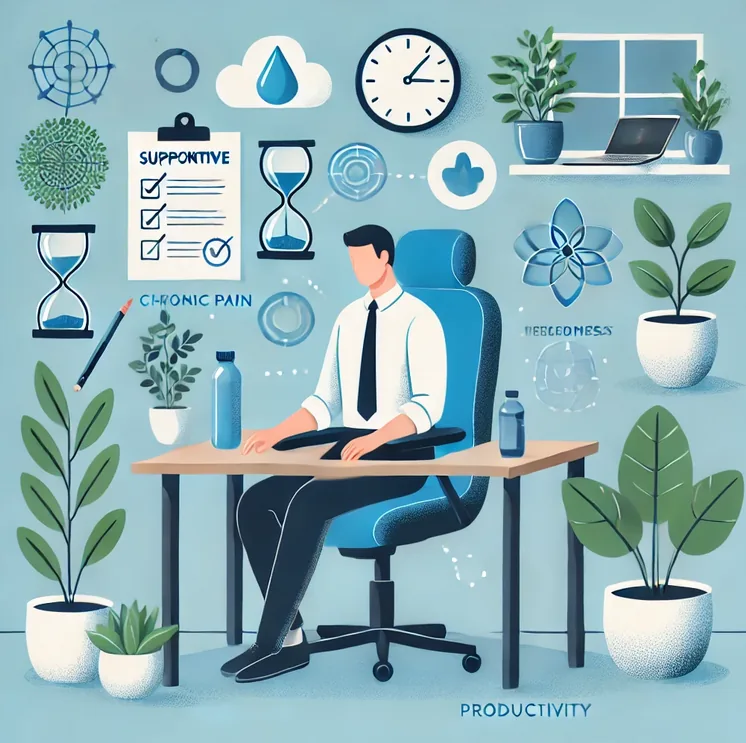
Manual labor occupations require physical presence on site, making standard telecommuting policies entirely ineffective [8].
Practical Accommodations Over Rhetorical Encouragement
Empathetic conversations cannot rectify poorly engineered workstations or introduce crucial rest periods into rigid operating schedules [2]. Figures compiled by the National Institute of Health and cited by OHSE indicate that chronic pain affects over 20 percent of adults, establishing chronic pain at work as an urgent operational priority. NIH estimates confirm that scale. Tangible physical accommodations must take precedence over well-meaning motivational speeches. Organizations can achieve immediate gains by supplying height-adjustable sit-stand workstations, ergonomic task chairs, specialized split keyboards, supportive orthopedic cushions, and anti-glare task lighting [6].
InHerSight data reveals that women managing severe chronic pain at work regularly dim fluorescent ceiling bulbs or install blackout shades to prevent sensory overload. Meaningful workplace flexibility should also incorporate intermittent leaves under frameworks like the Family and Medical Leave Act (FMLA), granting staff protected intervals to attend medical appointments or rest through severe flare-ups without endangering their livelihood [5]. Providing structured self-management guidance, ergonomic evaluations, and comprehensive health insurance coverage—encompassing physical therapy, occupational therapy, and evidence-backed movement regimens such as tai chi for symptom management—fosters long-term functional recovery [6]. Scientific findings detailing stress-related maladaptive behavioral patterns reveal why rigid managerial expectations compound chronic physical suffering.

Ergonomic workstation modifications deliver measurable relief from physical strain and help prevent task-induced flare-ups [6].
Building Sustainable Systems for Workplace Support
Sustaining front-line supervisory support requires providing managers with explicit organizational authority, dedicated accommodation budgets, and formal administrative training. When corporate leadership neglects structural resource allocation, department supervisors find themselves trapped between demanding output deadlines and the genuine welfare needs of staff managing chronic pain at work [8]. Latthitham cautions that companies must not outsource empathy entirely to human resources departments; instead, supervisors need training in disability regulations to guide affected personnel through accommodation processes directly and without bureaucratic friction [5].
Organizations must also establish structured return-to-work protocols, allowing individuals recovering from extended medical absences to resume responsibilities gradually through phased duty schedules and temporary task redistribution. Systematic evaluation of workplace initiatives requires tracking employee feedback, absenteeism records, and retention statistics through confidential periodic surveys. Specialized external bodies, including the American Chronic Pain Association and the Chronic Pain Association of Canada, provide valuable educational curricula to help organizations elevate health literacy among executives and team leaders [6]. By uniting transformational supervisory behaviors with robust physical ergonomics, accessible medical benefits, and flexible operational structures, businesses can effectively manage chronic pain at work while safeguarding the dignity and sustained productivity of their workforce.
Long-term workforce retention demands institutional investment in comprehensive disability support systems [6].
- PREPRINT Turner, N., Gulseren, D., & Sayın, F. (2026). Living with chronic pain at work: Supportive managers can help, but they can’t solve everything [Preprint – not peer reviewed]. [Article Link]
- ONLINE NEWS Gulseren, D. B., Sayın, F. K., & Turner, N. (2026, September 20). Living with chronic pain at work: Supportive managers can help, but they can’t solve everything. The Conversation. [Article Link]
- ONLINE NEWS Turner, N., Gulseren, D. B., & Sayın, F. K. (2026, September 20). Living with chronic pain at work: Supportive managers can help, but they can’t solve everything. Yahoo News Canada. [Article Link]
- ONLINE NEWS Gulseren, D. B. (2021, July 19). When someone on your team has chronic pain. Harvard Business Review. [Article Link]
- WEBSITE Hutto, C. (2025, December 3). Supporting employees living with chronic pain: A guide for managers and peers. InHerSight. [Article Link]
- WEBSITE OHSE. (2026, September 19). From pain to performance: Strategies for managing chronic pain in the workplace. OHSE. [Article Link]
- ACADEMIC JOURNAL Gulseren, D., & Kelloway, E. K. (2021). Working through the pain: The chronic pain experience of full-time employees. Occupational Health Science, 5(1-2), 69-93. [Article Link]
- ACADEMIC JOURNAL Stochkendahl, M. J., Bond, C. B., & Hartvigsen, J. (2025). Staying at work with musculoskeletal pain in a physically demanding job: A qualitative exploration of workers’ and managers’ perspectives. Journal of Occupational Rehabilitation. [Article Link]
APA 7: TWs Editor. (2026, September 21). Why Supportive Managers Cannot Solve Chronic Pain at Work Alone. PerEXP Teamworks. https://perexpteamworks.com/en/chronic-pain-at-work-support/


