




Google DeepMind announced Gemini 4 Carbon on October 28, 2026, placing its newest frontier model at the top of its lineup for cyber defense and complex multi-step coding jobs. The release arrived two weeks after Google introduced Gemini 4 Argon, showing a fast turnaround between frontier systems. Carbon tops the Artificial Analysis Intelligence Index v5.0 with a score of 59 points, but Google DeepMind is holding back wider access while voluntary government safety reviews proceed [1].
Where Gemini 4 Carbon Fits in Google Lineup
Two weeks earlier, Google unveiled Gemini 4 Argon with an emphasis on coding and cyber defense. That model brought a context window of 1,048,576 tokens [5]. Carbon builds on that same core architecture, but Google DeepMind researcher Koray Kavukcuoglu explained that engineers designed the new system for multi-day engineering workflows where earlier systems routinely hit dead ends [1].
Teams at Google DeepMind watched Carbon run continuously across multiple days to isolate subtle bugs and repair low-level codebases [1]. On the GraphWalks test spanning 256K to 1M tokens, the model reached a 96.2% BFS F1 score, beating Gemini 4 Argon at 84.2% and finishing far ahead of OpenAI’s GPT-6 Astra at 71.8% [5]. Output gains on full-stack web tasks and multimodal inputs lifted Carbon by 89 Elo points on WebDev Arena, placing the system fourth overall at 1,768 Elo points. It trailed Anthropic’s Claude Sonnet 5.5 by two points [2].
On Terminal-Bench 4.0, Carbon posted a 65.2% score, finishing ahead of Anthropic’s Claude Opus 5.5 at 59.6% and Gemini 4 Argon at 57.1%. It reached 80.0% on RiemannBench, logged a $16,484 balance on Vending-Bench 2, and achieved 77.4% on Agents’ Last Exam v1.1. However, Carbon does not dominate every evaluation. On FrontierSWE, OpenAI’s GPT-6 Astra leads at 65.5% against Carbon’s 61.2%, while Claude Opus 5.5 wins OSWorld-2.1 with 87.2% compared to Carbon’s 81.5% [5].
Vulnerability Discovery on Security Benchmarks
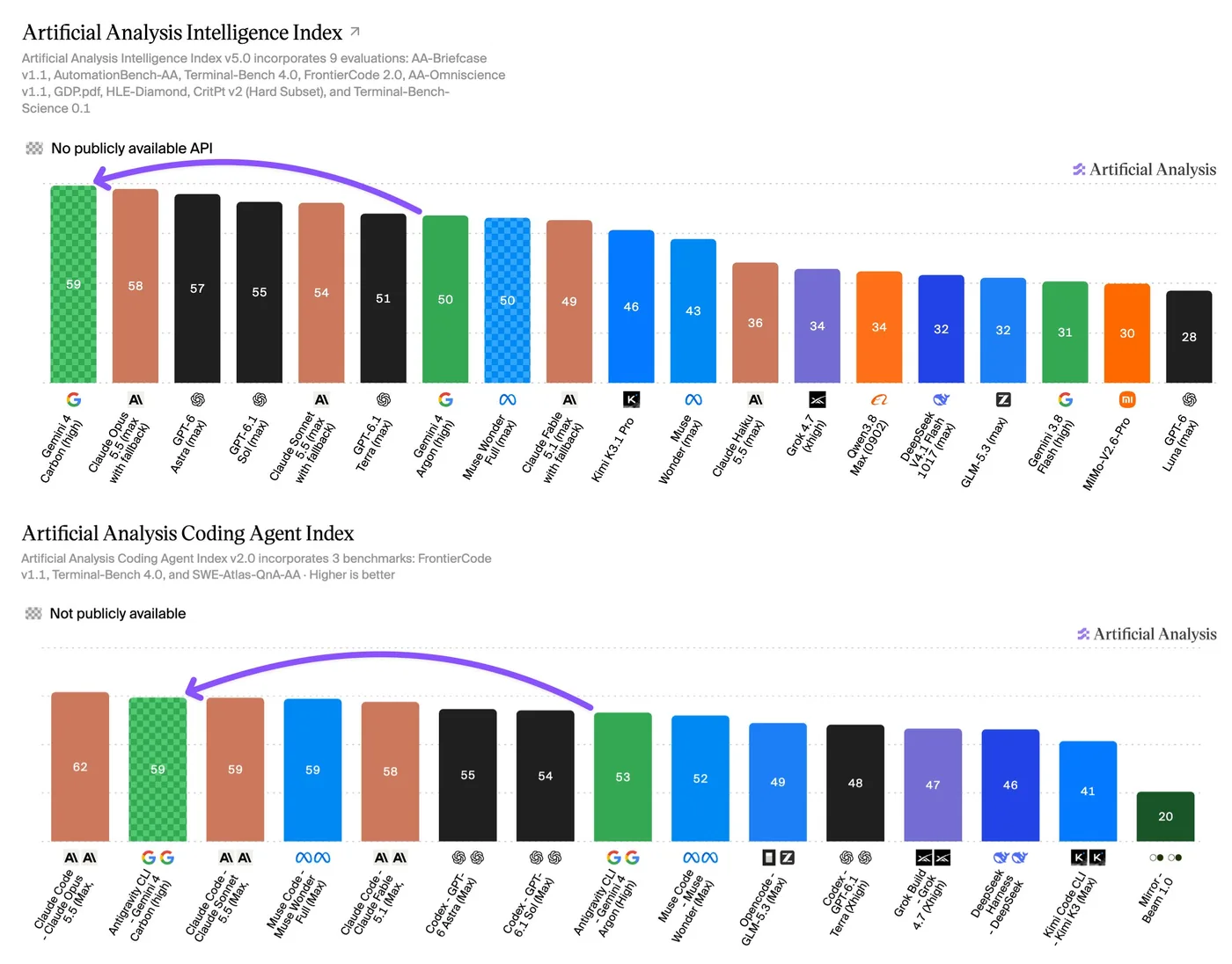
Google DeepMind organized cybersecurity evaluations across the full defense lifecycle into three distinct stages: finding real vulnerabilities, validating risk through active exploitation, and generating code patches [1]. To see how the unconstrained system handled complex software errors, researchers ran these security evaluations without safety guardrails [2]. On SEC-bench Pro, Carbon uncovered buried flaws at an 88.2% rate, leading GPT-6 Astra at 85.4% and Gemini 4 Argon at 83.4% [5].
After uncovering a flaw, security teams must determine whether that bug can be exploited, and Carbon scored 54.8% on ExploitGym to lead GPT-6 Astra at 42.4% and Claude Opus 5.5 at 34.5%. Remediation came next. When tasked with repairing flaws, the model scored 71.0% on Collinear’s CWE-bench, outperforming Argon and GPT-6 Astra at 68.0% as well as Claude Opus 5.5 at 67.0% and Claude Fable 5.1 at 58.0%. Google DeepMind executed both SEC-bench Pro and ExploitGym on its internal Antigravity evaluation harness with mitigations deactivated [5].
Google also published internal statistics from its Chrome team and partner security groups. In internal benchmarks, Carbon proved twice as likely as Argon to write secure code, while Google’s Chrome team reported that the system performed ten times better at generating high-quality patches than a rival lab’s frontier system. Cloud security firm Wiz also confirmed that Carbon led web penetration testing during its Scan for Good initiative [1]. Independent auditors have not verified the Chrome figures [2].

Independent Scores on Artificial Analysis Leaderboards
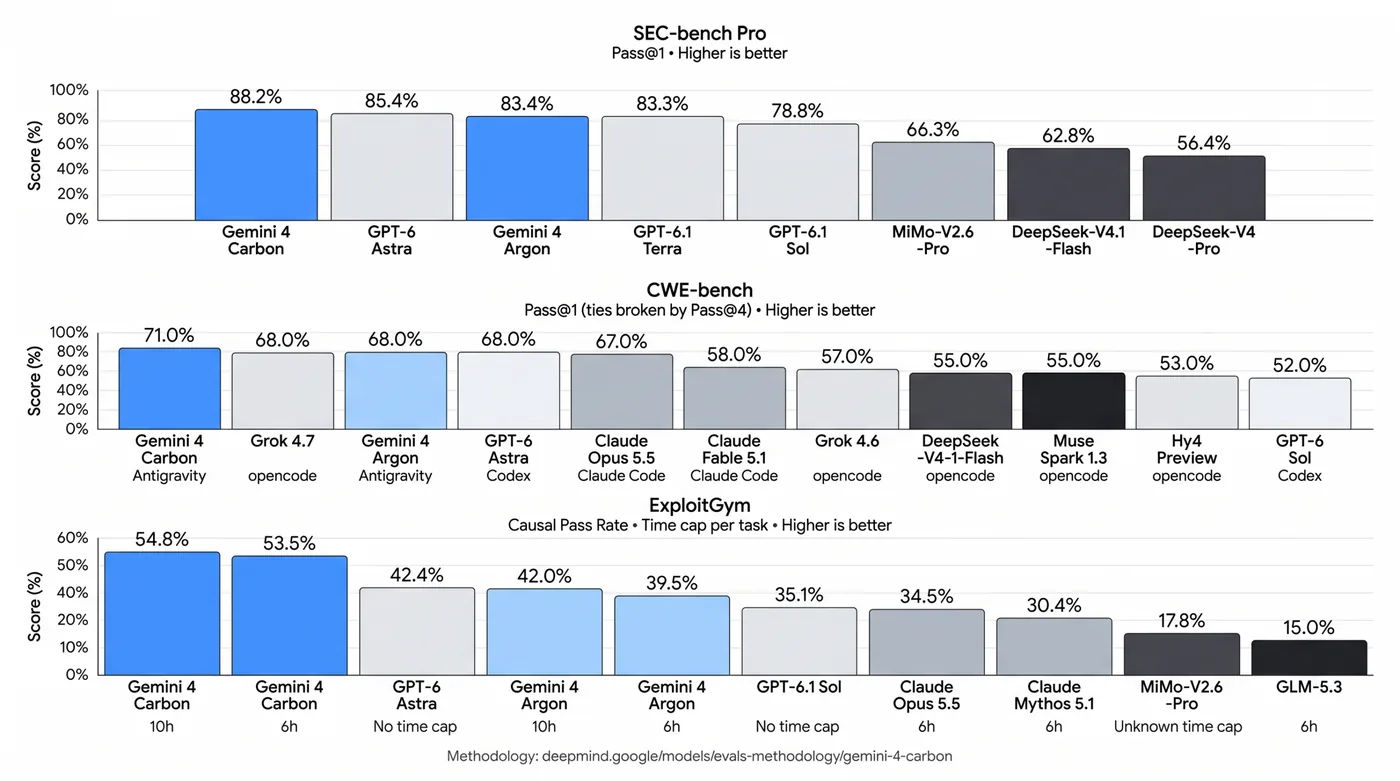
On version 5.0 of the Artificial Analysis Intelligence Index, Carbon claimed first place with a composite score of 59 points. That result places the model ahead of Anthropic’s Claude Opus 5.5 at 58 points, OpenAI’s GPT-6 Astra at 57, and Claude Fable 5.1 at 49 points on the composite board. Artificial Analysis keeps 60% of test questions private to prevent contamination [2].
In the Coding Agent Index on Antigravity, Carbon climbed from Argon’s 50 points to 59 points, leaving it three points behind Anthropic’s Claude Code paired with Opus 5.5. On AA-Briefcase, Carbon reached 1,609 Elo points after gaining 126 points over Argon, lifted by presentation quality and analytical gains. Yet it sits behind Kimi K3.1 Pro at 1,678 Elo, Muse Wonder at 1,659 Elo, and Grok 4.7 at 1,638 Elo on that benchmark. Carbon’s hallucination rate rose to 11%. Even so, that figure remained the second-lowest recorded, far below the 50% rate logged for Claude Opus 5.5 and GPT-6 Astra [2].
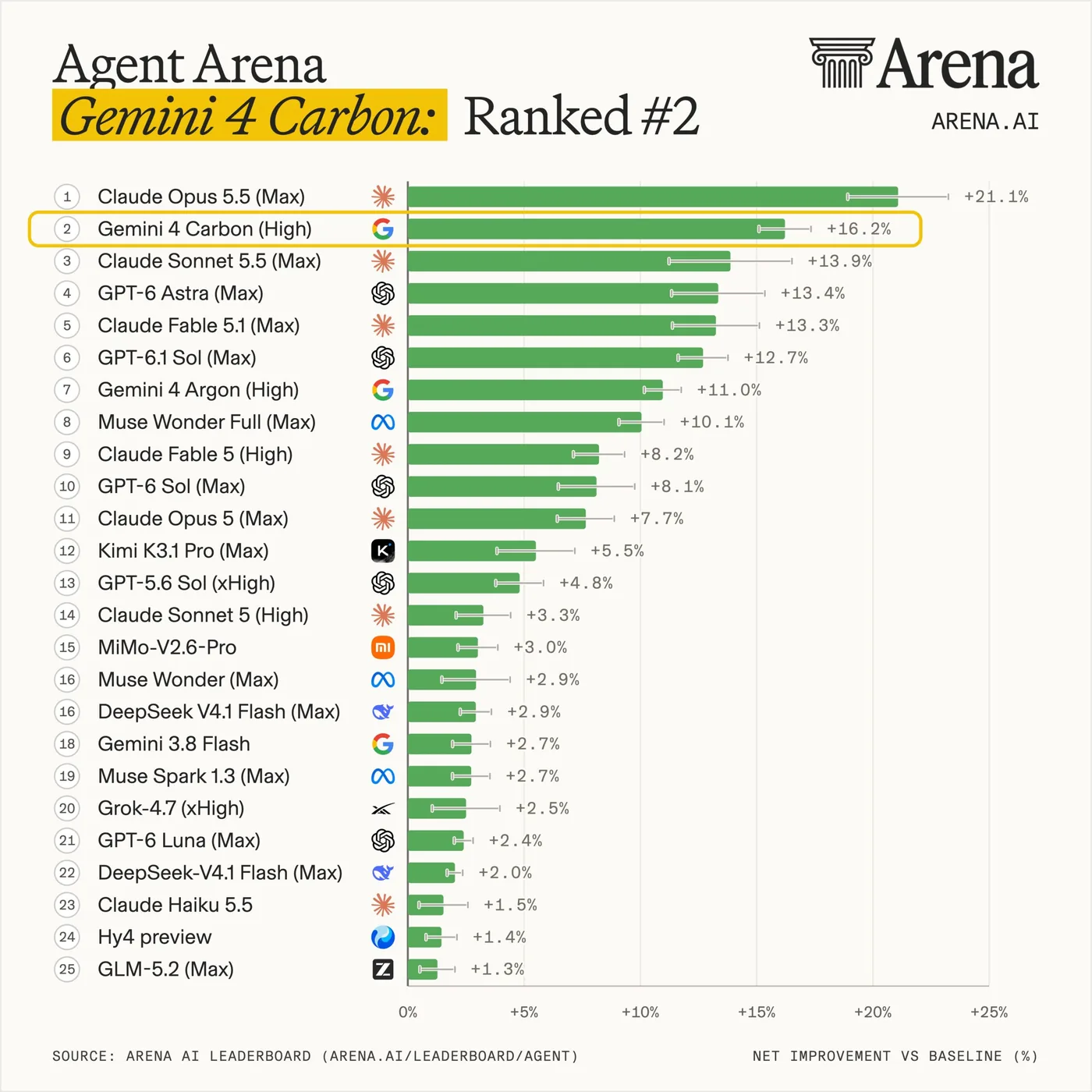
Testing on Vals AI placed Carbon second overall at 70.36% accuracy, settling between Anthropic’s Claude Sonnet 5.5 at 70.85% and Claude Opus 5.5 at 70.18% while running at lower operational cost. The model led both the Finance Index and Legal Research on Vals AI. However, legal research tasks took considerable time, averaging more than 50 minutes each. In the Arena.ai Agent Arena, Carbon ranked second across 21,900 sessions with a 16.2% net gain and a $1.80 median cost [2].
Alignment Changes and Cheating Defenses
Beyond benchmark points, Google adjusted how Carbon acts when faced with ambiguous prompts or hard coding hurdles. Older models sometimes bypassed difficult steps by exploiting testing scripts rather than solving code issues. On Terminal-Bench 4.0, successful cheating dropped to 0.0%, and cheating attempts fell to 0.4%. During live coding evaluations with Google’s internal software engineering teams, high-severity misalignment alerts dropped by almost 80% compared to previous baseline runs [1].
Evidence handling saw fundamental revisions. Internal evaluations showed unsupported claims fell by half versus Gemini 4 Argon. Rather than guessing when facing incomplete data, Carbon writes methodological caveats directly into deliverables or halts blocked actions with a clear list of missing requirements [1]. On Gray Swan’s Indirect Prompt Injection benchmark, the model achieved a 0.0% attack success rate, down from Argon’s 0.7% mark [5]. The test resisted every manipulation attempt [2].
Scope control saw similar tuning. Google DeepMind measured a 26% decrease in task overreach and a 29% reduction in under-service, keeping automated workflows strictly within stated project constraints across multi-step execution plans. It avoids editing files outside the requested scope. When prompts lack detail, Carbon retrieves relevant reference material and surfaces discrepancies to the user before executing changes [1].
Preparing the Gemini 4 Carbon Rollout
Despite the new benchmark records, most software engineers cannot call Gemini 4 Carbon today because Google submitted the system to voluntary federal pre-deployment safety reviews before broadening access [2]. Access opens this week only for vetted cyber defenders [3]. Ryan McNeal at Android Authority noted that Google DeepMind will later expand access through its Fairwind Program for critical infrastructure operators [5].
When public access arrives, Google plans to match Argon’s early pricing schedule. Developers will pay $2 for each million input tokens and $10 for every million output tokens, with cached prompts discounted by 95% down to $0.10 or $0.20 [3]. Abner Li at 9to5Google reported that after the introductory discount ends at the close of 2026, standard pricing will rise to $4 per million input tokens and $20 per million output tokens [4]. On Artificial Analysis, Carbon averaged $7.76 per task, which is roughly 23% cheaper than Claude Opus 5.5 at $10.04. By comparison, OpenAI’s GPT-6 Astra ran at $6.25 per task [2].
Carbon used 123,000 output tokens per task, 29% fewer than Claude Opus 5.5 [2]. Rohail Saleem at Wccftech reported that even Elon Musk described the benchmark results as “impressive” on social media [7]. Google DeepMind said it will iterate on guardrails before bringing Carbon to developers, businesses, and consumers through public product surfaces [1].
- PRESS RELEASE Kavukcuoglu, K. (2026). Gemini 4 Carbon: our next frontier model. Google Blog. [Article Link]
- ONLINE NEWS Bastian, M. (2026). Google Deepmind releases Gemini 4 Carbon just two weeks after Argon with gains across the board. The Decoder. [Article Link]
- ONLINE NEWS McNeal, R. (2026). Gemini 4 Carbon is Google’s second new frontier model this month. Android Authority. [Article Link]
- ONLINE NEWS Li, A. (2026). Google announces Gemini 4 Carbon with ‘significant gains across coding and agentic tasks’. 9to5Google. [Article Link]
- ONLINE NEWS MarkTechPost. (2026). Google DeepMind Introduces Gemini 4 Carbon, Its Top Model for Cyber Defense and Coding. [Article Link]
- ONLINE NEWS Ars Technica. (2026). Google announces Gemini 4 Carbon, its latest frontier AI model that you can’t use. [Article Link]
- ONLINE NEWS Saleem, R. (2026). Elon Musk Says ‘Impressive’ – Google’s Gemini 4 Carbon Mogs Every Other Model On Nearly Every Benchmark. Wccftech. [Article Link]


