



Morning routines across software and finance offices frequently collide with fragmented browser windows. To address that friction, Anthropic announced on Wednesday that Claude Cowork and its standard chat interface are merging into a unified operational environment. Instead of forcing knowledge workers to toggle between casual conversational prompts and a separate productivity hub, the artificial intelligence assistant now routes complex tasks autonomously from a single input bar. Users can request a pipeline review before commuting, and Claude continues background processing in the cloud even after they close their laptop lids. [4, 6]
Ending the Split Between Conversation and Work
Anthropic initially introduced Cowork as an isolated workspace for long projects while reserving regular chat for rapid inquiries. In practice, customers complained that dividing those environments created unnecessary friction because projects rarely stay confined to a single format. Workers drafted ideas in conversational threads only to discover that accumulated context, skills, and connectors failed to transfer to the dedicated productivity tab. Why force workers to choose modes before typing? By eliminating the manual toggle, Anthropic ensures that every conversation maintains immediate access to project memory and execution tools. [5, 6]
The structural overhaul also addresses growing enterprise friction as frontier labs push their chatbots into corporate workplaces. Technology reporter Matthias Bastian at The Decoder pointed out that the previous division resembled the confusion surrounding ChatGPT and ChatGPT Work, where overlapping interfaces left enterprise users unsure where work belonged. As workplace adoption encounters employee hesitation and corporate “work slop” (unstructured, low-quality automated outputs), simplifying the user experience becomes essential for retaining business subscribers. TechCrunch noted that the unified front end removes guesswork by routing prompts directly behind the scenes. [3, 4]
Anthropic aims to make Claude an indispensable workplace fixture competing with established productivity platforms from Google and Microsoft. Instead of demanding manual prompt configurations, the updated system analyzes incoming user text to determine whether an instruction requires a quick reply or agentic execution. The model manages workflow steps. Simon Batt of XDA Developers emphasized that this unified architecture consolidates disparate productivity modes into one continuous workspace rather than creating a fragmented clone of Google Gemini. [1, 6]
Claude Cowork Fuses Directly Into Everyday Chat
At the technical core of the redesigned Claude Cowork is an automated routing mechanism that operates directly behind the primary prompt bar. When subscribers type an inquiry, the underlying model determines what context and execution tools the assignment requires without demanding manual mode selections. The prompt bar unifies routing. The interface seamlessly incorporates Artifacts (Claude’s interactive workspace feature for reviewing code, mockups, and structured text) with full conversational history. Claude Design, introduced in April for visual layouts and prototype mockups, also operates directly within standard chat threads. [4, 6]
Knowledge workers previously struggled with isolated data silos that hampered complex office assignments. In earlier releases, an analyst drafting strategic guidelines in chat had to export text manually or reconfigure custom connectors when opening an agentic Cowork session. Under the consolidated framework, any conversation automatically retains access to connected files, enterprise connectors, and custom instructions. Senior Economist Andrew Keller highlighted the practical power of autonomous retrieval during testing, observing: “I could have Claude pull up [my legal research database], and it would pull all the cases, read them, figure out which other cases I might need, download them, and store them in a folder for my personal review.” [6]
Software engineering workflows remain deliberately separated from this consumer desktop consolidation. Anthropic confirmed that Claude Code remains a dedicated, separate product because programming requires specialized terminal interfaces and local directory controls that differ from office productivity tasks. Claude Code remains excluded. Zac Hall at 9to5Mac observed that dropping from three modes to two—Claude Chat and Claude Code—sharpens the product lineup while preserving existing projects, artifacts, and skills. [1, 2]


New Document Suites Challenge Workplace Software Giants
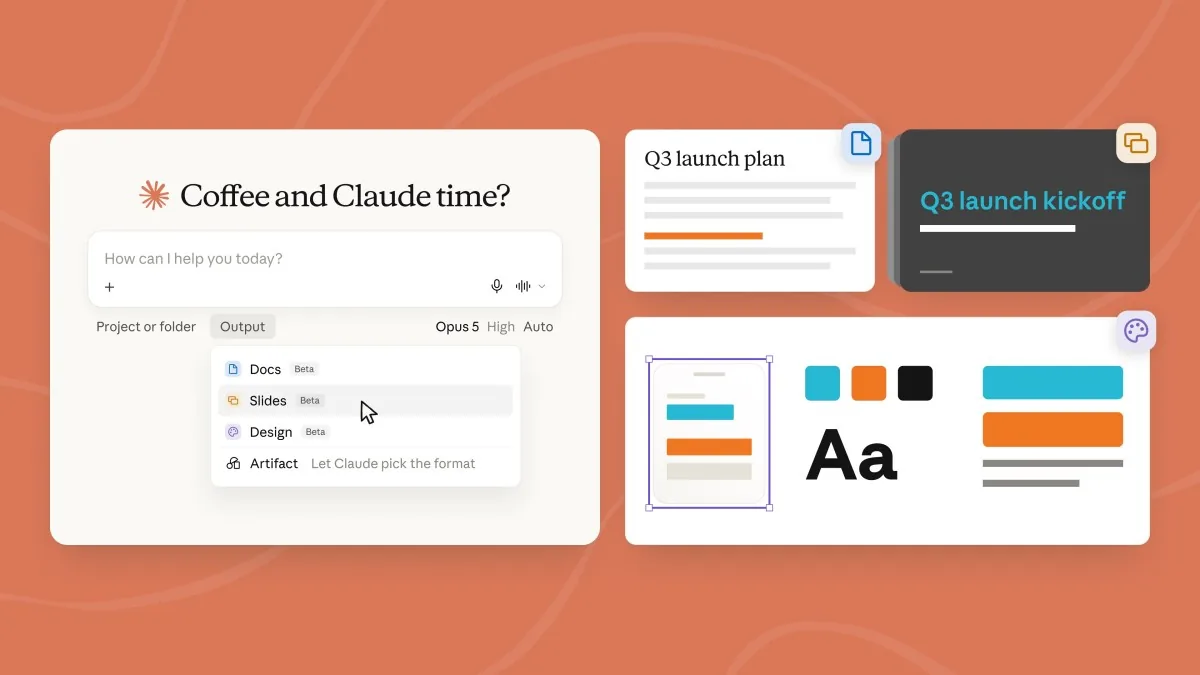
The updated interface introduces dedicated document creation widgets called Claude Docs and Claude Slides to convert conversational prompts into structured deliverables. Rather than merely outputting plain markdown text into the chat stream, the AI assistant creates interactive documents and slide decks that users can review, edit, and modify directly in the workspace window. Colleagues can collaborate in real time by highlighting specific passages, adjusting slide layouts, or adding comments to instruct Claude where to revise text. [1, 4]
Finished deliverables do not remain trapped inside the proprietary chatbot environment. Subscribers can share live projects through a single web link that colleagues can inspect on mobile phones, or export completed work as PowerPoint presentations and standard PDF files. PowerPoint presentations and standard PDF files give distributed teams direct flexibility. Native authoring tools position Anthropic to compete directly against traditional office software from Microsoft and Google, offering organizations an alternative to manual deck design. The capabilities also address recurring business curiosity regarding whether Anthropic will acquire external enterprise software suites like Salesforce to gain software distribution. By building native document, slide, and design capabilities directly into Claude, Anthropic demonstrates that generative foundations can deliver full office productivity without acquiring legacy software platforms. [5, 6]

Anthropic also upgraded context persistence across long-running team projects. Recent enhancements to Cowork’s memory layer enable Claude to retain project context, terminology, and user preferences across distinct sessions and team threads. A marketing lead can draft an initial campaign outline on a desktop computer, review changes on a phone during transit, and find revised presentation decks waiting in the cloud. Both formats support PowerPoint exports. Workspace continuity allows casual conversations to evolve naturally into formal corporate presentations without copy-pasting between external word processors. [1, 3]
Persistent Cloud Automation and Autonomous Execution Choices
A defining capability of Claude Cowork is persistent background processing that continues executing after workers disconnect their machines. Anthropic illustrated the workflow through a standard Monday reporting scenario: a manager facing a noon deadline asks Claude what moved in the sales pipeline last week, adds formatting guidelines, and requests five slides for a leadership meeting. Claude begins gathering data, flags slipped deliverables, drafts the report, and builds presentation slides while the manager commutes to the office. If ambiguous data points emerge during analysis, the assistant prompts the user for clarification rather than making unverified assumptions. [6]
Scheduled automation extends this background independence to recurring corporate routines. Users can configure routine instructions—such as scheduling Claude to compile weekly operational audits every Monday morning—allowing the model to initiate data synthesis without manual prompting. Supervisory settings remain customizable. By default, Claude pauses and asks for user confirmation before executing external actions or modifying shared project directories. Subscribers who prefer autonomous execution can toggle permissions to let the model work continuously in the background, intervening only when complex decisions require administrative review. Anthropic emphasizes this balance in its documentation: “You keep the final say.” [4, 6]

Can automated agents run enterprise workflows without constant supervision? That operational question carries significant weight as organizations grant frontier models direct access to internal databases and external application programming interfaces. Anthropic balances autonomous capabilities with strict administrative boundaries, ensuring that teams maintain full visibility over automated edits and shared links. Security remains a parallel focus for the research laboratory; PerEXP Teamworks previously detailed reports on suspected Claude bioweapons research blocked by internal filters as autonomous execution expanded across sensitive domains. Enterprise safeguards ensure that autonomous background processing operates under verifiable corporate policies. [3, 6]
Tiered Rollout Schedule and Enterprise Administrator Notice
Anthropic is deploying the unified Claude Cowork interface through a phased rollout across web, desktop, and mobile applications over the coming weeks. Subscribers on paid Claude Pro and Claude Max tiers receive immediate access without needing to flip manual feature flags or reinstall desktop clients. The deployment marks a quiet transition for individual power users, who will find Docs, Slides, and Design tools embedded directly into their standard conversation window upon logging in. [2, 5]
Broader availability will expand to additional subscription tiers as operational testing stabilizes. Anthropic confirmed that users on Free and Team subscription tiers will receive the integrated interface shortly after the initial Pro and Max rollout. Team tiers will follow soon. Enterprise accounts face a more deliberate onboarding timeline designed to protect corporate governance. To prevent sudden disruptions to established workplace protocols, Anthropic pledged to provide enterprise administrators with at least 30 days of advance notice before modifying workspace environments or default settings. [2, 3]
Admins retain thirty days of advance notice. IT departments gain adequate time to review data connectors, set file permissions, and verify organizational guidelines before automated workflows launch. [1, 2]
- ONLINE NEWS Batt, S. (2026, September 16). Anthropic merges Claude Cowork and chat into one, singular Claude. XDA Developers. [Article Link]
- ONLINE NEWS Hall, Z. (2026, September 16). Anthropic merging Claude Cowork with chat. 9to5Mac. [Article Link]
- ONLINE NEWS Bastian, M. (2026, September 16). Anthropic merges Claude Chat, Cowork, and more into a single product. The Decoder. [Article Link]
- ONLINE NEWS Mehta, I. (2026, September 16). Anthropic merges Claude chat and Cowork in one interface. TechCrunch. [Article Link]
- ONLINE NEWS Chedraoui, K. (2026, September 16). Anthropic Simplifies Claude’s Cowork and Design Tools. CNET. [Article Link]
- PRESS RELEASE Anthropic. (2026, September 16). Claude Cowork and chat are now one Claude. Claude. [Article Link]


