




Anthropic released research previews showing that its frontier AI model, Claude Fable 5.2, can produce photorealistic artwork without relying on standard diffusion image generators. Instead of predicting pixels in one step, it writes Python code that simulates bristle texture, wet paint, and canvas friction stroke by stroke [5]. During early tests, the system produced a parking garage scene using roughly 700,000 simulated brushstrokes, correcting its own errors by layering fresh paint over the digital canvas [1].
Virtual Canvas Mechanics in Claude Fable 5.2
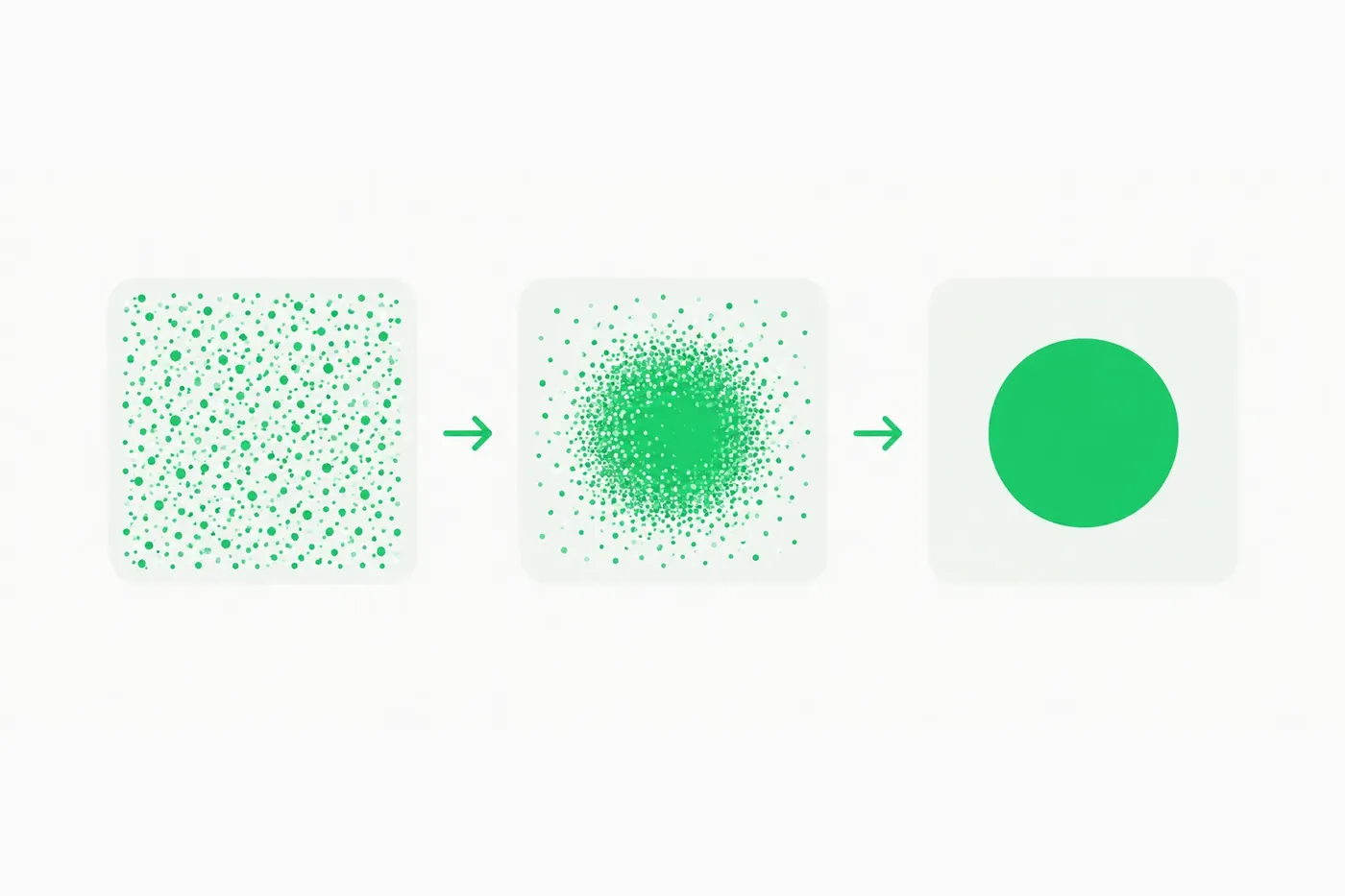
Mainstream image generators like Midjourney and Stable Diffusion build pictures through diffusion, gradually refining random pixel noise into a recognizable image inside a neural network [6]. Claude Fable 5.2 takes a different path [1]. It turns visual art into an executable programming problem by writing code that directs a simulated paint engine [6]. That engine models the spread of wet pigment, canvas resistance, and the stiffness of individual bristles [1].
Developer Jake Eaton, an Anthropic engineer working on model alignment and agent safety, shared how he steered the system to create distinct styles after earlier tests with Claude Opus 5.5 drew criticism for merely imitating existing artwork [1]. He changed tactics [6]. Eaton instructed the model to invent fictional painter personas with their own backstories, aesthetic philosophies, and consistent techniques [1]. One persona, named Dermot Hale, depicts gloomy weather with heavy oil paint in retail parks, while another called The Tidewright focuses exclusively on coastal seascapes with salt spray and rolling waves [6]. Claude manages these personas by writing custom brush scripts that keep stroke density and color palettes consistent across hours of generation [1]. Each piece produces between 1,000 and 2,000 lines of Python code [6].
Because the painting program runs without an undo command, the model must commit to every coordinate it places on the canvas [1]. Mistakes can’t be undone with a keystroke [6]. Instead, the model inspects the digital canvas, detects the flaw, and paints fresh layers directly over the bad strokes, an iterative workflow that mirrors broader agentic programming tasks detailed during the Mythos 5.2 and Fable 5.2 release [2].
The 700,000-Stroke Parking Garage Demo
To test how far the procedural engine could go, Eaton asked the model to create a scene that would be as hard to distinguish from a real photograph as possible [1]. Claude responded with an empty parking garage holding a shopping cart. It placed roughly 700,000 simulated brushstrokes to assemble the composition [6]. Eaton said the model worked without a separate image model, pre-rendered reference assets, or photo tracing [1]. Every highlight on the wire basket, every oil stain on the concrete floor, and every gradient in the overhead fluorescent lighting came from coordinate instructions written in Python [6].
Eaton guided the creation process by providing text comments between rendering passes [1]. The project sparked debate on developer forums like Hacker News thread 50429906 [6]. Some observers wondered if the AI secretly traced a 3D polygonal model, but Eaton said the scene emerged from procedural paint loops without intermediary geometry files. No external graphics assets were loaded [1].
The parking garage experiment also revealed the heavy computational demands of procedural art. Emitting hundreds of thousands of coordinate arrays burns through output tokens quickly, turning a single image into an expensive run. While standard diffusion models generate a web illustration in seconds for fractions of a cent, running six-figure stroke arrays through a frontier language model behaves more like a multi-hour software compile. Costs mount rapidly [6].

Bird Studies Without an Undo Button
Anthropic engineer Michael Graczyk conducted a smaller, highly controlled painting test to study how the model handles rigid physical constraints [1]. He prompted Fable 5.2 to paint a bird perched at sunrise without an undo button [6]. Graczyk shared a video tracking 111 strokes on a blank canvas. Every stroke was permanent [1].
The log files show how deliberate each stroke was from the start. For its very first mark, the model output color code #30346a, a stroke width of 90 pixels, and five slightly wobbling waypoints. Fable 5.2 stated that it added an intentional seven-pixel wobble because a human arm doesn’t draw a perfectly straight line. The bird’s back came out thin and scraggly. The model adapted immediately. It laid a bolder stroke over the flawed area, turning the stray bristle marks along the edges into realistic ruffled feathers [1].
In a second study showing two people painting at dusk, Graczyk observed similar self-correction across 280 strokes. A late lighting pass accidentally smeared paint tubes and a cup sitting on the table, so the model repainted those objects in subsequent steps. The prompt asked for both painters to touch shoulders, and the AI met that request by having both figures hold brushes with their outer hands [1]. Physical logic guided the scene [5].
Robotics Benchmarks and Physical Motor Limits
Anthropic links this procedural painting discipline to physical robotics and spatial reasoning [1]. On the company’s RoboDojo Sim benchmark, Claude Fable 5.2 achieved a score of 64.9 percent, well ahead of OpenAI’s GPT-6 Astra at 29.8 percent [2]. Planning brushstrokes tests skills that robotic arms need when manipulating tools. Virtual tasks mirror physical motion [1].
Real-world trials showed that simulated prowess doesn’t always translate into physical speed. AI researcher Aris Zhu tested both models using physical robot arms assigned to paint Vincent van Gogh’s The Starry Night. In Zhu’s test, GPT-6 Astra painted faster than Fable 5.2 and showed finer motor control. OpenAI’s model was also the only system that stood a domino on end, which it achieved by releasing grip pressure gradually so that gravity tipped the domino upright onto its edge [1]. The test revealed clear gaps between planning a path in software and executing it with robotic hardware in the physical world [6].
Beyond robotics, Anthropic pointed to other performance benchmarks where Fable 5.2 executed complex long-horizon code. In hardware engineering, the model designed three working electronic devices with circuit board manufacturer Diode. In theoretical physics, it completed calculations for two open problems about black holes and holographic duality, though Anthropic published those physics results as preprints that have not undergone independent peer review [2]. The system also coordinated over 1,000 sub-agents to program a bootable laptop operating system from an empty directory in eight days [1]. It formalized Pierre de Fermat’s Last Theorem in 30 hours, improving on an earlier unreleased model that needed 11 days [2].
Benchmark Gains and Pricing for Fable 5.2
Anthropic introduced Fable 5.2 alongside Mythos 5.2 on November 9, 2026, marking its second major upgrade since releasing the model family in June [4]. Anthropic priced incoming tokens at $8 per million and outgoing text at $40 per million, cutting rates by 20 percent compared to Fable 5.1. Cache reads cost $0.20 per million tokens [3]. Fast mode runs up to 2.5 times quicker at $16 input and $80 output across Amazon Web Services, Google Cloud, and Microsoft Foundry [2].
Anthropic positions Fable at the top of its model hierarchy, sitting above Claude Opus 5.5, Sonnet 5.5, and Haiku 5.5 [4]. On agentic coding evaluations like FrontierCode 2.0, Fable 5.2 reached 49.1 percent at high effort, outperforming Fable 5.1 at 32.4 percent and Opus 5.5 at 45.5 percent. On FrontierSWE v2, it scored 69.9 percent compared to 56.3 percent for Fable 5.1 and 62.3 percent for Opus 5.5. The model generates text 30 percent faster than Fable 5.1 [2]. As tech journalist Zac Hall reported for 9to5Mac, Anthropic granted eligible Pro and Team subscribers extra usage resets to encourage adoption [4].
Safety architecture also shapes how developers interact with the model [2]. Fable 5.2 includes automated safeguards that route flagged cybersecurity queries to Opus 4.8 and biology prompts to Opus 5, while verified enterprise customers can access unrestricted capabilities through tailored verification programs [3]. Anthropic reported that Claude now writes over 90 percent of the changes merged into its core codebase, including migrating a production service from Python to Rust that starts 26 times faster [2]. For software engineers, procedural painting shows how frontier language models can solve spatial problems by treating visual art as pure code [5].
- ONLINE NEWS Uth, M. (2026, November 15). Anthropic’s Claude Fable 5.2 doesn’t generate images, it paints them. The Decoder. [Article Link]
- PRESS RELEASE Anthropic. (2026, November 9). Introducing Claude Fable 5.2 and Claude Mythos 5.2. [Article Link]
- WEBSITE Anthropic. (2026, November 9). Claude Fable. [Article Link]
- ONLINE NEWS Hall, Z. (2026, November 9). Anthropic upgrades Claude with new Fable 5.2 model, details here. 9to5Mac. [Article Link]
- WEBSITE IT Consulting AI. (2026, November 15). Why Anthropic’s Claude Fable 5.2 Rewrites How AI ‘Generates’ Images. [Article Link]
- WEBSITE Thakker, Y. (2026, November 15). Fable 5.2 Paints With 700,000 Strokes — No Image Model. explainx.ai Blog. [Article Link]


