





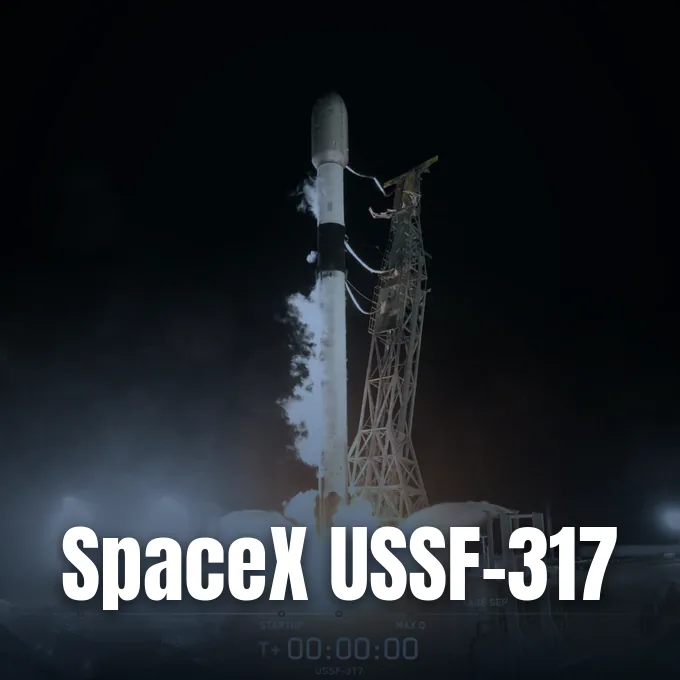
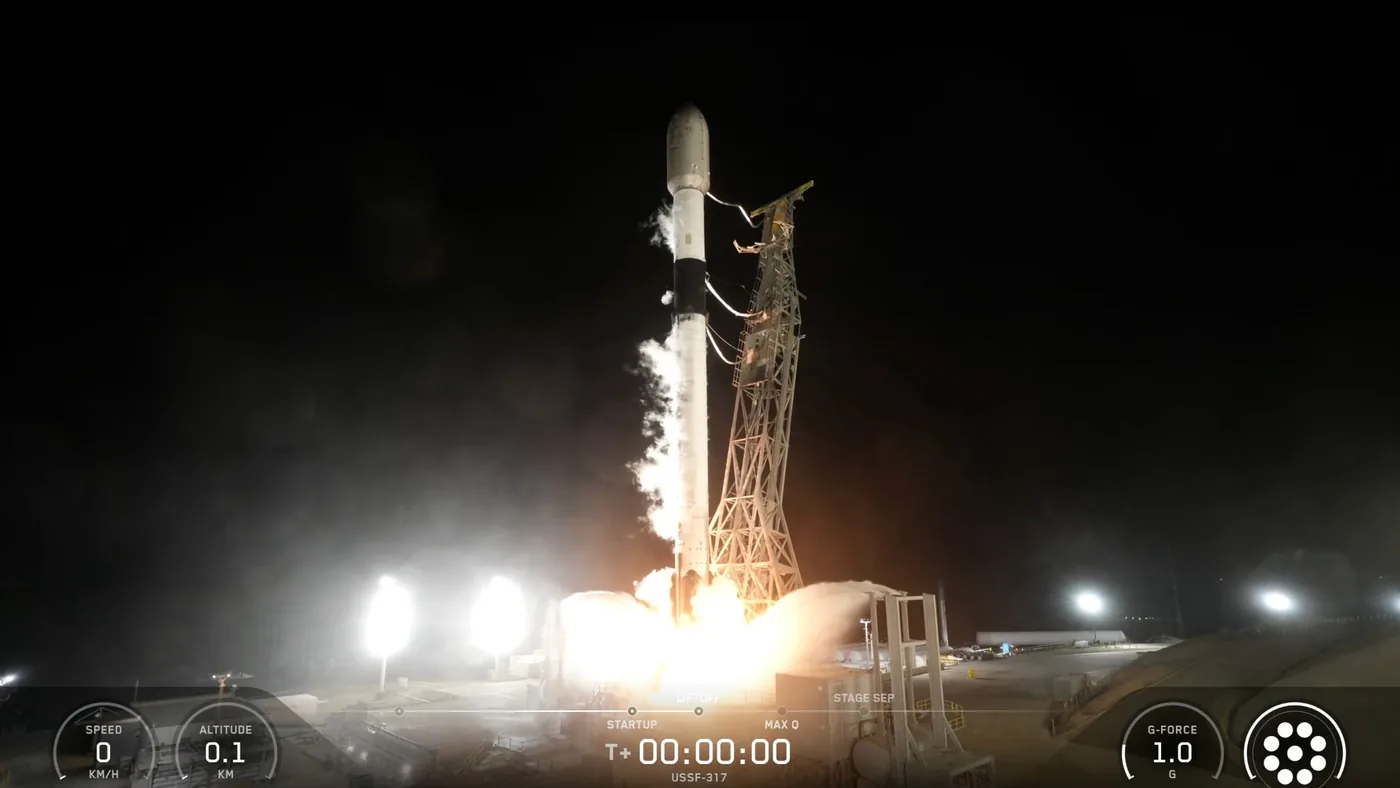
SpaceX launched a classified national security payload for the U.S. Space Force from California on November 20, 2026. Lifting off from Vandenberg Space Force Base on the central coast of California at 11:20 p.m. EST, the Falcon 9 rocket carried out the USSF-317 mission into low Earth orbit. The booster completed its flight smoothly and touched down on an ocean platform, but the military kept details about the upper stage and its destination secret [1].
USSF-317 Mission Liftoff and Ocean Recovery
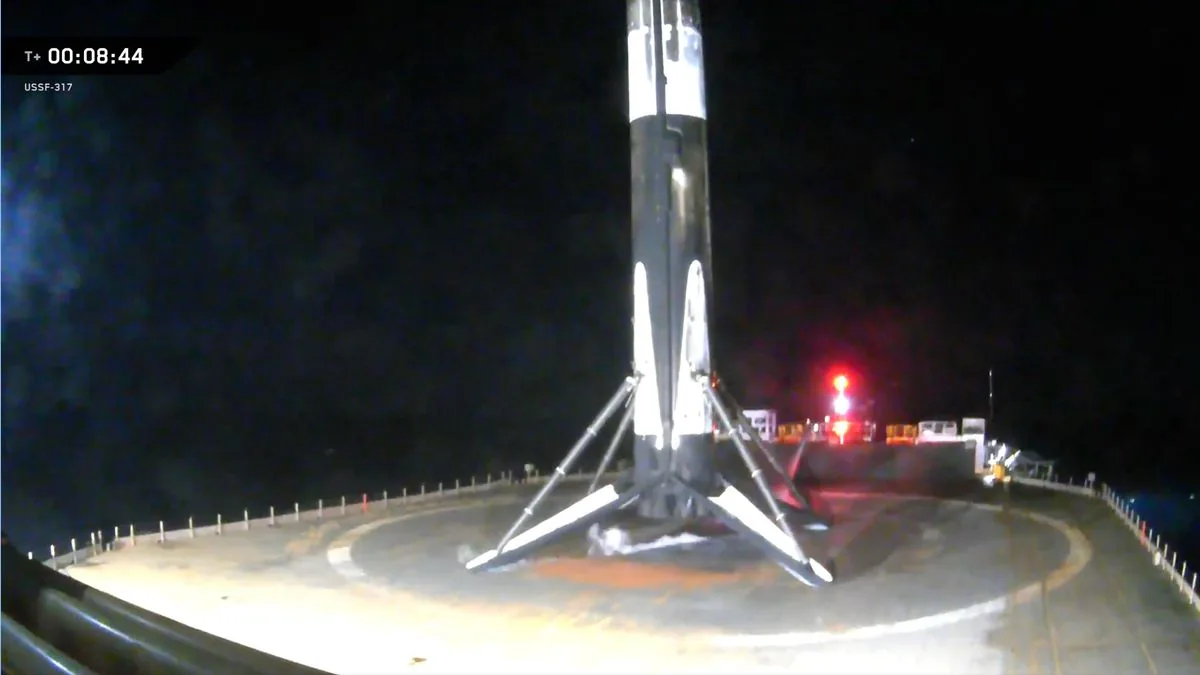
The late-night liftoff took place at 8:20 p.m. local California time (0420 GMT on November 21). About 8.5 minutes after leaving the launch pad, the Falcon 9 first stage returned to Earth and touched down in the Pacific Ocean. The landing occurred aboard the autonomous drone ship Of Course I Still Love You. This recovery marked the eleventh successful flight and landing for this particular booster, which carries the serial designation B1100 [1].
SpaceX cut its live webcast shortly after the first stage settled onto the drone ship deck, which prevented viewers from watching the second stage fire its Merlin vacuum engine. The military provided no orbital parameters or payload descriptions for the USSF-317 mission. Government agencies routinely impose broadcast blackouts on sensitive defense launches to stop foreign tracking stations from calculating trajectory paths. The upper stage continued in secrecy [1].
B1100 flew ten previous missions. Ground teams secured the upright rocket on the floating barge deck so support tugboats could tow the vessel back to port for inspection. Reusing boosters multiple times allows SpaceX to sustain high flight schedules without waiting for factory lines to assemble new rocket cores. Technicians at the port will inspect the hardware before engineers assign the stage to future orbital flights [1].
Suspected Payloads and Starshield Capabilities
Defense officials shared no public manifest, but outside analysts writing for publications like Space.com think the flight carried Starshield satellites built for military reconnaissance. The hardware supports the Space Force Space Based Sensing and Targeting program. That effort helps combat commands identify and track mobile surface assets anywhere in the world. SpaceX developed the Starshield product line by adapting its satellite manufacturing lines for defense customers who need resilient orbital constellations. These small spacecraft offer tracking capabilities that larger spy satellites cannot easily match [1].
Starshield draws heavily on the architecture developed for Starlink, which currently operates more than 11,000 satellites in low Earth orbit (LEO) [1]. Building thousands of identical spacecraft allowed SpaceX to lower unit costs while speeding up delivery schedules for defense programs. The commercial Starlink constellation generates the bulk of company revenue. It also provides a testbed for bus subsystems, solar arrays, and optical laser links [3]. Deploying military hardware on similar satellite frames lets the Pentagon replace lost assets quickly during international crises [2].
Military satellites in low orbit deliver lower latency and wider coverage than older systems parked in distant geosynchronous slots. By distributing tracking sensors across dozens of small spacecraft, the Space Force prevents a single anti-satellite missile from disabling an entire tracking grid. Small satellites orbiting hundreds of miles above Earth pass over ground targets frequently. They send updated coordinates straight to mobile field units [2].
Launch Cadence for Falcon 9
With the USSF-317 mission, SpaceX logged its 121st Falcon 9 launch of 2026. The flight was also the third mission SpaceX carried out for the Space Force during November alone. In 2025, the workhorse booster flew 165 times, setting a launch pace that far exceeded the annual flight totals of every foreign government and commercial competitor. About 70% of Falcon 9 flights in 2026 carried Starlink satellites, which demonstrates how internal broadband deployment drives the heavy flight schedule [1].
This rapid flight tempo grew out of years of reusable rocket testing that began after three early Falcon 1 failures between 2006 and 2008 almost caused bankruptcy. SpaceX achieved the first orbital-class booster landing in 2015 and completed the first booster reflight in 2017. That success followed earlier NASA cargo contracts signed in 2010, when the company first flew the Dragon 1 spacecraft to the International Space Station. By May 2026, SpaceX had completed roughly 650 orbital launches, flying more than 540 of those flights on previously used boosters for customers like NASA, the National Reconnaissance Office, SES, Eutelsat, and Axiom Space. Federal agencies gained confidence in reused rockets over time, which opened doors for deep space science like when NASA selected the SpaceX Falcon 9 for the StarBurst mission to study cosmic phenomena. Falcon 9 flights averaged three missions each week by mid-2026. This pace gave government payloads steady access to space [3].


Cold War Roots of the Space Force
The U.S. Space Force traces its ancestry to military space initiatives started by the Air Force, Army, and Navy during the Cold War. American military space assets supported combat operations as early as the Vietnam War and contributed to every armed conflict that followed. Defense planners often refer to the Gulf War as the “first space war” because satellite communications, positioning systems, and missile warning networks guided frontline combat units. President Ronald Reagan explored formal space force concepts during his administration (1981–89) under the Strategic Defense Initiative, which led to the creation of Air Force Space Command [2].
Why did military planners seek an independent space organization after decades of Air Force oversight? The National Space Council began reviewing plans for a dedicated Space Corps or Space Force after its establishment in 1989, but discussions paused under President Bill Clinton. Renewed concern over Chinese and Russian military space developments in the late 2010s pushed the concept back into legislative focus. The United States recognized that space had become a contested warfighting domain [2].
President Donald Trump signed the legislation creating the Space Force on December 20, 2019, establishing the sixth branch of the United States Armed Forces. It is the second independent space force in history after the Russian Space Forces. China also operates an independent space branch. The organization operates within the Department of the Air Force as an interim step toward a fully independent department, led by the Chief of Space Operations [2].
How the USSF-317 Mission Fulfills Core Defense Roles
Federal law outlines the statutory responsibilities of the service under 10 U.S.C. § 9081 and the United States Space Force Act, directing guardians to conduct sustained space operations and protect American interests from adversary attacks. The service organizes its responsibilities into three core functions: space superiority, global mission operations, and assured space access. Space superiority involves orbital warfare, electromagnetic defense, and battle management to keep satellites functioning during crises. Global mission operations link joint forces across land, sea, air, and cyberspace through missile warnings, secure communications, and positioning data [2].
Assured space access requires dependable rockets to place defense hardware in orbit whenever national security priorities dictate. Commercial launch partnerships satisfy this requirement without forcing the Department of Defense to build and maintain its own rocket fleets. SpaceX established its flight heritage through years of robotic space station runs, including flights detailed during the SpaceX resupply mission departure from the space station for NASA Commercial Resupply Services contracts. By contracting flights like the USSF-317 mission to proven commercial launchers, the Space Force maintains reliable access to orbit while holding down launch expenses [2].
The Space Force uses commercial providers to deploy hardware quickly without waiting years for government vehicles. Private competition has cut launch costs significantly. As other nations develop counterspace capabilities, the ability to launch replacement satellites on short notice provides a practical safeguard against orbital disruptions [2].
Fleet Evolution from Falcon to Starship
Although Falcon 9 is the most active rocket in history, SpaceX plans to phase out both it and Falcon Heavy [1]. The company aims to shift launch operations to its fully reusable Starship megarocket, which first reached orbit in September 2026 from the Starbase development site in Starbase, Texas [3]. Early development milestones drew steady public interest, including coverage when the first Starship orbital flight took place. Starship deployed 26 next-generation Starlink V3 satellites on its two most recent test missions, proving its payload bay mechanisms in orbital conditions [1].
Transitioning to Starship will allow SpaceX to carry far heavier defense payloads at lower launch costs for the Space Force [1]. The financial scale supporting these advanced programs expanded after the company went public on June 12, 2026, raising $85.7 billion in the largest initial public offering ever recorded. Elon Musk retains roughly 82% of the voting power through super-voting Class B stock, and he keeps leadership as Starship prepares for military satellite flights and NASA Artemis lunar landings. SpaceX expanded its enterprise in 2026 by acquiring xAI to form SpaceX Super Intelligence, partnering with Tesla to build the Terafab chip plant, and reporting $4.4 billion in quarterly net income on $14.6 billion in revenue [3].
- ONLINE NEWS Wall, M. (2026). SpaceX launches classified mission for US Space Force from California. Space.com. [Article Link]
- WEBSITE Wikipedia contributors. (2026). United States Space Force. Wikipedia. [Article Link]
- WEBSITE Wikipedia contributors. (2026). SpaceX. Wikipedia. [Article Link]
APA 7: PerEXP Teamworks. (2026, November 21). SpaceX Launches USSF-317 Mission for US Space Force. PerEXP Teamworks. https://perexpteamworks.com/en/ussf-317-mission-spacex-launch/


