






Threat actors have begun actively weaponizing a critical F5 zero-day vulnerability that exposes enterprise networking infrastructure to unauthenticated remote code execution without requiring administrative privileges, pre-existing credentials, or prior user authentication across perimeter environments. F5 confirmed active exploitation on Tuesday [2]. The underlying security flaw resides inside the Access Policy Manager (APM) component when systems act as an OAuth authorization server. Following the vendor disclosure, the Cybersecurity and Infrastructure Security Agency (CISA) gave federal civilian agencies until September 25 to protect exposed systems [1].
- Active Exploitation of the F5 Zero-Day Flaw
- OAuth Architecture Behind the BIG-IP APM Vulnerability
- Advisory Updates Narrow the F5 Zero-Day Scope
- Affected Software Branches and Emergency Hotfix Builds
- Federal Directive and Enterprise Attack Surface Exposure
- Forensic Triaging and Defending Against Active Intrusions
Active Exploitation of the F5 Zero-Day Flaw
The security flaw, tracked as CVE-2026-94127, represents a critical heap-based buffer overflow in the Access Policy Manager that allows remote, unauthenticated attackers to execute arbitrary code with elevated system privileges across underlying network appliances [1]. Reporting from Sergiu Gatlan at BleepingComputer and Jessica Lyons at The Register confirmed that external threat actors moved rapidly to attack unpatched endpoints as soon as technical details emerged [2]. F5 assigned the vulnerability a severity rating of 9.8 on CVSS v3.1, while scoring it 9.3 under CVSS v4.0 metrics. The flaw is a buffer overflow [1].
“We have learned that this vulnerability has been exploited,” F5 warned in its advisory, acknowledging active abuse without naming victims [2].
Neither the initial CVE record from F5 nor the Known Exploited Vulnerabilities catalog entry published by CISA identified the threat group responsible for the campaign. The disclosure documents similarly omitted the precise number of compromised devices and declined to name specific targeted victim organizations. While emergency federal patch orders previously targeted the Cisco ISE zero-day flaw to secure internal identity policy servers, this campaign strikes internet-facing application delivery controllers before perimeter firewalls can inspect traffic. Cisco ISE governs internal network authentication. F5 gateways face direct public exposure [1].

OAuth Architecture Behind the BIG-IP APM Vulnerability
BIG-IP Access Policy Manager functions as a centralized access management proxy designed to govern how authenticated users and remote applications connect to enterprise networks, cloud workloads, and internal application programming interfaces [2]. The dangerous vulnerability manifests only when network administrators configure APM to operate specifically as an OAuth authorization server, assigning it the responsibility of generating and issuing access tokens. This critical vulnerability emerges when operators bind an APM access policy together with an OAuth authorization profile to a single client-facing virtual server [1].
Under official F5 technical configuration documentation for software branches 17.1, 17.5, and 21.0, establishing this server profile requires navigating through Access > Federation > OAuth Authorization Server > OAuth Profile before binding the resulting configuration directly to an active client-facing virtual server. Because the virtual server itself receives incoming authentication traffic from external clients, standard firewall restrictions that isolate the BIG-IP management port offer zero protection against incoming exploits. Attackers route specially crafted requests straight to the external application delivery address. Perimeter firewalls fail to stop requests [1].
Advisory Updates Narrow the F5 Zero-Day Scope
Deployment topology dictates the exact attack surface across corporate infrastructure. F5 updated its official security advisory at 00:45 UTC on September 23 to clarify that the heap buffer overflow exists exclusively when APM actively performs the authorization server role, rather than in generic access configurations. Earlier bulletins published by CERT-EU and CISA had outlined the vulnerability more broadly, warning that any virtual server combining an access profile with an OAuth profile faced immediate risk. That advisory update narrowed the scope [1].
According to F5 technical guidance, administrators establish this vulnerable link by creating an authorization server profile under federation settings and attaching it directly to an active client-facing access profile [1]. In its security advisory, F5 affirmed that “deployments using APM strictly as an OAuth Client / Resource Server (without OAuth authorization server profiles configured) are not affected by this vulnerability” [2]. However, evaluating the F5 zero-day attack surface across enterprise networks requires verifying legacy software, because releases past End of Technical Support were not evaluated by the vendor. Legacy systems carry unassessed risks [1].


Affected Software Branches and Emergency Hotfix Builds
System administrators must inspect their active BIG-IP release versions to identify vulnerable deployment branches and apply the corresponding engineering hotfixes. For systems deployed on branch 21.1 running version 21.1.0, F5 issued Hotfix-BIGIP-21.1.0.2.0.30.22-ENG to resolve the buffer overflow. Appliances operating on the 17.5 branch between versions 17.5.0 and 17.5.1 require the installation of Hotfix-BIGIP-17.5.1.9.0.160.12-ENG. For organizations maintaining deployments on branch 17.1 across versions 17.1.0 through 17.1.3, F5 delivered Hotfix-BIGIP-17.1.3.5.0.41.14-ENG. F5 issued three engineering hotfixes [1].
Security teams that recently patched another critical APM vulnerability, tracked under CVE-2025-53521, remain susceptible if their appliances host active OAuth authorization server profiles. That earlier vulnerability entered the CISA Known Exploited Vulnerabilities catalog in March, prompting widespread updates to releases 17.1.3 and 17.5.1.3. Because those maintenance releases fall directly within the vulnerable ranges defined for CVE-2026-94127, prior updates do not mitigate this F5 zero-day vulnerability. Administrators must install the dedicated September hotfix regardless of earlier patch status. Appliance mode systems remain vulnerable [1].
When organizations cannot immediately reboot appliances or schedule maintenance windows to deploy the binary hotfix, F5 provides an interim mitigation through a custom iRule script [1]. Network operators obtain this script directly by submitting a support ticket to F5 customer assistance [2]. The script inspects traffic entering the virtual server and blocks malicious exploit payloads before they trigger memory corruption in the underlying daemon. However, F5 and cybersecurity agencies emphasize that scripts provide temporary protection rather than a permanent architectural remedy [1].

Federal Directive and Enterprise Attack Surface Exposure
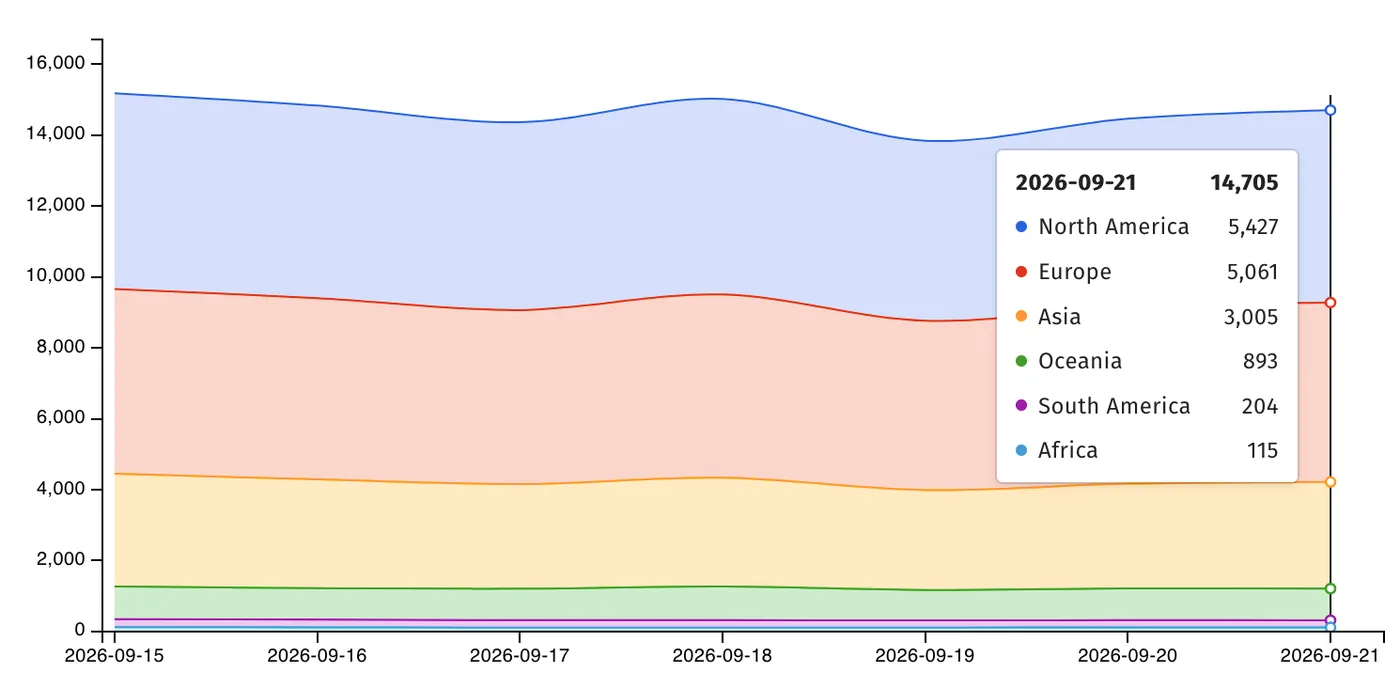
The global exposure of perimeter networking appliances magnifies the potential fallout of this F5 zero-day vulnerability across commercial and government enterprises. Internet threat monitoring non-profit Shadowserver currently tracks more than 14,700 IP addresses exhibiting active BIG-IP APM fingerprints accessible from the public internet. However, Shadowserver emphasized that telemetry data cannot confirm how many of those endpoints have applied hotfixes or serve as deceptive honeypots. Headquartered in Seattle, F5 operates as a Fortune 500 enterprise vendor providing application delivery networking, cybersecurity appliances, and cloud security services to more than 23,000 customers worldwide, a massive client base that includes 48 of the Fortune 50 companies and 80% of the Fortune Global 500. These appliances safeguard critical access paths into financial services, defense contractors, telecommunications operators, and multinational cloud infrastructures [2].
CISA responded to the confirmed exploitation by issuing an emergency binding operational directive requiring federal civilian agencies to secure vulnerable BIG-IP appliances by Friday, September 25 [1]. The cybersecurity agency cautioned that “these types of vulnerabilities are a frequent attack vector for malicious cyber actors and pose significant risks to the federal enterprise” [2]. Federal mandates reflect systemic concern over enterprise edge compromises, where threat actors breach external application gateways to bypass interior firewalls and internal monitoring controls. The federal directive expires Friday [1].
Historical incident tracking by cybersecurity agencies confirms that state-sponsored groups and ransomware syndicates routinely weaponize unpatched F5 enterprise gateways to establish persistent initial access. In October 2025, F5 disclosed that sophisticated state-sponsored cyber espionage operators had breached its corporate networks during August 2025, exfiltrating undisclosed BIG-IP security source code, diagnostic material, and confidential internal vulnerability records. Since November 2021, CISA has added eight actively exploited F5 vulnerabilities to its tracking catalog, with four of those flaws subsequently leveraged by adversaries in destructive ransomware attacks. Once adversaries achieve perimeter execution on BIG-IP devices, they frequently map internal servers, deploy data-wiping malware, and exfiltrate proprietary corporate data. Four flaws enabled ransomware extortion [2].

Forensic Triaging and Defending Against Active Intrusions
Incident responders must conduct rigorous forensic investigations following an F5 zero-day intrusion across exposed BIG-IP appliances rather than assuming a hotfix installation neutralizes active adversaries. European cybersecurity agency CERT-EU advised organizations to preserve volatile system memory and audit logs before applying software updates. F5 established that forensic review is urgently warranted whenever appliances display a specific triad: repeated OAuth authentication failures, followed by suspicious command executions, and culminating in a TMM SIGABRT process crash. Attackers leave distinctive diagnostic signatures [1].
Defenders should examine `/var/log/apm` for failed UserInfo queries showing the error “The access token is invalid,” especially if ten or more requests originate from a single IP address in rapid succession. Running the diagnostic command tmctl global_oauth_stat -s total_requests,total_userinfo_requests,total_failed helps administrators spot suspicious surges in the total_failed metric. Concurrently, security engineers must audit `/var/log/audit` for anomalous administrative commands executed near the timestamps of those OAuth errors. Investigating Traffic Management Microkernel (TMM) core crash files remains vital during forensic response, because unauthenticated exploit payloads force TMM processes into recurring execution loops that prompt the underlying SOD watchdog daemon to send a fatal SIGABRT termination signal. The SOD daemon triggers SIGABRT [1].
Official advisories published by F5, CISA, and CERT-EU omit any guarantee that applying the hotfix revokes footholds an attacker already obtained prior to remediation. Consequently, CISA instructed federal agencies to implement the vendor iRule first to enable proactive forensic triage before completing binary patch installations. If administrative audits uncover unauthorized lateral movement or unexpected credential generation, organizations must immediately initiate complete incident response protocols. Network defenders must isolate suspicious virtual servers to contain potential intrusions while defending perimeter environments from the F5 zero-day attack cycle [1].
- ONLINE NEWS The Hacker News. (2026, September 23). F5 patches critical BIG-IP APM zero-day exploited for unauthenticated RCE on OAuth servers. The Hacker News. [Article Link]
- ONLINE NEWS Gatlan, S. (2026, September 23). F5 patches BIG-IP APM zero-day flaw exploited in RCE attacks. BleepingComputer. [Article Link]
- ONLINE NEWS Lyons, J. (2026, September 23). Someone’s attacking a critical 0-day RCE in F5 BIG-IP APM. The Register. [Article Link]


