



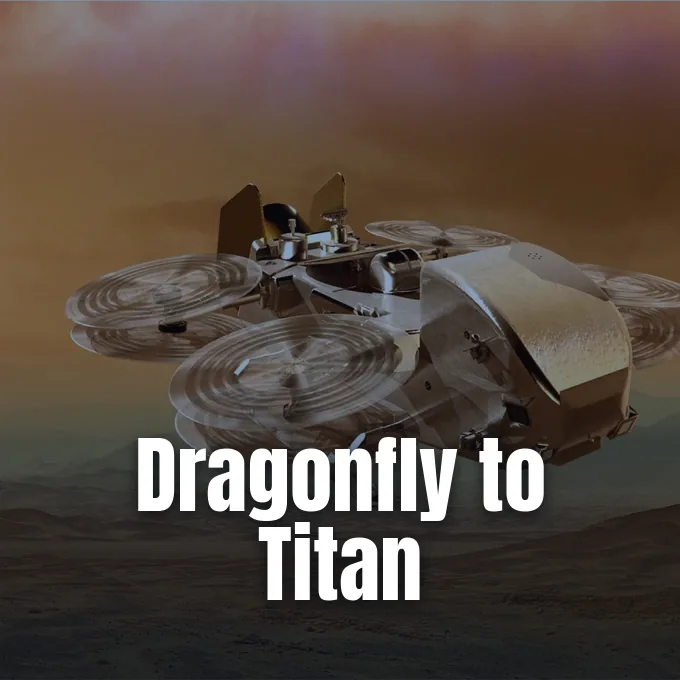
NASA opened a public submission portal allowing people around the globe to send their names to Saturn’s largest moon aboard the Dragonfly mission. Participants can register online to have their names etched onto a microchip that will travel on the rotorcraft during its flight to Titan in 2028. After a journey spanning nearly a billion miles through the outer solar system, the robotic craft will reach the alien moon in late 2034 to examine prebiotic chemistry and diverse surface landscapes. Agency officials confirmed that submissions will remain open until early 2027, giving the public a personal connection to deep space exploration [2].
Public Name Campaign and Boarding Pass Details
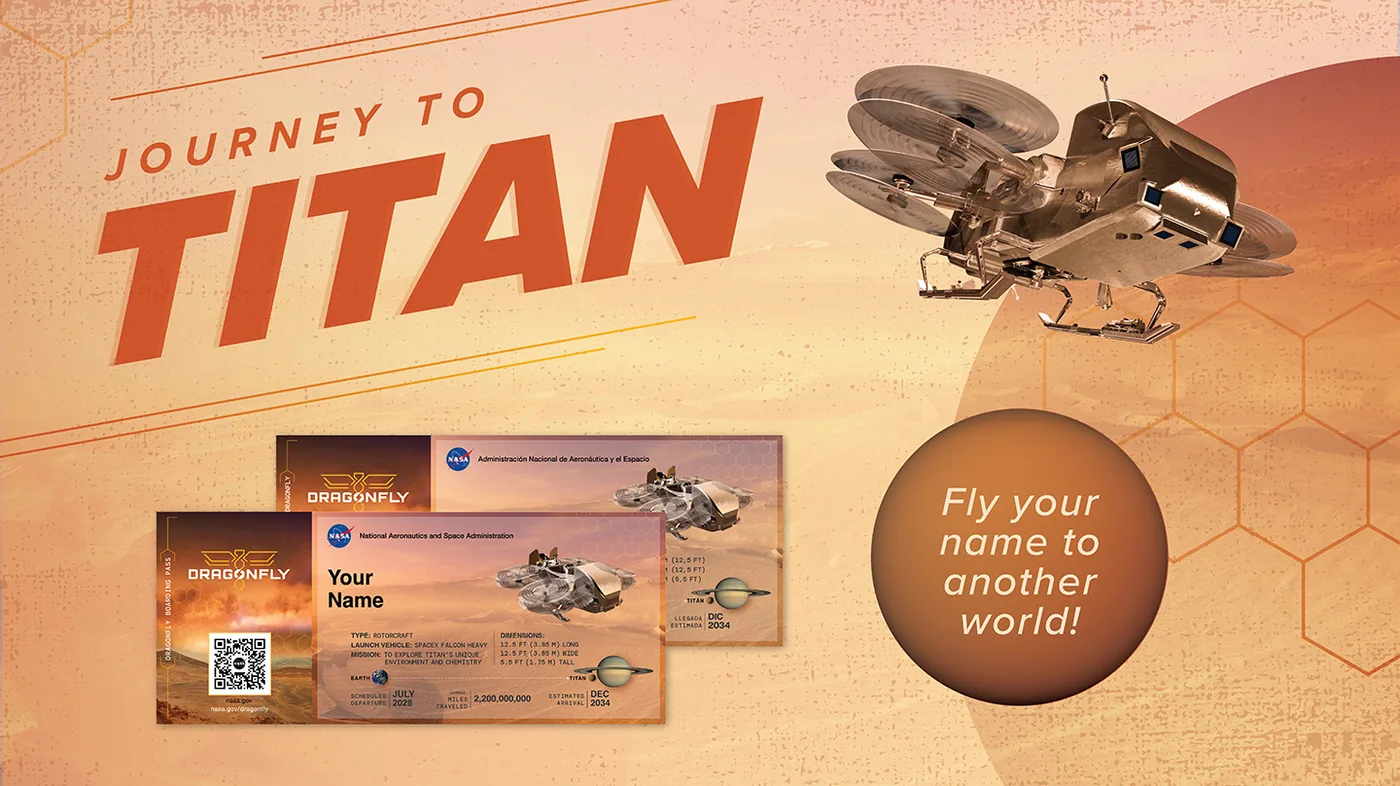
The public registration program runs until Jan. 15, 2027, closing at 11:59 p.m. EST. Anyone entering their details through the web portal receives a personalized digital boarding pass commemorating their inclusion on the flight [3]. The names will be etched onto a microchip mounted to the vehicle during assembly in Maryland. NASA previously organized outreach initiatives for Mars rovers, but this flight represents the first time members of the public can send their names to the surface of an outer planet moon [1].
Agency leaders highlighted the broad appeal of sending names to a world rich in organic material. “NASA’s Dragonfly mission will simply blow your mind,” said Nicky Fox, associate administrator for the Science Mission Directorate at NASA Headquarters [2]. Fox noted that the rotorcraft will search for signs of habitability while traveling over an alien world that shares intriguing physical traits and atmospheric dynamics with early Earth. By inviting global participants, project leaders hope to spark lasting interest in planetary science [4].
The microchip will travel aboard a rotorcraft roughly the size of a standard road vehicle. Engineers will secure the silicon chip within the primary chassis so it withstands launch vibrations and intense atmospheric entry loads [1]. Team members at the Johns Hopkins Applied Physics Laboratory in Laurel are overseeing hardware assembly and schedule milestones. Every accepted entry will remain permanently affixed to the lander after it touches down on Titan [4].

Flight Schedule for the Dragonfly Mission
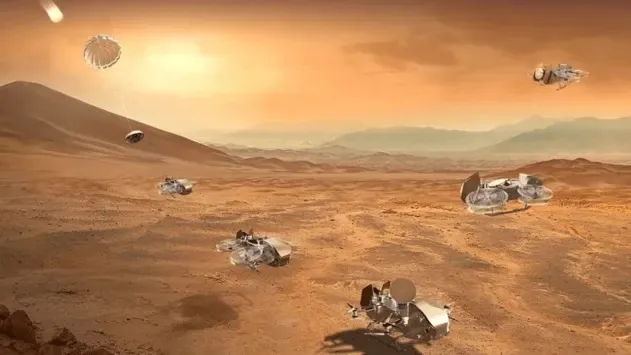
Current flight plans target a launch in 2028, sending the spacecraft on a six-year cruise toward Saturn. The rotorcraft will reach its destination in late 2034, when it will enter the dense atmosphere and deploy parachutes before starting powered flight over the dunes [3]. Mission controllers plan for a baseline surface operation lasting approximately 3.3 Earth years. During that period, the nuclear-powered craft will hop between widely separated landing sites rather than remaining stationary like traditional landers [1].
Flight operations on Titan will follow a schedule dictated by the moon’s rotation rate. One Titan day, known to scientists as a Tsol, lasts approximately 16 Earth days [1]. Dragonfly will make one flight every one to two Tsols, resting between aerial hops to charge systems, run laboratory instruments, and transmit science data back to Earth [3]. This measured cadence ensures the science team can evaluate imagery and telemetry from each landing before selecting the next destination [1].
Rotorcraft flight offers substantial advantages over wheeled rovers on a terrain packed with tall dunes and rough craters. Because Titan’s gravity is about one-seventh that of Earth while its atmosphere is four times denser, flying requires less energy than on any other known world [1]. A single hop can cover miles in minutes. By leaping over obstacles that would halt a ground rover, the craft can sample multiple geological units during its planned operational lifetime [3].

Landing Sites on Titan’s Diverse Surface
Dragonfly will set down initially among the sprawling equatorial dunes of Titan before navigating toward more complex geological targets. These vast dune fields consist of dark hydrocarbon grains rather than quartz sand, shaped by wind currents moving through the thick nitrogen sky [1]. Scientists selected this region because the smooth sand sheets provide a safe touchdown zone for initial operations while still offering direct access to organic compounds deposited from the atmosphere [3].
The primary science destination for later hops is Selk crater, a young impact structure where ancient heat once melted surface water ice into liquid pools. Space scientists are eager to examine Selk because liquid water and complex hydrocarbons may have mixed there for hundreds or thousands of years, creating a natural laboratory for chemical evolution [1]. Samples drilled from the crater floor could reveal whether organic molecules underwent reactions resembling the early stages of terrestrial biochemistry before the impact melt froze [3].
Titan is unique among solar system moons because it possesses a dense atmosphere, rain, rivers, and surface lakes made of liquid methane and ethane. While astronauts prepare for crewed lunar flights under Artemis, robotic craft venture outward to inspect these alien hydrological cycles firsthand. Although Dragonfly will operate far from the polar hydrocarbon seas, its regional flights will document the dynamic interplay between atmospheric haze, seasonal weather, and surface geology [1].



Prebiotic Chemistry and Planetary Habitability Goals
A central objective of the Dragonfly mission is decoding prebiotic chemistry, the sequence of chemical reactions that occurred before biological life emerged on Earth. Titan’s surface preserves a frozen record of carbon compounds bathed in liquid methane and solar ultraviolet radiation, offering an environment that may mirror our planet’s earliest stages. NASA researchers want to find out whether habitable conditions existed on the moon in the past, or if organic synthesis continues to advance beneath the smoggy haze [2]. By collecting drill cuttings and analyzing them with onboard mass spectrometry, the craft will search for chemical biosignatures and determine whether life could develop without abundant liquid water [3].
The rotorcraft carries an integrated suite of scientific instruments designed to inspect surface materials without returning samples to Earth. Drills on the landing skids will extract powdered samples from the regolith and transfer them into an internal analysis chamber [1]. Mass spectrometers and gamma-ray sensors will identify specific elements, amino acids, and aromatic hydrocarbons within each sample. These measurements will help researchers differentiate between simple abiotic mixtures and compounds shaped by pre-biological processing [3].
Investigators also want to test whether water-based or hydrocarbon-based chemical indicators exist in the upper regolith. “Upon arrival in 2034, Dragonfly will fly from place to place on this intriguing world to uncover clues about this remarkable moon, and the chemistry that could help us understand the ingredients for life,” agency officials said in mission documentation [1]. Such findings will help planetary scientists assess whether Titan’s deep subsurface ocean might support habitable niches beneath miles of solid water ice [2].
Avionics Testing at Johns Hopkins APL
Design, construction, and testing of the rotorcraft are centered at the Johns Hopkins Applied Physics Laboratory in Laurel, Maryland. On Oct. 23, 2026, engineers achieved a key development milestone by completing Dragonfly’s first simulated flight on a computer testbed [3]. The simulation evaluated flight software running in real time on flightlike avionics, verifying control algorithms that will guide the lander through Titan’s atmosphere without human intervention [4].
Because radio signals take over an hour to travel between Saturn and Earth, autonomous navigation is vital for safe landings. Principal investigator Zibi Turtle of APL leads the science and engineering team through this intensive integration phase [2]. “Dragonfly is a mission of discovery, and we want everyone to share in this adventure,” Turtle said during recent project updates [4]. Her team uses high-fidelity simulation testbeds to rehearse complex flight scenarios, potential sensor dropouts, and gusty atmospheric winds before hardware integration finishes at the Maryland facility [3].
Dragonfly represents the fourth project selected under NASA’s New Frontiers Program, which funds medium-class planetary exploration initiatives. The program is managed by NASA’s Marshall Space Flight Center in Huntsville, Alabama, for the Science Mission Directorate, which also oversees university collaborations such as NASA Space Grant campus flight research in multiple states. Selected in 2019, Dragonfly joins an elite portfolio of planetary probes tackling foundational questions about our solar system [2].
How the Dragonfly Mission Builds on Past Exploration
Dragonfly follows a remarkable legacy of robotic exploration at Titan initiated by the Cassini-Huygens mission two decades ago. The European Space Agency’s Huygens probe landed on the moon on Jan. 14, 2005, after detaching from NASA’s Cassini orbiter. Huygens transmitted data for several hours from the frozen ground, recording detailed atmospheric profiles and returning the first clear surface photographs of the outer solar system. Cassini continued operating in orbit until September 2017, completing over 100 close flybys of Titan to map its topography and surface lakes with radar [1].
Atmospheric flight on other worlds began with the Ingenuity mini-helicopter, which arrived on Mars in 2021 with the Perseverance rover. Originally planned for just five technology demonstrations, Ingenuity completed 72 flights before sustaining rotor blade damage on Jan. 18, 2024. The Mars helicopter proved that controlled aerodynamic flight is possible in thin air, paving the way for future aerial concepts like NASA’s proposed SkyFall mission that could send three rotorcraft to Mars as early as 2028 [1].
Dragonfly expands this aerial lineage into the outer solar system with a larger, nuclear-powered platform designed for sustained scientific work. By combining mobility over diverse terrains with comprehensive laboratory analysis, the craft will spend years exploring questions that began when Cassini first glimpsed Titan’s veiled surface [1]. Through the public name campaign, members of the public can join this scientific journey, securing their own place on the microchip before the 2027 deadline [2].
- ONLINE NEWS Howell, E. (2026). Send your name to Saturn’s moon Titan with NASA’s upcoming Dragonfly mission. Space.com. [Article Link]
- PRESS RELEASE Taveau, J. (2026). Send Your Name to Titan Aboard NASA’s Dragonfly Mission. NASA. [Article Link]
- ONLINE NEWS Bland, C. (2026). Send your name to Saturn’s moon Titan aboard NASA’s Dragonfly. Yahoo Tech. [Article Link]
- PRESS RELEASE Buckley, M. (2026). Send Your Name to Titan Aboard NASA’s Dragonfly. Johns Hopkins University Applied Physics Laboratory. [Article Link]
APA 7: PerEXP Teamworks. (2026, November 8). NASA Dragonfly Mission Invites Public Names for Titan Flight. PerEXP Teamworks. https://perexpteamworks.com/en/dragonfly-mission-public-names-titan/


