





College engineering teams are stepping into flight work through the NASA Space Grant network [1]. During recent campus stops led by NASA Administrator Jared Isaacman, student teams showed balloon packages, small satellites, and lunar soil tools designed to support upcoming agency missions. These multi-state university visits connected campus labs in Iowa, Arizona, Alaska, and North Dakota with agency teams preparing for long-term Moon Base and Artemis operations [5]. State programs give students early access to flight hardware while helping NASA build its engineering workforce [2].
Iowa State Mining and Satellite Teams
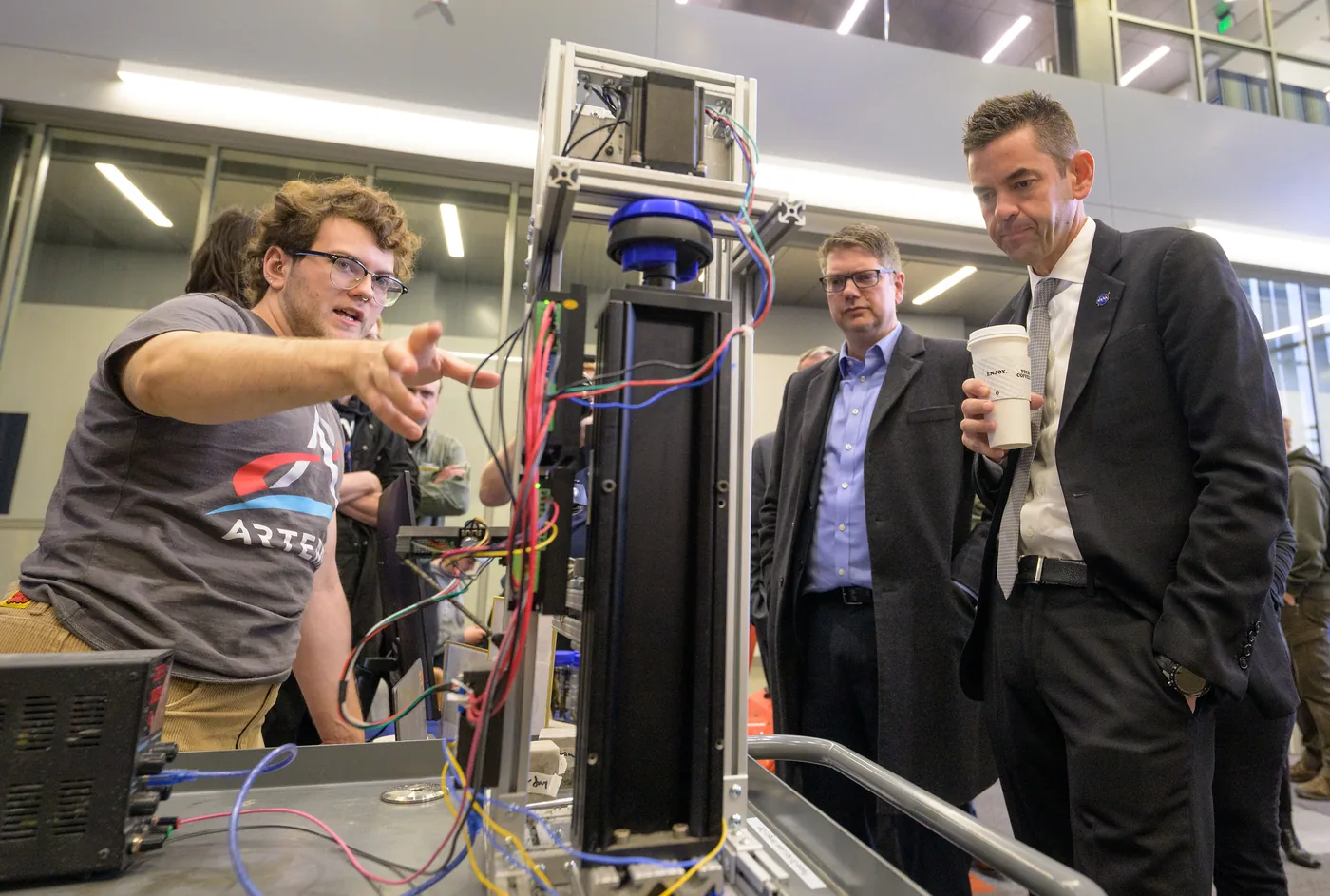
At Iowa State University, Administrator Isaacman toured the Make to Innovate lab, where student teams build working flight gear for agency review. Students in the Mission Moon program shared project data with visiting officials and three consortium-funded student clubs. The student groups include Cardinal Space Mining, CySat, and CyLaunch. Cardinal Space Mining showed prototype excavation tools, while CySat and CyLaunch demonstrated small satellite hardware and student rocket systems designed to survive harsh space environments during flight. Bench tests let student crews spot flaws and fix control code before formal agency evaluations. Hands-on lab work helps students solve manufacturing problems under real spaceflight limits. Isaacman inspected each student rig during the lab tour [1].
The Iowa visit included an open town hall where agency specialists briefed students on Moon Base plans and lunar surface systems. Sara Nelson, director of the Iowa Space Grant Consortium, spoke about the value of hosting NASA heads on campus. “We’re grateful for the opportunity to welcome NASA leadership to Iowa State,” Nelson said. “The excitement among students was incredible, and the visit highlighted how the research and innovation happening in Iowa can help advance Artemis and NASA’s future exploration efforts.” [1]
Agency programs often link student teams with Moon exploration goals. Related educational tracks include NASA SEES interns modeling lunar propellant for future Artemis surface landings. Modeling at Iowa State gives students practical bench experience that supports those lunar goals [1]. Early hardware builds prepare students for aerospace careers [4].
NASA Space Grant Teams in Arizona
At the University of Arizona, Isaacman reviewed space research and optical systems backed by the Arizona Space Grant Consortium. Students at the Tucson campus run tests on satellite communications and build custom optics to peer into deep space [1]. The University of Arizona has built a long record of contributing to agency programs through student-built high-altitude balloon payloads and small satellites that fly to the edge of space [4]. During the stop, Isaacman met high school and college students in an open question-and-answer session about flight timelines, payload integration, and upcoming careers across the aerospace sector. Student engineer Ella Miller, a junior studying mechanical engineering at the University of Arizona, presented balloon research conducted by SEDS (Students for the Exploration and Development of Space) to Isaacman and visiting NASA staff [1].
“It was incredible to present the high-altitude ballooning research we do in SEDS (Students for the Exploration and Development of Space) to Jared Isaacman and those at NASA,” Miller said [1]. SEDS teams documented payload stability, battery levels, and temperature swings during stratospheric ascents [4]. Miller showed balloon data to Isaacman [1].
Miller explained how regular flight projects guided her career path. “Arizona Space Grant has allowed me to get hands-on experience through an entire mission design process every semester, helping me pursue a career in space research and secure internships in this field,” Miller said [1]. Full payload design teaches students how to track mass budgets, power draws, and sensor calibration [4]. That lab experience leads students to internships at NASA centers and industry contractors [2].

Sounding Rockets at Poker Flat
The Alaska tour stop brought agency heads to the University of Alaska Fairbanks, where Isaacman toured two sites run by the university Geophysical Institute. The itinerary featured the sounding rocket site at Poker Flat Research Range, along with tracking dishes at the Alaska Satellite Facility [1]. Poker Flat serves as a scientific launch range for sounding rockets that carry instruments into the upper atmosphere and northern auroral zones. Ground antennas at the satellite facility download synthetic aperture radar images and telemetry from polar-orbiting spacecraft, giving students practical experience with Earth observation and ground station upkeep [2]. Students help track telemetry while studying how orbital sensors document polar terrain [1]. Poker Flat hosts sounding rocket launches [2].
During an Alaska Space Grant science fair, students shared projects from several scientific fields [1]. Teams showed new CubeSat technology, demonstrating how compact satellites carry experimental sensors into orbit at low cost [2]. Other students presented research on animal hibernation biology, studying metabolic drop mechanisms that could aid astronaut health on long space voyages. Students also asked Isaacman about Moon Base jobs [1].
Atmospheric Imaging at North Dakota
At the University of North Dakota, student fellows and NASA interns shared research on future spaceflight tools and atmospheric science. Student groups used satellite imagery to analyze supercell mergers, tracking how severe storm clouds form and grow [1]. Other students investigated the geomagnetic conditions of the aurora borealis, looking at how solar particle events disturb high-latitude communications and radio signals during major solar storms [4]. Campus labs also presented work on in-situ resource utilization, testing chemical methods to extract water, oxygen, and structural metals from lunar and Martian dirt to support surface outposts. Testing soil analogs on campus lets students measure extraction output before flight hardware is built [1]. These projects show how student fellowships tackle real agency research problems [2].
Student ambassadors also ran robotics and drone events under the statewide Mission Moon initiative, linking educators and schools across North Dakota. Research fellow and STEM ambassador Malissa Reinhardt spoke with Isaacman about student projects. “Getting to speak with the NASA Administrator was an amazing opportunity!” Reinhardt said. “He genuinely cared about what we students had to say and the research we’re working on, which makes all the hard work we put into our research and North Dakota Space Grant Consortium so rewarding.” [1]

Statewide partnerships allow students to test drones and rovers in rugged outdoor settings [1]. Outdoor tests help students improve rover control before entering student fly-offs [2]. Agency programs also support student inventors through challenges like the NASA ORBIT Challenge for student inventors. State teams test drones in field trials [1].
How NASA Space Grant Consortia Train Engineers
How do university partnerships prepare students for the aerospace workforce? The national network of NASA Space Grant consortia links colleges with agency centers, funding student teams that design hardware from initial sketch to test flight over multiple academic terms [1]. Student team placements turn campus workshops into training centers for future space missions. Undergraduates gain hands-on practice with sensor wiring, thermal tests, and flight reviews that match NASA rules. Academic consortia also connect students directly with space contractors seeking trained recruits. Student teams also shared research into lunar spacesuits, CubeSats, and robotics designed for surface deployment, highlighting recruitment pathways for upcoming agency flights and Artemis missions. Building flight hardware gives students strong portfolios for job interviews [2].
Visits to Iowa, Arizona, Alaska, and North Dakota proved that early lab grants keep students enrolled in STEM degrees [3]. The Space Grant model brings public, industry, and campus partners together to back American space leadership [1]. Early funding builds lasting campus engineering teams [5]. State programs support young inventors [3].

NASA officials stress that returning to the Moon requires a steady flow of trained engineers and scientists [1]. Grant awards give students the tools and lab space needed to study advanced space disciplines [4]. When students work on lunar robotics alongside agency scientists, they learn practical skills that textbooks don’t teach [1]. These university programs ensure that incoming engineers arrive ready for Artemis flight programs [2].
The MAX POWER Showcase
Agency heads planned the tour to conclude with MAX POWER on Nov. 7 and 8, creating an open showcase for flight technology. The event highlights NASA’s goal to train students for what leadership calls a “Golden Age of innovation and exploration”. The public event brings student inventors, researchers, and flight companies together to display systems that will support humanity’s next giant leap into space during upcoming deep-space voyages [1]. Visitors will see student CubeSats, rovers, and balloon sensors built on campuses nationwide [2]. Public exhibits give student crews a chance to explain their designs to aerospace leaders. MAX POWER opens on Nov. 7 [1].
From high-altitude balloons in Arizona to rocket launches in Alaska, campus researchers show their value to national space programs [1]. Student teams deliver flight-tested hardware while mastering space science [4]. Campus partnerships ensure that America’s future in space starts in student labs [1].
- PRESS RELEASE NASA STEM Team & May, S. (2026, November 4). NASA Space Grant Students Fuel Agency’s Inspiration Tour. NASA. [Article Link]
- ONLINE NEWS Leo Space Editorial. (2026, November 4). NASA Space Grant Students Showcase Research During Inspiration Tour Stops. Leo.space. [Article Link]
- ONLINE NEWS Worldnewsdotcom. (2026, November 4). NASA Space Grant Students Fuel Agency’s Inspiration Tour. WN.com. [Article Link]
- ONLINE NEWS Mirage News. (2026, November 4). NASA Space Grant Students Power Inspiration Tour. Mirage News. [Article Link]
- ONLINE NEWS ShortSingh. (2026, November 4). NASA Space Grant Students Join Agency’s Inspiration Tour Across the Country. ShortSingh. [Article Link]
APA 7: PerEXP Teamworks. (2026, November 5). NASA Space Grant Students Present Flight Research on Campus. PerEXP Teamworks. https://perexpteamworks.com/en/nasa-space-grant-student-research/


