






NASA has selected SpaceX to provide commercial launch services for the agency’s StarBurst mission, sending an agile small satellite into low Earth orbit to investigate the violent physics driving extreme cosmic collisions. Can compact orbital detectors pinpoint the precise source of sudden energetic flares before their signals fade into the cosmic background? The spacecraft targets short gamma-ray bursts (brief flashes of high-energy light) generated during catastrophic neutron star mergers. Under the newly awarded task order, the satellite will launch from Florida aboard a Falcon 9 rocket no earlier than 2028 [1].
StarBurst Mission Launch on Falcon 9
SpaceX will provide commercial launch services for the small satellite under a firm-fixed-price task order finalized by NASA. The flight will lift off from Space Launch Complex 40 at Cape Canaveral Space Force Station in Florida, delivering the astrophysics instrument directly toward its designated operational orbit without requiring dedicated booster hardware. Agency managers scheduled the liftoff no earlier than 2028 to align the payload integration cycle with broader program milestones. NASA designated the astrophysics payload as a ride aboard a commercial *Bandwagon* rideshare flight, maximizing the cost-efficiency of orbital delivery while maintaining strict schedule alignment with partner research institutions [1].
SpaceX will oversee the launch. The mission flies in 2028. Liftoff occurs from Cape Canaveral Space Force Station [2].
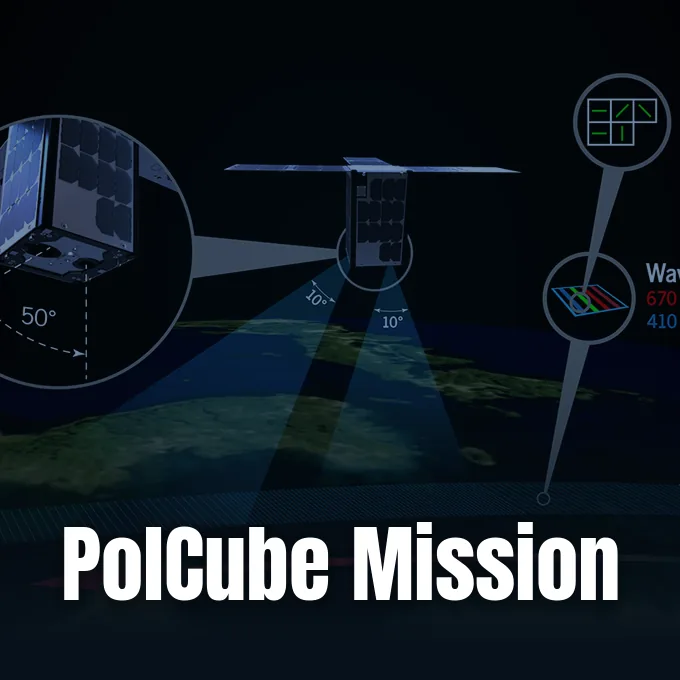
Commercial rideshare missions aggregate multiple independent payloads onto a single heavy rocket, allowing smaller science investigations to reach orbit without purchasing an entire dedicated booster at substantial expense to public research programs. By sharing the substantial lift capacity of a Falcon 9 vehicle, smaller instruments gain dependable access to space at a fraction of standard dedicated launch expenses across multi-year development cycles. This shared launch framework mirrors operational models across modern orbital research, much like how the PolCube mission maps Earth’s atmosphere and oceans through targeted small satellite technology operating in synchronized orbits. Operating as a secondary payload requires the StarBurst mission team to conduct careful structural modeling, strict vibrational testing, and coordinated separation sequencing during deployment. Once deployed from the booster’s second stage in orbit, the satellite will initiate automated stabilization procedures and prepare its primary detector arrays for continuous sky monitoring across designated astronomical sectors [1].
SpaceX Rideshare Architecture Under VADR
NASA secured the SpaceX launch order through the VADR contract vehicle, an acronym denoting the Venture-Class Acquisition of Dedicated and Rideshare program designed to foster commercial aerospace partnerships for scientific research. This acquisition structure streamlines procurement for small satellites by adopting commercial contracting standards and competitive task orders. The procurement strategy reduces regulatory overhead for missions that accept higher operational risk profiles than flagship orbital observatories. By pairing small astrophysics instruments with commercial launch providers, NASA accelerates the development cadence of experimental missions [1].
The underlying VADR agreement functions as an indefinite-delivery/indefinite-quantity (IDIQ) contract across its operational lifetime. The underlying structure allows NASA to acquire commercial launch services across a 10-year ordering period, establishing a maximum total cumulative value of $1 billion across all awarded task orders to diverse aerospace vendors [2]. Multiple commercial aerospace vendors compete under this umbrella agreement to secure specific orbital transport contracts. StarBurst represents one of several specialized science missions leveraging this competitive framework for rideshare access.
Small spacecraft require adaptive launch solutions that match constrained project budgets without sacrificing orbital precision. Firm-fixed-price task orders protect agency resources by establishing firm financial commitments before payload integration commences. Achieving budgetary predictability enables astrophysics teams to concentrate engineering resources directly on instrument calibration and flight software validation rather than contending with fluctuating commercial launch expenditures during mission integration. The StarBurst mission benefits directly from this predictable acquisition architecture, locking in commercial launch services years ahead of its scheduled 2028 deployment window from the Florida spaceport [1].
Detecting Short Gamma-Ray Bursts From Orbit
The primary operational goal of the StarBurst satellite centers on detecting intense high-energy explosions originating across deep space. Engineers designed the orbiting observatory to monitor the entire portion of the sky not blocked by the physical bulk of Earth, ensuring continuous coverage across previously unmapped celestial sectors [1]. This extensive field of view guarantees that fleeting bursts occurring in unmapped celestial coordinates do not escape scientific detection. Orbiting above atmospheric absorption layers gives the detectors unhindered access to high-energy photons.
Gamma-ray bursts represent the most luminous electromagnetic events known in the universe. Timing is critical during these explosions. Short gamma-ray bursts emit the vast majority of their high-energy radiation in brief, energetic pulses. Because these cataclysmic events terminate almost instantly, the orbital detector must capture the initial high-energy emission the exact moment photons strike the sensor array to trigger automated ground alerts [2]. Immediate automated detection permits rapid notification to astronomical networks worldwide.
Observing high-energy transient events requires broad scientific context to understand how cosmic particles accelerate through extreme gravitational fields. High-energy astrophysical processes often connect across distinct particle spectra, as demonstrated when researchers analyzed how cosmic ray electrons traced back to nearby sources shed light on local galactic accelerators operating in interstellar magnetic fields. For the StarBurst mission, rapid photon registration allows astrophysicists to catalog energetic outputs and establish baseline characteristics for violent merger events. Identifying the onset of gamma-ray emission unlocks critical clues about relativistic jets bursting from newborn black holes [1].

Neutron Star Mergers and Multimessenger Astronomy
Short gamma-ray bursts originate primarily when dense stellar remnants called neutron stars collide and merge. Neutron stars pack immense matter. These ultra-dense stellar remnants form when massive stars exhaust their nuclear fuel and undergo gravitational collapse. When such remnants spiral inward and collide, the resulting impact unleashes extreme relativistic shockwaves. The ensuing explosion synthesizes heavy elements while releasing enormous quantities of prompt gamma radiation into surrounding space [1].
Studying these cataclysms demands an observational approach known as multimessenger astronomy. Signals arrive across vast distances. How do researchers confirm that a faint burst of gamma rays corresponds to a specific collision across the distant universe? Scientists achieve empirical verification by synchronizing orbital electromagnetic readings with gravitational-wave measurements recorded by ground-based interferometers to determine the physical properties of colliding stellar bodies across cosmic distances [2]. Gravitational waves represent ripples in the fabric of spacetime produced as dense masses whirl toward impact.
The StarBurst mission will provide the prompt gamma-ray alerts needed to mobilize ground telescopes for extensive follow-up observations across optical, infrared, and radio wavelengths before fading occurs [1]. Observatories require immediate celestial coordinates to track the expanding glow produced by radioactive decay in the merger debris. Combining distinct signals (gravitational waves, gamma rays, and longer electromagnetic wavelengths) builds a complete physical portrait of the collision. Without rapid spaceborne detection, ground facilities often miss the earliest phases of the explosion.
Astrophysics Pioneers Program and Cost Limits
StarBurst represents an official component of NASA’s Astrophysics Pioneers Program, an agency initiative created to foster innovative scientific research using small spacecraft platforms, scientific balloons, and CubeSat technologies. Small spacecraft lower operational expenses. The program purposefully targets compelling scientific questions that can be answered using small satellites rather than billion-dollar observatories. By capping total mission expenditure at modest financial thresholds, the agency encourages targeted experimental concepts that test fresh instrumentation while providing vital observational capabilities to the global scientific community [1].
Can focused, lower-cost missions successfully deliver breakthrough insights in modern astrophysics? Experience demonstrates that specialized detectors operating within targeted frequency ranges frequently outperform massive general-purpose observatories in scanning agility. The StarBurst mission embodies this targeted philosophy by concentrating exclusively on short gamma-ray bursts rather than attempting broad multi-wavelength surveys. Restricting mission scope shortens development timelines and minimizes overall technical complexity during construction [2].
The success of small astrophysics platforms depends heavily on the availability of frequent commercial launch opportunities. Frequent flights provide dependable access. When rideshare missions launch regularly, scientific teams can plan payload delivery schedules with greater confidence and lower financial overhead. By utilizing commercial Falcon 9 flights, small satellite programs avoid the extended delays that historically accompanied specialized dedicated booster procurement. This operational alignment between commercial launch capacity and scientific innovation underpins NASA’s long-term small spacecraft strategy [1].
Kennedy Space Center Manages Flight Delivery
Contractual execution and mission integration for the StarBurst mission fall under the direct supervision of NASA’s Launch Services Program Office. Stationed at Kennedy Space Center in Florida, the program office administers the VADR contract mechanism and oversees commercial vehicle compliance. Engineers at Kennedy Space Center will coordinate directly with SpaceX technical teams to verify payload adapter interfaces, environmental qualification standards, and launch range safety protocols prior to liftoff [1]. This institutional oversight ensures that commercial rideshare operations meet strict mission success criteria.
Agency communication channels coordinate program activities between regional space centers and national headquarters. Project management at NASA Headquarters in Washington involves Joshua Finch and Jimi Russell (reachable at telephone 202-358-1100), who coordinate broader public and institutional engagement for astrophysics announcements across the agency. At Kennedy Space Center in Florida, Leejay Lockhart (telephone 321-747-8310) leads launch communication operations for the VADR program. Maintaining centralized communication across centers guarantees transparent oversight as the mission progresses toward its 2028 target date [1].
As launch preparations advance toward 2028, engineering teams will complete final instrument calibration and sensor assembly at partner facilities. The StarBurst satellite will undergo rigorous thermal vacuum testing to confirm that its gamma-ray detection modules withstand the harsh thermal cycling and ionizing radiation environment characteristic of low Earth orbit [2]. Once delivered to Space Launch Complex 40 at Cape Canaveral, technicians will mount the spacecraft onto the Falcon 9 payload stack. The upcoming StarBurst mission will stand ready to capture the briefest, most powerful explosions in the cosmos.
- PRESS RELEASE Taveau, J. (2026, September 17). NASA Awards Launch Services for StarBurst Gamma-Ray Detector. NASA. [Article Link]
- ONLINE NEWS Eurasia Review. (2026, September 17). NASA Awards Launch Services For StarBurst Gamma-Ray Detector. Eurasia Review. [Article Link]
APA 7: TWs Editor. (2026, September 18). NASA Selects SpaceX Falcon 9 for StarBurst Mission. PerEXP Teamworks. https://perexpteamworks.com/en/starburst-mission-spacex-falcon-launch/


1 comment