





A Trusted Platform Module is a secure cryptoprocessor that creates, stores, and shields keys behind a hardware barrier [15]. By keeping private key portions separated from OS memory, the chip prevents malware from stealing logins or altering system files [3]. Modern PCs depend on this anchor to ensure that the early boot path stays intact before unlocking encrypted drives [4].
Device Identity at Startup
The main job of a Trusted Platform Module is to confirm whether a PC behaves as intended from the first electrical pulse [15]. David Weston, who directed enterprise and OS security at Microsoft, said that the purpose of the chip is “to protect encryption keys, user credentials, and other sensitive data behind a hardware barrier so that malware and attackers can’t access or tamper with that data” [2]. While typical operating systems handle crypto in software memory where malware can inspect running tasks, a hardware module operates independently through its own firmware and logic circuits. Because the CPU talks to the chip over a motherboard bus, private key material stays isolated from software bugs. Memory rootkits cannot read these secrets [3].
Each compliant chip carries a factory-burned Endorsement Key. This unalterable identity pairs with a True Random Number Generator that supplies entropy for key generation and session tokens. A 2010 preprint study by Alin Suciu and Tudor Carean at Cornell University’s arXiv repository, which did not undergo formal peer review, benchmarked generator output across multiple chips and found that vendors mix hash values with thermal noise and clock jitter. These internal noise sources prevent outside software from predicting or duplicating keys generated on the chip [1].
Industry coordination began under the Trusted Computing Group, a consortium including AMD, Hewlett-Packard, IBM, and Intel. The first deployment rolled out in 2003 as version 1.1b before formalizing into the TPM Main Specification Version 1.2. The International Organization for Standardization and the International Electrotechnical Commission later approved this standard as ISO/IEC 11889:2009 [15].
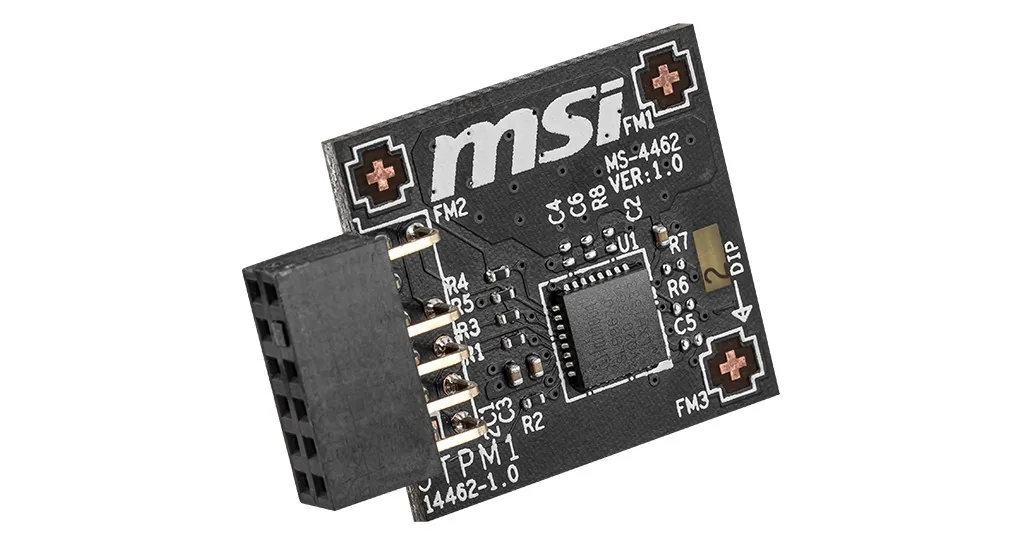
Trusted Platform Module Storage Architecture
Inside the chip perimeter, the Storage Root Key acts as the master wrapping key that never leaves non-volatile memory. When the OS creates secret files, the module generates a key and wraps it so only the silicon can open it. This binding keeps private keys away from users, background apps, and rogue code. The module never exposes private keys in plain text [3]. Applications request crypto calculations through standard APIs, but math runs on isolated logic gates, stopping memory dumps from scraping data during live sessions [4].
Sealing ties decryption to specific platform state checks stored in slots called Platform Configuration Registers [16]. If firmware setup changes or an unapproved bootloader runs, hash values shift and the chip refuses to unseal secrets [3], [15]. Full disk encryption tools lock data until authentic system state is restored [3].
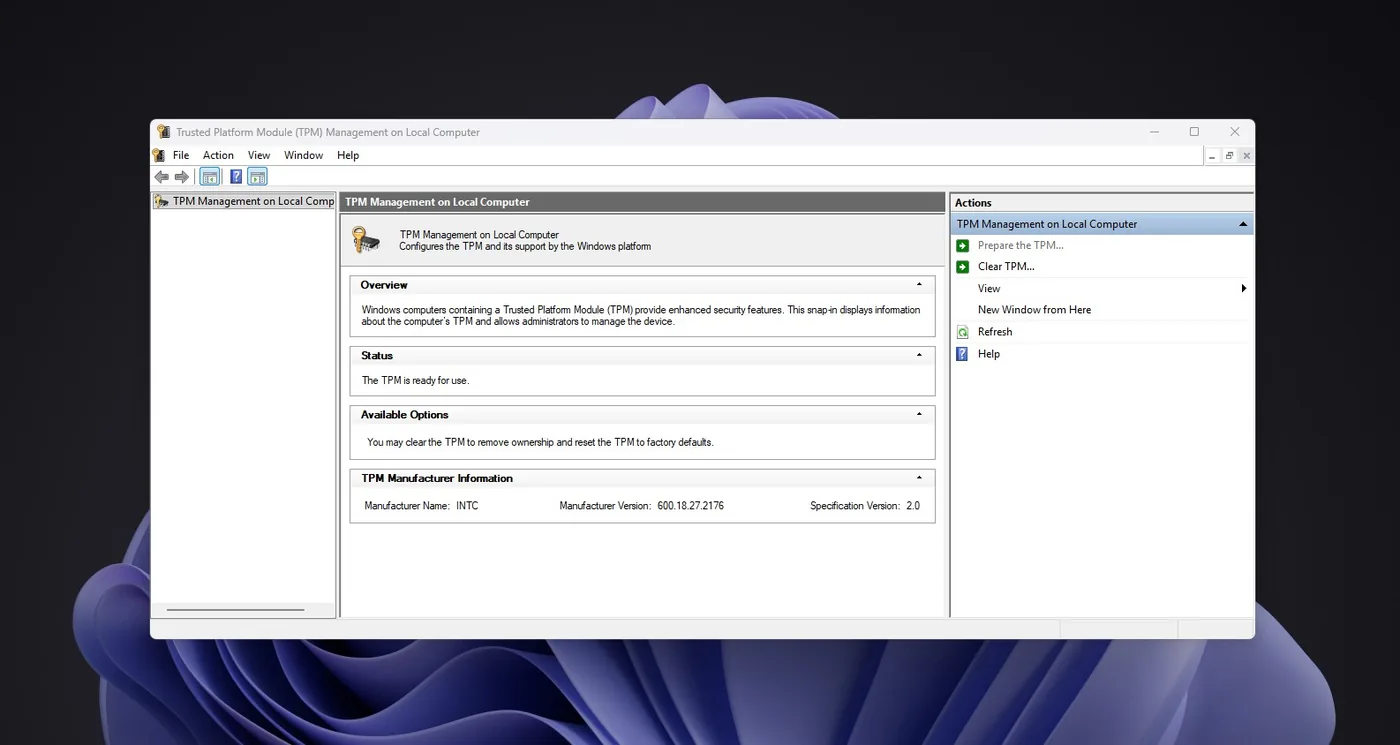
Administrative setup on Windows platforms uses the TPM Base Services layer so apps can share crypto resources cleanly. IT staff can configure settings through the native management console by running tpm.msc from a Run prompt. Clearing the module wipes all stored secrets, preventing old corporate data from being recovered when an OEM PC is recycled [3].
Boot Integrity Measurements
Establishing trust requires an unbroken chain of checks from initial power reset. Intel Trusted Execution Technology, also known as Intel TXT and developed under the codename LaGrande Technology, relies on the module to measure software before execution. The sequence starts with a Static Root of Trust for Measurement at system reset. The CPU measures an Authenticated Code Module from the chipset maker, checks its digital signature, and extends that hash into register PCR0 [16].
Register extension blends the existing register content with the new measurement hash and replaces the slot with the resulting digest. Modifying any component breaks the chain. System firmware logs option ROMs into PCR2 and PCR3, stores host setup in PCR1, and hashes initial bootloader code into PCR4. If a rootkit tampers with startup files, final register values will not match known baseline measurements, alerting the system to unauthorized modifications before sensitive data can be unlocked [16].
Dynamic trust chains allow the OS to launch secure zones long after boot completes. By issuing special CPU instructions, the platform triggers a Dynamic Root of Trust for Measurement that resets dynamic registers PCR17 through PCR22. The CPU measures a signed component called the SINIT ACM to verify Launch Control Policy rules set by the platform owner. This dynamic check lets secure hypervisors and isolated OS kernels run safely, shielding system memory from compromised drivers or rootkits [16].
Differences Between TPM 1.2 and TPM 2.0
Moving from legacy version 1.2 to the modern standard brought major crypto agility and flexible authorization rules [4]. Although version 1.2 hardware first arrived in 2011, IT teams deployed the silicon almost exclusively on managed business desktops [2]. While version 1.2 supported only RSA and SHA-1, the TPM 2.0 standard supports newer crypto algorithms to speed up drive signing and key creation. Moving away from SHA-1 became necessary in the technology industry after the National Institute of Standards and Technology mandated SHA-256 for federal agencies in 2014, prompting Microsoft and Google to discontinue SHA-1 certificates in 2017 [4]. The Trusted Computing Group published this library specification in April 2014, and ISO approved it as ISO/IEC 11889:2015 [8], [9].
Unlike its predecessor, TPM 2.0 is not backward compatible and requires computers to run native UEFI firmware without legacy BIOS Compatibility Support Modules [4]. The library standard also redesigned authorization policies by adding flexible policy trees. Administrators can combine authorization rules with logical operators, demanding both digital signatures and user presence before unlocking secrets [15]. The Trusted Computing Group maintains ongoing revisions, reaching library version 184 in March 2025 and issuing version 185 errata in March 2026 [9], [15].
Lockout rules against dictionary attacks also changed between revisions. Legacy version 1.2 allowed hardware OEMs to set their own lockout policies, producing uneven defense against brute-force password guessing. In contrast, the newer specification lets Windows manage lockout thresholds directly, providing consistent dictionary attack protection among PC brands like Dell, HP, Lenovo, and ASUS [4], [15].


Discrete, Integrated, or Firmware Chips
Hardware security modules are manufactured in three main forms: discrete chips, integrated chipsets, and firmware implementations. A discrete module is a standalone silicon package soldered to the board, communicating over a Low Pin Count or Serial Peripheral Interface bus [4],. Discrete chips achieve FIPS-140 level 3 tamper resistance, making them standard in defense and corporate hardware certified by vendors like Infineon, Nuvoton, and STMicroelectronics [15]. Standalone chips add manufacturing cost, prompting OEMs to adopt integrated options for thin consumer laptops [4].
Integrated and firmware designs eliminate extra motherboard chips by running security logic inside the main CPU [4]. Intel provides firmware security through Platform Trust Technology on Core Ultra processors, while AMD incorporates firmware capabilities into its Platform Security Processor on Ryzen chips [2],. Qualcomm similarly embeds trusted execution logic inside its Snapdragon silicon [6]. Microsoft takes no official preference between implementation styles, stating that Windows handles any compatible module in the same way [4]. This flexibility allows mainstream laptops to meet platform security rules without separate chips [2].
Microsoft unveiled its Pluton security processor in November 2020 alongside chip partners to eliminate motherboard bus sniffing. While Pluton was initially designed to emulate a full Trusted Platform Module, Microsoft updated its technical guidance in late 2026 to change how upcoming PCs operate. Starting with 2026 silicon, Pluton no longer serves as the module on new AMD and Qualcomm PCs, returning that role to vendor firmware or discrete chips. Pluton remains present for other platform security tasks, but processor firmware updates from OEMs must now deliver any future cryptographic patches. Early adoption also met hurdles: Lenovo turned off Pluton on its 2022 Ryzen 6000 ThinkPads out of the factory, while open-source operating systems waited until developer Matthew Garrett brought compatibility patches into Linux kernel 6.3 [6].

Windows Features That Rely on TPM Silicon
When Microsoft unveiled Windows 11 in June 2021, the OS established version 2.0 compliance as a mandatory requirement. Microsoft reported from its Security Signals survey that 83 percent of surveyed businesses had experienced a firmware attack, yet only 29 percent allocated resources to protect that layer. With more than 1.3 billion Windows 10 machines in active use worldwide at that time, Microsoft sought to enforce hardware isolation for all certified PCs. The sudden enforcement caused confusion because many consumer motherboards shipped with firmware security turned off in BIOS menus [2].
Core Windows features depend on hardware security to protect secrets [4]. BitLocker uses the chip to seal volume encryption keys, ensuring drives stay locked if moved to another PC [3]. Windows Hello stores facial data and PINs on the chip, shielding sign-ins from memory scrapers. Secure Boot works in tandem with Measured Boot to log early launch stages. System maintenance remains necessary: Microsoft released an emergency patch to stabilize Windows 11 platforms encountering operational flaws. In corporate setups, Credential Guard and System Guard use dynamic measurements to isolate authentication tokens, preventing memory theft attacks from compromising domain logins [4].
Hardware links can cause friction when physical components fail. Dell documentation reports that after a technician replaces a motherboard, users may see error 80090016 in Microsoft Outlook and Microsoft 365 apps. This error occurs because cached authentication broker tokens in Windows still look for the original keys from the old chip. Fixing the issue requires clearing old token folders or re-registering the PC in Microsoft Entra ID [11]. In addition, special exceptions exist: custom Windows images shipped to China and Russia can waive module requirements where local laws restrict foreign crypto chips [10].
Physical Probing and Sleep Exploits
Laboratory access can expose security chips to invasive micro-probing techniques. At the Black Hat 2010 conference, researcher Christopher Tarnovsky demonstrated an attack against an Infineon security chip used in devices like the Xbox 360. By removing the chip case and placing micro-needles on data buses, he captured unencrypted communications. Infineon confirmed that such physical attacks were possible, but said that success demands advanced laboratory tools, deep expertise, and hours of direct access [14].
Power transitions introduce another attack vector for PCs with discrete chips. In August 2018, four researchers from South Korea’s National Security Research Institute presented a paper titled “A Bad Dream: Subverting Trusted Platform Module While You Are Sleeping” at the Usenix conference. By using Advanced Configuration and Power Interface sleep states to trigger power interrupts during system suspension, attackers could reset the security chip and replay fake hashes back into the boot chain to deceive platform measurement registers. The team tracked this vulnerability under identifier CVE-2018-6622 on systems from Intel, Dell, Gigabyte, and ASUS [5].

Firmware security modules running inside CPUs have faced unique timing bugs [6], [15]. In 2022, stuttering bugs caused by firmware module latency prompted AMD to distribute BIOS updates containing AGESA 1207 code [6],. Frustration with these interruptions led Linux creator Linus Torvalds to criticize processor-based entropy generation, declaring in August 2023, “Let’s just disable the stupid fTPM hwrnd thing” [15]. TU Berlin researchers later demonstrated that attackers using two hundred dollars of hardware could compromise AMD firmware modules on Zen 2 and Zen 3 processors after several hours of physical access [6].
Open Stacks for Embedded Devices
Expanding hardware protection beyond traditional PCs sparked major open-source software efforts across the embedded industry [12], [13]. Intel engineers created an open-source TPM 2.0 software stack project featuring tpm2-tss, tpm2-tools, and tpm2-abrmd to provide unified Linux and Windows support. The code includes the Enhanced System API developed with Fraunhofer SIT, cutting programming complexity for crypto sessions [12], [13]. Project maintainers added automated test suites reaching 80% test coverage to maintain code quality across distributions [12].
Infineon Technologies validated this middleware on evaluation boards including the OPTIGA TPM SLB 9670. Gordon Muehl, global chief technology officer for security at Huawei, said that the software stack accelerates module adoption across network equipment and industrial machinery. Michael Roeder at Avnet Silica noted strong interest across IoT, IIoT, Industry 4.0, and automotive markets. By configuring the module as a protected key store for OpenSSL, developers shield network traffic against devastating memory extraction bugs like Heartbleed while giving automotive and IoT hardware access to audited open cryptographic primitives. Broader web protocols share similar validation models: Cloudflare adopted Merkle tree certificates for web PKI to verify certificate trust chains. Fraunhofer SIT project leader Andreas Fuchs described the release as a major step for embedded hardware protection [13].
New security regulations have accelerated firmware module adoption in European embedded markets. In October 2026, Variscite partnered with SecEdge to deliver firmware-based security across its i.MX system-on-modules. The design runs SecEdge SEC-TPM in OP-TEE using Arm TrustZone on i.MX 93 and i.MX 95 processors, relying on NXP EdgeLock Secure Enclaves as the root of trust. This architecture helps OEMs comply with the European Union’s Cyber Resilience Act, which mandated reporting exploited vulnerabilities within 24 hours starting September 11, 2026, followed by full notifications within 72 hours [7].
- PREPRINT Suciu, A., & Carean, T. (2010). Benchmarking the True Random Number Generator of TPM Chips. arXiv. [Article Link]
- ONLINE NEWS Warren, T. (2021). Why Windows 11 is forcing everyone to use TPM chips. The Verge. [Article Link]
- WEBSITE Microsoft. (2008). Windows Trusted Platform Module Management Step-by-Step Guide. Microsoft Learn. [Article Link]
- WEBSITE Microsoft. (2025). TPM recommendations. Microsoft Learn. [Article Link]
- ONLINE NEWS Cimpanu, C. (2018). Researchers Detail Two New Attacks on TPM Chips. BleepingComputer. [Article Link]
- ONLINE NEWS Abhijith, M. B. (2026). Windows 11 still needs TPM 2.0, but Microsoft quietly changed who provides it on new AMD and Qualcomm PCs without explaining why. Windows Latest. [Article Link]
- ONLINE NEWS Embedded Staff. (2026). Variscite, SecEdge Add Firmware TPM 2.0 Security to i.MX SoMs. Embedded. [Article Link]
- PRESS RELEASE Trusted Computing Group. (2014). TPM 2.0 spec delivers improved platform and device security. Trusted Computing Group. [Article Link]
- REPORT Trusted Computing Group. (2026). TPM 2.0 Library. Trusted Computing Group. [Article Link]
- ONLINE NEWS Torres, J. C. (2021). Windows 11 TPM 2.0 Requirement Has A Special Exception. SlashGear. [Article Link]
- WEBSITE Dell GB. (2026). Microsoft Office Outlook Exchange Error 80090016 After a System Board Replacement. Dell. [Article Link]
- WEBSITE Dock, D. T. (2018). The TPM2 Software Stack: Introducing a Major Open Source Release. Intel. [Article Link]
- ONLINE NEWS Gazmer, J. (2018). Infineon Enables Open Source Software Stack for TPM 2.0. Bisinfotech. [Article Link]
- ONLINE NEWS Szczys, M. (2010). TPM Crytography Cracked. Hackaday. [Article Link]
- WEBSITE Wikipedia contributors. (2026). Trusted Platform Module. Wikipedia. [Article Link]
- WEBSITE Wikipedia contributors. (2026). Trusted Execution Technology. Wikipedia. [Article Link]


