





Sea surface temperatures in the equatorial Pacific Ocean govern global weather patterns and atmospheric circulation, yet their long-term response under greenhouse warming is actively debated in climate science. Coupled numerical models typically project that rising greenhouse gas emissions will weaken the Pacific SST gradient, but historical observations from recent decades reveal that the zonal SST contrast has actually strengthened with cooler eastern conditions [2]. A 2026 study in AGU Advances shows that this apparent conflict reflects a two-phase response where early surface cooling eventually shifts to deep ocean warming [1].
Two Phases in Equatorial Pacific Ocean Warming
In a 2026 study published in AGU Advances, climate researchers Dirk Olonscheck and Sarah M. Kang evaluated how tropical Pacific SST patterns adjust under an abrupt quadrupling of atmospheric carbon dioxide. By testing this 4x CO2 scenario using coupled climate models, they identified a two-phase transition in basin temperatures where the zonal SST gradient initially strengthens before entering a prolonged weakening phase. In this early stage, eastern equatorial Pacific Ocean waters warm far more slowly than the western warm pool, producing an enhanced east-west thermal contrast that resembles a persistent La Niña state [1].
This enhanced gradient does not last indefinitely. Over decades of steady greenhouse forcing, excess atmospheric heat slowly mixes downward into the intermediate ocean layers, changing vertical thermal stratification and subsurface currents. Subsurface waters gradually warm. As heat penetrates the pycnocline, the eastern cold tongue loses its ability to buffer the surface against rising atmospheric temperatures. The climate state then evolves into an El Niño-like pattern where the eastern basin warms faster than the west, bridging the gap between short-term observations and century-scale projections [1].
Writing for Eos, Alberto Montanari, editor-in-chief of AGU Advances, stated that the findings “shed new light on oceanic feedback after global warming and support the improvement of future projections under climate change”. The research explains why past trends differ from future equilibrium forecasts [1].
Why Climate Models Disagree with Observations
The zonal SST gradient reflects the temperature contrast between the western warm pool and the eastern cold tongue [1]. Most simulations in the Coupled Model Intercomparison Project predict that rising atmospheric carbon dioxide will reduce this contrast, yet climate scientists Clara Deser and Adam Phillips documented how internal climate variability creates wide spread in Pacific SST projections. Meanwhile, researchers Richard Seager and Mark Cane demonstrated that rising greenhouse gases can prompt an ocean dynamical thermostat effect that initially enhances the zonal SST gradient [2]. In a related context, research on deforestation in the Maritime Continent shows how local land disruptions alter wind patterns and climate predictability over the Pacific [1].
In a 2024 review published in Nature, an international research team led by Masahiro Watanabe and Sarah M. Kang evaluated the competing physical mechanisms driving these Pacific SST patterns with co-authors Matthew Collins, Yen-Ting Hwang, Shayne McGregor, and Malte F. Stuecker. The authors evaluated global energy budget constraints together with coupled dynamical processes. They concluded that past decadal trends were dominated by mechanisms that actively strengthened the temperature gradient, but weakening mechanisms will probably dominate as deep ocean adjustments catch up with surface warming [2].

Trade Wind Feedback
Early strengthening of the zonal SST gradient relies on rapid air-sea interactions because the lower troposphere heats up within months, whereas the deep ocean remains cold due to its massive thermal capacity. Warming over the Northern Hemisphere alters inter-hemispheric energy balances, displacing the Intertropical Convergence Zone northward and invigorating easterly trade winds along the equator. The intensified winds enhance coastal and equatorial upwelling, which pulls cold subsurface water to the surface and dampens eastern Pacific warming [1].
This wind-driven cooling creates a positive feedback loop known as the Bjerknes feedback, where a cooler eastern basin further reinforces trade wind strength. Global hydrological calculations by Isaac Held and Brian Soden indicate that atmospheric water vapor increases by roughly seven percent per degree of surface warming, whereas precipitation increases by only two to three percent. To balance this moisture discrepancy, the global convective circulation must ultimately weaken, yet local air-sea feedbacks overpower this thermodynamic constraint so that the Walker circulation strengthens during early decades [2].
Within the equatorial Pacific Ocean, this fast atmospheric response delays eastern warming for multiple decades, matching patterns recorded by orbital instruments in NASA satellite observation tracks that monitor surface wind and height variations [2]. Upwelling continues to lift cold water as long as strong trade winds persist [1].


Deep Ocean Adjustment
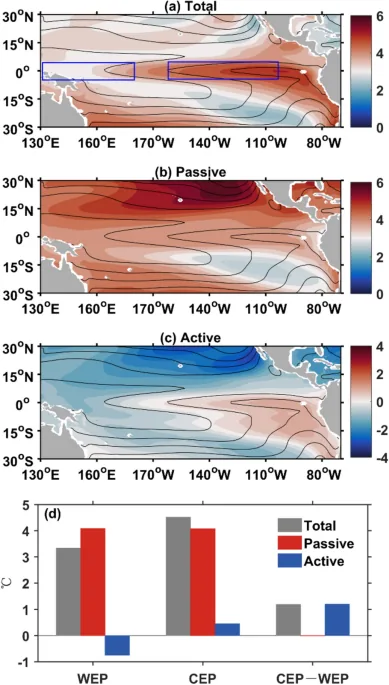
While atmospheric feedbacks dominate the early response, subsurface ocean circulation dictates the climate trajectory over longer horizons, as researchers Qiuxian Li, Yiyong Luo, Jian Lu, and Fukai Liu demonstrated in Climate Dynamics. They applied the partial coupling method formulated by O. A. Garuba and P. J. Rasch within the Community Earth System Model to separate SST anomalies into an atmosphere thermally forced passive component and an ocean dynamically induced active component [3].
Li and his team found that the passive SST component produces a largely uniform warming band along the equator, reflecting a balance between mean ocean heat transport divergence and passive surface heat flux changes. In contrast, the active ocean component generates the entire spatial warming pattern at both stages, with changes in meridional and vertical ocean circulation sustaining the La Niña-like cold tongue during the early stage. Over centennial timescales, however, heat penetrates deep into subtropical subduction zones, gradually warming the water that feeds equatorial upwelling plumes. As warmer water reaches the surface from below, the ocean dynamical thermostat breaks down, eroding the zonal temperature gradient and driving the transition to an El Niño-like pattern [3].
Tropical Pacific Ocean Circulation
The primary ocean mechanism driving this shift is the response of the Pacific subtropical cells, which are shallow wind-driven overturning loops that connect mid-latitude subduction zones with equatorial upwelling by transporting cold water toward the equator. In model experiments, Li, Luo, Lu, and Liu found that greenhouse warming induces a gradual slowdown of these subtropical cells, reducing cold-water transport and allowing heat to accumulate in the upper equatorial ocean [3].
This circulation slowdown alters both meridional and vertical ocean heat transports, warming the eastern cold tongue and removing the thermal contrast that sustained strong trade winds. As easterly winds subside, zonal currents adjust and push warm water eastward through the basin, confirming that ocean circulation controls the timing of the transition [3].
Earlier simulations by researchers U. K. Heede, A. V. Fedorov, and N. J. Burls also noted that tropical Pacific responses depend on competing timescales between fast thermostat effects and slow circulation adjustments [5]. Their modeling experiments showed how ocean mixing rates determine when the transition occurs, with Li and colleagues demonstrating that subtropical cell deceleration acts as the main physical trigger [3].
Future Climate Impacts
Understanding how equatorial Pacific Ocean temperatures evolve through these warming phases is essential for refining climate forecasts because tropical Pacific sea surface temperatures drive deep atmospheric convection, global rainfall belts, and global climate sensitivity. If the eastern Pacific stays relatively cool over the next several decades, rainfall will stay concentrated over the western Pacific and Maritime Continent, sustaining dry conditions across southwestern North America [2].
Once slow ocean adjustments take hold, the shift to an El Niño-like warming state will alter global weather systems as convective rainfall shifts eastward into the central Pacific [1]. This eastward shift will displace mid-latitude storm tracks, while reduced marine cloud cover over the eastern basin will decrease solar reflection and increase global surface warming rates [2].
By identifying this two-phase adjustment, climate scientists can reconcile historical data with long-term model projections, clarifying the timeline of greenhouse impacts as early cooling trends precede eventual warming [1]. These insights help researchers build more reliable models and assist societies in preparing for the shifting stages of global climate change [2].
- ACADEMIC JOURNAL Olonscheck, D., & Kang, S. M. (2026). Phase transition of CO2-driven equatorial Pacific warming pattern governed by ocean dynamics and remote forcing. AGU Advances, 7(1), e2026AV002437. [Article Link]
- ACADEMIC JOURNAL Watanabe, M., Kang, S. M., Collins, M., Hwang, Y., McGregor, S., & Stuecker, M. F. (2024). Possible shift in controls of the tropical Pacific surface warming pattern. Nature, 634(8033), E3–E3. [Article Link]
- ACADEMIC JOURNAL Li, Q., Luo, Y., Lu, J., & Liu, F. (2024). Revisiting the equatorial Pacific sea surface temperature response to global warming. Climate Dynamics, 62(3), 2239–2258. [Article Link]
- ACADEMIC JOURNAL Garuba, O. A., & Rasch, P. J. (2020). A partial coupling method to isolate the roles of the atmosphere and ocean in coupled climate simulations. Journal of Advances in Modeling Earth Systems, 12(9), e2019MS002016. [Article Link]
- ACADEMIC JOURNAL Heede, U. K., Fedorov, A. V., & Burls, N. J. (2021). A stronger versus weaker Walker: understanding model differences in fast and slow tropical Pacific responses to global warming. Climate Dynamics, 57(9-10), 2505–2522. [Article Link]
Cover image: European Union, Copernicus Marine Service Data / Wikimedia Commons, Attribution
APA 7: PerEXP Teamworks. (2026). Slow Ocean Adjustment Mitigates Equatorial Pacific Ocean Warming. PerEXP Teamworks.


