



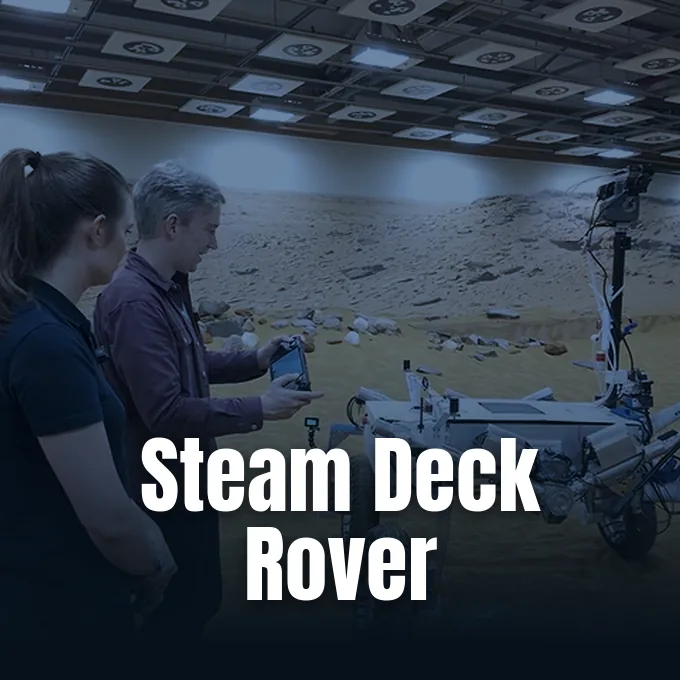
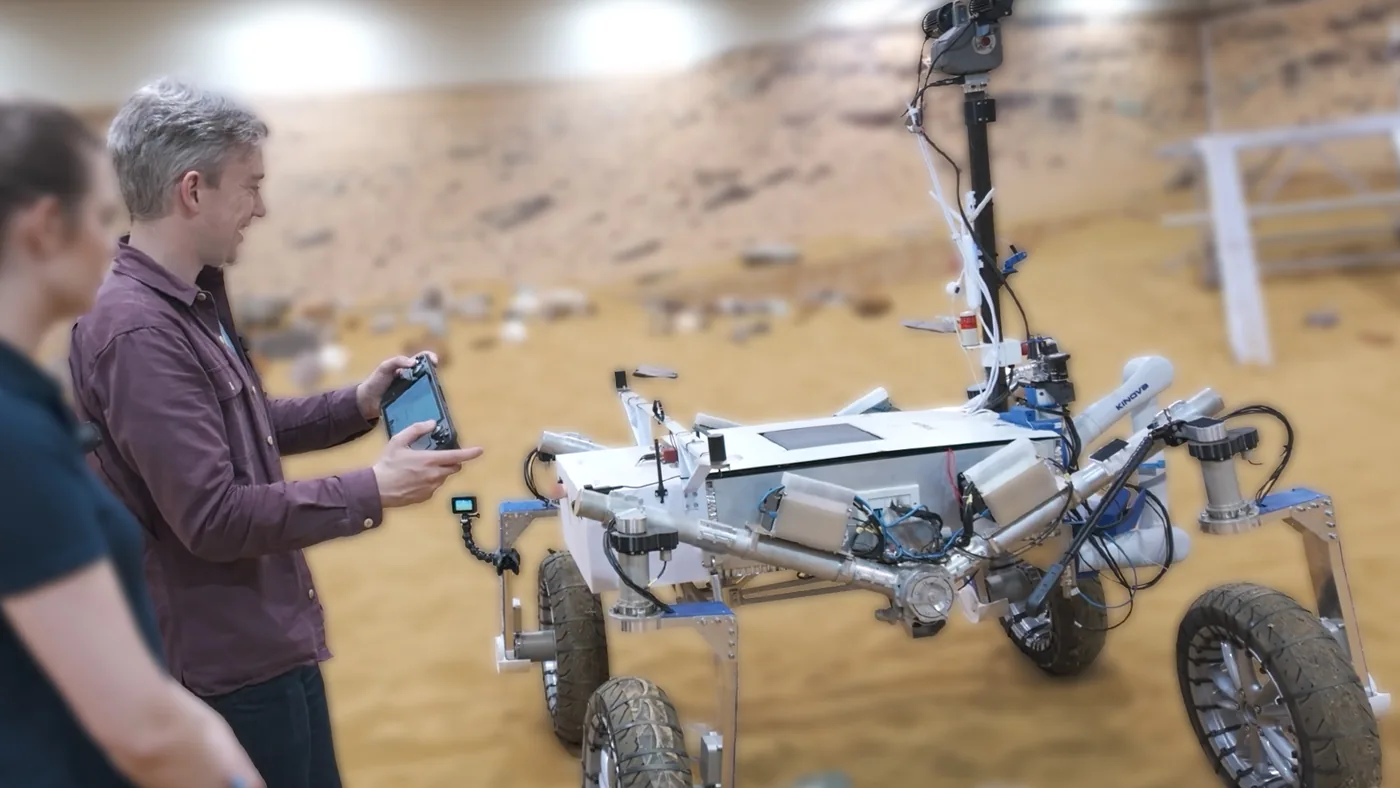
In a specialized robotics yard in Stevenage, an aerospace technician holds a handheld gaming PC, taps a shoulder bumper, and watches a six-wheeled planetary rover pivot its wheels sideways on artificial terrain. Airbus Defence and Space UK is testing locomotion systems for the European Space Agency’s upcoming Rosalind Franklin mission, relying on a modified Valve Steam Deck rover interface to direct the vehicle before autonomous navigation routines take over. While interplanetary exploration typically relies on bespoke ground stations and expensive control consoles, off-the-shelf gaming hardware solved an immediate engineering problem on Earth [1].
Airbus Adopts Steam Deck Rover Controls in Stevenage
When popular science documentarian Tom Scott visited the Stevenage facility of Airbus Defence and Space UK, engineers were testing navigation software on an ExoMars rover prototype called Codi. Scott arrived to film an episode titled This Mars rover’s cool. But have you seen its wheels? and received a direct demonstration of the driving setup. As Scott explained, technicians gave him “a quick course in how not to break it, and then was handed what’s basically a gaming console” to guide the six-wheeled chassis across rocky ground. Working the console’s thumbsticks, triggers, and face buttons, Scott maneuvered the vehicle across simulated regolith. The engineering team deployed the Steam Deck rover setup because manual maneuvering remains essential during ground assembly and calibration routines before the craft ever flies toward deep space [1].
The finished rover drives itself. Until planetary touchdown occurs, human operators must still steer the prototype around terrestrial test beds. Building an exclusive, proprietary handheld controller for Earth-bound testing would have wasted valuable development resources. Valve created the portable PC with integrated physical controls, a responsive touchscreen, Wi-Fi, and Bluetooth connectivity. Those built-in features allowed software specialists to install custom navigation programs directly without manufacturing custom interface hardware [1].
Airbus teams at the Stevenage campus carry responsibility for designing the propulsion, mechanical, and thermal systems of the mission’s landing platform. Daily development demands frequent adjustments. Technicians must repeatedly align sensor rigs, reposition wheel bogies, and verify drive motor responses under varied surface friction. The commercial gaming device provided an immediate bridge between engineering workstations and the physical prototype, offering responsive analog thumbsticks and tactile buttons for precise low-speed steering [2].
ExoMars Steam Deck Interface Replaces Conventional Hardware
Airbus selected standard hardware. Technicians required a standalone mobile unit that standard DualSense or Xbox pads could not deliver [1].
Conventional console gamepads function solely as peripheral input accessories, requiring an external host machine to process signals and execute scripts. In contrast, the ExoMars Steam Deck configuration operates an onboard Arch Linux operating system. This capability allowed Airbus engineers to execute specialized driving routines directly on the handheld device. Writing for PC Gamer, hardware editor Jess Kinghorn noted that while she could not confirm whether technicians utilized the LCD or OLED iteration, the chassis matched the appearance of a standard retail unit [2].
The portable gaming space has expanded with alternative models such as the Asus ROG Xbox Ally X, the original Asus ROG Xbox Ally, and the MSI Claw 8 EX AI+. Before focusing on handheld hardware, Kinghorn spent years contributing to print gaming outlets, including PLAY and Official PlayStation Magazine. However, Valve’s open software environment offered Airbus a streamlined platform for rapid customization. Instead of hauling cumbersome development laptops next to the moving prototype, technicians walked freely around the test yard while monitoring telemetry on the portable screen [2].


Turning Codi Wheels Ninety Degrees on Test Bed Rocks
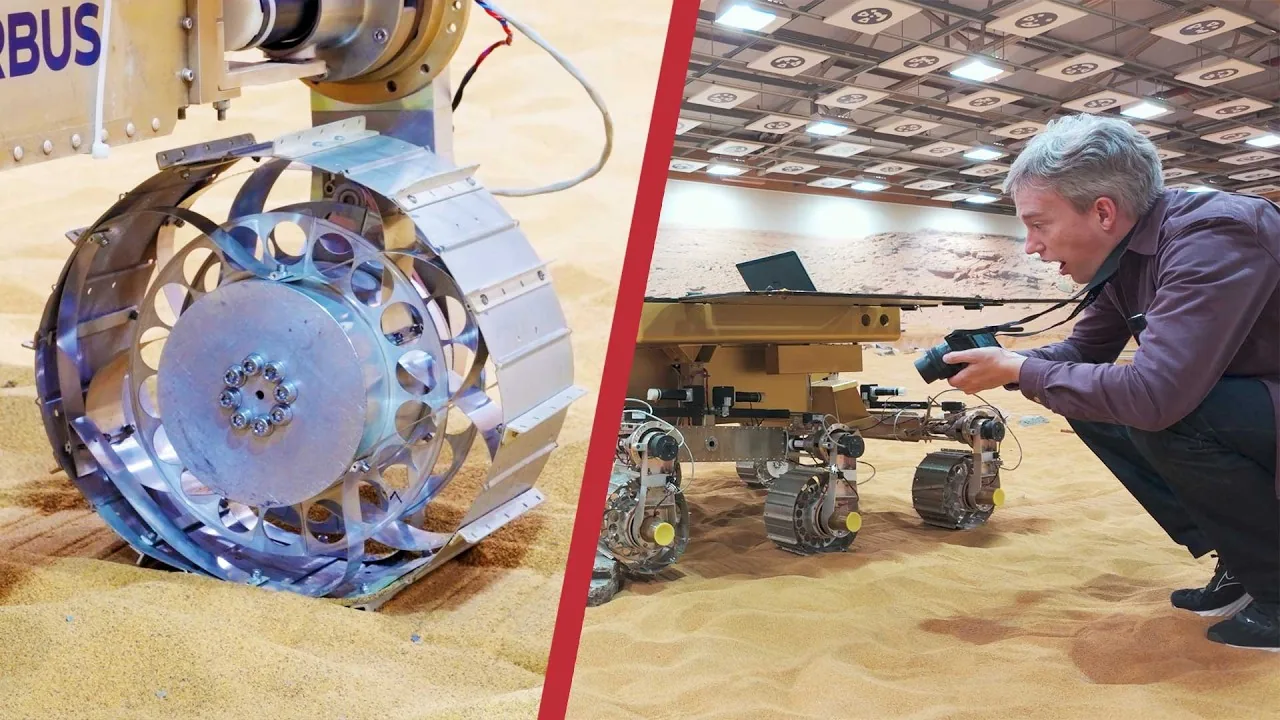
Tom Scott visited the facility. During the technical demonstration, Scott operated the prototype’s steering mechanisms across an obstacle-filled indoor testing yard. Tapping a shoulder bumper triggered an actuator command that swung all of Codi’s wheels ninety degrees simultaneously. Scott noted that this rapid realignment allowed the vehicle to scuttle sideways “like a crab.” That lateral mobility prevents the rover from becoming trapped when navigating tightly grouped boulders, eliminating cumbersome multi-point turning maneuvers on treacherous surfaces [1].
Preventing wheel entrapment is critical because Mars provides no rescue options when mechanical assemblies fail. Terrestrial test facilities recreate harsh slopes and abrasive rock fields to evaluate how suspension linkages bear dynamic loads. Specialized mechanical damping protects sensitive scientific packages from severe shock, echoing principles seen where a Swiss engineering design cushions spacecraft structures against violent deceleration forces during touchdown [2].
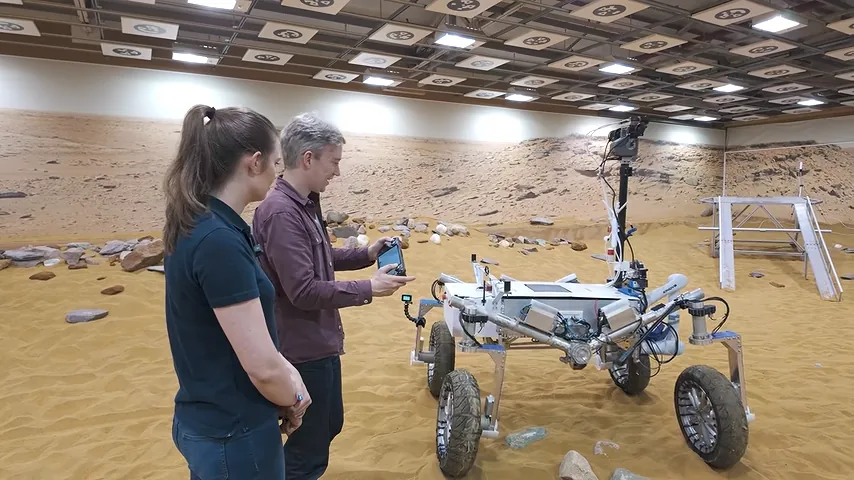
Engineers in Stevenage deliberately run the chassis over uneven obstacles to confirm that independent wheel pods pivot reliably under heavy strain. When an operator triggers crab steering through the handheld console, internal actuators rotate the corner bogies without requiring forward vehicle momentum. This capability safeguards drive motors from excessive torque spikes when tires press against solid rock faces, preserving mechanical integrity throughout grueling qualification trials [1].
Rosalind Franklin Mission Prepares for Mars in 2030
Every trial completed with the Steam Deck rover configuration supports preparations for the European Space Agency’s Rosalind Franklin mission. The platform touches down in 2030. The long-planned expedition aims to search for potential biosignatures beneath the Martian surface. Back in 2025, Kata Escott, managing director of Airbus Defence and Space UK, emphasized the immense scope of the program, describing reaching the Martian surface safely as “the culmination of more than 20 years’ work” [1].
Once deployed on Martian soil, the finished rover will calculate its path autonomously rather than waiting for terrestrial commands. Radio signals travelling between Earth and Mars require several minutes to cross interplanetary space, rendering direct remote steering impossible during real-time surface travel. Handheld manual steering remains strictly a pre-launch utility, helping engineers validate mechanical, propulsion, and thermal responses while the vehicle remains inside terrestrial development bays [2].
Space exploration programs frequently cross paths with civilian technology in surprising ways. While specialized aerospace technology occasionally flows outward into consumer industries—such as the way NASA Mars machines carbonate beer across commercial breweries—the Stevenage project demonstrates consumer devices flowing directly inward to accelerate deep-space vehicle testing [1].
Handheld Hardware Bridges Consumer Tech and Deep Space
Repurposing consumer video game equipment for aerospace research underscores how powerful retail hardware has become. Contemporary handheld PCs integrate multi-core x86 processors, high-speed wireless radios, and ergonomic control layouts into rugged portable enclosures. While Valve designed the Steam Deck primarily for playing digital game libraries from living rooms or during transit, its open software foundation makes it an adaptable diagnostic controller for advanced robotics laboratories [1].
Gaming merchandise has previously journeyed into orbit under official aerospace programs. Pikachu logged 1,040 orbits. Earlier this year, a Pikachu plush spent 67 days aboard the International Space Station, orbiting Earth hundreds of times before returning safely to terrestrial ground. Whether serving as commemorative items for orbital crews or steering planetary Steam Deck rover prototypes through rocky English test yards, consumer entertainment items continue crossing into serious aerospace environments [1].
Valve’s handheld console will remain firmly on Earth when the Rosalind Franklin rover embarks on its journey toward Mars. The flight model will traverse Martian sands under the guidance of autonomous software algorithms designed to analyze hazards without human intervention. Yet in the testing bays of Stevenage, standard gaming controls gave aerospace engineers the exact mechanical responsiveness needed to prepare the mission for launch [2].
- ONLINE NEWS Maldonado, C. (2026, September 24). YouTuber drives Mars rover prototype with a Steam Deck. Dexerto. [Article Link]
- ONLINE NEWS Kinghorn, J. (2026, September 24). Mars rover project uses Steam Deck for steering. PC Gamer. [Article Link]


