






Researchers at Push Security uncovered an ongoing phishing campaign that uses fake AI events to steal workplace Microsoft and Google logins. Bogus web portals impersonate conferences and livestreams hosted by OpenAI, SpaceX, and Anthropic. To lure corporate staff, these pages promise free perks like ChatGPT Pro subscriptions, access to Grok Heavy, and SpaceX shares [1]. Instead of delivering tools, the sham portals feed victim traffic into Kali365 and VoidProxy, two criminal phishing services built to harvest session tokens and bypass two-step verification [2]. Reporting by Sead Fadilpašić for TechRadar shows that hackers increasingly weaponize artificial intelligence hype against corporate targets [1].
Lures Behind Fake AI Events
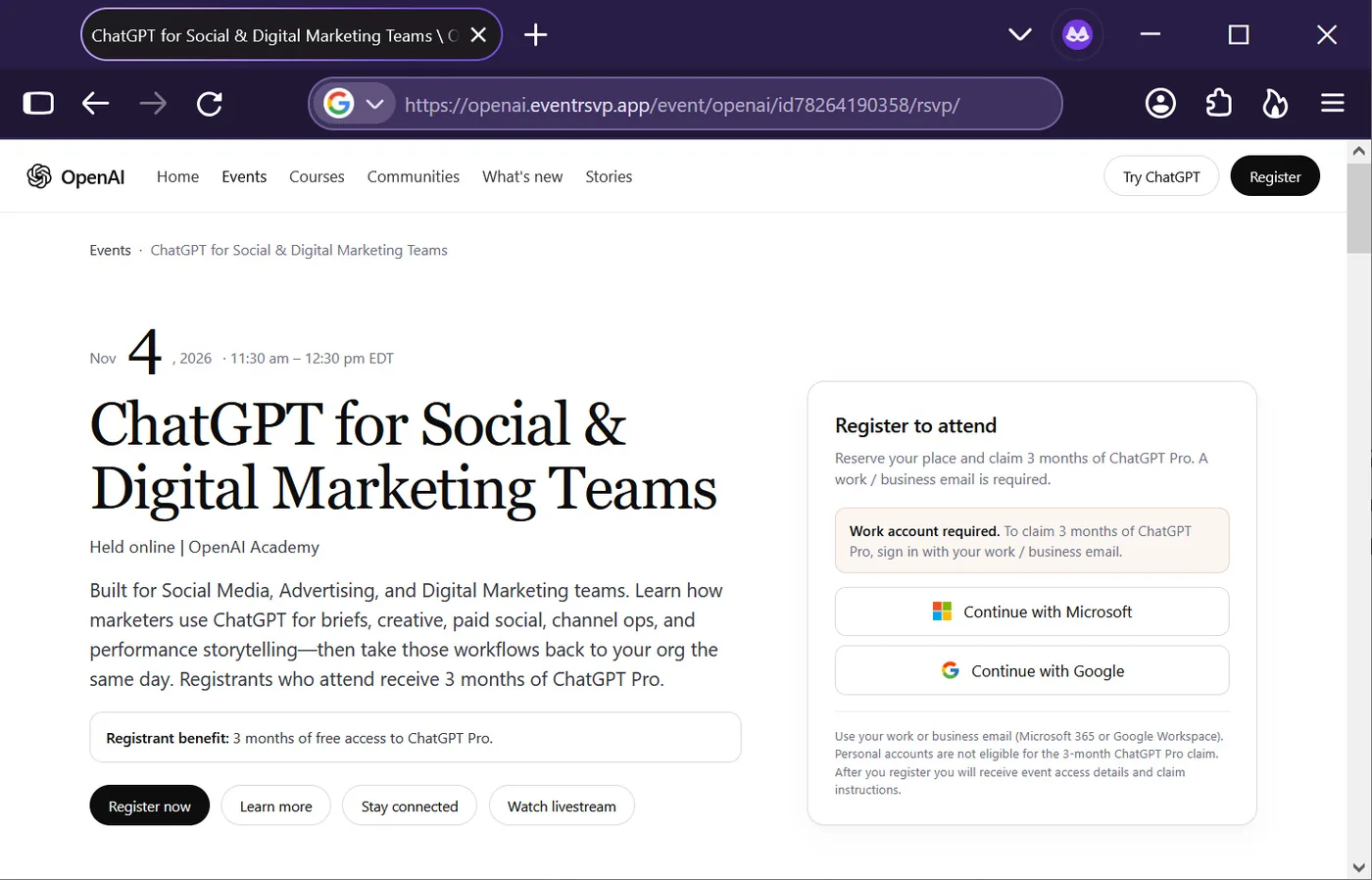
Push Security first spotted and blocked visits to these sham registration portals in late October 2026 [2]. Threat groups set up lookalike web pages that copy official events from OpenAI, SpaceX, and Anthropic to deceive enterprise staff [1]. One bogus portal advertised an OpenAI workshop titled “ChatGPT for Social & Digital Marketing Teams,” promising registrants three free months of ChatGPT Pro. Another portal pitched a private SpaceX briefing set for November 12 and promised attendees who finished registration either three months of Grok Heavy or a “SpaceX share”. Lawrence Abrams of BleepingComputer reported that both lures relied on identical underlying code [2].
Attackers also built a page mimicking an Anthropic session at AWS re:Invent 2026, but defenders took that domain offline before it drew heavy traffic [2]. Coverage from TechRadar revealed that the same campaign promoted fake OpenAI Academy livestreams and private sessions on marketing automation. Hackers targeted OpenAI and Anthropic. “Employees want access to the latest AI tools, making them excellent bait for attacks,” Push Security said in its report. Workers constantly seek trial access to tools like ChatGPT Pro, meaning an invitation that offers three months of free service at zero cost easily sweeps aside ordinary workplace caution and verification habits across affected teams [1].
To view session agendas or claim software perks, visitors must click either “Continue with Microsoft” or “Continue with Google”. Before reaching those login buttons, visitors must solve a Cloudflare CAPTCHA that asks them to “Confirm you’re not a robot”. Cloudflare blocks automated web scrapers. The check stops security scanners from inspecting malicious code. Once past the barrier, victims see genuine-looking login prompts [2].
Device Code Exploits with Kali365
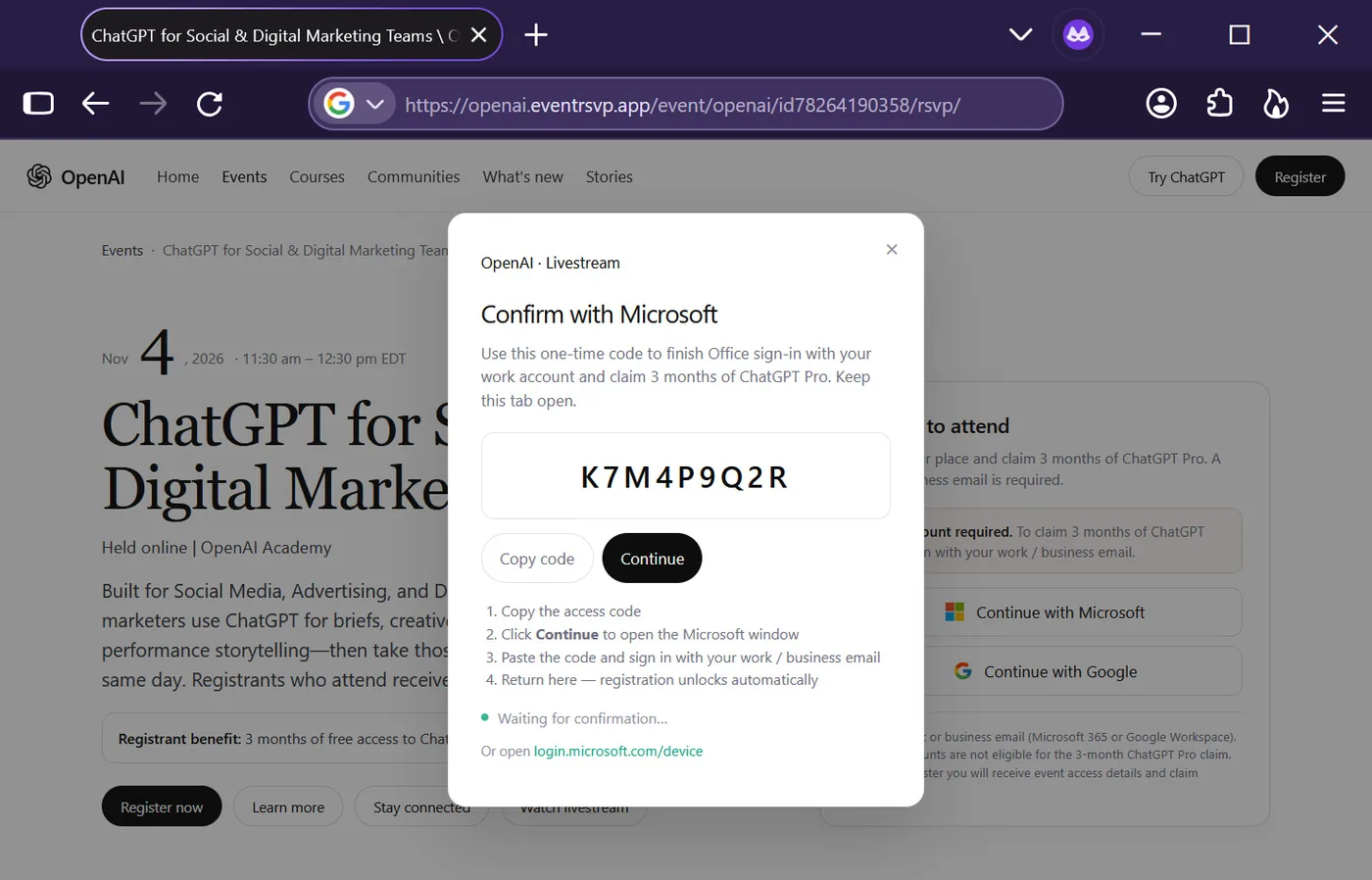
When a worker clicks the Microsoft button, the phishing portal contacts Kali365, an automated phishing-as-a-service platform built to exploit device sign-in protocols. Kali365 generates a device code [2]. The portal then instructs the visitor to paste that alphanumeric string into Microsoft’s official device login site. Because workers enter the code on Microsoft’s real domain, standard browser warnings never fire while the user authenticates normally, completely oblivious that their approval links directly to an active attacker session [1].
Intruders abuse the standard OAuth 2.0 device authorization process to capture access tokens tied to a worker’s Microsoft Entra profile [2]. Once the employee signs in and approves the request on Microsoft’s genuine portal, Microsoft sends an active OAuth token straight to the Kali365 session [1]. Hackers bypass user passwords entirely. That single token gives criminals immediate entry into connected SSO business apps. Connected systems often include Microsoft 365, Salesforce, Google Workspace, Dropbox, Adobe, SAP, Slack, Zendesk, and Atlassian; this wide access exposes company emails, client records, and team chat rooms [2].
Device code phishing has appeared in past cyberespionage cases, but Kali365 turns the technique into a turn-key service for novice scammers [2]. After the device code grant succeeds, the fake event site redirects the victim to a secondary sign-in page operated by VoidProxy. Intruders use this follow-up form to harvest the victim’s actual password and session cookies. VoidProxy steals backup user passwords. The dual-stage approach lets intruders keep control even if token access expires [1].

Session Theft Through VoidProxy
Workers who choose “Continue with Google” face a different attack chain run by VoidProxy [1]. Instead of generating a device code, the phishing portal spawns a pop-up window containing a Google sign-in form. The window displays a convincing copy of Google’s real login page, but it runs on an adversary-in-the-middle (AiTM) reverse proxy operated by the attackers. VoidProxy intercepts active web traffic. The proxy sits between the victim’s browser and Google’s production servers [2].
When the user types their email address and password into the proxied window, VoidProxy relays those details to Google’s real servers in real time. Google responds by asking for two-step verification, like an authenticator app code or a prompt sent to a smartphone. The victim approves the notification, believing the step is routine account protection [1]. Because VoidProxy relays the exchange live, Google validates the response and sends an authenticated session cookie back to the browser, which VoidProxy copies straight to attacker servers [2]. With that live cookie, an intruder opens the account in a new browser window without needing passwords or solving security prompts [1].
Stealing active session cookies allows adversaries to bypass standard two-step verification rules [2]. The worker sees a registration confirmation screen and assumes everything went smoothly [1]. Intruders compromise Google Workspace accounts. Meanwhile, intruders gain full entry to Google Workspace, Gmail, and Google Drive files linked to that profile; they can read executive emails, download internal documents, and harvest corporate address books [2].
Detection Evasion and Distribution
Push Security identified two custom phishing kits: ZoomMock and MSDRoot. Investigators believe a single threat group operates both toolsets because they share identical hosting infrastructure, align on victim targeting, and distribute the same phishing payloads [2]. The surge in fake AI events reflects how hackers abuse recognized trademarks to sneak past mail filters. “All of these detection evasion techniques, plus the MFA-bypassing AiTM and device code phishing payloads, mean this attack is designed to get around or through the controls that most organizations rely on to stop phishing attacks today,” Push Security said [1].
To send links without triggering security warnings, the fraudsters route visitors through trusted URL shorteners run by Google and Zapier [2]. Email filters regularly trust these legitimate domains, letting malicious links slide straight into user inboxes. Push Security has not mapped every delivery path, but investigators suspect invites travel via email pitches, social networks, and Telegram groups [1]. In July 2026, security firm ANY.RUN observed hackers hosting sham webinars on genuine Zoom infrastructure while impersonating Meta, OpenAI, and Anthropic to harvest corporate credentials and bypass authentication. Earlier, Cofense spotted matching lures distributed through GoTo Webinar email systems [2]. Cybercriminals repeatedly hijack respected SaaS platforms to mask their redirection chains [1].
Credential theft crews constantly modify their delivery infrastructure to slip past enterprise defenses. Tech vendors previously collaborated on a phishing network takedown in Japan, proving that coordinated legal action can dismantle malicious server clusters. Modular phishing toolsets resist disruption. Even so, modular platforms like Kali365 and VoidProxy let crooks spin up fresh scam pages within minutes of an address ban. Modular flexibility makes tracking decentralized phishing infrastructure difficult [2].
Defenses Against Fake AI Events
Halting account compromise driven by fake AI events requires updated security rules paired with user vigilance. Staff must recognize that genuine event organizers never ask attendees to type Microsoft device codes into third-party sites, nor do they require SSO credentials to unlock a standard webinar stream. Real organizers never demand OAuth. When an invitation demands corporate logins in exchange for free AI software, users should verify the offer through internal IT channels [2].
Security teams can restrict OAuth 2.0 device authorization flows inside Microsoft Entra, disabling the flow completely if staff do not need device code logins for shared meeting room screens or smart displays. Companies should also deploy phishing-resistant authentication, such as hardware-based FIDO2 security keys, which can’t be tricked by reverse proxies like VoidProxy [2]. In its report analyzing VoidProxy, Push Security discovered that attackers relay live authentication exchanges, which means traditional one-time passwords offer zero protection [1]. FIDO2 hardware stops VoidProxy. Because FIDO2 binds cryptographic credentials directly to the genuine browser URL, an adversary running a reverse proxy on a spoofed domain can’t complete the handshake. Enforcing strict device compliance rules also blocks stolen session cookies from touching cloud resources on unmanaged hardware [2].
Half a decade has passed since the debut of ChatGPT, yet user enthusiasm for generative models remains an ideal opening for social engineering, which makes AI-themed phishing campaigns attractive to cybercriminals. Criminals track emerging trends and craft lures around software updates and product rollouts. TechRadar noted that earlier attacks featured fake Claude download ads, malicious custom GPTs, downloadable artifacts, and deceptive shared conversation links. Scammers exploit artificial intelligence interest. As long as employees crave early access to artificial intelligence, scammers will package malicious login flows inside attractive invitations [1].
- ONLINE NEWS Fadilpašić, S. (2026, November 6). Hackers use fake OpenAI, SpaceX, and Anthropic event invites in new phishing scam to steal Microsoft and Google accounts. TechRadar. [Article Link]
- ONLINE NEWS Abrams, L. (2026, November 5). Fake OpenAI, SpaceX events used to steal Microsoft, Google accounts. BleepingComputer. [Article Link]


