





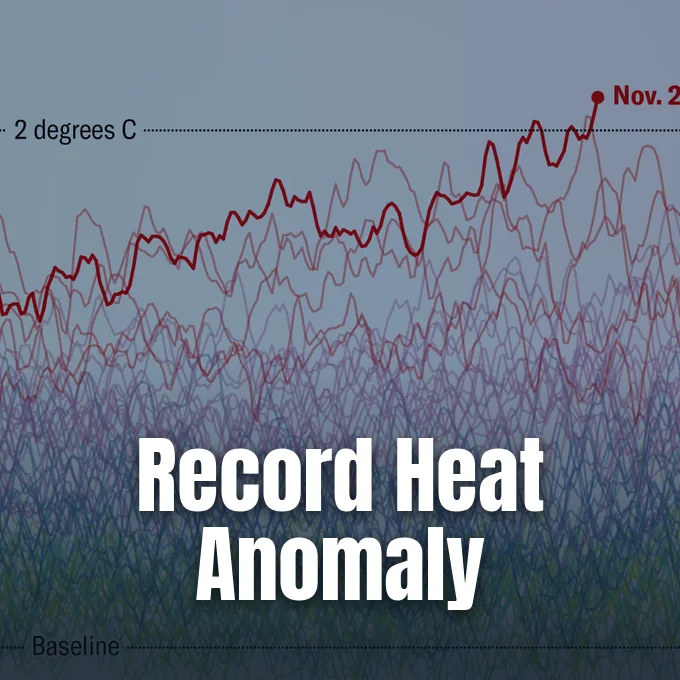
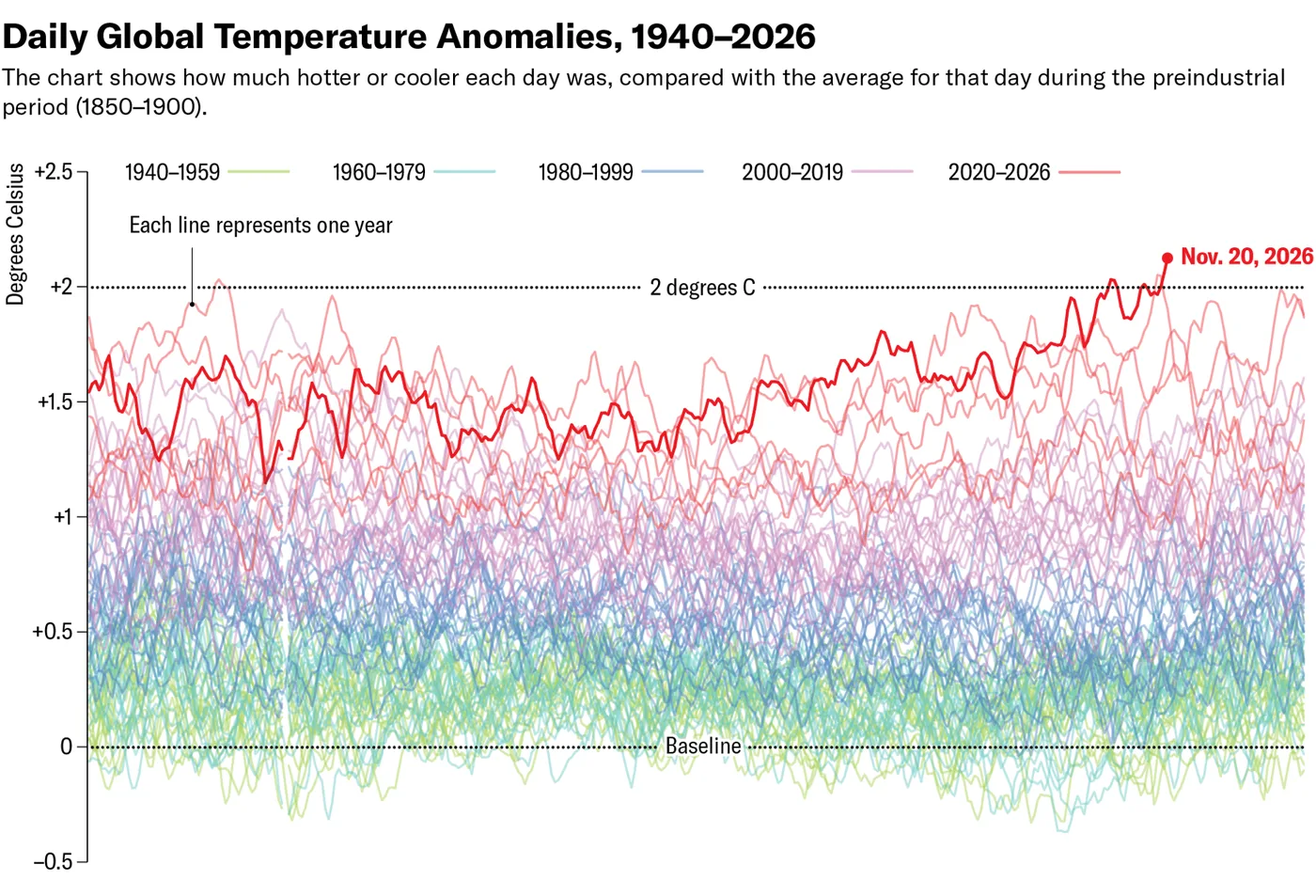
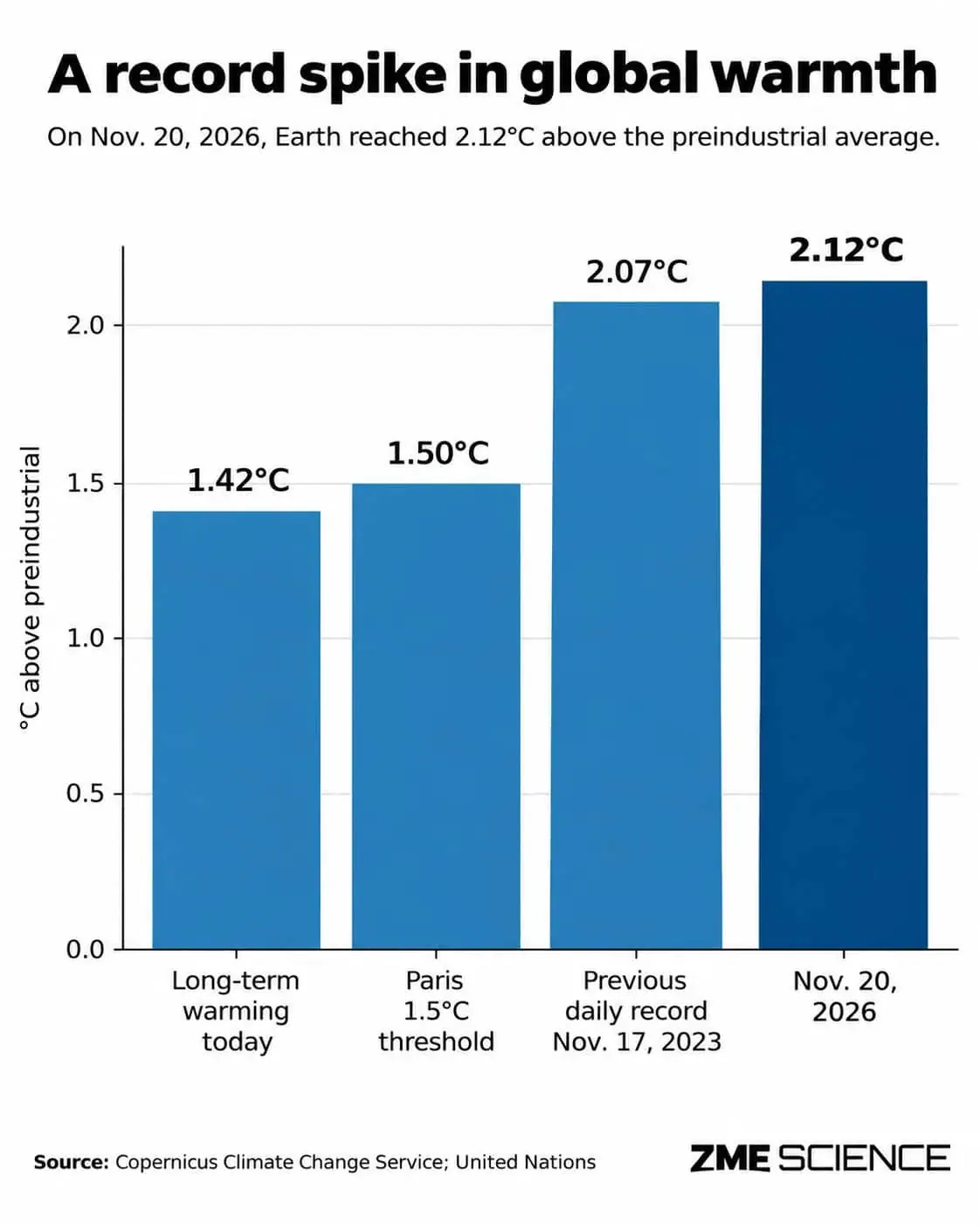
Preliminary data from the Europe-based Copernicus Climate Change Service C3S indicates that Earth reached a record daily heat spike on Friday, November 20, 2026. Friday established a global temperature anomaly of 2.12 degrees Celsius (3.82°F) above preindustrial averages, surpassing all previous daily marks in modern observational records. Climate researchers evaluate this threshold against the 1850–1900 baseline, a historical benchmark used by the United Nations to define conditions before widespread coal and oil burning altered atmospheric physics [1, 2]. The sudden surge arrived as an intense El Niño in the Pacific Ocean combined with baseline warming driven by human greenhouse gas emissions [1]. That heat record coincided with the collapse of the COP31 climate conference in Antalya, Turkey, where international negotiators failed to produce an overarching pact to curb fossil fuels [2].
Global Temperature Anomaly Records
The Europe-based Copernicus Climate Change Service C3S, an Earth observation program funded by the European Union, calculates daily anomalies by comparing surface air measurements gathered from thousands of monitoring points with long-term preindustrial climate baselines. On November 20, global mean temperatures reached 2.12 degrees Celsius above preindustrial averages. Researchers monitor these variations using surface weather stations, ocean buoys, and orbital sensors integrated into global reanalysis models [1]. When measuring daily extremes, analysts evaluate how far a single date deviates from typical conditions documented between 1850 and 1900 [2]. Surface heat accumulated across both hemispheres simultaneously, demonstrating that planetary warming trends now influence the northern and southern halves of the globe concurrently [1].
The previous daily record occurred on November 17, 2023, when planetary temperatures climbed 2.07 degrees Celsius above the preindustrial baseline. That earlier event surprised climate researchers because it developed unusually early during a burgeoning El Niño cycle. The new mark topped 2023 by 0.05 degrees [1, 2]. Small fractions of a degree represent vast amounts of additional thermal energy absorbed by global atmosphere and ocean systems [2]. European satellites and surface monitors confirmed that global temperature anomaly values surpassed all prior daily records since measurements began. Scientists at the Copernicus Climate Change Service C3S stated that preliminary readings undergo extensive verification, although historical retrospective revisions have rarely altered the broader planetary warming signal [1, 2].
Records from 2023 to 2026
Copernicus records from November 2026 contrast sharply with the earlier spike observed in late 2023 [1, 2]. Annual mean temperatures exceeded 1.5 degrees Celsius above preindustrial baselines across the entirety of 2024. That annual milestone confirmed that temporary warm spells were steadily consolidating into prolonged planetary warmth [2]. An analysis published by Scientific American points out that both 2026 and 2027 are expected to exceed 1.5 degrees Celsius above preindustrial baselines, mirroring temperatures previously observed only during 2024. Spikes now recur within three years [1, 2]. Such sustained warmth highlights how baseline shifts reshape seasonal expectations across every continent [1].
Earlier observations, including analysis of how a NASA scientist examined the 2023 heat wave, showed how regional sea-surface warmth can accelerate planetary heat anomalies. Ocean waters in 2026 ran warmer than in 2023. A climate assessment from Carbon Brief showed that sea-surface temperature anomalies in the tropical Pacific Ocean surpassed earlier satellite-era records, demonstrating that marine basins are storing record amounts of thermal energy. When ocean water accumulates vast quantities of excess heat, it steadily transfers thermal energy into the troposphere over extended periods. That stored energy lingers in atmospheric currents for months, lifting planetary temperature averages above historical benchmarks [2].
Pacific El Niño Dynamics
Ocean cycles trigger sudden heat peaks. During an El Niño event, trade winds weaken and unusually warm water shifts eastward through the equatorial Pacific Ocean. This massive displacement of tropical water releases thermal energy into the atmosphere, altering global weather patterns and jet stream trajectories. Paleoclimate evidence gathered from ancient tree rings and tropical coral sediments suggests that this El Niño could become the strongest such event observed anywhere on Earth in the past 1,000 years [1, 2]. But climate scientists emphasize that this cyclical ocean event is not acting in isolation. The natural phenomenon operates on top of chronic background warming generated by two centuries of fossil fuel emissions, which allows ordinary cyclical swings to drive global surface readings to record levels [2].
Related research on changing seasonality and extreme heat events details how seasonal shifts compound ocean-driven warming cycles across continents, amplifying local impacts whenever tropical marine temperatures surge. Emissions steadily elevate ocean baseline temperatures. When an intense El Niño develops, it releases that accumulated heat into the air in a rapid surge [1, 2]. Zachary Labe, a scientist at Climate Central, explained that El Niño is pushing daily values higher than in past cycles. “I think we will likely see more days exceeding 2 degrees C over the next couple of months (possibly through March 2027),” Labe said. Labe noted that such days should remain a rarity rather than the daily norm. The United Nations recently announced that global surface temperatures are currently on course to reach 1.8 degrees Celsius above preindustrial levels unless governments implement much steeper reductions in annual greenhouse emissions [1].



Global Temperature Anomaly and Treaties
Under the 2015 Paris Agreement drafted at the COP21 conference, participating governments pledged to hold global warming well below 2 degrees Celsius and pursue sustained efforts to limit warming to 1.5 degrees Celsius. Calculating a multi-year global temperature anomaly helps climate researchers evaluate long-term treaty compliance over multi-decade intervals rather than judging overarching environmental progress by isolated daily fluctuations. One hot day does not violate the treaty. Scientists evaluate climate goals using thirty-year averages to filter out temporary weather anomalies and cyclical ocean fluctuations. Long-term planetary warming currently stands at approximately 1.4 degrees Celsius above preindustrial averages, according to United Nations figures [1, 2]. A single day at 2.12 degrees Celsius illustrates what daily life will resemble if global emissions continue to rise unabated [1].
Has the Paris Agreement failed? Climate scientists say it has not, but they caution that passing 2 degrees Celsius for even twenty-four hours provides an alarming demonstration of conditions that will become routine if carbon pollution continues [1, 2]. Every tenth of a degree of warming increases the frequency of severe droughts, catastrophic storms, and agricultural disruption. The United Nations Environment Programme warned in its latest emissions assessment that existing national policies put the planet on track toward approximately 2.8 degrees Celsius of warming this century. Even the most ambitious climate pathways now anticipate that global temperatures will temporarily overshoot 1.5 degrees Celsius before declining [1, 2].
Antalya Climate Summit Talks
The record temperature on November 20 arrived just as international diplomats concluded fraught negotiations at the COP31 climate summit in Antalya, Turkey, where talks collapsed without an overarching agreement on emissions. Despite the urgency highlighted by record heat readings, the summit collapsed without an overarching agreement on emissions reductions [1, 2]. It was the first total summit collapse since Copenhagen in 2009. Negotiators deadlocked over whether the final treaty text should explicitly mention fossil fuels, including coal, oil, and natural gas. The European Union and vulnerable developing nations rejected a compromise text that omitted fossil fuels, but major petroleum-producing states strongly resisted any binding phase-out commitments in the final treaty language. Irish environment minister Darragh O’Brien condemned the draft. “It is unconscionable that we would have a climate pact that makes no mention of fossil fuels,” O’Brien said, as reported by the BBC [2].
Finance talks ended in deadlock. Several smaller agreements survived, but the primary political agreement fell apart completely [2]. The United States did not send an official delegation to the Antalya summit, removing a crucial diplomatic counterpart and further diminishing the likelihood of an ambitious multilateral consensus. Outgoing United Nations Secretary-General António Guterres expressed profound frustration with the outcome in Antalya. “Temperatures keep shattering records. Climate extremes keep intensifying. Emissions remain far too high. And every delay makes our task harder and more costly,” Guterres said. Guterres warned that the world is now poised to exceed the agreed 1.5-degree limit and that the diplomatic window to keep that overshoot short and shallow is closing rapidly [1].
Projections for 2027 Heat
Because oceans require time to transfer thermal energy into the atmosphere, the global heat impact of an El Niño typically lags several months behind its peak in the tropical Pacific Ocean. Reports by Scientific American and ZME Science indicate that 2026 could rival or surpass 2024 as the warmest year ever observed [1, 2]. The strongest impact arrives in 2027. That delayed ocean-atmosphere response makes 2027 almost certain to become the warmest calendar year in modern instrumental history, surpassing the records established during both 2024 and 2026. As El Niño reaches its peak near the end of 2026, global atmospheric temperatures will continue climbing through the following months [1, 2].
Researchers will watch global monitoring stations closely over coming months to assess how frequently daily temperatures approach or exceed the critical 2-degree threshold as El Niño matures. Labe said that although individual record days will not occur constantly, additional spikes exceeding 2 degrees Celsius are probable through March 2027 [1]. The contrast between deadlocked diplomacy in Antalya and record heat in the atmosphere illustrates the persistent divergence between climate policy and atmospheric reality. Physics does not wait for diplomacy [1, 2]. Until global greenhouse emissions experience sustained reductions, daily temperatures that appear anomalous in contemporary records will form the permanent foundation of climate baselines in coming decades [2].
- ONLINE NEWS Thompson, A. (2026, November 22). Earth just saw the most anomalously hot day ever on record. Scientific American. [Article Link]
- ONLINE NEWS Puiu, T. (2026, November 22). Earth just had its most abnormally hot day ever as global climate talks collapsed. ZME Science. [Article Link]
APA 7: PerEXP Teamworks. (2026, November 23). Copernicus Reports Record Global Temperature Anomaly. PerEXP Teamworks. https://perexpteamworks.com/en/global-temperature-anomaly-record/


