




How does the annual calendar dictate the true danger of rising global temperatures? Climatologists now warn that changing seasonality is quietly reshaping extreme weather patterns, pushing lethal heat waves deep into the margins of spring and autumn. Rather than experiencing elevated temperatures solely during the core summer months, populations worldwide must navigate prolonged exposure before physiological acclimatization occurs. Analyzing 45 years of observational climate records, researchers discovered that extreme heat seasons have expanded across roughly half of the world’s land area since the 1980s [2].
- Decades of Observations Reveal Changing Seasonality
- Asymmetrical Shifts Across Spring and Autumn Months
- Phoenix Case Study Highlights Extended Autumn Hazards
- Contrasting Atmospheric Drivers of Dry and Humid Heat
- Daily Disruptions Straining Sleep Schedules and Household Budgets
- Public Health Infrastructure Lags Behind Shifting Seasons
Decades of Observations Reveal Changing Seasonality
Climatic investigations have traditionally evaluated global warming by tracking shifts in average annual temperatures. Summer weather conditions in mid-latitude regions, for example, have lengthened by roughly six days per decade since 1990 [2]. Yet broad seasonal averages often conceal the volatile behavior of individual acute heat spikes. To determine whether dangerous thermal events move in step with broader warming trends, an international research team investigated 45 years of historical measurements spanning the six inhabited continents [1]. The investigation focused on how seasonal timing shifts independently from baseline temperature increases [2].
Lead author Catherine Ivanovich, a climatologist at the NASA Goddard Institute for Space Studies (GISS) affiliated with the Columbia Climate School, examined daily extremes alongside fellow GISS climate scientist Benjamin Cook and Sonali Shukla McDermid of New York University. Publishing their findings in AGU Advances, the authors established a baseline decade between 1980 and 1989, defining extreme heat as days landing within the hottest 5% of historical daily temperatures. Their methodology evaluated standard thermometer readings to assess dry heat while incorporating wet bulb globe temperature (a metric combining air temperature, relative humidity, and solar radiation to assess environmental stress on the human body). Prior to this empirical evaluation, researchers widely assumed that uniform planetary warming would simply lower the threshold for extreme heat evenly throughout all twelve calendar months [1].
Asymmetrical Shifts Across Spring and Autumn Months
When comparing the 1980s baseline against the recent decade spanning 2015 through 2024, the researchers discovered that extreme heat seasons expanded significantly across just over half the world’s land area for dry heat, and just under half for humid heat [1]. Crucially, this geographic growth proved remarkably lopsided. In the western United States, eastern China, northern Africa, and eastern Europe, extreme events accumulated rapidly during the two months following historical summer seasons [2]. Regional contrasts are stark.
Western Europe, southern Africa, and northwestern India displayed an inverted pattern, encountering extreme heat waves predominantly in the two months preceding summer [1].
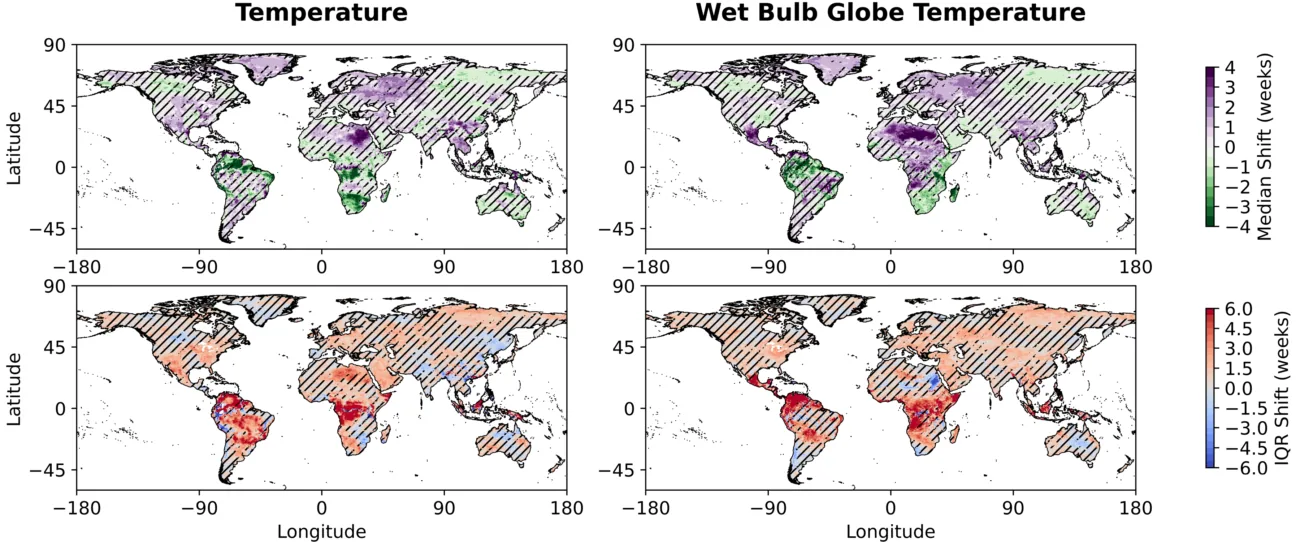
Early spring heat spikes catch human populations before biological adaptation can take place, compounding historical vulnerabilities observed during the deadly heat waves across Europe that claimed over 70,000 lives in previous record-shattering seasons. To ensure these spatial asymmetries were not computational artifacts, the investigators cross-referenced data compiled by NASA with independent reanalysis from the European Centre for Medium-Range Weather Forecasts [2]. Both datasets confirmed consistent spatial trends. The findings demonstrate that asymmetrical temporal expansion is fundamentally altering the calendar distribution of severe heat rather than simply amplifying peak midsummer temperatures [1]. In many populated regions, changing seasonality has turned late spring and early autumn into perilous extensions of the warm season [2].
Phoenix Case Study Highlights Extended Autumn Hazards
Municipal data from Phoenix, Arizona, illustrates how these shifts manifest on the ground. During the 1980s baseline decade, Phoenix logged 183 extreme heat days, with none occurring after the historical heat season had officially closed. Between 2015 and 2024, the city recorded 338 extreme heat days, and 6 percent of those events transpired after the traditional season ended [2]. The median arrival date for dry heat extremes shifted 10 days later into the autumn calendar, whereas humid heat extremes advanced 5.5 days earlier into the spring [1]. As Ivanovich highlighted, extreme heat is transforming into an entirely different environmental challenge across the American Southwest [2].
Prolonged exposure exacts a severe public health toll. In 2024, Phoenix endured 113 consecutive days above 100°F, subsequently matching or breaking daily temperature benchmarks for 21 consecutive days from late September into mid-October. Public records indicate Maricopa County suffered 608 heat-related fatalities in 2024, following 645 deaths in 2023. While July historically accounted for 64 percent of annual fatalities, its share dropped to 46 percent in 2024 as autumn mortality surged. Recent conditions underscore this trend: the city registered nine days reaching at least 100°F this past March. Such early heat is unprecedented. Urban communities must confront changing seasonality as autumn records fall repeatedly [2].


Contrasting Atmospheric Drivers of Dry and Humid Heat
Why does the seasonal expansion of extreme heat fail to progress uniformly across global regions? Ivanovich and her colleagues tested whether baseline greenhouse warming alone could reproduce the asymmetrical pattern, finding that uniform warming accounts for intensification at the height of summer but fails to generate the lopsided shifts documented at seasonal boundaries [1]. Localized dynamics—specifically climatic feedback mechanisms (including shifting rainfall patterns, soil moisture depletion, and regional land use modifications)—play an active role in driving seasonal extensions [2]. Understanding how changing seasonality operates at regional scales remains essential for projecting future atmospheric risk [1]. The underlying dynamics vary substantially between arid interiors and moisture-laden coastal zones [2].
The distinction between dry and humid extremes carries acute environmental consequences. Dry heat accelerates moisture evaporation from soils and vegetation, ravaging agricultural yields and expanding into peak wildfire seasons across the western United States. Conversely, humid heat severely restricts the human body’s capacity to cool itself through evaporative sweating, directly threatening physiological survival as explored in research on rising temperatures rendering regions uninhabitable for human physiology under sustained atmospheric stress. When multiple environmental hazards happen concurrently or in rapid succession, Ivanovich cautioned that they prove far more dangerous than isolated shocks. Temporal expansions also heighten the likelihood of compound disasters, such as extreme heat intersecting with late-season hurricanes in the American Southeast [2]. Timing dictates human vulnerability.
Daily Disruptions Straining Sleep Schedules and Household Budgets
While climatologists map global data grids, empirical evidence demonstrates that prolonged high temperatures directly disrupt daily personal routines. In August 2026, the Annenberg Public Policy Center (APPC) at the University of Pennsylvania surveyed 1,904 nationally representative American adults through the Annenberg Science and Public Health project, documenting how changing seasonality translates into personal disruption. The findings revealed that 76% of respondents reported extreme outdoor heat disrupted their daily activities over the preceding year. APPC managing director of survey research Ken Winneg noted that extreme heat now systematically impacts household financial budgets and regular living routines [3].
Public inquiries frequently question whether unseasonal heatwaves degrade physical well-being. The Annenberg survey confirmed that 56% of adults experienced impaired sleep due to extreme heat, matching the 56% whose regular outdoor exercise routines were disrupted. Both figures marked notable increases from the 50% recorded in 2025. Furthermore, household financial strain escalated: 82% reported increased electricity bills, while 46% faced unexpected utility charges tied to severe heat or wildfires. Pet welfare suffered as well, with 45% reporting heat impacts on domestic animals [3]. Nighttime relief remained elusive.

Compounding thermal stress, deteriorating air quality repeatedly forced populations indoors. Sixty percent of survey respondents indicated that local health officials flagged unhealthy air quality days during summer 2026, up from 48% in August 2025. Wildfire smoke disrupted activities for 38% of Americans, well ahead of flooding at 20%. In response, 82% stayed indoors more than usual, while 12% wore protective masks outdoors [3]. Heat alters everyday behavior.
Public Health Infrastructure Lags Behind Shifting Seasons
Despite widespread exposure, institutional preparedness remains poorly synchronized with expanding thermal seasons. Municipal cooling centers and public health alerts are predominantly organized around a traditional summer calendar. APPC survey data revealed that 65% of Americans do not know where their nearest cooling center is located, with only 35% aware of designated local facilities. APPC research analyst Laura A. Gibson emphasized that municipalities must do far more to inform residents, particularly vulnerable demographics, about cooling infrastructure as unseasonal heat exposure expands into adjacent months [3]. Preparation requires fresh timelines.
Knowledge deficits regarding physiological symptoms further heighten medical vulnerability. While 88% of adults recognize dizziness and 83% identify nausea as heat illness signs, just 47% know that cold, pale, clammy skin signals a serious emergency. Furthermore, only 32% know that extreme heat exposure during pregnancy increases the risk of premature delivery. Public awareness of age-related vulnerability is higher: 69% correctly identify adults aged 65 and older as facing the highest mortality risks. In a broader climate context, NOAA reported that summer 2026 was the hottest across the lower 48 states in 132 years of record-keeping [3].
Looking forward, 59% of Americans anticipate that heat stroke will become more common in their communities over the coming decade, an expectation underscored by United Nations reports confirming that global sea surface temperatures reached an all-time observed high [3]. Climate scientists plan to evaluate these observational trends using extensive climate model simulations, testing whether theoretical projections mirror empirical patterns [1]. Until warning systems decouple from rigid summer calendars and adapt to changing seasonality, communities will remain structurally vulnerable to the expanding reach of extreme dry and humid heat [2].
- ACADEMIC JOURNAL Ivanovich, C. C., Cook, B., & McDermid, S. (2026). Extreme Dry and Humid Heat Seasons Are Changing Asymmetrically. AGU Advances, 7(6). [Article Link]
- ONLINE NEWS Columbia Climate School. (2026, September 10). Dangerous Hot Days Are Spreading Beyond Summer. State of the Planet. [Article Link]
- ONLINE NEWS Ionescu, A., & Ralls, E. (2026, September 18). Extreme Heat Is Changing Daily Life for Most Americans. Earth.com. [Article Link]
APA 7: PerEXP Teamworks. (2026, September 19). How Changing Seasonality Expands Extreme Dry and Humid Heat. PerEXP Teamworks. https://perexpteamworks.com/en/changing-seasonality-extreme-heat-events/


1 comment