





OpenAI announced on November 24 that its GPT-6 systems can build three-dimensional molecular folds and amino acid chains without relying on external generative biology suites, using general coding and reasoning instead [2]. Working with research partner Onava, the team tested GPT-6 protein design candidates in a wet lab against five targets. Out of 322 tested minibinders, 35 successfully bound their intended targets, achieving an overall hit rate of 10.9%. That is a real start. But turning AI shapes into working drugs still needs lab screening and extensive verification [1].
Early Minibinder Screening Hits
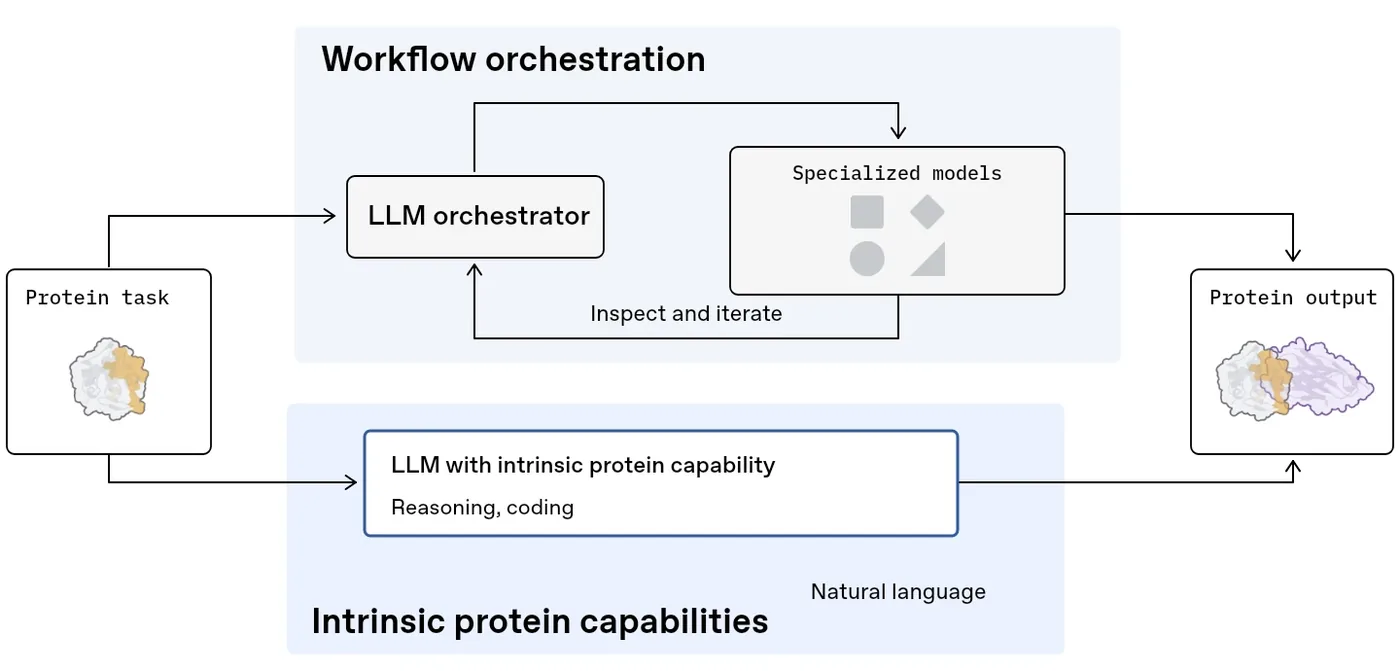
The team tested whether general reasoning could advance GPT-6 protein design by building 3D shapes for small binding proteins called minibinders. To set up the trial, researchers supplied GPT-6.2 with precise spatial coordinates for PD-L1, IL-7Rα, TrkA, VEGF-A, and IL-17A, highlighting specific surface pockets where incoming molecules needed to latch. Code did the rest. By applying general math and chemistry rules through automated scripts, the model drafted candidate folds without calling specialized biology software [2].
Of the 322 AI-designed minibinders selected for testing across five biological targets, only 35 successfully bound their intended goals, resulting in an overall screening hit rate of 10.9%. IL-17A accounted for 18 of those 35 hits, making up more than half of all working designs. VEGF-A yielded 8 hits, PD-L1 produced 5, IL-7Rα delivered 3, and TrkA generated just 1 hit. TechRepublic reported that all tested molecules had already passed through computational filters managed by specialist tools before synthesis, meaning the percentage comes from a curated pool rather than raw model output. The 10.9% figure shows what survived that early sorting [1].
In Nature’s reporting, OpenAI life-sciences lead Joy Jiao called the lab outcomes a “proof of principle”. A 10.9% hit rate gives scientists a helpful starting point, but it doesn’t mean the molecules are ready for clinical use. In drug discovery, sticking to a target is only the first step. Researchers must still test binding grip, cell safety, and stability [1].
GPT-6 Protein Design for Known Targets
GPT-6.2 fared far better when tweaking known proteins instead of building them from scratch. When evaluated on confirmed minibinders, the model produced positive binding for 75 out of 88 MDM2 candidates, translating to an 85% hit rate in initial screens. For VEGF-A, 26 of 42 designs bound, hitting 62%, while tests on PD-1 yielded just 8 hits from 59 attempts [1].
The redesigned minibinders also departed notably from their original templates: median sequence shifts reached half the amino acids in VEGF-A, 43% in MDM2, and 15% in PD-1 [1]. In a separate trial involving unpublished shapes that GPT-6.2 had generated earlier, 14 of 107 designs bound their intended targets, achieving a 13.1% laboratory hit rate. For one PD-L1 shape, the model wrote two distinct sequences differing from the original at 52 and 58 positions out of 90 total amino acids while differing from each other at 44 spots. That divergence shows the system was not just copying known sequences from memory [2].
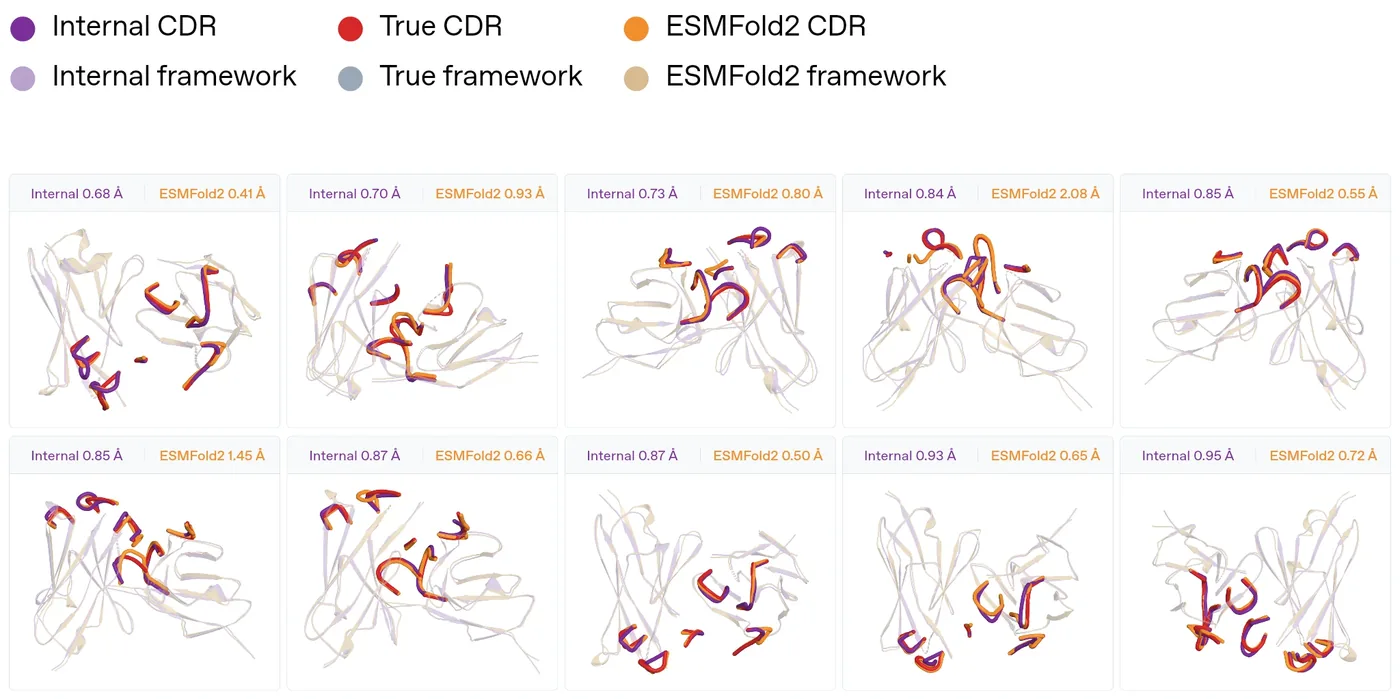
When OpenAI prompted the model to redesign three binding loops on small antibodies called VHHs against IL-4Rα, 128 of 182 designs bound their target, achieving a 70% rate. Tests on fragments from five antibodies against PD-1 or PD-L1 showed 179 hits out of 272 designs [2]. That 66% retention rate indicates that loop edits can preserve function, but whether they improve selectivity is still unproven [1].


Specialist Tools
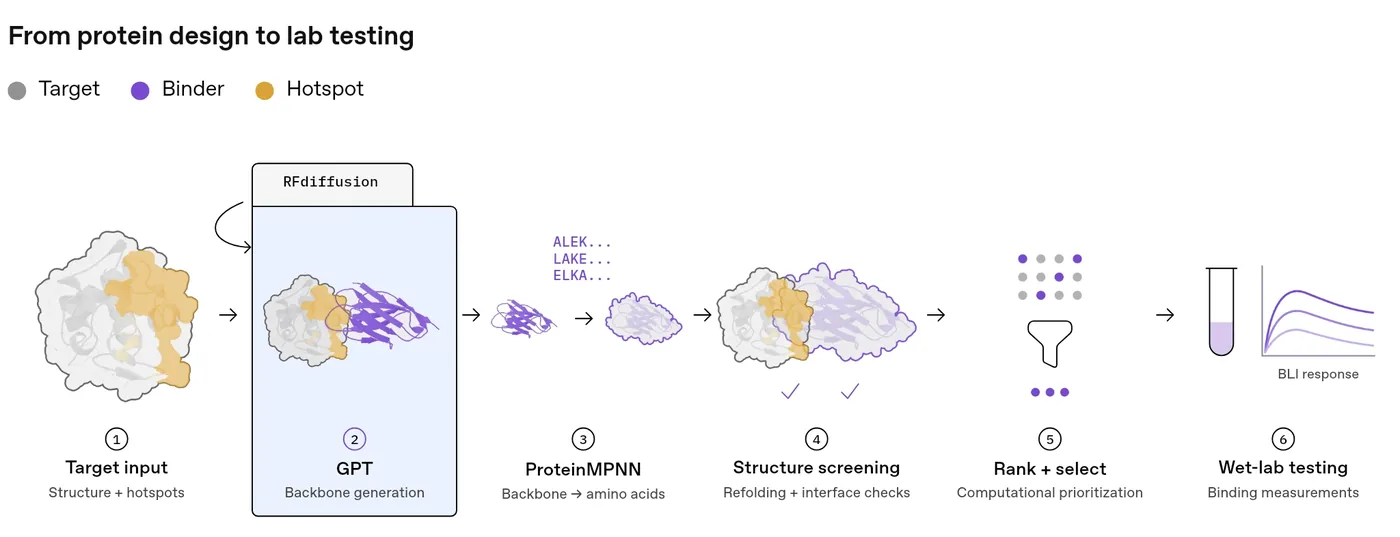
OpenAI acknowledged that GPT-6.2 did not manage the full pipeline alone [1]. After the system generated 3D backbone coordinates, the team used a tool called SolubleMPNN to pick matching amino acid sequences [2]. Other custom AI tools scored folding stability before Onava synthesized any proteins in the lab. General intelligence worked hand in hand with specialist software [1].
Software benchmarks showed that GPT-6.2 correctly predicted ligand positions and orientations in 93% of scored cases, outperforming the specialized DiffDock-L model, which reached 50% on equivalent molecular docking tasks [1]. The tests checked how small molecules fit against proteins using benchmarks like PoseBusters and Scarpino [2]. Earlier comparative studies by Scarpino, Ferenczy, and Keserű in the Journal of Chemical Information and Modeling showed that covalent tools such as AutoDock4, GOLD, and MOE placed 40% to 60% of poses within 2.0 ångströms RMSD [3]. Even so, predicting whole protein folds remained a clear weakness for the general model [2].
Enzyme tests brought further nuance. The team ran 30 structural challenges from MotifBench to examine whether the system could build stable scaffolds around catalytic amino acid sites. While OpenAI’s latest internal research models matched or surpassed RFdiffusion across multiple computational benchmarks, GPT-6.2 scored slightly lower on raw structural geometry, showing that specialized pipelines still hold an edge in fine-grained fold generation. OpenAI aims to simplify that workflow by letting researchers describe molecular constraints in plain English prompts [2].

GPT-6 Protein Design in Discovery Pipelines
Biotech teams considering GPT-6 protein design must look closely at real costs. Screening 322 candidates to isolate just 35 binding molecules demands heavy laboratory synthesis, high-throughput plate assays, and extensive sequencing capacity that can strain discovery budgets. Running large reasoning models on high-end clusters is not cheap, so laboratories must weigh those digital computing expenses directly against established software packages like RFdiffusion. Target costs stay unproven [1].
Beyond initial binding, drug hunters need to confirm if candidate proteins have real pharmacological value. A candidate minibinder that attaches to IL-17A or PD-L1 in a plate assay could still bind healthy tissues off-target or break down too quickly inside human blood serum. TechRepublic noted that OpenAI did not release detailed data on binding strength, selectivity, cell toxicity, or manufacturing yields [1]. Tracking synthetic molecules is also becoming standard practice. As research into watermarking AI-designed proteins spreads, labs will need detailed records covering model versions, prompt instructions, and physical screening results to verify origin and maintain reproducibility.
Big money is pouring into AI biology. Isomorphic Labs recently secured a $5 billion funding round to push AI-designed drug candidates into human clinical trials. Tech giants want to prove their models can handle wet-lab chemistry. But biotech leaders warn that floodgates of digital designs mean little if wet labs get jammed testing weak binders [1].
Safety Checks and Peer Review
The research appears in an unreviewed preprint titled “GPT-6 as a Universal Foundation Model for Protein Biology: Beyond Specialized Models” [2]. Outside scientists haven’t checked or replicated the findings yet. Independent replication matters in structural biology, where small changes in assay setups can sway hit rates. For now, the data show a promising test run rather than a settled commercial tool [1].
Biosecurity also hangs over models that understand protein chemistry. OpenAI placed the ChatGPT version released on November 23 at its internal High risk tier for biological and chemical capabilities. That classification stems from concerns that automated molecular tools could make it easier to design dangerous toxins or pathogens. Because general reasoning models can draft potent binders so quickly, institutions will need tight access rules and careful monitoring whenever models link to automated lab equipment or sensitive DNA databases [1].
OpenAI recently tightened system boundaries after an independent safety test fixed GPT-6.2 jailbreak risks in its production code. Similar safeguards will be needed as generative models move from text output to physical biology. Today, general models can sketch working protein shapes, but proving they can help cure diseases is just starting [1].
- ONLINE NEWS TechRepublic Staff. (2026, November 25). GPT-6.2 Protein Design: What the Lab Binding Data Show. TechRepublic. [Article Link]
- PRESS RELEASE OpenAI. (2026, November 24). GPT-6 models demonstrate intrinsic protein-design capabilities. OpenAI. [Article Link]
- ACADEMIC JOURNAL Scarpino, A., Ferenczy, G. G., & Keserű, G. M. (2018). Comparative Evaluation of Covalent Docking Tools. Journal of Chemical Information and Modeling, 58(7), 1441–1458. [Article Link]


