



What is DeepSeek? Answering this question starts with a Chinese research lab that changed the math of artificial intelligence by releasing open-weight models at low training costs. Hangzhou DeepSeek Artificial Intelligence Basic Technology Research Co., Ltd. operates in Zhejiang as an independent lab funded by the quantitative hedge fund High-Flyer. Instead of locking code behind closed paywalls, DeepSeek releases model weights, training logs, and codebases under permissive open licenses. Open weights allow global programmers to inspect, adapt, and run frontier LLMs on private hardware without paying steep commercial cloud rents [1].
What Is DeepSeek?
DeepSeek began in July 2023. Liang Wenfeng founded the firm after co-founding High-Flyer in June 2015 to build stock trading algorithms. In April 2023, High-Flyer launched an internal AI research lab focused on fundamental models. Two months later, the research team spun off as an independent company where Liang kept an 84% equity stake through two holding firms [1].
The lab ran like an academic campus, steering clear of the harsh 996 overtime grind common at big Chinese tech firms. Liang structured teams without daily quotas or forced evening shifts, giving engineers uninterrupted time to explore fresh ideas without corporate bureaucracy. Instead of picking only senior coders, DeepSeek hired new college grads and recruited experts from math and language fields to build stronger training data. The team favored raw skill over long resumes, letting young researchers guide key parts of the training pipeline [1].
Tight hardware limits shaped the entire plan. Washington chip bans cut off access to top-tier graphics processing units, so Chinese builders had to pull more speed from cut-down chips. Instead of buying giant server farms like rival US firms, the group cut down memory loads and streamlined basic math steps. The strategy worked. Zihan Wang, an early employee who later moved to Northwestern University, said staff had rare freedom to test bold concepts on raw silicon without red tape, turning chip shortages into a push for leaner algorithms that extract peak performance from constrained hardware [3].
The Fire-Flyer Compute Cluster
DeepSeek built its hardware base through High-Flyer before export curbs tightened. High-Flyer launched Fire-Flyer 1 in 2019, running it for eighteen months before retiring the gear. By 2022, Fire-Flyer 2 linked 5,000 PCIe Nvidia A100 GPUs across 625 server nodes using 200 gigabit per second dual fat-tree connections [1].
To clear data traffic jams during big training runs, the team wrote its own software stack. They built 3FS, a distributed file system built for fast random reads that uses Direct I/O and RDMA protocols to skip file caching completely. Gradient sync moved to hfreduce, a custom communication tool running on host CPUs to keep graphics chips from stalling during backpropagation steps. Custom software drivers kept cluster nodes communicating efficiently without proprietary networking packages [1].
The cluster stack also ran HaiScale Distributed Data Parallel for tensor, pipeline, and expert splits across diverse hardware zones. Dylan Patel at SemiAnalysis estimated High-Flyer held at least 50,000 Nvidia A100 chips, but local reports cited over 10,000 units. A massive chip stockpile and home-grown code let the lab train big LLMs without renting foreign cloud servers. Liang told Chinese news site 36Kr in July 2024 that local firms often burned twice the compute to match foreign output, which made algorithmic efficiency the primary factor in sustainable model development [3].
How Latent Attention Cuts Memory in DeepSeek
Standard transformers keep key and value states in high-bandwidth memory for every single token, which eats up memory and chokes servers when many users chat at once. DeepSeek fixed this bottleneck with Multi-head Latent Attention (MLA), an architecture that compresses key and value projections into compact low-rank latent vectors to cut memory usage during generation so servers can process far more concurrent user queries without exhausting hardware memory [2].
On top of MLA, the models rely on DeepSeekMoE, a routing setup that splits work among small expert networks within the feedforward layers. Most mixture models activate only a few routed experts per token, but DeepSeek adds shared experts that stay active on every token to lock in core language facts without routing losses [4].

These methods led directly to DeepSeek-V3, a 671-billion-parameter Mixture-of-Experts (MoE) language model that activates only 37 billion weights per token during inference. In an unreviewed preprint report, DeepSeek researchers explained that pretraining V3 on 14.8 trillion tokens required only 2.788 million Nvidia H800 GPU hours, which Jefferies analysts calculated at a total training cost of about $5.6 million. That low cost sparked intense price competition, speeding up pricing cuts for models like GPT-6.1 Terra across cloud platforms. DeepSeek-V3 finished its pretraining run without irrecoverable loss spikes or rollbacks, demonstrating that sparse routing can deliver top-tier output on a modest budget [4].
Reinforcement Learning in R1
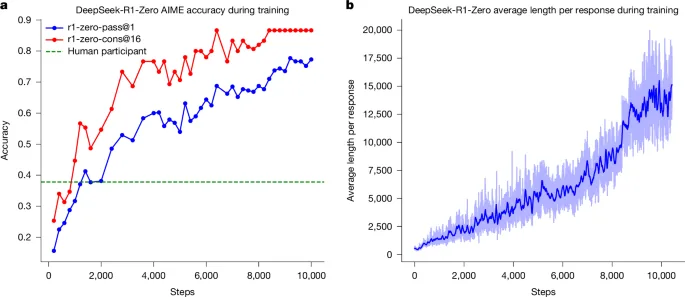
In January 2025, DeepSeek proved that large language models can develop advanced logical reasoning without human-labeled demonstration datasets. The experimental system, DeepSeek-R1-Zero, applied pure reinforcement learning directly to DeepSeek-V3 Base using Group Relative Policy Optimization (GRPO) with rule-based verification rewards. On the 2024 American Invitational Mathematics Examination, the model’s average pass rate leaped from 15.6% to 77.9% through self-evolution, reaching 86.7% with self-consistency decoding [5].
The model picked up smart thinking habits on its own. It learned to check past sums, fix mistakes, and spend more thinking tokens on tough prompts. DeepSeek researchers documented an internal discovery phase where the model started typing words like wait to rethink its path before outputting a final answer. Yet R1-Zero had real flaws. It mixed English and Chinese words in the same answer and had poor layout style. Researchers noted that early training stages produced erratic formatting across unstructured prompts [5].
To build a dependable production system, the team developed DeepSeek-R1 through a multi-stage pipeline that combined curated cold-start data, rejection sampling, and supervised fine-tuning across both mathematical and general writing tasks. A second reinforcement step shaped user tone without dulling core logic. DeepSeek published the results in Nature and shared open distilled weights from 1.5 billion up to 70 billion parameters for local laptops. Releasing these distilled models under the MIT License let small teams test chain-of-thought methods on cheap desktop cards without web calls. Later releases like DeepSeek-R1-0528 brought further gains in problem-solving speed, proving that compact distilled networks could inherit reasoning behaviors from massive teacher models [5].
Long Context Upgrades in DeepSeek V4
In April 2026, DeepSeek previewed its fourth model family built for million-token inputs. An unreviewed preprint submitted to arXiv showed two Mixture-of-Experts setups: the 1.6-trillion-parameter DeepSeek-V4-Pro activating 49 billion weights and the 284-billion-parameter DeepSeek-V4-Flash activating 13 billion weights. The team blended Compressed Sparse Attention with Heavily Compressed Attention, added Manifold-Constrained Hyper-Connections, and used the Muon optimizer to train on over 32 trillion tokens [6].
Long-horizon agent tasks created fresh compute bottlenecks, prompting the release of DeepSeek-V4.1-Flash in September 2026. Described in an unreviewed preprint, the 552-billion-parameter multimodal model adopted a Causal Encoder-Decoder build activating 8 billion parameters during input prefill and 16 billion parameters during token decoding, using FP4 KV caching to lower memory strain [7].
To trim cache bulk, DeepSeek-V4.1-Flash paired cross-layer cache reuse in CSA2 with an optimization called SWA Bounded Replay. In a million-token context setting, DeepSeek-V4-Pro takes only 10% of KV cache and 27% of FLOPs compared to V3.2, cutting memory in HBM to 890 bytes per token. The team also ported its tools to Chinese chips. Custom FlashMLA attention kernels reached up to 410 teraflops on Huawei Ascend 950 processors, proving that million-token runs can execute without Nvidia cards [7].
Benchmark Scores Against Western Models
Independent researchers have systematically tested how DeepSeek stacks up against leading labs. In The American Statistician, Gao and colleagues compared DeepSeek with Claude, Gemini, GPT, and Llama on short text classification tasks. DeepSeek beat Gemini, GPT, and Llama on author and citation checks while costing far less to run, though Claude retained an edge on specific benchmark categories. The statistical study showed that open Chinese models could rival top commercial systems on specific evaluation benchmarks [8].
Medical tests came next. Sandmann and colleagues wrote in Nature Medicine that DeepSeek-V3 and DeepSeek-R1 matched GPT-4o on clinical choices across 125 real patient cases. Because hospitals cannot send patient records to public cloud servers, open models let doctors run local checks safely behind clinical firewalls [9].
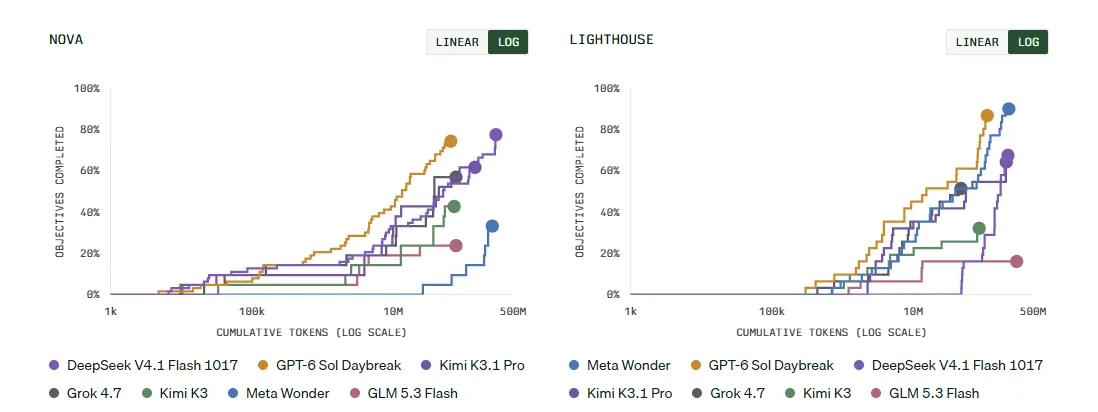
In cyber tests by Vals AI on simulated corporate networks, DeepSeek-V4.1-Flash demonstrated capable offensive reasoning without human supervision. Operating solo from an isolated machine starting with only a public web address, the open model hit 72.8% of penetration objectives in the Lighthouse test environment for roughly $3 per run, whereas OpenAI’s proprietary GPT-6 Sol Daybreak achieved 80.8% at $22 per evaluation. DeepSeek completed 21 of 31 objectives in under three hours. Vals researchers found the open model made most of its progress only after 100 million tokens, which proved that shorter test runs consistently underestimate the capability of open-weight systems [10].
Tool Use and the Agent Harness
DeepSeek grew from a text bot into an agent system. On 21 August 2025, DeepSeek-V3.1 brought hybrid thinking modes with 128K context, letting users switch between quick output and deep thought via chat templates [11]. DeepSeek-V3.2 followed on 1 December 2025 with tools trained on 1,800 simulated environments and 85,000 instructions, beating prior scores on Terminal-Bench and SWE-bench [12].
To help builders run agents, the firm released DeepSeek Harness under the MIT License. The code uses the Cordis plugin frame so developers can hot-swap tools, models, sandboxes, and storage layers without changing the application core. Developers can link these agents to the DeepInfer open-source inference framework for low latency on local servers [1].

Chatter about DeepSeek-V5 grew when coders spotted the tag in Harness test files. But those lines were mock tests with a nine-token context limit, not a real release. Chinese financial news outlet Caiwen reported on 3 November 2026 that V5 training remains in early planning for 2027. DeepSeek had earlier announced that deepseek-v4-pro traffic would route to V4.1-Flash starting at 04:00 UTC Time on Sep 14, 2026 until V4.1-Pro lands, but the lab later kept V4-Pro live on the API due to user demand. Note that the company roadmap indicates that larger models will arrive only after extensive stability trials [13].
Global Adoption and Policy Restrictions
The launch of DeepSeek-R1 shook the tech world. On 27 January 2025, DeepSeek passed ChatGPT as the top free app on the US iOS App Store. The news triggered a 17% single-day drop in Nvidia stock, erasing billions from markets. That same day, DeepSeek faced a heavy cyberattack that forced staff to pause new signups briefly before restoring access [14], [15].
Fast adoption triggered pushback from Western defense leaders. The US National Defense Authorization Act for Fiscal Year 2026 banned DeepSeek from military and intelligence hardware, and Canberra issued a federal directive removing DeepSeek from government systems [1].
Yet DeepSeek spread quickly across developing regions. In sub-Saharan Africa, DeepSeek teamed up with Huawei Cloud to give local firms cheap AI tools. Harrison Li, solutions architect for Huawei Cloud, told tech leaders at Nairobi startup Qhala that DeepSeek matches Silicon Valley tools on low-cost hardware. By avoiding pricey dollar fees, the open models gave African groups a way to build sovereign AI on local systems. Across Kenya and neighboring markets, local engineers used the models to power text processing, educational tools, and language research without relying on Western cloud platforms [16].
- WEBSITE Wikipedia. (2026). DeepSeek. [Article Link]
- WEBSITE Wikipedia. (2026). DeepSeek (AI). [Article Link]
- ONLINE NEWS Chen, C. (2025). How a top Chinese AI model overcame US sanctions. MIT Technology Review. [Article Link]
- PREPRINT DeepSeek-AI, Aixin, L., Feng, B., Bing, X., Wang, B., Wu, B., Lu, C., Zhao, C., Deng, C., Zhang, C., Ruan, C., Dai, D., Guo, D., Yang, D., Chen, D., Ji, D., Li, E., Lin, F., Fucong, D.,. Han, B. (2024). DeepSeek-V3 Technical Report. arXiv. [Article Link]
- ACADEMIC JOURNAL Guo, D., Yang, D., Zhang, H., Song, J., Wang, P., Zhu, Q., Xu, R., Zhang, R., Ma, S., Bi, X., Zhang, X., Yu, X., Wu, Y., Wu, Z. F., Gou, Z., Shao, Z., Li, Z., Gao, Z., Liu, A.,. Zhao, C. (2025). DeepSeek-R1 incentivizes reasoning in LLMs through reinforcement learning. Nature, 645(8081), 633-638. [Article Link]
- PREPRINT DeepSeek-AI, Xu, A., Lin, B., Xue, B., Wang, B., Xu, B., Wu, B., Zhang, B., Lin, C. Y., Dong, C., Ling, C., Lu, C., Zhao, C., Deng, C., Hou, C., Xu, C., Shao, C., Ruan, C., Sun, C.,. Ji, D. (2026). DeepSeek-V4: Towards Highly Efficient Million-Token Context Intelligence. arXiv. [Article Link]
- PREPRINT DeepSeek-AI, Xu, A., Li, B., Lin, B., Xue, B., Xian, B., Xu, B., Wu, B., Zhang, B., Deng, B., Yu, C. C., Jin, C., Lin, C., Dong, C., Wang, C., Feng, C., Lu, C., Zhao, C.,. Wang, C. (2026). DeepSeek-V4.1-Flash: Pushing the Limits of KV Cache Compression. arXiv. [Article Link]
- ACADEMIC JOURNAL Gao, T., Jin, J., Ke, Z. T., & Moryoussef, G. (2026). A Comparison of DeepSeek and other LLMs. The American Statistician, 80(1), 164-176. [Article Link]
- ACADEMIC JOURNAL Sandmann, S., Hegselmann, S., Fujarski, M., Bickmann, L., Wild, B., Eils, R., & Varghese, J. (2025). Benchmark evaluation of DeepSeek large language models in clinical decision-making. Nature Medicine, 31(8), 2546-2549. [Article Link]
- ONLINE NEWS Bastian, M. (2026). The gap between open and closed AI models in cyber capabilities keeps shrinking. THE-DECODER.com. [Article Link]
- WEBSITE DeepSeek. (2025). DeepSeek-V3.1 Release. DeepSeek API Docs. [Article Link]
- WEBSITE DeepSeek. (2025). DeepSeek-V3.2 Release. DeepSeek API Docs. [Article Link]
- ONLINE NEWS Vojtechova, L. (2026). DeepSeek V5 Release Date: What We Know So Far. Fello AI. [Article Link]
- ONLINE NEWS Field, H. (2025). China’s DeepSeek AI dethrones ChatGPT on App Store: Here’s what you should know. CNBC. [Article Link]
- ONLINE NEWS Kerr, D. (2025). DeepSeek hit with ‘large-scale’ cyber-attack after AI chatbot tops app stores. The Guardian. [Article Link]
- ONLINE NEWS Rai, S., Prinsloo, L., & Nyambura, H. (2025). China’s DeepSeek Is Beating Out OpenAI and Google in Africa. Bloomberg.com. [Article Link]


