




Can a dead star shine with an eerie emerald hue? For centuries, astronomers believed stellar colors followed a simple thermal rule where surface heat dictated every visible shade. New research led by Mark Hollands at the University of Warwick shows that dead white dwarfs can depart from that pattern when dense atmospheric gases filter their radiation. The team identified WD J1330+6435 as the first confirmed green star after its heavy atmospheric layer absorbed orange wavelengths of light [2].
- Why Dense White Dwarfs Defy Standard Colors
- WD J1330+6435 Becomes the First Known Green Star
- How Planetary Debris Fuels a Green Star Atmosphere
- Convection Brings Core Carbon to Produce Deep Salmon Tones
- How Spectral Fingerprints Reveal True Chromaticity
- Surveying One in Thirty Oddly Colored Stellar Remnants
Why Dense White Dwarfs Defy Standard Colors
In typical stars, surface temperature governs the light emitted into space, where cool stars look orange, solar analogues appear white, and the hottest active stars shine with a pale blue tint [2]. Astronomers compare this heating process to a blacksmith working iron until it glows dull red, then orange, and finally white-hot. White dwarfs form when stars with a mass similar to the sun exhaust their nuclear fuel and collapse under their own gravity, compressing solar mass into an Earth-sized sphere with an outer layer as dense as water, which is millions of times denser than the solar photosphere.
When matter reaches a density of one gram per cubic centimeter, heavy elements interact with surrounding helium plasma. Those tight atomic collisions broaden absorption zones so much that whole bands of color vanish from outgoing starlight [3].
Mark Hollands said: “Most stars, including most white dwarfs, behave like ‘perfect radiators,’ so their colour is set almost entirely by temperature. But nobody had really looked into what else might be possible for white dwarfs” [2]. Just as simulations linking early black holes to little red dots showed that compact environments skew radiation in surprising ways, white dwarf envelopes bend old assumptions of stellar appearance [1].
WD J1330+6435 Becomes the First Known Green Star
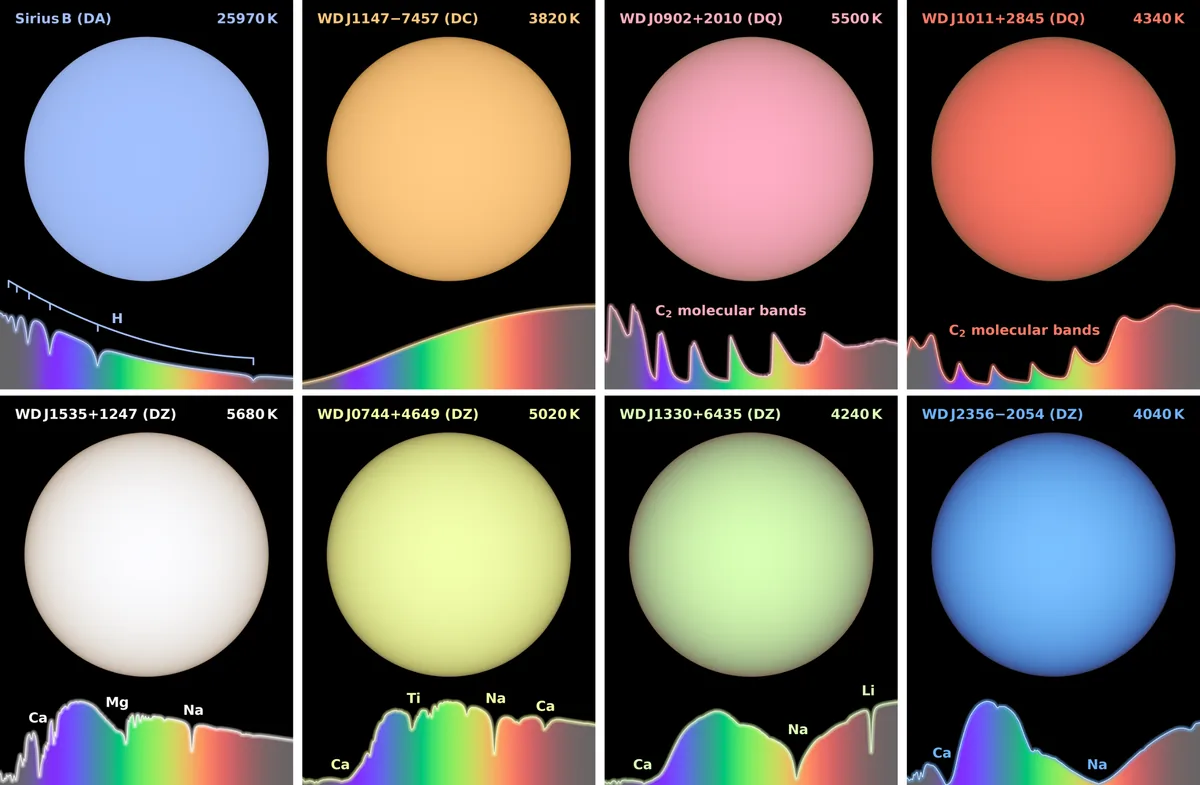
The clearest example of this unexpected shift occurs in a cool stellar corpse cataloged as WD J1330+6435, which sits approximately 284 light-years away from Earth in popular estimates, though some models place it near 326 light-years [3]. Over billions of years, the star cooled to a surface temperature of about 7,232 degrees Fahrenheit (4,000 degrees Celsius). Normal stars at that temperature radiate an orange glow. Yet calculations of its spectrum reveal an eerie chartreuse tone that human eyes would see as green.
Astronomers believe WD J1330+6435 gained its tint by swallowing pieces of its former planetary system. The white dwarf steadily accreted that debris, pulling calcium, lithium, and sodium into its outer layers [2].
In thin gas, sodium atoms cast a pair of sharp yellow emission lines, familiar from older streetlights. In this star, high atmospheric pressure broadens that sodium band until it swallows almost all yellow, orange, and red light [4]. Because sodium removes the warmer wavelengths, only green light escapes into space without heavy absorption. Hollands said: “The traces of sodium in the atmosphere of this white dwarf absorb the orange part of the spectrum, leaving behind a ghostly green glow” [2]. Standing on an orbiting world would feel like science fiction.
How Planetary Debris Fuels a Green Star Atmosphere
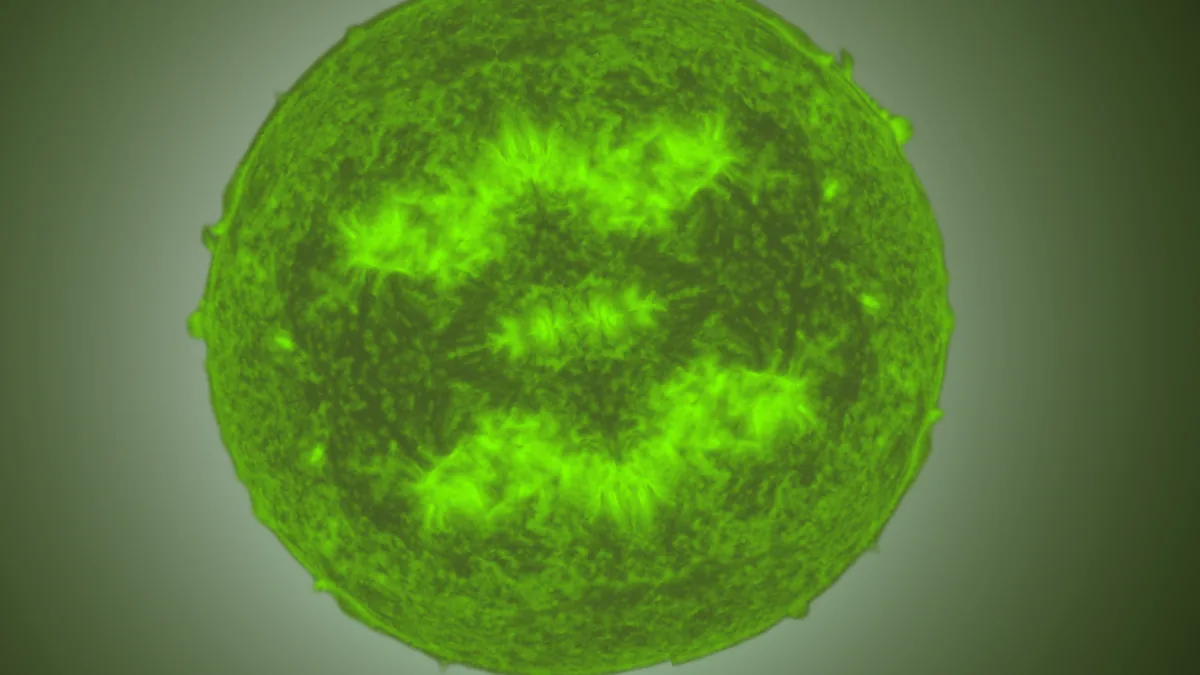
This green appearance depends on a process known as stellar pollution. White dwarfs have strong surface gravity that pulls heavy elements downward toward their centers within days or weeks. When astronomers spot calcium or sodium on a white dwarf, those elements must have arrived recently from external debris [3]. Asteroids, comets, or shattered moons that stray too close get pulverized and vaporized into gas. The remnants form a dusty accretion disk that slowly settles onto the stellar surface, altering its chemistry before the heavy atoms sink below visibility [2].
Different chemical mixes yield different chromatic appearances. White dwarfs enriched with iron and debris from comets often take on a pale yellow hue, while cooler remnants with mixed hydrogen and helium envelopes produce cyan or pale blue tones [3].
These collision-induced absorptions block red photons, shifting the balance toward shorter wavelengths. Just as research into ancient stars as potential havens for life examines how long-lived radiation shapes local environments, tracking white dwarf spectra helps scientists map the fate of ancient planetary systems [1]. The findings also offer a glimpse into the distant fate of our own solar system. Billions of years from now, the sun will expand into a red giant before shedding its outer gas to leave behind a cooling white dwarf [2].


Convection Brings Core Carbon to Produce Deep Salmon Tones
While green marks one extreme of atmospheric filtration, carbon creates another visual anomaly at the opposite end of the spectrum. The research team found WD J1011+2845, a stellar remnant sitting roughly 48 light-years away, which may be the reddest star yet recorded [2]. This white dwarf gets its hue from deep within its own structure. A deep convection zone extends down toward the core, dredging up ancient carbon atoms to the surface envelope [3].
At high atmospheric pressures, these carbon atoms bond into diatomic carbon molecules that absorb light across wide swaths of the visual spectrum, squeezing nearly all escaping light into wavelengths longer than 600 nanometres [3].
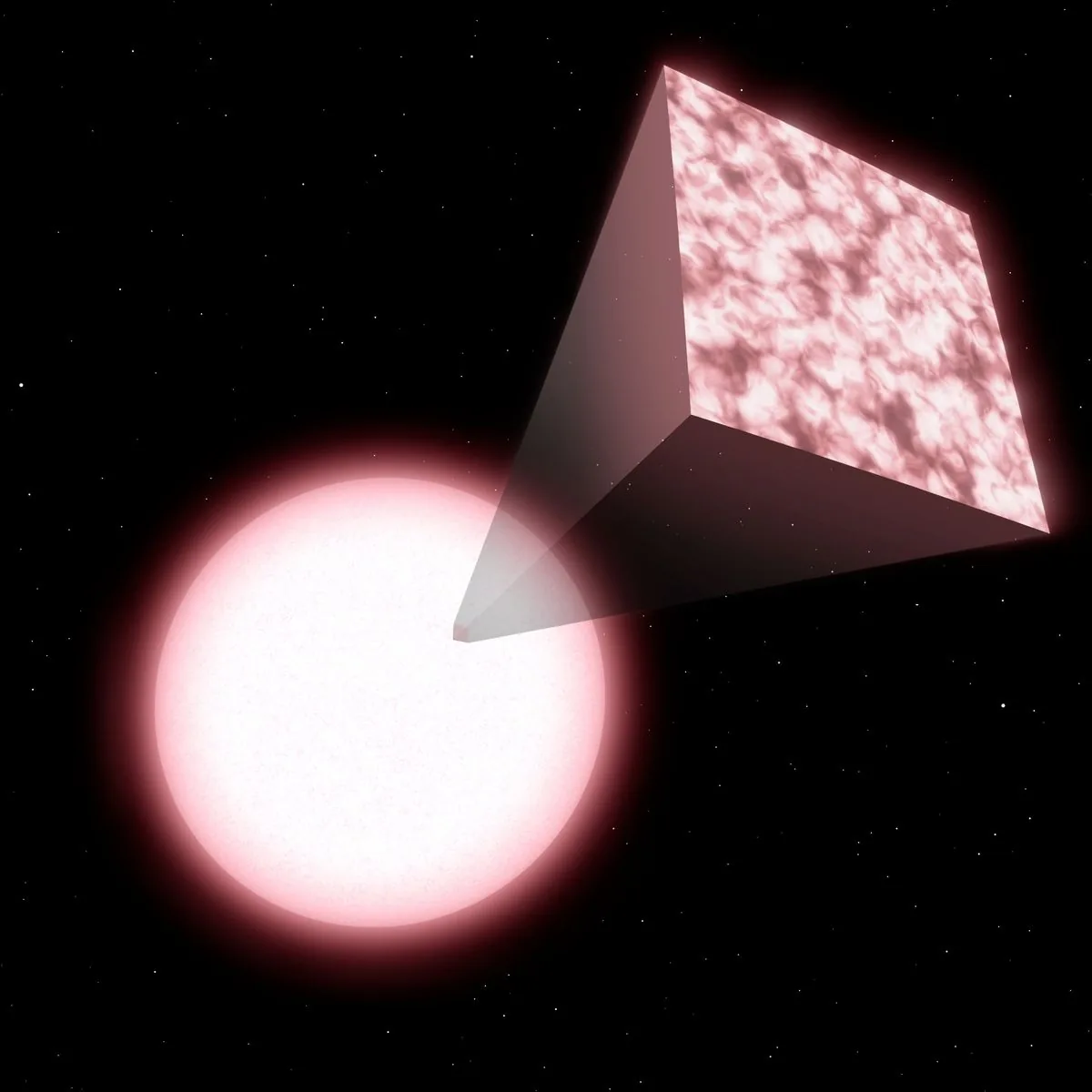
Because the shorter blue, green, and yellow photons can’t escape, the remaining radiation produces a deep salmon-pink glow. Other carbon-rich white dwarfs glow with purple or magenta hues depending on their exact atmospheric pressure and temperature [4]. Objects enriched from below dredge up internal material through convection, whereas objects enriched from above accrete rocky shards from old planetary systems [1]. While some astronomical outbursts like supernova impostors that mimic star death without exploding briefly alter their brightness through violent surface flares, these white dwarfs alter their colors through steady atmospheric equilibrium [2].
How Spectral Fingerprints Reveal True Chromaticity
None of these white dwarfs is close enough to Earth for human observers to see their colors directly through an optical eyepiece, since their compact surfaces emit modest total luminosity [2]. Ground telescopes reveal only faint, shimmering points of light. To determine how these objects would actually look to the human eye, the Warwick researchers turned to spectroscopy, using a spectrometer that splits starlight into individual wavelengths to record which colors get absorbed [3].
The researchers fed those measured spectra into a computer model calibrated to the spectral sensitivity of human retinal cones, which rely on three photopigments sensitive to blue, green, and red light [3].

By calculating how cone cells respond to filtered stellar photons, the algorithm determined the precise chromaticity coordinates for each star. That modeling confirmed that the chartreuse tint of WD J1330+6435 triggers human green photoreceptors strongly enough to register as a genuine green star. The team published their computational framework and color calculations in the journal RAS Techniques and Instruments [1]. This spectral approach corrects a long-standing observational bias in astronomy, where surveys favored hot, bright white dwarfs that glowed pale blue over cooler remnants [4].
Surveying One in Thirty Oddly Colored Stellar Remnants
To test how common these colorful stellar remnants are, the team analyzed a volume-complete sample of 151 white dwarfs within 65 light-years (20 parsecs) of Earth, finding only five stars that displayed unusual chromatic properties [3]. Two glowed yellow, and three glowed pink. None of the white dwarfs in that immediate radius appeared green [2]. That local ratio suggests that roughly one in 30 white dwarfs shines with an odd color rather than an ordinary white or blue glow.
The researchers also evaluated the remaining 146 white dwarfs in the survey to find the typical appearance of a stellar remnant. The median color temperature of the sample came out to approximately 6,800K, which human eyes perceive as neutral white [3].
Boris Gänsicke said: “Yet if we take the median across a representative population of white dwarfs, we found that the average white dwarf really is white”. While unusual colors represent an outlier group, the vast size of the Milky Way means millions of oddly colored dead stars drift through space. As Gänsicke explained, “One in thirty might not sound like a huge fraction, but across the entire population of white dwarfs in the universe, that is still a lot of oddly colored stars out there” [2]. Discovering that WD J1330+6435 shines as a green star proves that dying stars can break old rules when planetary chemistry intervenes [4].
- ACADEMIC JOURNAL Hollands, M. A., Gänsicke, B. T., Tremblay, P., & Koester, D. (2026). Any colour you like: the diverse chromaticities of white dwarfs. RAS Techniques and Instruments, 5. [Article Link]
- ONLINE NEWS Lea, R. (2026, October 15). Astronomers discover the 1st ever green star, a cosmic zombie just in time for Halloween. Space.com. [Article Link]
- ONLINE NEWS Baisas, L. (2026, October 15). Astronomers discover first green star and the reddest star ever recorded. Popular Science. [Article Link]
- ONLINE NEWS Knowridge Science Report. (2026, October 15). Astronomers discover a green star hiding in our galaxy. Knowridge Science Report. [Article Link]
APA 7: TWs Editor. (2026, October 16). The First Green Star Emerges from a Planetary Feeding Ground. PerEXP Teamworks. https://perexpteamworks.com/en/green-star-discovered-white-dwarf/


