




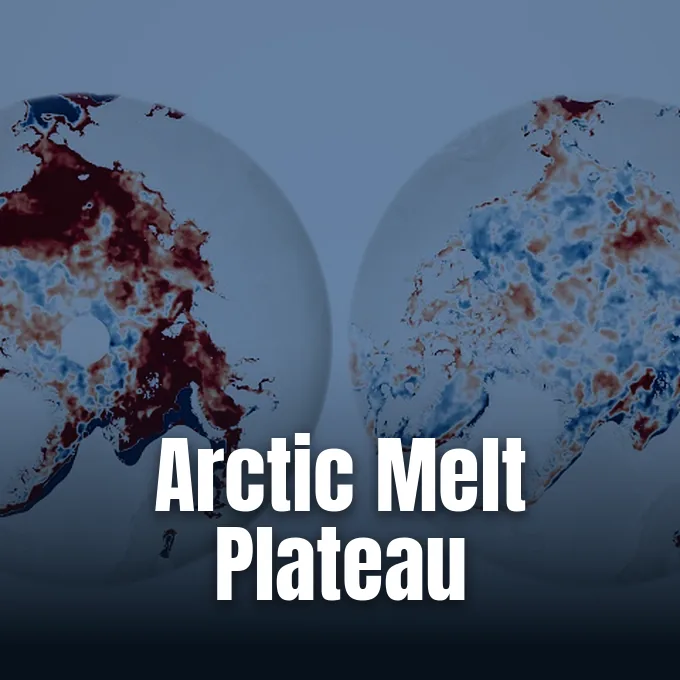
For most of the satellite era, Arctic sea ice has melted earlier each spring and frozen later each fall. A NASA-led study now finds that this stretching of the melt season stopped around 2010 [1]. The Arctic sea ice melt season is still about 40 days longer than it was in 1979, but nearly all of that growth happened before 2010; since then the average has held roughly steady while individual years swing widely.
Satellite Observations Reveal Unexpected Melt Plateau
The team used satellite observations from 1979 to 2023 to pin down, for each year, when the ice began to melt in spring and when it refroze in autumn. The paper, by Linette Boisvert of NASA’s Goddard Space Flight Center with C. Parker, E. Valkonen and R. Tilling, appears in Communications Earth & Environment [1]. Its headline result runs against what the earlier record suggested: after three decades of steady lengthening, the average season stopped growing and settled into a pattern of large year-to-year swings.
NASA’s own summary of the work describes the same thing in plainer terms: the mean length has “remained relatively unchanged” since 2010, “despite large year-to-year fluctuations” [3].
The fastest growth came in the 2000s, the decade of rapid ice loss. A plateau is not a recovery, and the authors are careful to say so. The average stopped moving because thinner ice now reacts strongly to each year’s weather, so a short season one year and a long one the next can leave the decadal average flat [1].

Why Arctic Sea Ice Melt Shifted After 2010
The method is not new. In 2009, T. Markus, J. C. Stroeve and J. Miller used the same kind of satellite record in the Journal of Geophysical Research: Oceans to show that melt onset was arriving earlier and freezeup later across the Arctic Ocean, lengthening the season on both ends [2]. What the new study adds is the record that came after, and those years do not continue the line Markus and colleagues drew.
Seasons shifting out of their old shape is a theme well beyond the Arctic; researchers have tied changing seasonality to more extreme heat events at lower latitudes too. In the Arctic, Boisvert’s team describes a variable regime, in which the weather of a given summer can cancel out, or amplify, the extra sunlight absorbed by open water [1].
The key change is the loss of multiyear ice (thick ice that survives at least one summer without melting away). “Previously, there was more of this multiyear ice that didn’t melt away each summer,” Boisvert said. “Now that the ice is thinner and there’s less of it, there’s a lot more variability” [4]. Younger, thinner ice is more exposed to swings in cloud cover, storms and winds.
Delayed Autumn Freezeup Drives Four-Decade Extension
Tracking the precise dates of spring melt onset and autumn freezeup proved essential for deciphering the 40-day expansion recorded between 1979 and 2023. When Boisvert and her colleagues dissected forty-four years of satellite observations, they found that the lengthening was driven primarily by sea ice freezing later in the autumn rather than melting earlier in the spring [1]. Open water left behind in summer absorbs far more sunlight than ice does, and that heat has to leave the ocean before new ice can form. So the Arctic sea ice melt season grew mostly at its autumn end, as the ocean held on to summer heat.
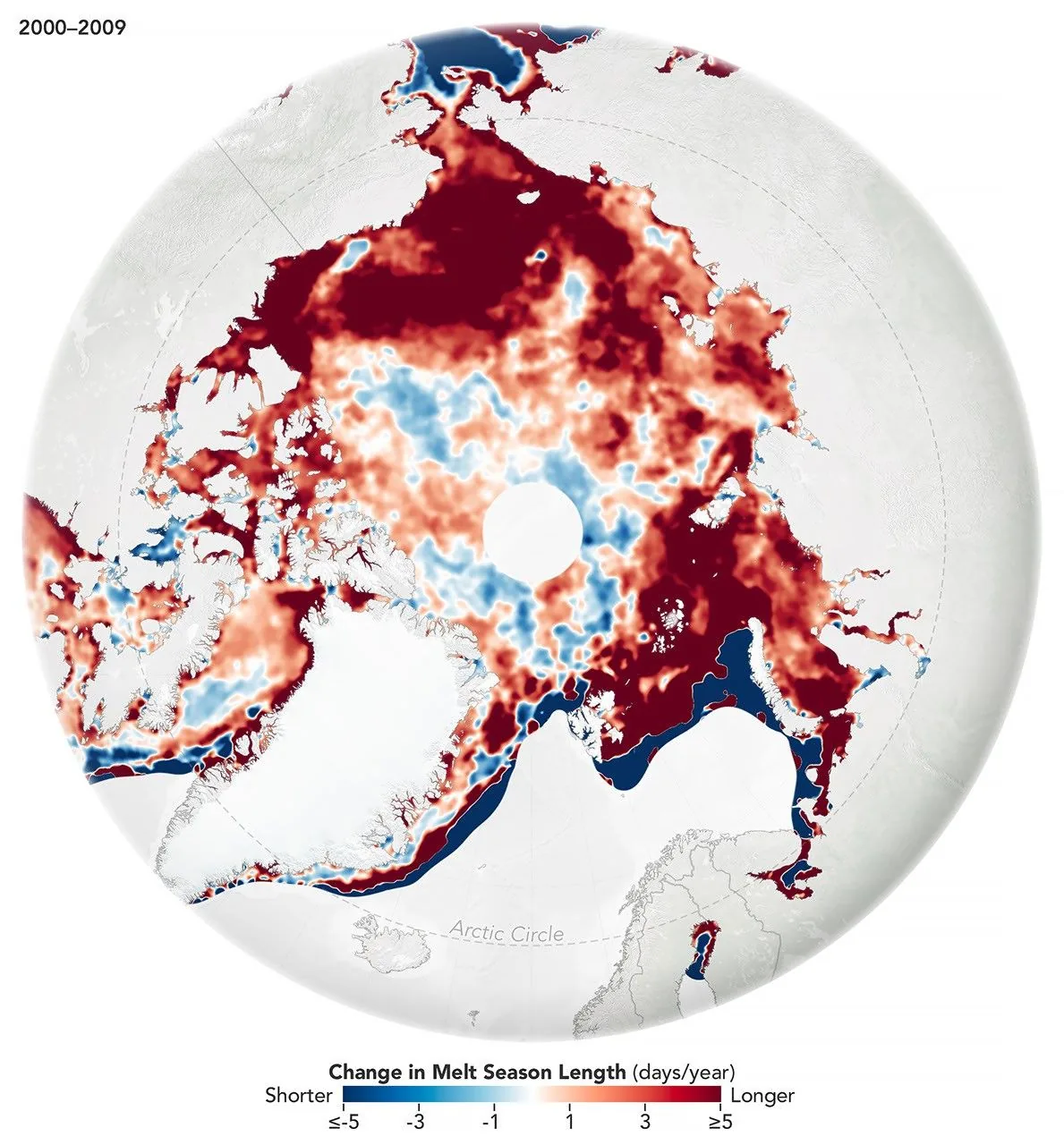
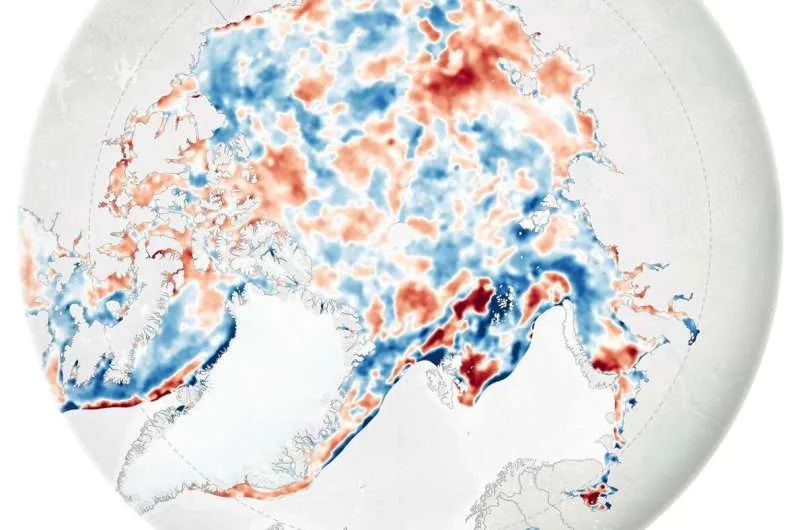
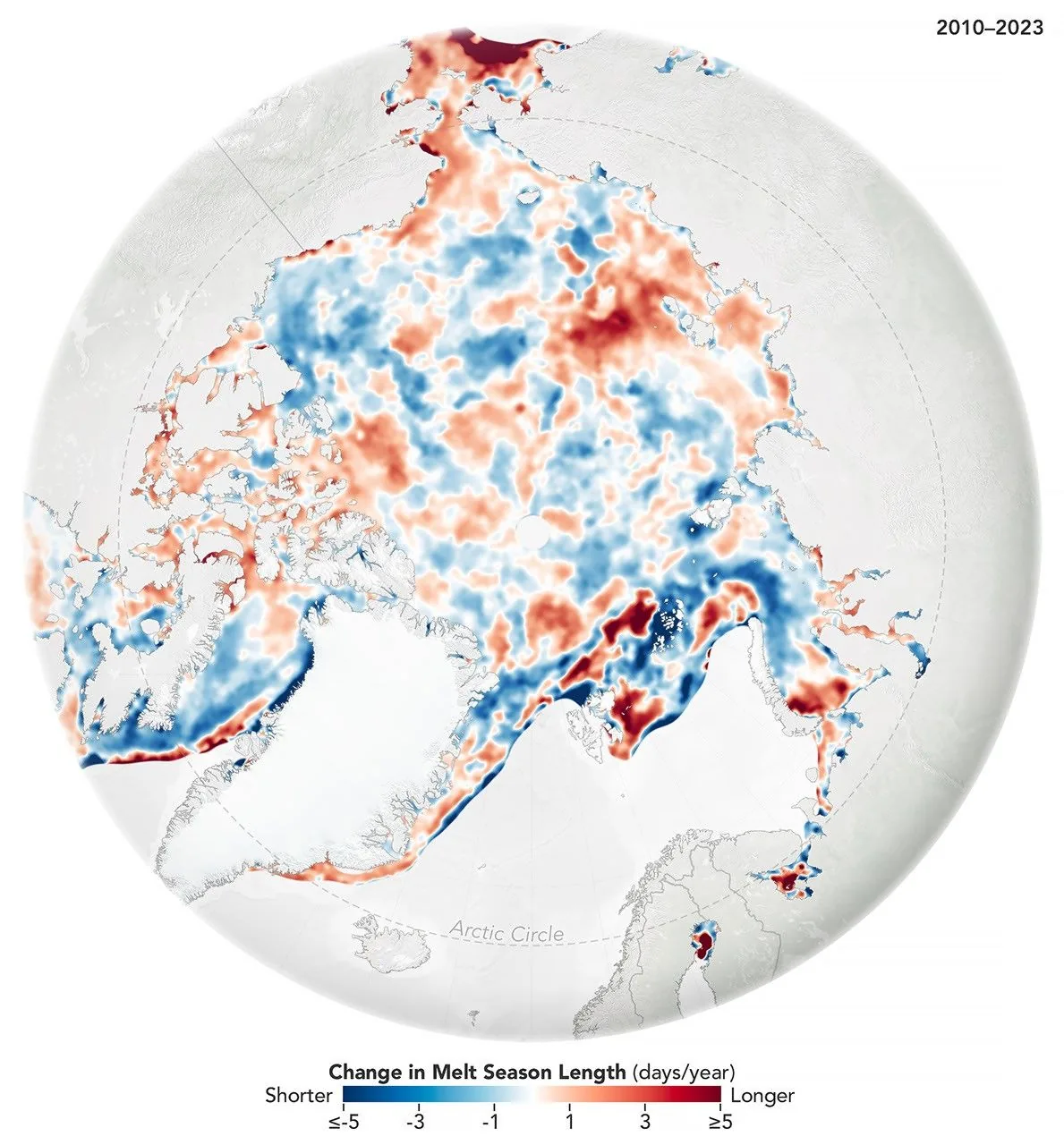
That mechanism peaked in the 2000s. On the NASA Earth Observatory map of that decade, prepared by Michala Garrison, the reddest areas are where the melt season grew by up to 5 days per year [3]. On the companion map for 2010 to 2023, the same regions fade to pale blues and reds.


Atmospheric Energy Balance and Shifting Cloud Cover
To explain why the rapid expansion halted, the research team analyzed changes in the Arctic’s energy balance (the net difference between incoming heat from the Sun, atmosphere, and ocean and the outgoing infrared radiation emitted back to space). At the scale of a single crystal, physicists are still working out how the surface of ice begins to melt below zero; at the scale of an ocean, what matters is reflectivity, or albedo. Snow-covered ice reflects most sunlight, dark water absorbs most of it, and during the 2000s every summer of ice loss exposed more water and absorbed more heat [1].
After 2010, clouds changed the balance. Shifting cloud patterns reduced the sunlight reaching parts of the Arctic Ocean, and the extra solar heating that had driven the 2000s slowed down [4]. The result, in NASA’s words, is a melt season that “fluctuates from one year to the next but remains relatively stable over longer periods” [3].
Nothing in the study suggests the clouds are a lasting shield. “Melt season length is much more dependent on atmospheric effects,” Boisvert said. “They seem to be playing a bigger role because the ice is generally thinner and more vulnerable to begin with” [1]. In other words, the Arctic may have entered a phase in which each year’s weather decides more of the outcome than the long-term trend does.
Vulnerability of Modern Thin Seasonal Ice
Thick multiyear ice used to act as a buffer: it took more than one warm summer to remove it, so a single unusual year left little mark on the record [4]. Much of the Arctic’s ice is now younger and thinner, and thin ice responds to every warm spell or calm, cloudy stretch. That is why the Arctic sea ice melt record since 2010 looks jagged rather than smooth.
Despite the observed plateau in melt season length, the Arctic continues warming nearly four times faster than the global average. The authors stress that the findings do not mean climate change has stopped affecting the region [1]. The remaining sea ice is substantially thinner than it was several decades ago, and a flat line for season length says nothing about how much ice is left at the end of each summer.
The decline in sea ice thickness and extent seen during the 2000s “appears to have stopped for the time being,” NASA writes [3]. The qualifier matters as much as the finding.
Perennial Ice Bastions and Future Polar Trajectories
Thick multiyear ice has not vanished entirely from polar waters; resilient expanses continue to survive north of Greenland and throughout the Canadian Arctic Archipelago. These regions hold the last of the thick ice that once covered much of the basin [1]. The researchers warn that continued thinning there could trigger another period of rapid ice loss and lengthen the melt season again, which would make the post-2010 plateau look like a pause rather than a new normal.
Which of those it turns out to be depends on data that does not exist yet. The study’s closing point is a practical one: only an unbroken satellite record, and continued measurements of the Arctic’s energy balance, will show whether the plateau holds [3]. The answer will probably be written in the perennial ice north of Greenland, and in whether the Arctic sea ice melt season starts to grow again once that ice thins [1].
- ACADEMIC JOURNAL Boisvert, L., Parker, C., Valkonen, E., & Tilling, R. (2026). A recent stabilization in the lengthening of the Arctic sea ice melt season into a highly variable regime. Communications Earth & Environment, 7(552). [Article Link]
- ACADEMIC JOURNAL Markus, T., Stroeve, J. C., & Miller, J. (2009). Recent changes in Arctic sea ice melt onset, freezeup, and melt season length. Journal of Geophysical Research: Oceans, 114(C12). [Article Link]
- WEBSITE Riordon, J. (2026, September 21). Arctic Melt Season Length Levels Off. NASA Science / NASA Earth Observatory. [Article Link]
- ONLINE NEWS Riordon, J. (2026, September 21). Satellite record reveals Arctic melt season has plateaued after decades of lengthening. Phys.org. [Article Link]
APA 7: PerEXP Teamworks. (2026, September 22). Arctic Sea Ice Melt Season Stabilizes in Variable Regime. PerEXP Teamworks.


