





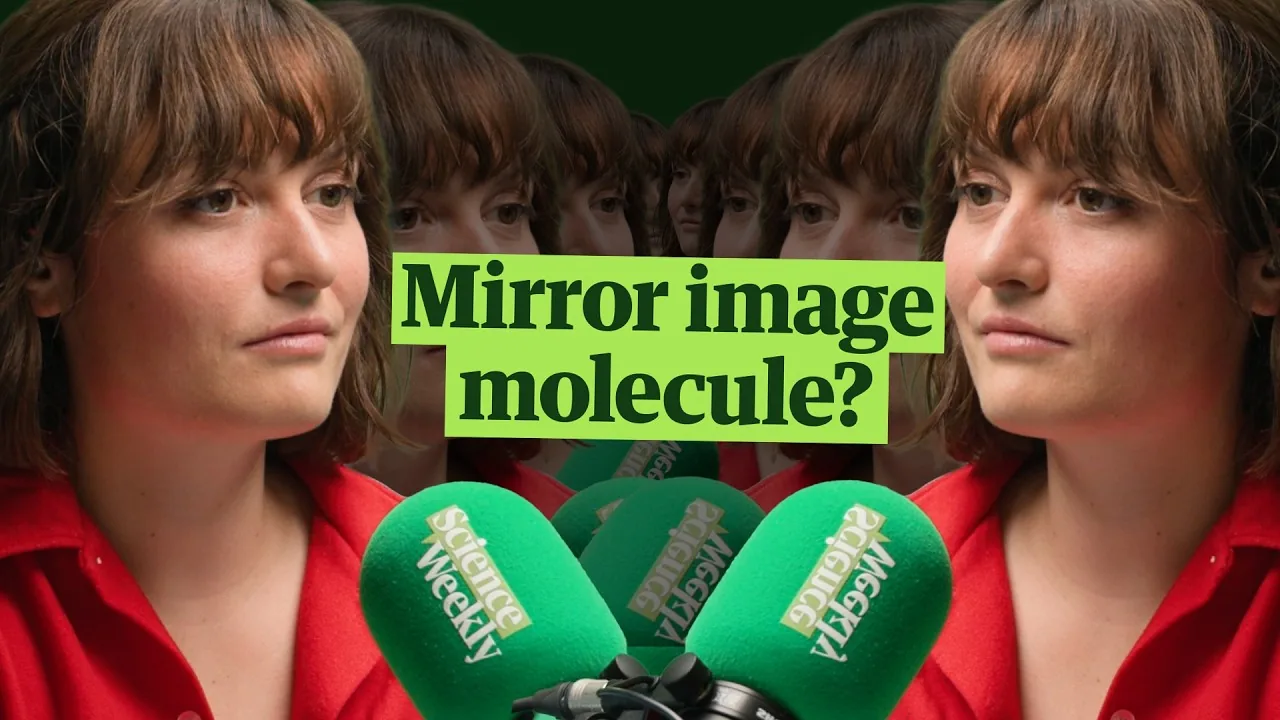
The Royal Swedish Academy of Sciences awarded the 2026 Nobel Prize in Chemistry to Henri B. Kagan and Kenso Soai for solving a longstanding puzzle about how mirror-image molecules form in nature. Many organic compounds exist in two mirrored versions that share the same chemical formula but cannot be superimposed on each other, much like human hands. For decades, synthetic laboratory reactions routinely yielded equal quantities of both shapes, leaving scientists unable to explain how living cells came to rely almost exclusively on single-handed building blocks. By designing asymmetric reactions that favor one mirrored form over the other, Kagan and Soai gave chemists practical methods to synthesize targeted compounds for modern pharmaceuticals [3].
How the 2026 Nobel Prize in Chemistry Emerged
Biological chemistry is fundamentally one-handed, a structural trait that researchers call homochirality after the Greek word for hand. Across terrestrial biology, cellular enzymes assemble protein chains using L-amino acids, whereas the structural sugars supporting DNA and RNA adopt the opposite D-configuration (molecules that exist as nonsuperimposable mirror images). Even though both mirrored variants contain identical atoms and bonds, their three-dimensional orientation dictates how they dock into biological receptors [3].
When synthetic chemists attempt to create chiral molecules from simple starting materials in ordinary laboratory flasks, the chemical reactions typically generate equal fifty-fifty mixtures of both mirror forms, known as racemates. Because the two halves possess identical physical properties such as boiling points and molecular weights, separating them after the reaction finishes requires tedious purification steps that waste half of the synthesized material. For more than a century, chemists could not explain how prebiotic Earth could have produced one-handed molecules without an existing biological guide [5].
Everyday sensory experiences demonstrate why molecular handedness matters so profoundly to biological organisms. For example, one mirrored form of the compound limonene produces the familiar scent of oranges, whereas its opposite mirror partner smells like lemons because human olfactory receptors are built from left-handed amino acids. Similarly, one form of the molecule carvone creates the aroma of caraway seeds and helps prevent stored potatoes from spoiling, while its mirrored twin smells like spearmint and repels mosquitoes [4].
Is Nobel Prize Awarded for Chemistry?
The Nobel Prize is awarded for chemistry annually to recognize foundational breakthroughs in molecular science, having been presented 118 times since the original prize was awarded in 1901. Across that history, the committee has honored 202 prize winners representing 200 distinct individuals, because Frederick Sanger and Barry Sharpless each received the award twice. Only 8 women have won the chemistry prize so far, while the youngest laureate was 35 years old and the oldest recipient stood at 97 at the time of recognition [6].
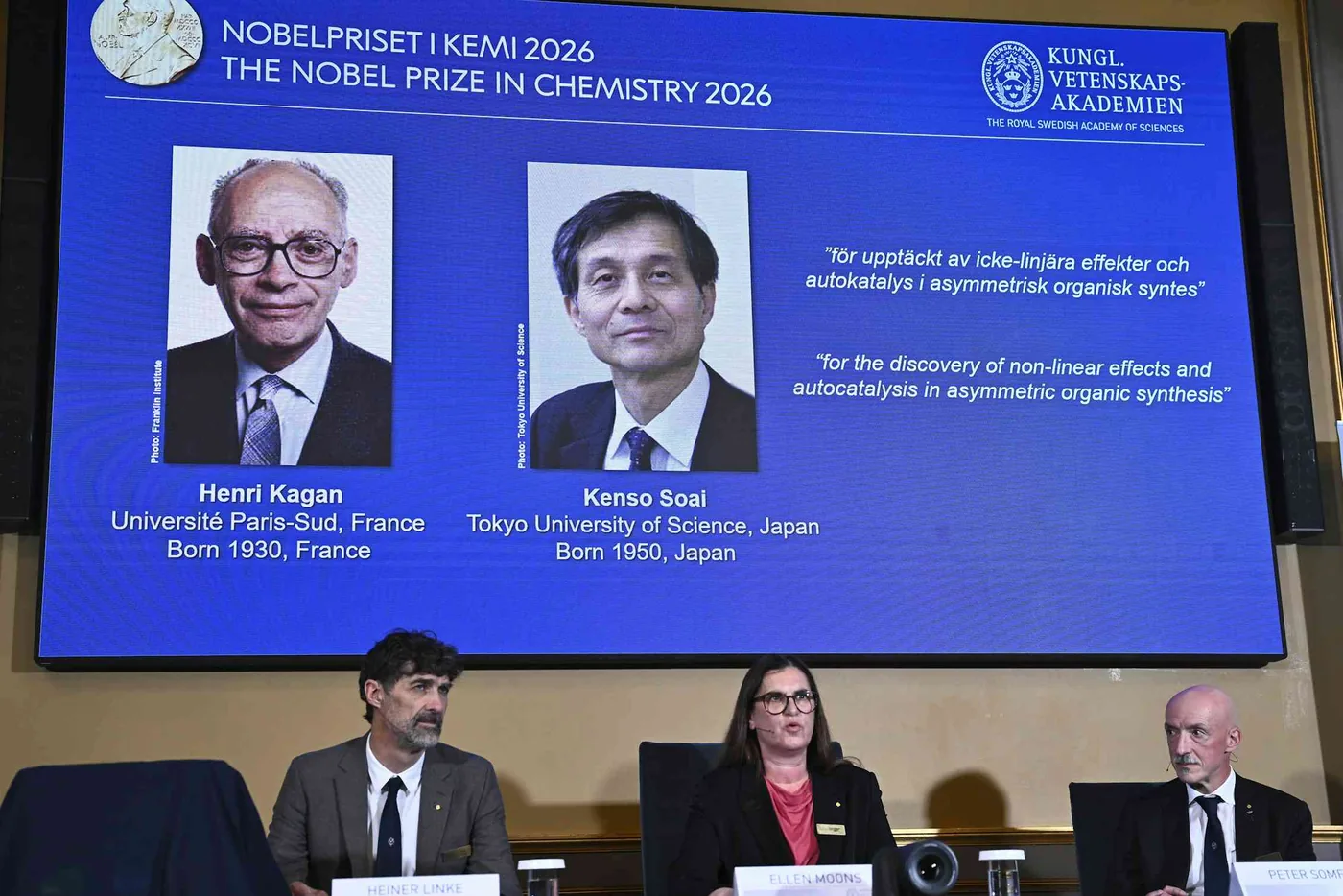
The Royal Swedish Academy of Sciences announced that Kagan and Soai will share an equal division of the 12 million Swedish kronor purse, which equals roughly 1.2 million dollars. Connecting modern laboratory breakthroughs with historical scholarship, such as work on Harvard Nobel laureates in modern science, shows how international recognition tracks long-term conceptual shifts rather than quick experimental trends. The chemistry prize had previously honored asymmetric catalysis in 2001 and 2021, showing that controlling molecular shape remains central to scientific progress [6].
Swedish chemist Christina Moberg, an emeritus professor at KTH Royal Institute of Technology and an academy member, pointed out that this selection honors the specific phenomena the laureates discovered rather than standard catalytic frameworks. Instead of building another routine catalyst, the two winners revealed unexpected reaction pathways that break symmetry spontaneously. Their work showed how small molecular biases grow into dominant outcomes [7].
How Kagan Discovered Nonlinear Catalytic Effects
Henri B. Kagan, who was born at Boulogne-Billancourt in 1930 and serves as an emeritus professor at Université Paris-Saclay, initiated the modern understanding of asymmetrical reaction control in 1986. Before his publications, organic chemists had operated under the assumption that a chiral catalyst could only transfer its handedness in a strict linear proportion to the newly synthesized product, meaning that a catalyst with ten percent excess of one hand could never yield more than ten percent excess in the resulting mixture. Kagan overturned that belief by showing that mixtures containing both forms of a chiral catalyst could yield far greater product purities than their starting ratios suggested, reporting these breakthrough nonlinear effects in asymmetric oxidations within the Journal of the American Chemical Society [2].
Kagan showed that when left-handed and right-handed catalyst molecules associate in solution, they can form dimeric complexes that exhibit vastly different catalytic reaction speeds. If the mixed pairs prove less reactive than the pure single-handed pairs, the reaction selectively consumes the dominant hand, multiplying an initial tiny imbalance into an overwhelming excess of the desired product. Erick M. Carreira, an organic chemist at the Swiss Federal Institute of Technology ETH in Zurich, said that Kagan’s discovery proved useful across synthetic laboratories because it freed chemists from needing absolute enantiomeric purity in their starting catalysts [7].


Kenso Soai and the Breakthrough of Autocatalysis
Kenso Soai, born in Hiroshima in 1950 and now a lecturer at Tokyo University of Science, took Kagan’s concepts further by asking whether chemical reactions could achieve homochirality without any initial chiral catalyst at all. In 1995, Soai published a seminal paper in Nature outlining the theoretical and experimental possibility of an organic reaction that could amplify its own symmetry breaking [5].
In 2003, Soai succeeded by demonstrating the alkylation of a pyrimidine aldehyde using diisopropylzinc, creating a reaction governed by autocatalysis (where the created molecule catalyzes its own formation). In this reaction, the chiral product acts as an asymmetric template for incoming reagents, producing more molecules of its own mirrored hand while suppressing the opposite variant. Starting from almost imperceptible statistical fluctuations or tiny isotopic differences, the reaction amplifies the favored enantiomer until it comprises 99.99 percent of the final yield. Peter Somfai, a member of the Nobel Committee for Chemistry from Lund University, called Soai’s experiment “probably the coolest experiment in organic chemistry ever” [3].
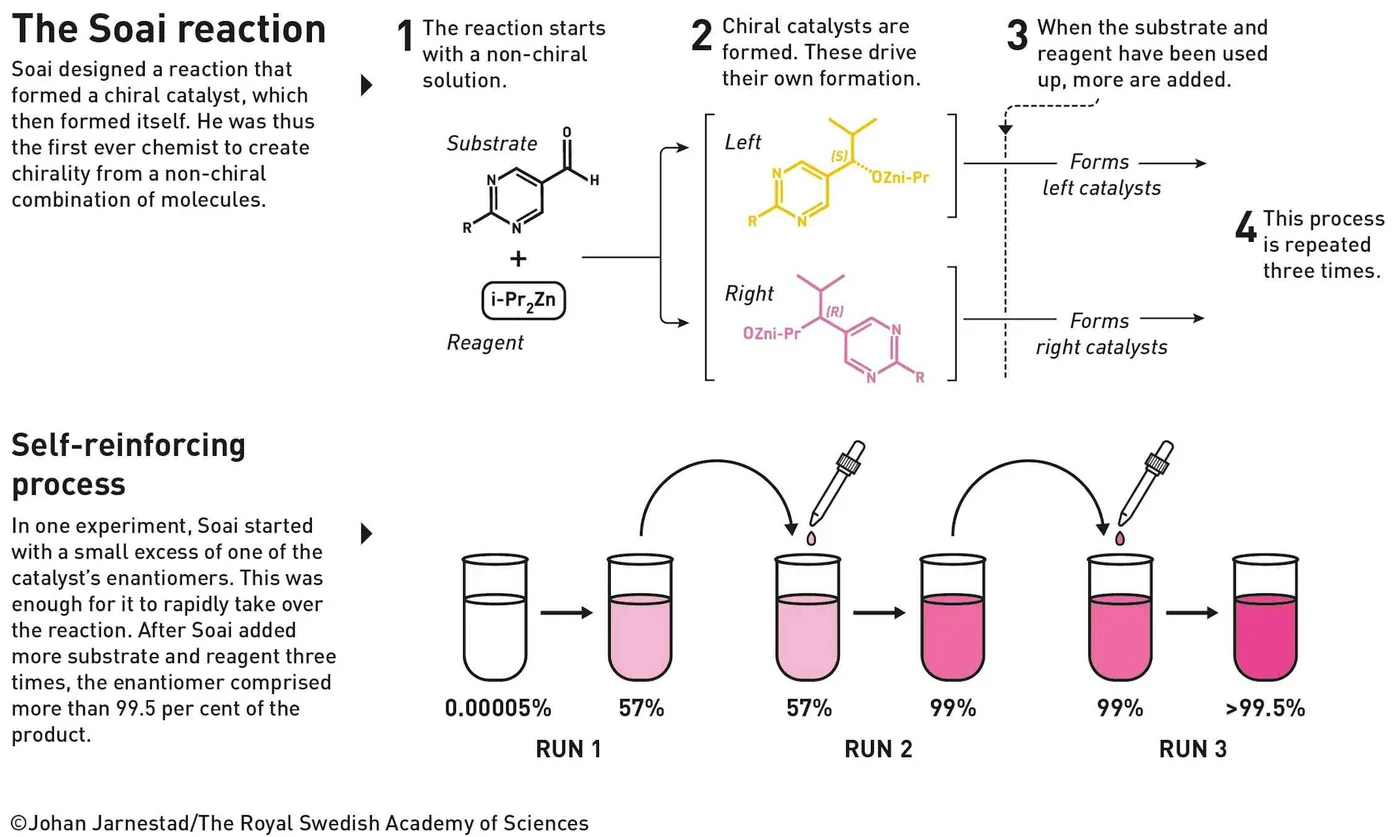
An academic overview by Matthew Addicoat, published as a preprint that has not yet undergone formal peer review, points out that the Soai reaction provided the first laboratory proof of spontaneous homochirality since the dawn of life four billion years ago. By demonstrating how nonchiral starting reagents can generate a single-handed product from scratch, Soai offered an experimental model for how prebiotic Earth may have established its original biochemical preference [1].
Why Chirality Matters for Safer Pharmaceuticals
Controlling chiral reactions carries immense practical importance for human healthcare because more than half of clinically approved therapeutic medications are chiral. As organic chemist Andre Cobb from King’s College London said, “Although these molecules look very similar, they can behave very differently when they interact with other molecules,” which means that mirrored versions of a drug can produce distinct physiological reactions [3].
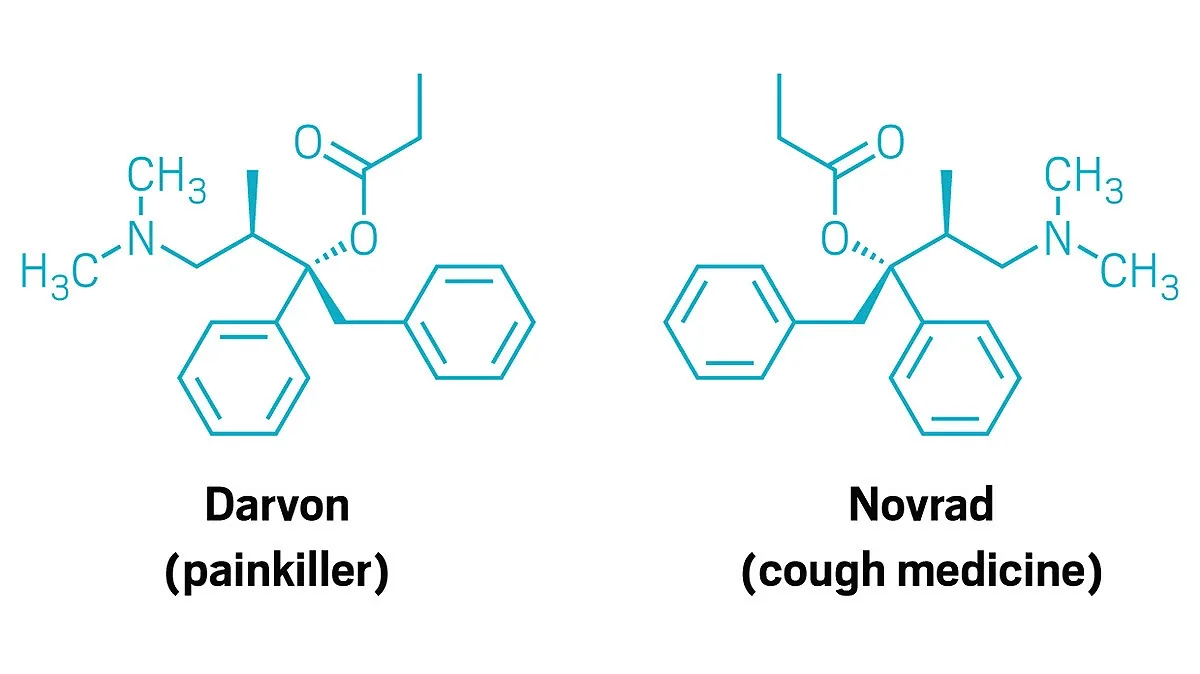
The most tragic demonstration of molecular handedness occurred during the 1950s and early 1960s with the sedative thalidomide, which doctors prescribed to pregnant women suffering from morning sickness. While the right-handed version acted as a safe sleep aid, the left-handed mirror twin caused severe limb malformations in thousands of newborn children [5]. A milder pharmaceutical example arose at Eli Lilly and Company in the 1960s, where chemists developed Novrad as a cough medicine and its mirror twin Darvon as a prescription pain reliever [7].
Because biological receptors fit chiral molecules like keys into locks, pharmaceutical companies rely on innovative catalytic chemical synthesis to manufacture pure enantiomers instead of crude racemic mixtures. Rigoberto Hernandez, president of the American Chemical Society, said the prize serves as “a reminder that chirality, or handedness, matters” whenever chemists attempt to control how medicinal therapies behave inside the human body [7].
When Is Nobel Prize Chemistry Announced?
The Royal Swedish Academy of Sciences announced the 2026 chemistry prize winners in Stockholm on Wednesday, October 7, maintaining the customary tradition of unveiling the chemistry award two days after physiology or medicine [3]. Speaking on behalf of the selection committee, Heiner Linke said: “Henri Kagan and Kenso Soai have provided a solution to a chemical mystery that is over a century old: how homochirality can emerge spontaneously. The chemical reactions they have developed are spectacular” [5].
Reaching Kenso Soai by telephone in Japan on Wednesday morning, the 76-year-old chemist expressed gratitude for the honor, describing the phone call from Stockholm as “one of the most exciting days of my life” [3]. He noted that many researchers contributed to unraveling asymmetric synthesis over recent decades, and he expressed deep satisfaction at sharing the podium with the 95-year-old Kagan [6].
The recognition highlights how fundamental chemistry addresses broad questions that connect molecular physics with natural history. Professor Angus Davison, an evolutionary geneticist at the University of Nottingham, said that chiral chemistry helps explain why macroscopic bodies exhibit asymmetry, from human hearts developing on the left side of the chest to garden snail shells coiling toward the right. Professor Robert Mokaya, president of the UK Royal Society of Chemistry, added that fundamental research of this caliber underpins solutions to global scientific challenges [5].
- PREPRINT Addicoat, M. (2026). Nobel prize in chemistry awarded for work on mirror-image molecules. [Article Link]
- ACADEMIC JOURNAL Puchot, C., Samuel, O., Dunach, E., Zhao, S., Agami, C., & Kagan, H. B. (1986). Nonlinear effects in asymmetric synthesis. Examples in asymmetric oxidations and aldolization reactions. Journal of the American Chemical Society, 108(9), 2353-2357. [Article Link]
- ONLINE NEWS Geddes, L. (2026). Nobel prize in chemistry awarded for work on mirror-image molecules. The Guardian. [Article Link]
- ONLINE NEWS Addicoat, M. (2026). Nobel prize in chemistry awarded for work on mirror-image molecules. The Conversation. [Article Link]
- ONLINE NEWS Gill, V., & Stallard, E. (2026). Chemistry Nobel awarded for solving mystery of life’s asymmetry. BBC News. [Article Link]
- ONLINE NEWS Merelli, A. (2026). 2026 Nobel Prize in chemistry awarded for ‘mirror image’ molecule research, with impact on pharmacology. STAT. [Article Link]
- ACADEMIC JOURNAL Barbu, B. (2026). 2026 Chemistry Nobel awarded for chiral chemistry advances. Chemical & Engineering News, 0-0. [Article Link]
APA 7: TWs Editor. (2026, October 8). Kagan and Soai Win Nobel Prize in Chemistry for Mirror Molecules. PerEXP Teamworks. https://perexpteamworks.com/en/nobel-prize-in-chemistry-kagan-soai/


