





The International Energy Agency (IEA) released an assessment on Thursday reporting that the energy shock from the Iran war is permanently changing global power planning. The agency said that “there is no going back to the way it was before” the current hostilities began, warning that prolonged fighting will deepen market disruptions worldwide. Governments are responding by accelerating investments in solar generation and nuclear facilities to protect national energy security and keep electricity affordable [1].
How the IEA Energy Shock Alters Planning
Associated Press reporters Anton L. Delgado and Sibi Arasu reported that the International Energy Agency presented its findings on Thursday amid rising volatility in fuel supplies around international commodity markets. Fighting in West Asia forced fuel-importing nations to reorganize their delivery networks. Energy planners now treat instability as an enduring condition, placing supply security and affordability above earlier expectations of cheap fuel to shield basic power generation from foreign interruptions [1]. State treasuries fund alternative power.
Electricity consumption patterns changed markedly this year. For the first time this year, international energy demand for cooling overtook demand for heating, adding heavy strain to distribution networks during warmer months in the northern hemisphere. The IEA warned that the crisis will deepen the longer the war lasts, pushing energy ministers to act before electricity deficits spread into industrial sectors. Grid managers order utilities to diversify power fleets with solar installations and atomic units [1].
The International Energy Agency expects market pressures to compound as naval hostility obstructs oil tankers navigating narrow passages in the Persian Gulf. Maritime insurance premiums surged. Rising shipping risks and transport costs pushed national energy timelines forward by several years, prompting ministries to build strategic reserves that protect public grids from international turmoil [1].
Solar and Nuclear Power
Solar generation emerged as a primary beneficiary of the ongoing fuel emergency. In response to the IEA energy shock, several countries accelerated building permits for photovoltaic installations to replace imported hydrocarbons with local clean power before next summer arrives. Photovoltaic stations deploy faster than thermal stations. Governments pair solar arrays with storage batteries to balance output fluctuations and support transmission systems [1].
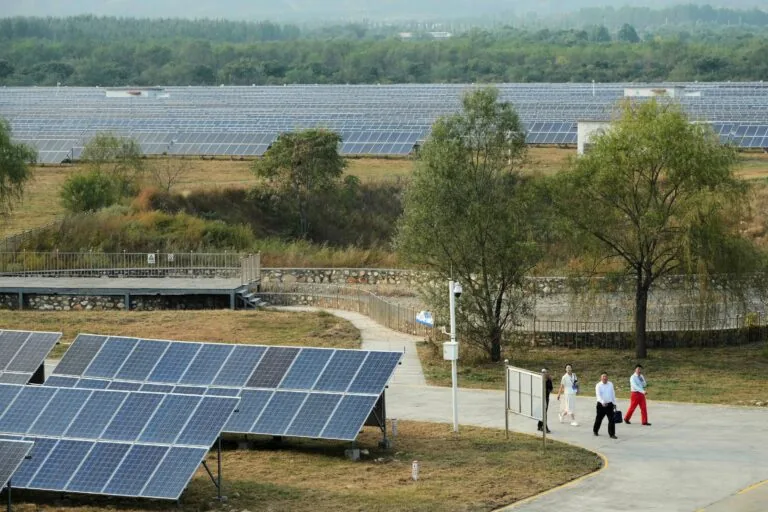
Associated Press photographer Achmad Ibrahim recorded activity beside solar arrays managed by Huadian Beijing New Energy Development Co. Ltd. in Beijing on Sept. 23, 2026. China expands clean generation. Chinese energy authorities rely on solar installations to generate clean power without burning petroleum transported by tankers [1].
Nuclear power is gaining new public funding. Planners view atomic reactors as dependable suppliers of uninterrupted baseload electricity for heavy industries that cannot tolerate intermittent generation or sudden import price spikes. Reactor construction takes years of capital, yet existing stations receive license extensions to keep stable electrical outputs online during crises [1].
Shipping Risks in Hormuz
The maritime chokepoint at the Strait of Hormuz is a vulnerable link in international petroleum trade. The IEA projects a decrease in oil passing through the waterway as naval hostilities and military strikes endanger merchant vessels. Tanker operators diverted ships around southern capes to avoid combat, adding heavy transit fees and lengthening delivery timetables for refineries that depend on Persian Gulf crude [1]. Fewer tankers risk the crossing.
Iran occupies a strategic geographic position along the northern coastline of the waterway, bordering both the Persian Gulf and the Gulf of Oman where international oil tankers navigate daily. Naval boats monitor merchant lanes. The nation borders Iraq to the west, Turkey, Azerbaijan, and Armenia to the northwest, Turkmenistan to the northeast, and Afghanistan and Pakistan to the east. Territorial control along the coastline links northern land corridors to the Gulf of Oman [2].
Hostilities disrupted non-petroleum sectors as well, including when Iran strikes Amazon data centers during cross-border missile strikes. Modern warfare targets fuel routes and electronic infrastructure simultaneously. Telecommunication server hubs need vast amounts of electrical power to maintain continuous operations during wartime [1].

Iran’s Oil History
To understand the origins of the current fuel shock, historians examine Iranian petroleum within centuries of state formation in West Asia. With a population of over 92 million people, Iran ranks seventeenth globally in both geographic size and population. Tehran serves as the national capital. The territory saw early governance under the Medes in the 7th century BC before Cyrus the Great founded the Achaemenid Empire in the 6th century BC, followed by conquests by Alexander the Great in the 4th century BC. After Parthian and Sasanian rule, Islamization reshaped the region, leading to the Safavid dynasty founding a unified realm in the 16th century centered on Twelver Shia Islam. The Afsharid Empire held influence during the 18th century, before Qajar rulers governed until 1925 [2].
Reza Shah established the Pahlavi dynasty in 1925 after removing the last Qajar monarch, creating state agencies that oversaw petroleum extraction. Following the Anglo-Soviet invasion of Iran in 1941, his son Mohammad Reza Pahlavi took power. Prime Minister Mohammad Mosaddegh attempted to nationalize oil assets to keep petroleum earnings inside the country, provoking the Anglo-American coup in 1953. The 1953 coup restored royal rule and secured foreign oil concessions until the revolution [2].
Iran possesses vast proven natural gas reserves alongside rich petroleum deposits. A centrally planned economic model retains state ownership over key production assets, ensuring that hydrocarbon sales supply the bulk of government revenues. The country contains 31 provinces organized into five regions, possessing 30 UNESCO World Heritage Sites as a founding member of the United Nations [2]. When Iranian petroleum flows slow, international buyers face immediate supply tightness.
War and Oil Markets
Tensions between Iran and Western powers deepened after the 1979 Iranian Revolution. The revolution ended monarchical governance and established the Islamic Republic of Iran under Ruhollah Khomeini, who served as supreme leader. In 1980, Iraq invaded southwestern territory, igniting the eight-year-long Iran–Iraq War that damaged petroleum export facilities and tanker loading platforms in the Persian Gulf. Proxy rivalries with Israel and Saudi Arabia followed over subsequent decades [2].
Military friction erupted into direct warfare during recent campaigns. In 2025, Israeli strikes on Iranian territory led to the Twelve-Day War, triggering economic hardships and large public demonstrations across Iranian cities. A wider armed conflict began in 2026 when American and Israeli forces carried out the assassination of Ali Khamenei, leading to Mojtaba Khamenei being elected to head the Islamic Republic [2]. War halted normal commerce.
Armed clashes damaged petroleum processing facilities and imperiled shipping routes throughout the Persian Gulf, after earlier hostilities where missiles hit Amazon data centers in neighboring countries. Global trading houses faced sudden shortfalls in crude shipments. Energy buyers turned to alternatives as warfare threatened sustained disruption to Gulf hydrocarbons [1].
The IEA Energy Shock at COP31
International climate meetings now address energy security alongside carbon reduction goals. At the COP31 climate talks held in Turkey, government representatives highlighted electrification and diminishing fossil fuel reliance as urgent economic necessities. Ministers view clean generation as a shield against foreign fuel blockades, showing that solar farms and power interconnectors reduce vulnerability to overseas conflict [1].
The long-term impact of the IEA energy shock permanently redirects international infrastructure spending. Associated Press writers Anton L. Delgado and Sibi Arasu reported from the IEA report that countries are restructuring power supplies around solar panels and nuclear generators to insulate themselves from geopolitical strife. Dependence on vulnerable fuel routes will decline in coming decades [1].
- ONLINE NEWS Delgado, A. L., & Arasu, S. (2026). There is no going back ‘to the way it was before’ the Iran war’s energy shock, IEA says. Mongabay. [Article Link]
- WEBSITE Wikipedia contributors. (2026). Iran. In Wikipedia, The Free Encyclopedia. [Article Link]
APA 7: PerEXP Teamworks. (2026, November 20). IEA Energy Shock Report Warns of Permanent Global Shift. PerEXP Teamworks. https://perexpteamworks.com/en/iea-energy-shock-reshapes-global-power/


