




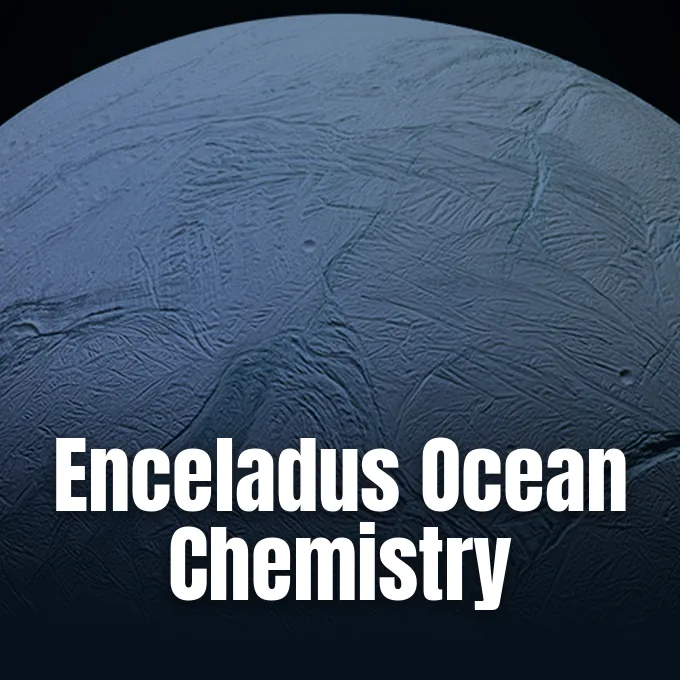
Could an alien Ocean World shrouded beneath kilometers of frozen crust sustain extraterrestrial organisms across the Outer Solar System? Planetary scientists exploring the Saturnian System view Saturn Moon Enceladus as an exceptional astrobiological target for Space Mission planning. Beneath a thick icy shell lies a global sea of Liquid Water interacting directly with a silicate Rocky Core. Two new studies in Science Advances significantly strengthen prospects for discovering life on Enceladus. Researchers demonstrate that cryovolcanic ice grains naturally segregate oceanic compounds during slow freezing, while primitive Deep Sea microbes successfully adapt to simulated alkaline ocean waters [1, 2].
- What Makes Enceladus Such a Promising Ocean World?
- How Slow-Freezing Plumes Concentrate Signs of Life on Enceladus
- Cassini Data and Oceanic Mineral Segregation
- Testing Enceladus Habitability with Deep-Sea Methanogens
- Could Life on Enceladus Really Exist in Alkaline Waters?
- Future Planetary Exploration and the ESA L4 Mission
What Makes Enceladus Such a Promising Ocean World?
Enceladus stands out as one of the most promising extraterrestrial habitats because active cryovolcanic plumes eject pristine samples from its subsurface ocean directly into space [4]. Cryovolcanism (volcanic eruptions of volatile liquids instead of molten rock) drives continuous geological activity across the South Pole terrain. NASA recorded data across multiple flybys [3]. Gigantic fissures in the crust allow pressurized Water Vapor and ice grains to erupt hundreds of kilometers into space. Vents blast freezing mist. These natural plumes provide the scientific community with an unprecedented opportunity to evaluate prospects for life on Enceladus without needing to drill through kilometers of impenetrable surface ice [4].
The Cassini Spacecraft passed through these towering plumes several times before completing its orbital mission around Saturn [3]. Onboard spectrometers detected mineral salts, simple organic compounds and carbon-bearing molecules dissolved within the ejected ice grains [1]. Other Cassini findings pointed to energetic hydrothermal activity where the ocean meets the silicate seafloor [3]. These geochemical discoveries indicate that Saturn Moon Enceladus possesses Liquid Water, essential chemical elements and sustained hydrothermal energy sources necessary to support living organisms. Enceladus represents the sole alien reservoir from which human probes have collected and directly tested in-situ oceanic material [4].
Comparative planetology highlights the distinct scientific value of this active cryovolcanic environment across the Outer Solar System. While researchers investigating other distant worlds have examined Titan’s honeycombed hydrocarbon ice structures to understand surface dynamics, Enceladus offers direct access to internal oceanic liquids without drilling [3]. Scientists avoid complex melting probes. Active cryovolcanic vents deliver fresh oceanic material straight into space [4].
How Slow-Freezing Plumes Concentrate Signs of Life on Enceladus
Professor Frank Postberg at Freie Universität Berlin investigated how cryovolcanic grains preserve signs of life on Enceladus [4]. Publishing in Science Advances with an international team of researchers, Postberg analyzed measurements from the Cassini CDA with long-term laboratory experiments and theoretical computer models. The physical investigation focused on thermodynamic mechanisms occurring as ocean water ascends toward surface fissures. Rising gas bubbles burst [1]. Expanding steam sweeps this aerosol upward through structural fissures in the exterior ice shell [4].
Scientists previously assumed that oceanic droplets froze instantaneously when exposed to frigid temperatures within icy fractures. The new investigation demonstrates that droplets freeze slowly, allowing dissolved mineral salts and organic compounds to segregate into distinct physical layers within each grain. As freezing proceeds from the outside inward, dissolved chemicals separate based on solubility and thermodynamic properties [1]. Organic compounds and mineral salts distribute into separate locations rather than remaining uniformly mixed throughout the ice particle [4].
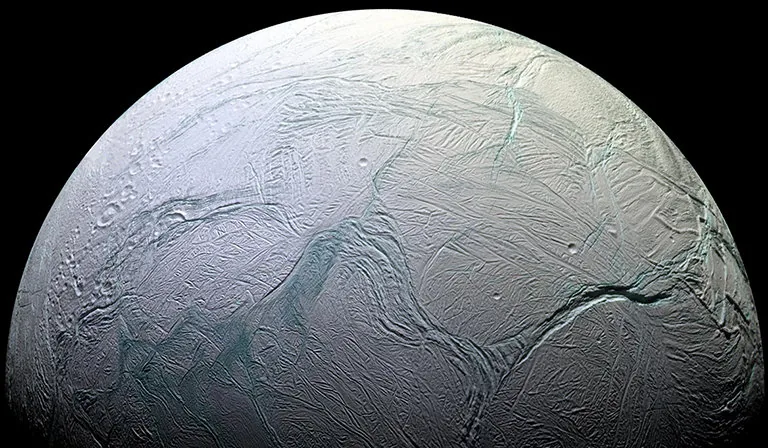
Ascending ice particles attain velocities reaching 1,000 km/h (620 miles per hour) inside the vents [4]. When these high-velocity particles collide with the walls of icy cracks, they fragment into tiny pieces measuring only a few micrometers across [1]. Frank Postberg directed the physical modeling. “Enceladus actually does a lot of the work for us in preparing samples for analysis that usually take a lot of effort in chemical labs on Earth,” Postberg explained, emphasizing how natural physical processes purify target substances for Spacecraft Instruments during high-speed orbital encounters [4].
Cassini Data and Oceanic Mineral Segregation
The detailed physical models demonstrate clear chemical differentiation among various types of dissolved salts during the freezing process. Measurements from the Cassini CDA show that Sodium Chloride (common Table Salt) physically segregates from Sodium Carbonate inside individual droplets as crystallization occurs. Table Salt separates from Sodium Carbonate [1]. This separation ensures that individual micrometer-sized fragments emerge into space carrying remarkably pure concentrations of specific oceanic minerals, providing sharp analytical targets for spacecraft instruments [4].
This natural concentration mechanism provides profound advantages for detecting potential biosignatures during future space missions [4]. If alien microbial cells or complex organic fragments exist within the ocean of Enceladus, those biological materials would concentrate into a tiny fraction of individual ice grains [1]. Instead of being diluted across millions of mixed particles, microbial markers would appear in concentrated, relatively pure form within select grains [4]. Just as planetary scientists track surface volatiles to understand the salt glaciers and astrobiological potential of Mercury, the mineral segregation on Enceladus provides clear clues about internal water-rock chemistry [3]. Pure biological signals sharpen detection of life on Enceladus [4].
Water vapor accelerates the icy spray [1]. Cassini measured speeds reaching 1,000 km/h. Frozen droplets shatter against icy walls [4].


Testing Enceladus Habitability with Deep-Sea Methanogens
A companion study in Science Advances led by Vanessa Helmbrecht examined Enceladus habitability by testing whether Earth microbes could survive in its ocean [2]. Conducted by scientists at Ludwig Maximilians Universität München with contributions from Frank Postberg and Dr Nozair Khawaja from Freie Universität Berlin, the research investigated microbial growth in simulated extraterrestrial waters [4]. The researchers focused on Methanothermococcus okinawensis, an anaerobic methane-producing microorganism [2]. This single-celled archaean normally inhabits Deep Sea hydrothermal vent systems on Earth and thrives in environments devoid of atmospheric oxygen [4].
The geochemical environment beneath the icy crust of Enceladus presents severe environmental challenges for terrestrial biology [2]. Cassini observations revealed that the global ocean is extremely alkaline, exhibiting high pH values of 10 or 11 with minimal dissolved oxygen and high carbonate concentrations [4]. The ocean pH reaches 11. Scientists recreated these extreme alkaline conditions in the laboratory, including continuous chemical interactions between heated water and the underlying rocky core. Under normal laboratory conditions, Methanothermococcus okinawensis completely failed to grow at such elevated pH because dissolved carbon dioxide becomes virtually unavailable [2, 4].
When introduced into the comprehensive Enceladus ocean simulant, however, the microorganism produced surprising results [4]. The archaean successfully grew and generated methane by utilizing molecular hydrogen produced directly from water-rock reactions [2]. The microbes adapted their metabolic machinery to capture trace amounts of carbon dioxide under severe chemical constraints. Nozair Khawaja analyzed the metabolic data. “This was really a surprise to us,” stated Nozair Khawaja, adding that “this was an experiment for which we did not expect such a successful outcome” [4]. The findings prove that specialized biological metabolisms can thrive within simulated Enceladus ocean chemistry [2].
Could Life on Enceladus Really Exist in Alkaline Waters?
Recent laboratory simulations demonstrate that primitive terrestrial microbes can survive and generate methane within geochemical conditions matching the alkaline ocean of Enceladus [2]. This empirical finding addresses longstanding skepticism regarding whether extraterrestrial oceans with pH values of 10 or 11 could sustain biological activity [4]. The experiments demonstrate that methanogenesis (biological methane production without oxygen) remains viable even when carbonate chemistry drastically limits available carbon dioxide [2]. Microbial cellular material yields biosignatures [4]. Water-rock reactions at the seafloor continuously replenish hydrogen, supplying an abundant and steady source of metabolic energy for anaerobic organisms [2].
Geochemical parallels across the Outer Solar System emphasize how common chemical ingredients assemble into habitable niches. Similar to the carbon source identified on the surface of Europa, understanding carbon dynamics remains essential for evaluating planetary habitability [3]. On Enceladus, carbonate-rich alkaline waters interact with silicate cores to produce a rich chemical broth. The research confirms that high alkalinity does not constitute an insurmountable barrier to ancient forms of chemosynthetic life. Methanogens demonstrate that metabolic processes that arose early in Earth’s history could find a hospitable setting inside Enceladus [2, 4].
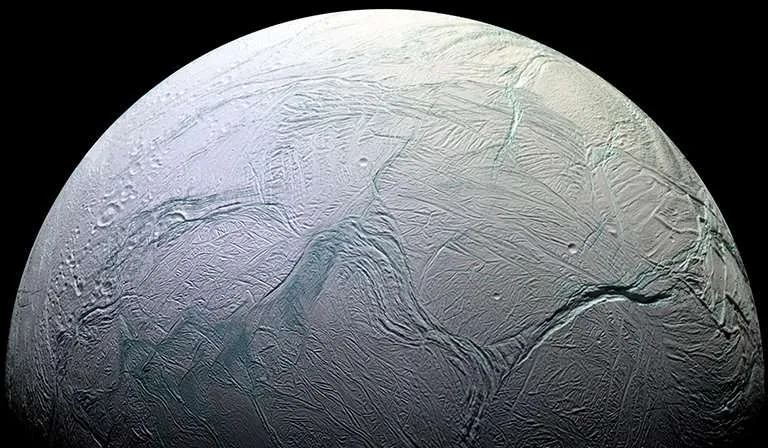
Frank Postberg highlighted the evolutionary importance of these geochemical findings for Planetary Science. “On Enceladus the specific geochemical conditions might allow one of the oldest known metabolic systems on Earth to work, even in very alkaline environments,” Postberg observed. While laboratory survival does not prove that living organisms inhabit Saturn’s moon, it confirms that its internal ocean provides fundamental physical and chemical prerequisites for life [4]. The presence of Liquid Water, thermal energy, organic compounds and viable metabolic pathways makes Enceladus an increasingly compelling target for future exploration [1, 2].
Future Planetary Exploration and the ESA L4 Mission
These dual discoveries carry immediate practical significance for upcoming space missions designed to search for extraterrestrial biology across the Solar System. The European Space Agency is currently planning the ESA L4 mission, an ambitious large-class Space Mission dedicated to exploring the Saturnian System and searching for biosignatures at Enceladus. ESA plans the dedicated L4 mission. Previous laboratory research conducted in Postberg’s facility at Freie Universität Berlin showed that modern mass spectrometers can detect cellular material inside individual ice grains. Concentrated biosignatures simplify analytical detection [1, 4].
Future exploratory spacecraft will not require complex landing systems or heavy drilling equipment to investigate whether life exists within this alien Ocean World [4]. Instead, a spacecraft flying through cryovolcanic plumes can collect thousands of individual ice grains, analyzing their chemical composition in real time with high-resolution dust analyzers [1]. “That is great news in the search for life,” Postberg noted, explaining that “future spacecraft will have to analyze many individual ice particles in the plume. But if they come across one with microbial material in it, they could identify biosignatures in the particle relatively easily with already available technology”. Cryovolcanic activity dramatically reduces technological barriers [1, 4].
Senior Editor Robert Egan and Editor Gaby Clark evaluated these findings for Phys Org while reports from Knowridge Science Report reviewed plume dynamics [3, 4]. Free University researchers joined the international team. Neither Cassini nor laboratory simulations have found living extraterrestrial organisms, and laboratory conditions cannot replicate every environmental nuance of an alien ocean [3, 4]. Nevertheless, the research confirms that Enceladus concentrates oceanic ingredients and proves that Earth-like anaerobic metabolism remains viable within its alkaline waters [1, 2].
- ACADEMIC JOURNAL Postberg, F., Zou, Z., Sekine, Y., Koga, M., Schmidt, J., Fox-Powell, M., Klenner, F., Hillier, J. K., Khawaja, N., Kadono, T., Çakar, M., Kempf, S., & Srama, R. (2026). Cassini CDA observes compositional segregation of Enceladus’ ice grains from slow freezing and fragmentation of oceanic spray. Science Advances, 12(39). [Article Link]
- ACADEMIC JOURNAL Helmbrecht, V., Postberg, F., Khawaja, N., Reichelt, R., Klein, F., Grohmann, D., & Orsi, W. D. (2026). Enceladus-like geochemistry fuels methanogenesis under extreme CO2 limitation. Science Advances, 12(39). [Article Link]
- ONLINE NEWS Knowridge Science Report. (2026, September 26). Saturn’s icy moon may make the search for life easier. Knowridge Science Report. [Article Link]
- ONLINE NEWS Clark, G., & Egan, R. (2026, September 25). Great news from Saturn’s moon Enceladus in the search for life in space. Phys.org. [Article Link]
APA 7: TWs Editor. (2026, September 26). Cassini Plume Analysis Strengthens Hope for Life on Enceladus. PerEXP Teamworks. https://perexpteamworks.com/en/life-on-enceladus-ocean-plumes/


