



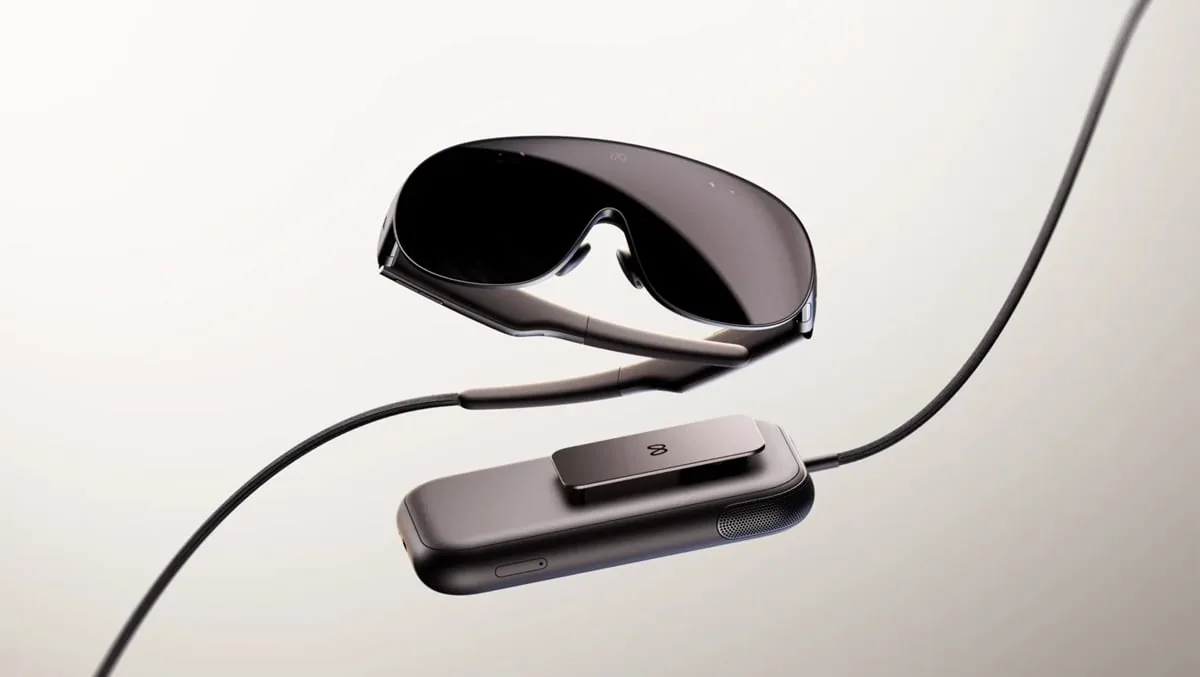
Meta Chief Executive Officer Mark Zuckerberg unveiled the Meta VR Glasses during the Meta Connect 2026 keynote, revealing a 100-gram head-mounted device scheduled to reach consumers in spring 2027 for $1,300 [2]. Designed without a traditional rigid head strap, the magnesium alloy frames offload battery and processor weight to an external pocket puck connected by an optical tether [1]. The announcement marks Meta’s most aggressive push to transition virtual reality from bulky headsets into everyday optical hardware [2].
Inside the Meta VR Glasses Hardware
The core visual system inside the Meta VR Glasses relies on custom ultra-compact pancake lenses paired with twin micro-OLED panels to project a 5K Infinite Display. Delivering 37 pixels per degree, the optical pipeline emphasizes fine text legibility and high contrast supported by Dolby Vision integration. Dolby Atmos spatial audio drivers are built directly into the magnesium alloy frame stems, allowing users to hear environmental soundscapes without sealing their ears from ambient surroundings [2].
To achieve a frame weight of approximately 100 grams, engineering teams separated the computing architecture from the facial mount entirely [2]. An optical tether links the glasses to an external processing puck that clips to a pocket or belt [1]. This puck houses Qualcomm’s Snapdragon Reality Elite processor with internal storage and a rechargeable battery cell. Fast charging reaches 45W. Meta rates the external power cell for three hours of continuous 5K media playback before requiring external power [2].
By shedding internal cooling fans and weighty batteries from the visor, Meta created a profile roughly five times lighter than the existing Meta Quest 3 headset [2]. That lightweight philosophy sharply contrasts with traditional standalone helmets; while our breakdown of the Steam Frame VR lighter design examines Valve’s choice to retain integrated headgear and physical controllers, Meta eliminates facial straps entirely by shifting system weight down to the waistline. The visor weighs 100 grams. Open temples and passthrough cameras preserve environmental awareness, yet wearers must accept a persistent physical cable descending to their pocket [1].
What Games Arrive at Launch?
The operating environment of the Meta VR Glasses dispenses with bundled handheld wands, relying on multimodal eye tracking, voice commands, and precision computer vision algorithms to interpret unassisted hand gestures. Meta AI operates at the system level, allowing wearers to launch software, calibrate virtual monitors, or dictate replies without reaching for manual inputs. Physical Touch Plus controllers remain backward-compatible for specialized software [2]. Controllers are not included [1].
Gaming announcements served as a major pillar of the hardware showcase, highlighted by Capcom’s Phoenix Wright Ace Attorney: Dual Destinies VR. Diego Argüello of Game Developer noted that the courtroom adaptation translates the fifth mainline entry into an interactive legal stage while fans continue waiting for a seventh numbered sequel. Players physically gesture to present evidence at witnesses and shout objections aloud into the microphone through calibrated voice-recognition triggers. Capcom adapted the fifth game. Meta complemented the reveal with Tetris Effect: Mixed Realities, which incorporates spatial room tracking, while Beat Saber: Flux introduces updated rhythm mechanics engineered specifically for controller-free hand motions [1].
Meta confirmed that all three featured titles will debut in 2027 and will maintain cross-generational compatibility with Quest headsets rather than remaining locked to new hardware [1]. Beyond native software, the ecosystem supports streamed gaming through Xbox Cloud Gaming, enabling users to link a Bluetooth gamepad and project cloud titles across an expansive virtual screen [2]. However, gaming outlet GameSpot observed that streaming Xbox titles through a $1,300 optical frame represents one of the most expensive ways to access cloud gaming, particularly when compared to entry-level alternatives like the Quest 3 and Quest 3S [3]. The platform plans to host more than 75 gesture-controlled titles when consumer units ship [2].

Entertainment Beyond the Meta VR Headset
Can a lightweight wearable replace a dedicated home theater? Meta is positioning the device as the first commercial hardware to receive IMAX Enhanced certification, granting subscribers direct access to expanded aspect ratio film presentations. A high-profile partnership with Disney brings stereoscopic 3D streaming to Disney+ across select international territories. Disney+ adds 3D this November. Viewers using the Meta VR Glasses will be able to watch Marvel Studios productions such as The Avengers and Black Panther within themed virtual viewing environments, including Tatooine, Avengers Tower, and the Scare Floor [2].
Software distribution will expand further through the newly introduced Disney Immersive Cinema by ILM application, enabling interactive viewing of cinematic classics like Star Wars: A New Hope and Avengers: Infinity War. Additional media agreements encompass Paramount+, Peacock, and HBO Max, all of which will introduce dedicated 3D streaming catalogs for the platform. Meta also disclosed a technical collaboration with director James Cameron and Lightstorm Vision to engineer original 3D theatrical experiences scheduled for release throughout 2027 [2]. Diego Argüello of Game Developer observed that Meta dedicated most of its hardware unveiling to these expansive entertainment agreements rather than focusing purely on interactive gaming [1].

Live sports coverage anchors the entertainment rollout. An ongoing collaboration with ESPN introduces Immersive Sports broadcasting, delivering 8K resolution feeds and 180-degree courtside perspectives that debut with college football broadcasts on Quest before transitioning to the glasses. Over 100 live sporting events will stream annually through licensing agreements with MLB, NBC Sports, TNT Sports, and the UFC. Production deals also include the documentary Open Season featuring NBA champion Draymond Green, followed by Matthew Vaughn’s action film Stuntnuts. Open Season streams September 29 [2].
Computing and Holograms in Daily Use
Beyond entertainment, Meta is pitching the Meta VR Glasses as a private, portable desktop workstation capable of replacing multiple physical computer monitors during travel or remote office work. Wearers can cast virtual displays from a Mac or Windows PC wirelessly or over a direct USB-C connection while retaining visual clarity through full-color video passthrough. The operating interface allows any flat desk surface to function as a projected touch keyboard and tracking surface [2]. While GameSpot noted that standard headsets like the Quest 3 remain portable for casual tasks, Meta engineered these tethered glasses specifically for professionals who need an unencumbered face during extended work sessions [3].
Communication features introduce photorealistic holograms designed to display real-time facial expressions, gaze direction, and mouth movements during hands-free remote calling. Compatible with platforms like WhatsApp and Zoom, the system renders a digital likeness of the wearer for participants connecting from mobile phones or desktop computers. Spatial audio rendering pins the caller’s voice directly to the spot where their avatar stands in physical space, establishing a convincing sense of conversational presence [2].
Meta also expanded its broader smart eyewear ecosystem, detailing the Ray-Ban Meta Audio glasses. Ray-Ban Meta Audio weighs 43 grams. The design provides up to 12 hours of standalone playback and reaches 48 additional hours with its charging case. The wider lineup introduces the Clubmaster and Burbank styles, joined by Ray-Ban Meta Gen 3 models such as Aviator and Zena. New styling collaborations include frames designed with Kylie Jenner and musical artist LISA, demonstrating Meta’s determination to normalize face-mounted electronics across diverse demographic segments [2].

Commercial Strategy Behind Meta Smart Glasses
The steep retail price of $1,300 highlights an ambitious pivot toward premium hardware, arriving amid intense economic scrutiny surrounding Meta’s immersive hardware operations. Reality Labs lost $83.6 billion. The business unit, which oversees internal hardware research and consumer VR software distribution, accumulated those $83.6 billion in operational losses over a six-year period while attempting to establish the metaverse as a mainstream commercial computing paradigm. To recalibrate corporate expenses, Meta shuttered several prominent in-house game studios, including Sanzaru Games, which developed Asgard’s Wrath, Twisted Pixel Games, creators of Deadpool VR, and Armature Studio, the development team responsible for adapting Resident Evil 4 VR. High consumer pricing directly reflects the expensive silicon and custom micro-OLED optical components required to shrink a full-featured headset into lightweight glasses [1].
Market pressures are intensifying as rival manufacturers target the premium virtual reality segment with alternative engineering compromises. Valve recently disclosed hardware specifications for its upcoming Steam Frame, a wireless headset bundled with physical controllers that aligns closely with the traditional Meta Quest form factor. However, Valve’s Steam Frame price structure starts at $1,059 for the base 256GB edition and climbs to $1,200 for the 1TB configuration without bundled power accessories [1].
By pitching the Meta VR Glasses as a dual-purpose consumer workstation and entertainment wearable, Meta hopes to attract enterprise professionals and high-end multimedia enthusiasts who find traditional helmets unwieldy. The company is actively courting software developers with promises of hand-tracked interface standards that do not require cumbersome peripherals. Enterprise adoption could offset softening retail momentum across the gaming sector, providing a viable financial path forward for the optical division [1].
Consumer shipments begin in spring 2027 at $1,300, testing whether a 100-gram optical frame can justify enterprise pricing [1].
- ONLINE NEWS Argüello, D. (2026, September 24). Meta announces VR glasses that cost $1,300 and weigh 100 grams. Game Developer. [Article Link]
- ONLINE NEWS Takahashi, D. (2026, September 24). Meta VR Glasses are coming in spring 2027 with 5K viewing for $1,300. GamesBeat. [Article Link]
- ONLINE NEWS GameSpot. (2026, September 24). Meta’s $1,300 VR Glasses Could Be The Most Expensive Way To Play Xbox Games. GameSpot. [Article Link]


