





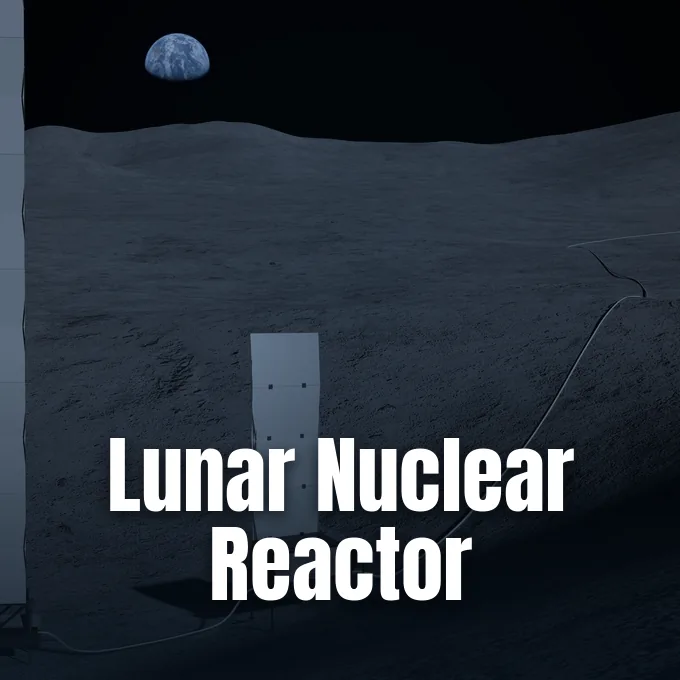
NASA is asking commercial contractors to design and test the first fission surface power system intended for the lunar surface, officially designated as Lunar Reactor-1. The space agency aims to construct a lunar nuclear reactor capable of delivering 20 kilowatts of steady electricity to sustain human crews on the Moon. Engineers must ready the flight hardware by 2030, establishing an independent energy supply that operates without interruption through the freezing, two-week lunar night when solar cells receive no sunlight [1].
NASA Proposals for Surface Power
The formal solicitation, released under the Space Power and Reactor Capabilities program, calls on American industry to present flight designs and testing methods for surface nuclear hardware. NASA published a draft proposal in August and collected industry feedback during a conference held in September at the Ohio Aerospace Institute in Cleveland. Proposals close on Dec. 21. Department of Energy safety regulations govern the entire design phase, requiring strict safeguards before any hardware receives clearance for lunar launch [1].
Brian Giblin leads the initiative within the Space Reactors Division alongside nuclear specialists from the Department of Energy. Managers plan to operate the system on the lunar surface for at least five years after landing. “Space nuclear systems will provide continuous power to NASA assets in any environment without dependency on sunlight,” said Brian Giblin, NASA’s Lunar Reactor-1 program manager. A 20-kilowatt output provides enough electrical energy to supply roughly 16 average households in the United States every year [1].
While current awards focus on Lunar Reactor-1, NASA indicated that follow-on task orders could fund alternative space fission hardware as exploration requirements expand. Civil space planners and government nuclear scientists collaborate closely to evaluate reactor core safety, launch vehicle packaging, and liquid cooling channels. Core structures must withstand fierce vibration during launch and rough handling through space transit [1].
Why the Moon Demands Continuous Power
Orbital mechanics create extreme environmental conditions for lunar machinery. Earth’s natural satellite follows an elliptical orbit at an average separation of 378,000 kilometers (235,000 mi) from our planet. Gravitational attraction causes tidal locking, which fixes the lunar rotation period to its synodic cycle of 29.5 days. Because the synodic month lasts 29.5 days and tidal locking binds the lunar rotation to its orbital path, any outpost near the equator or south pole must endure roughly 14 Earth days of unbroken darkness [1, 3].
Solar panels perform effectively during lunar daylight, but they shut down entirely when sunset covers the landscape in cold shadows. Chemical batteries capable of sustaining a base across two weeks of darkness would add prohibitive mass to launch vehicles. Fission generates thermal energy continuously. A small core supplies steady electricity for crew habitats, automated rovers, life support systems, and radio relays [1].
Surface terrain worsens the power dilemma because deep craters near the lunar south pole stay permanently shadowed from solar rays. Thick regolith dust blankets ancient volcanic plains called maria, where ground temperatures plunge during the two-week lunar night [3]. Without dependable electricity from a lunar nuclear reactor, scientific sensors and drilling rigs deployed across these frozen craters would rapidly freeze and fail [1]. Lunar landings require careful flight modeling, where previous research investigated propellant models for lunar landings to guide spacecraft down toward landing sites across the low-gravity crust.
Fission Mechanics and Core Fuel Efficiency
Nuclear reactors generate energy by maintaining a steady chain reaction inside a compact core. When heavy fissile isotopes such as uranium-235 or plutonium-239 absorb a neutron, the nucleus splits into lighter fission products, releasing gamma radiation, kinetic energy, and several free neutrons. Unbound neutrons subsequently collide with neighboring fissile atoms to sustain further fission events. Low-enriched uranium delivers exceptional fuel density, holding roughly 120,000 times more energy by mass than coal [2].
Operators control the fission rate using neutron moderators and movable control rods containing neutron poisons that soak up excess particles before heating becomes dangerous. When fissile fragments split, their kinetic energy transforms into heat as high-speed nuclei collide with surrounding atoms. Circulating coolant transfers that heat to drive an electrical generator shaft. Engineers also install automated emergency trips alongside physical controls so workers can quickly halt fission whenever core monitors register dangerous thermal spikes [2].
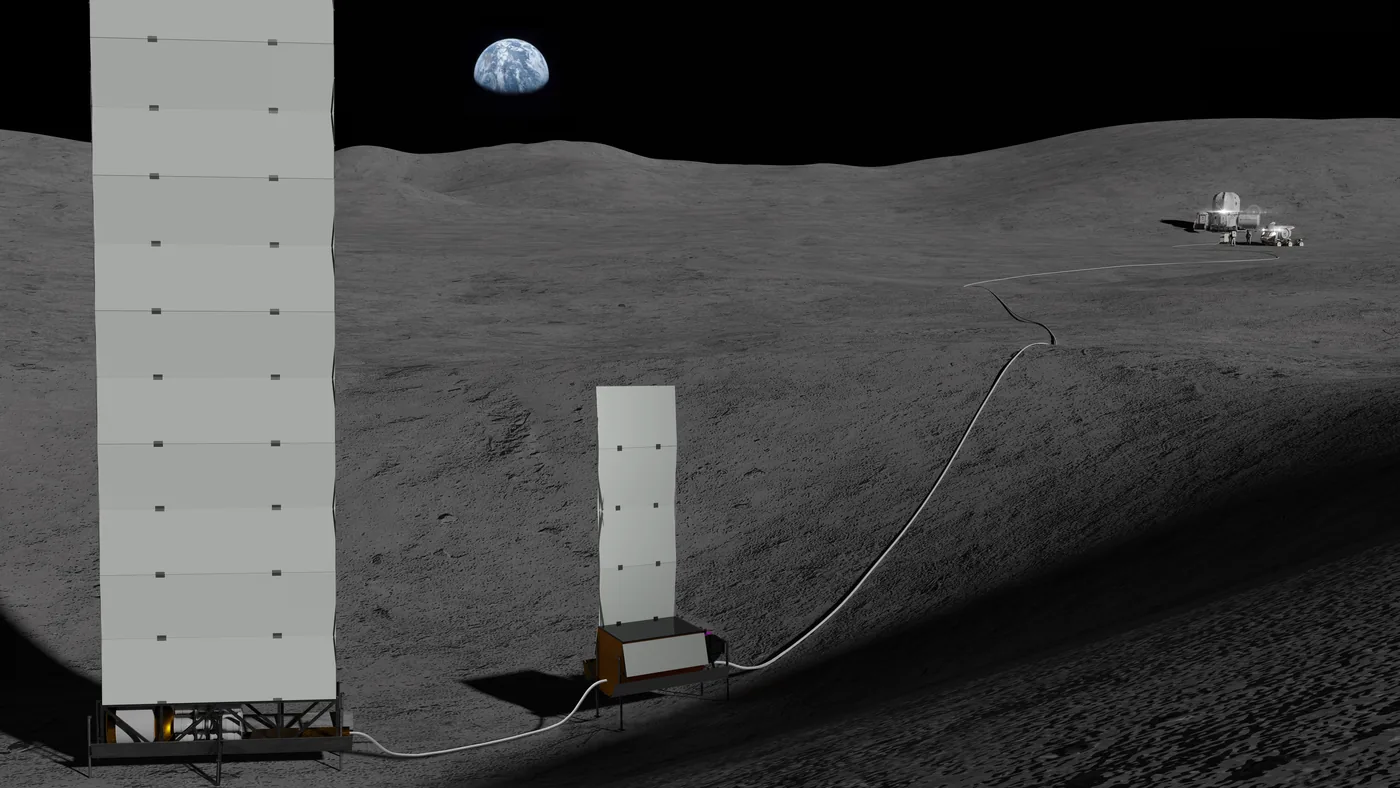
Civilian power stations on Earth rely primarily on pressurized water reactors, which represent about 70% of commercial reactors worldwide [2]. Terrestrial stations circulate immense volumes of liquid water to moderate neutrons, cool reactor vessels, and spin turbines. The Moon, by contrast, has no open water, lacks an atmosphere, and possesses surface gravity only one-sixth that of Earth [3]. Lunar engineers must instead rely on closed gas loops or liquid metal heat pipes to shed waste heat into space [2].
Designing a Lunar Nuclear Reactor for Surface Operations
Operating a nuclear reactor on the lunar surface involves harsh physical conditions unknown in commercial plants on Earth. The Moon has a diameter of 3,474 km (2,159 mi) and a mass only 1.2% that of Earth, producing a gravitational pull roughly one-sixth of terrestrial gravity, slightly lower than Mars and far beneath Jupiter’s moon Io. Surface gear faces fine, jagged regolith dust and extreme temperature swings between day and night [3]. Under technical requirements drafted by the Space Reactors Division and the Department of Energy, contractors must deliver a compact 20-kilowatt flight package capable of withstanding rough rocket launches and running autonomously on the lunar surface for five years [1].
Compact space reactors draw upon experimental reactor programs initiated during the twentieth century. Following the discovery of nuclear fission in 1938, researchers at the Metallurgical Laboratory built Chicago Pile-1 in 1942, paving the way for the Hanford Site reactors in 1944 and the US Navy submarine reactor S1W in 1953. The Soviet Union commissioned the Obninsk station in 1954 to generate electricity, while the United Kingdom opened Calder Hall at Sellafield in 1956. Global operators run 441 commercial reactors, 228 research reactors, and more than 200 marine propulsion reactors, illustrating that compact fission hardware functions reliably in isolated, demanding settings [2].
Space exploration probes have long relied on radioisotope thermoelectric generators, but those systems differ substantially from true fission cores. Decay devices harvest heat from passive radioactive decay without generating a self-sustaining chain reaction, producing modest wattage suitable only for small robotic instruments. A true lunar nuclear reactor uses controlled neutron multiplication to generate thousands of watts. High electrical output enables a permanent base to heat crew cabins, recharge lunar rovers, and run heavy regolith drill rigs [1, 2].
Surface Systems Versus Deep Space Propulsion
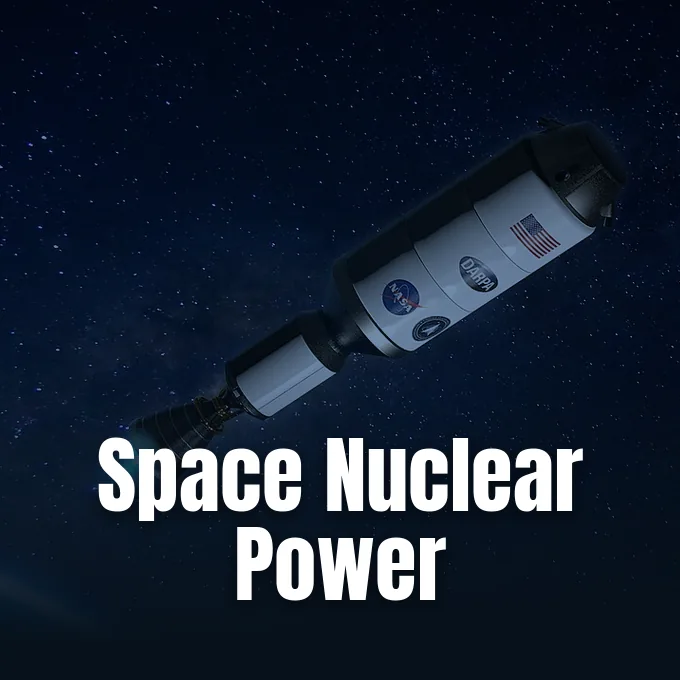
NASA’s Space Reactors Division is directing two complementary nuclear initiatives that address separate phases of space exploration. In addition to Lunar Reactor-1 for stationary surface power, the division is managing SR-1 Freedom, a robotic mission scheduled to launch in 2028. The 2028 mission will deliver three SkyFall helicopters to Mars while testing nuclear electric propulsion across interplanetary distances. Space nuclear electric propulsion converts reactor heat into electricity to run ion thrusters, enabling robotic craft like SR-1 Freedom to transport three SkyFall helicopters to Mars while surviving interplanetary environments where solar radiation grows weak [1].
Surface reactors and spacecraft thruster cores satisfy distinct engineering requirements. Stationary surface reactors reject thermal energy through radiator wings in a vacuum while shielding human quarters from neutron radiation [1, 2]. In-flight propulsion reactors operate over months of space transit to drive spacecraft toward distant planetary targets. While LR-1 focuses on stationary surface electricity, NASA is also evaluating how space nuclear power enables deep space exploration through nuclear electric propulsion systems. Both applications solve the limitations of solar energy, which weakens rapidly past Mars and vanishes during global Martian dust storms [1].
How a Lunar Nuclear Reactor Fits Artemis Plans
Commercial aerospace bidders have until Dec. 21 to submit flight architecture proposals to NASA. Technical committees will evaluate core safety, power conversion loops, radiation shielding materials, and rocket fairing compatibility. Following contractor selection, NASA and the Department of Energy will conduct comprehensive ground tests to confirm automated shutdown software before assembling the flight model. NASA project schedules target complete flight testing by 2030, aligning reactor development with wider international plans to return crews to the lunar surface [1].
Humans last walked on the lunar surface in 1972, concluding an era where missions lasted only a few days at a time. While Apollo 8 entered lunar orbit on December 24, 1968, and Apollo 11 landed astronauts on July 20, 1969, six total Apollo expeditions put twelve people on the lunar surface before the program ended in 1972. Current lunar exploration under Artemis, featuring the planned crewed Artemis II orbital flyby in 2026, focuses on creating lasting surface infrastructure [3]. Sustaining an enduring base will require deploying a rugged lunar nuclear reactor to maintain life support systems throughout the two-week lunar night [1]. Building reliable surface bases connects directly with academic research such as student challenges for Moon base design, ensuring future astronaut crews have the steady electrical energy required for deep space missions.
- PRESS RELEASE Wittry, J., & Lam, D. (2026, November 23). NASA seeks partners to design first nuclear reactor for the Moon. NASA. [Article Link]
- WEBSITE Wikipedia contributors. (2026). Nuclear reactor. Wikipedia, The Free Encyclopedia. [Article Link]
- WEBSITE Wikipedia contributors. (2026). Moon. Wikipedia, The Free Encyclopedia. [Article Link]
APA 7: PerEXP Teamworks. (2026, November 24). NASA Seeks Industry Partners for Lunar Nuclear Reactor Design. PerEXP Teamworks. https://perexpteamworks.com/en/lunar-nuclear-reactor-nasa-design/


