





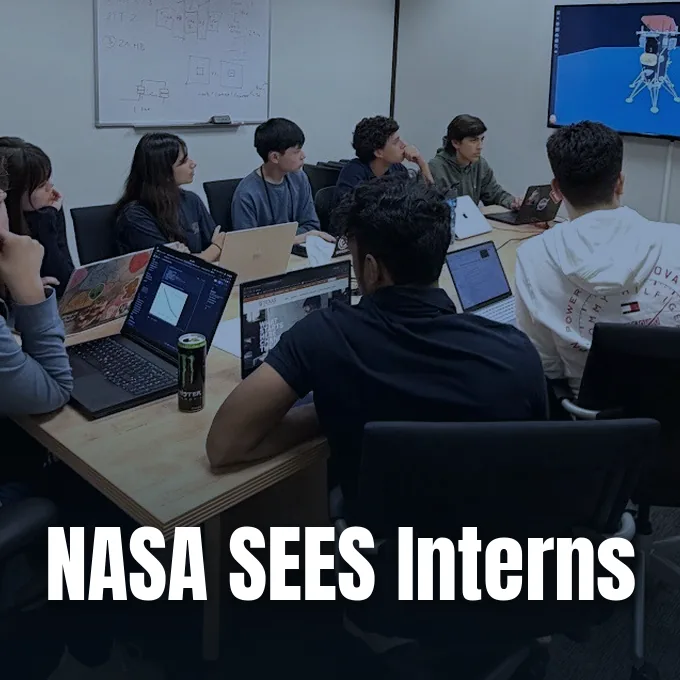
A student research team working through the NASA SEES internship has developed predictive computer models to track rocket fuel aboard commercial lunar spacecraft. High school researchers in the summer 2026 session modeled acoustic sensors for the Intuitive Machines IM-3 mission, which will place a robotic lander named Trinity on the lunar surface in 2027. Operating through the University of Texas Center for Space Research, the team evaluated how sound waves passing through propellant tanks can calculate remaining fuel when weightlessness makes fluids float and stick to container walls [1].
Structure of the NASA SEES Internship
The STEM Enhancement in Earth Science program places eleventh and twelfth grade students into focused research teams mentored by aerospace professionals. Under the NASA SEES internship structure, students collaborate remotely before completing analytical work with specialists from government facilities, universities, and commercial aerospace companies. The initiative operates through an agreement between NASA and the University of Texas Center for Space Research under cooperative agreement award number NNH15ZDA004C within the NASA Science Activation Program [1].
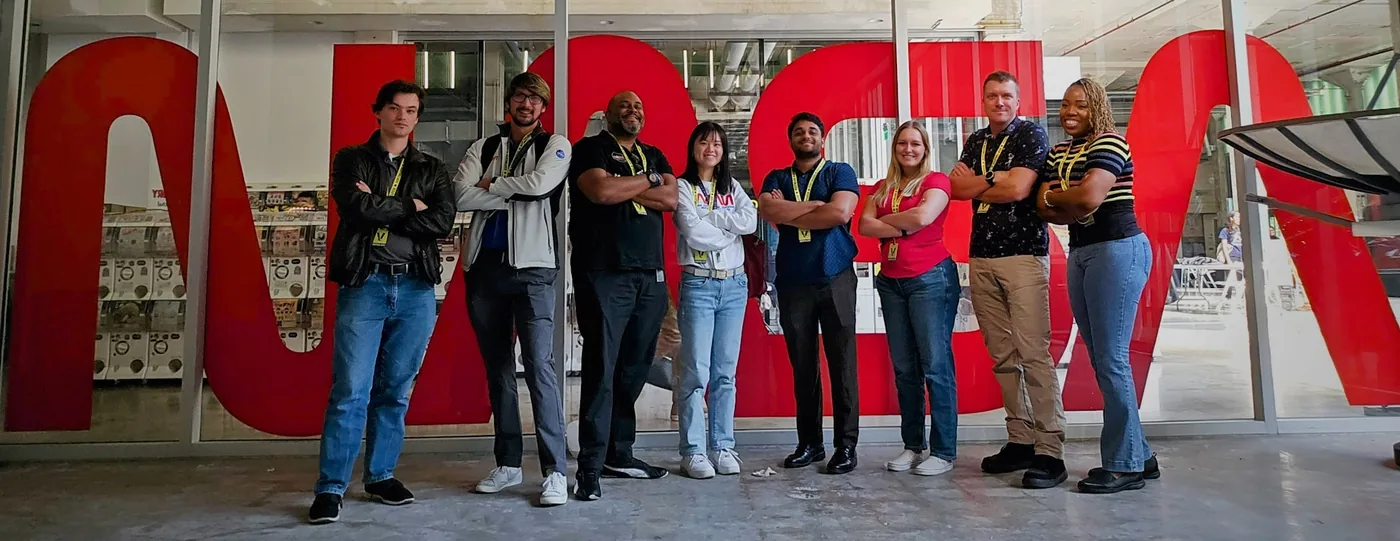
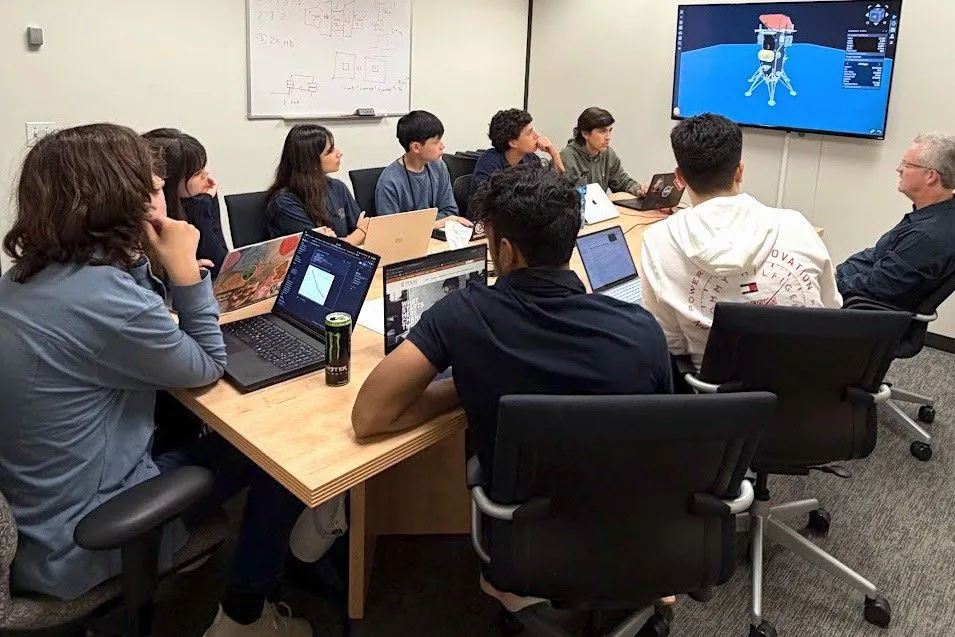
During the summer 2026 term, eight high school students joined the Mission Architecture Tool for Research, Integration, and eXploration team, known as MATRIX. The cohort included Raiymbek Abdykalykov from The Woodlands, Texas, Emmanuel Bravo from Boca Raton, Florida, Winston Huang from San Francisco, California, Adrianna Krajnovic from Dallas, Texas, Marco Lo Cicero from Tomball, Texas, Henry Martin from Milwaukee, Wisconsin, Reva Paul from Bethlehem, Pennsylvania, and Swayam Sahoo from North Chelmsford, Massachusetts. Mauro Esquivel, a high school mathematics teacher from McAllen, Texas, served as the project assistant to guide daily student tasks. Working together across different time zones, the students spent less than a month mastering numerical modeling techniques that aerospace engineers use to evaluate spacecraft systems during spaceflight operations [1].
Mentors shaped the research around live flight challenges rather than textbook exercises. Dr. Kevin Crosby, a physics professor from Carthage College in Kenosha, Wisconsin, led the student investigation. Crosby also works through the Wisconsin Space Grant Consortium and has partnered with space agencies for years to study lunar propellant problems. His guidance gave high school researchers direct access to flight hardware data and numerical tools used in the modern space sector [4].
Microgravity Challenges in Propellant Gauging
Tracking fuel levels inside a spacecraft tank sounds simple on Earth, where gravity pulls liquid down to a flat surface. In the microgravity environment of deep space, however, liquid fuel floats, breaks into bubbles, and clings to tank walls due to surface tension. Float gauges and pressure sensors can’t measure volume accurately under these conditions. This fluid behavior creates major hurdles for lunar landers that need precise propellant knowledge to perform descent burns safely. NASA faces this exact hurdle as robotic landers and crewed vehicles prepare for the Artemis program, which depends on accurate fuel estimates for landing maneuvers, orbital rendezvous, and future propellant transfer depots in lunar orbit [1].
To address this issue, Dr. Crosby and colleagues developed an acoustic measurement technique called Modal Propellant Gauging (MPG). Instead of inserting probes into the fuel, MPG uses external sensors to measure sound waves traveling through the metal tank. The tank acoustic resonance shifts depending on how much liquid mass touches the walls. The method showed promising results during suborbital flights and parabolic aircraft tests. NASA and Intuitive Machines now plan to test the hardware during the IM-3 mission, which aims to land the Trinity spacecraft in the Moon’s Reiner Gamma swirl region in 2027 [1].
Reconstructing the IM-3 Flight Trajectory
Because Intuitive Machines had not published a complete flight profile for IM-3, the MATRIX team had to reconstruct the mission path from publicly available records. The students gathered telemetry from previous missions through the NASA Jet Propulsion Laboratory Navigation and Ancillary Information Facility. Known as NAIF, the facility archives positional data for spacecraft across the solar system. Commercial landers on these trajectories rely on communications managed through lunar ground stations to relay navigation telemetry back to Earth. By comparing reconstructed IM-2 flight paths with unthrusted orbital models, the students mapped engine burns and estimated changes in velocity [1].
The interns converted those velocity estimates into a custom reconstruction algorithm to approximate the IM-3 lunar trajectory. To model fluid behavior within the tanks, the team ran computational fluid dynamics (CFD) simulations that mapped liquid slosh dynamics during active engine thrusting. They paired this fluid modeling with Monte Carlo simulations to evaluate hundreds of possible fuel distribution states. In addition, the team built an interactive software dashboard for the IM-3 mission that allows flight controllers to adjust engine parameters, spacecraft mass, and orbital variables to observe effects on fuel margins [3].
The MATRIX members applied these algorithmic simulations to determine when the IM-3 lander could launch in 2027. Their trajectory models mapped landing dispersions across the Reiner Gamma target area on the lunar surface, showing where the spacecraft could touch down within safe limits [1].
Acoustic Gauging Windows During Engine Burns
The primary goal of the modeling effort was identifying specific mission phases where Modal Propellant Gauging can collect clean acoustic data. When rocket engines fire, acceleration pushes fuel against the tank floor, briefly stabilizing the liquid surface. The MATRIX team’s fluid simulations revealed that Modal Propellant Gauging can capture reliable measurements during two primary engine burns: Lunar Orbit Insertion (LOI) and Powered Descent. During these periods, continuous thrust settles propellant against the tank shell, allowing acoustic pulses to measure liquid depth without interference from erratic sloshing [1].
The team also discovered that sensor readings may be possible during Descent Orbit Insertion under specific spacecraft orientations. How long each measurement window lasts depends on starting mass at engine ignition. Heavier spacecraft produce different settling times and damping rates inside tanks. By establishing these operational windows before launch, the students gave Intuitive Machines guidelines for scheduling sensor pings during descent [4].
Student Findings in the NASA SEES Internship
After completing their calculations, the MATRIX team presented their findings to propulsion specialists at Intuitive Machines. The students walked industry engineers through their algorithms, showing that public telemetry data can yield rigorous mission analysis. Their research paper was titled “Computational Models to Estimate Modal Propellant Gauging (MPG) Windows on the Intuitive Machines IM-3 Mission.” In their presentation, the students explained how their fluid slosh models matched expected tank acoustics during powered descent toward the Moon [1].
Crosby praised the high school cohort for mastering university-level engineering tools in a condensed timeframe. “This high school team, in a period of less than a month, developed a depth of understanding and facility with advanced methods that rivals advanced graduate students in the field,” said Kevin Crosby. “Their work product is exceptional, and their presentation to Intuitive Machines engineers impressed everyone with the sophistication and creativity of their work. The SEES program has consistently provided a unique environment for students to demonstrate they can achieve far more than what is asked of them, even in the most advanced classes” [1].
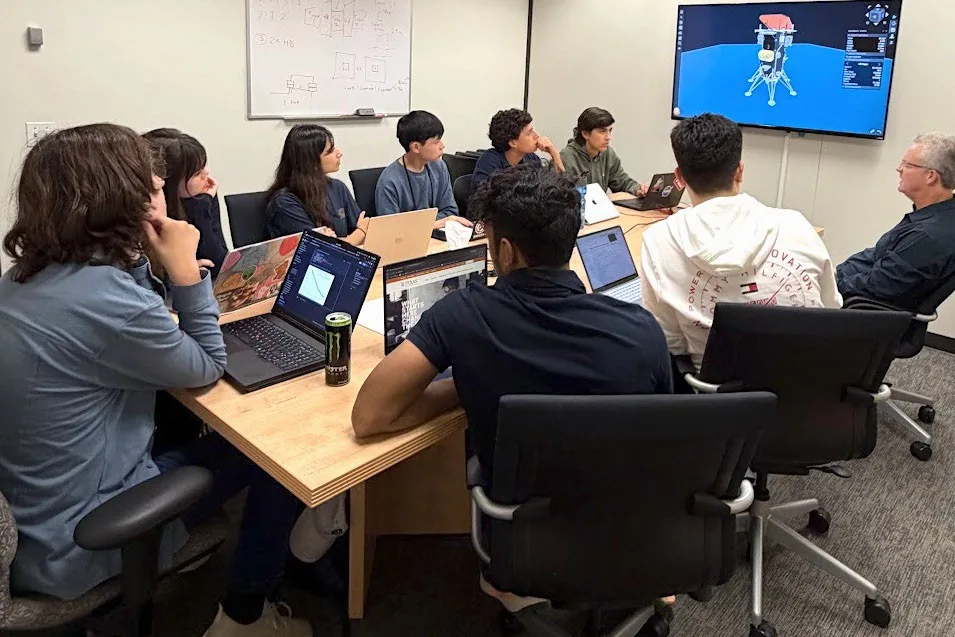
The team shared their findings with the academic community at the SEES Annual Symposium and the Wisconsin Space Grant Consortium Annual Conference. In December 2026, the students will travel to San Francisco to present their research poster at the American Geophysical Union (AGU) Annual Meeting. Their trajectory analysis offers practical insights for upcoming lunar exploration efforts, where accurate propellant gauging will be needed for automated refueling operations and orbital propellant depots [5].
Broader Pathways in NASA STEM Engagement
The SEES internship connects to a wider federal pipeline that introduces students to aerospace careers. The NASA Office of STEM Engagement, known as OSTEM, manages competitive internships placing college and graduating high school students with civil servant researchers. NASA also opens agency patents through the NASA ORBIT challenge, where student teams solve aerospace engineering problems. While SEES offers short-term immersion through university partnerships, OSTEM and Pathways internships provide longer assignments at NASA centers [2].
NASA sets specific requirements for each educational route to match student experience levels. OSTEM internships operate as paid positions lasting ten weeks in the summer and fifteen weeks during the fall or spring terms. Applicants must be at least 18 years old or graduating high school seniors with a minimum 3.0 GPA on a 4.0 scale, submitting materials through the NASA STEM Gateway. The application deadline for Summer 2027 closes on March 1, 2027 at 11:59 p.m. Eastern Time, while Fall 2027 applications close on May 24, 2027. By comparison, Pathways internships require a 2.9 GPA and at least 480 completed work hours before graduation, serving as direct employment pipelines into civil service through USA Jobs [2].
These student programs often lead to lasting careers across planetary exploration missions. Former intern Vivian Li built a pilot user interface at the Jet Propulsion Laboratory to help engineers navigate the Perseverance rover on Mars. Another former intern, Clare Luckey, joined Forbes 30 Under 30 after evaluating human Mars landing architectures, while Diné engineer Aaron Yazzie developed mechanical systems for deep space spacecraft. Research experiences like the MATRIX project prove that high school teams can deliver useful analysis for lunar missions [2].
- PRESS RELEASE Keholloway, & NASA Science Editorial Team. (2026, October 26). NASA SEES Interns Tackle Real-World Challenges in Lunar Exploration. NASA Science. [Article Link]
- WEBSITE May, S. (2023, January 23). NASA Internship Programs. NASA. [Article Link]
- ONLINE NEWS La Primera en Línea. (2026, October 26). NASA SEES Interns Tackle Real-World Challenges in Lunar Exploration. La Primera en Línea. [Article Link]
- ONLINE NEWS Mirage News. (2026, October 26). NASA SEES Interns Tackle Lunar Exploration Challenges. Mirage News. [Article Link]
- ONLINE NEWS Worldnewsdotcom. (2026, October 26). NASA SEES Interns Tackle Real-World Challenges in Lunar Exploration. World News. [Article Link]
APA 7: PerEXP Teamworks. (2026, October 27). NASA SEES Interns Model Propellant for Moon Landings. PerEXP Teamworks. https://perexpteamworks.com/en/nasa-sees-internship-lunar-propellant/


