




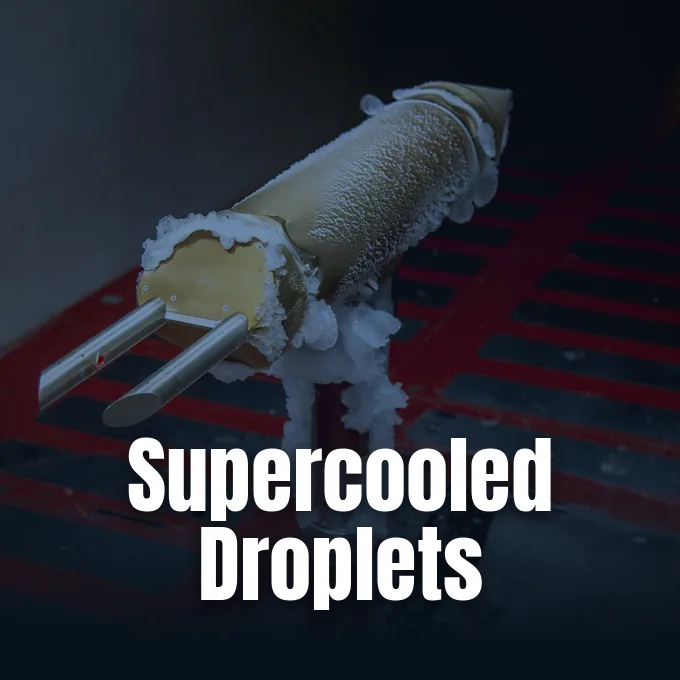
NASA researchers in Ohio are investigating a persistent aviation hazard that occurs when aircraft encounter unusually cold liquid water droplets suspended inside winter clouds. In typical atmospheric conditions, water freezes once temperatures drop, but pure cloud moisture can chill below freezing without solidifying into ice. When planes fly through these clouds, supercooled large droplets can strike exposed wings and rapidly freeze to aerodynamic surfaces that lack ice protection [1]. Researchers at Glenn Research Center in Cleveland are now testing new calibration probes inside the Icing Research Tunnel to evaluate this rare phenomenon [3].
What Is NASA Testing in the Icing Tunnel?
NASA is testing drop sizing probes and cloud generation equipment inside the refrigerated Icing Research Tunnel at Glenn Research Center in Cleveland to discover how water drops form, drift through airflow ducts, and behave during simulated winter flights. Why do standard deicing tools fall short? Standard safety gear defends only the forward leading edge of a wing. Large droplets splash backward across untreated wings and freeze into rough ice ridges. The Cleveland team wants to verify whether computer simulation software accurately tracks this fluid physics. By evaluating new instruments inside refrigerated wind tunnels, engineers measure droplet diameters across wide spectra in real time rather than waiting for post-test photographic scans [1].
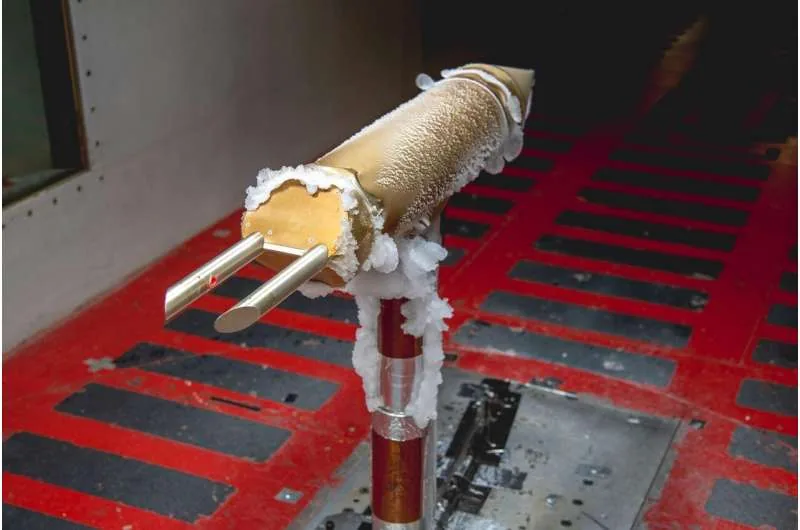
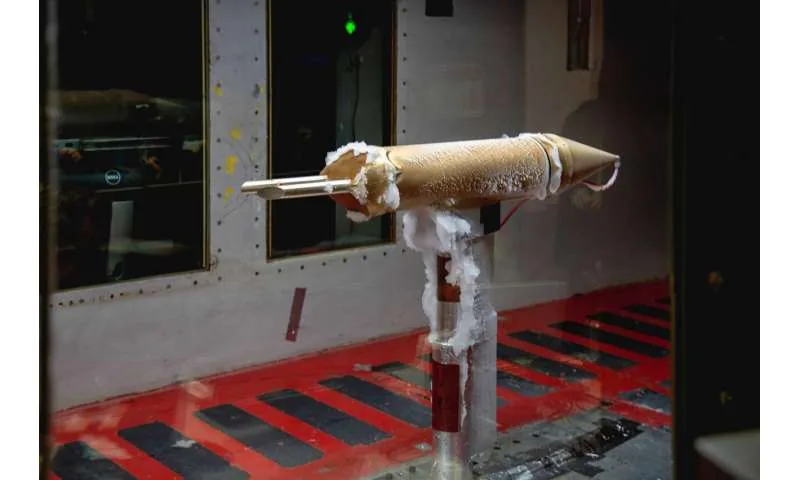
Test runs conducted between June 8 to 11, 2026 focused on calibrating particle size distributions inside the test section to help aviation manufacturers build safer passenger aircraft for severe winter operations. During the test entry, engineers evaluated the 1D2D-X probe to record drop sizes as experimental clouds drifted through the test chamber. Quentin Schwinn photographed ice gathering on unheated probe surfaces. Unheated surfaces collected thick ice [3].
Aerospace companies depend on computer simulation tools during the design phase to predict where ice might stick during freezing flights. While current aerodynamic modeling software reliably estimates ordinary cloud moisture conditions, aerospace engineers have repeatedly questioned whether those mathematical simulation codes can accurately capture the complex physical dynamics, splash mechanics, and freezing trajectories of supercooled large droplets. Collecting physical data from tunnel trials gives engineers empirical baselines to validate numerical simulation codes before flight tests. Better software tools help manufacturers design resilient wings without adding dead weight to the airframe [2].
How Supercooled Water Droplets Form Inside Clouds
Liquid water can remain unfrozen below 32 degrees Fahrenheit (0 degrees Celsius) whenever clean air lacks tiny dust particles or mineral motes around which ice crystals normally form. When an airplane wing slices through this supercooled moisture, the sudden mechanical impact breaks the delicate physical balance and causes the cold liquid to freeze almost instantly into hard rime or glaze [2].
Typical cloud formations contain tiny moisture droplets that span between 2 and 100 microns in diameter, with an average human hair measuring roughly 70 microns across for physical scale comparison. These microscopic droplets have very little mass. Because these small particles follow air streamlines closely around the curved profile of a moving wing, conventional heating boots and thermal strips positioned on forward leading edges can melt or deflect them before they build into dangerous shapes. Leading edge heaters protect against small droplets [1].
In rarer meteorological events, clouds generate supercooled large droplets that reach diameters of up to 2,000 microns, matching the heavy freezing rain beads that people observe at ground level during severe winter storms. Large drops carry much greater momentum. Instead of following curving airflows safely around the airframe, these massive droplets punch straight through the protective boundary layer, striking exposed metal skin and splashing backward toward unprotected aft surfaces [5].
Why Supercooled Large Droplets Threaten Modern Aircraft
When large water drops splash past protected deicing boots, ice accumulates along untreated control surfaces and distorts the smooth aerodynamic contour that produces safe flight lift. Standard deicing boots cover only the narrow forward curve of a wing. Supercooled large droplets strike further back along the wing chord, forming irregular ice ridges that disturb airflow over flaps, ailerons, and tail fins. Pilots cannot see aft ice from cockpit windows [1].
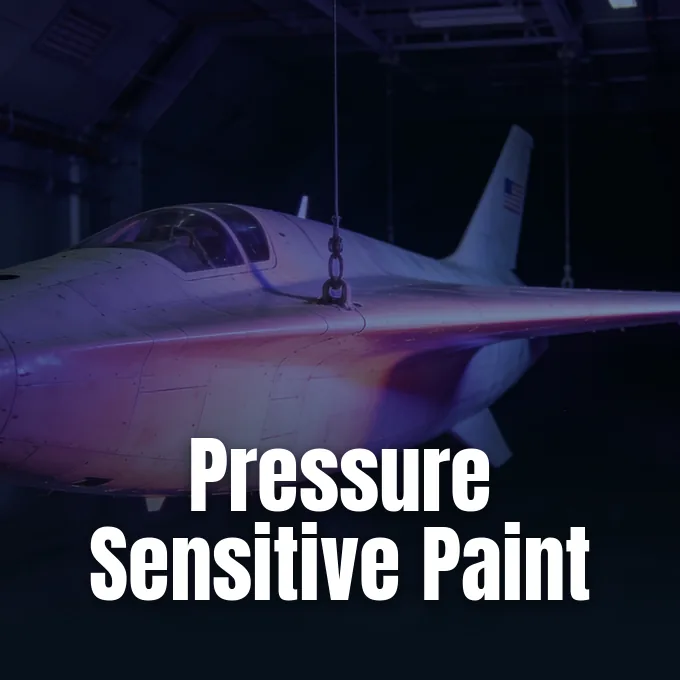
Distorted airflow over a frozen wing increases aerodynamic drag while reducing the maximum lift the wing can produce at normal cruising speeds. Unexpected ice accumulation behind deicing strips can cause aircraft to stall at higher airspeeds during descents. To understand how ice patterns modify flight dynamics, NASA researchers compare icing tunnel data with findings from pressure sensitive paint wing testing, which records dynamic air pressure distributions over wing surfaces during high-speed flow simulations. While pressure-sensitive paint tracks aerodynamic loads on wing skins, the Icing Research Tunnel focuses on how subfreezing water droplets adhere to cold aircraft structures. The two research programs examine different aviation hazards [3].
Aviation safety regulators established updated airworthiness certification guidelines after investigating winter weather accidents involving passenger turboprops and business jets flying through atmospheric freezing drizzle. Natural clouds make flight testing dangerous. Replicating rare subfreezing cloud moisture inside a controlled ground tunnel provides the safest and most reliable way to collect repeatable engineering data [4].

Calibrating Probes for Supercooled Large Droplet Icing
Measuring cloud water content accurately inside a high-speed wind tunnel needs sensor technology designed to endure subfreezing air streams. NASA researchers mounted the 1D2D-X probe inside the tunnel test section during the June 2026 test campaign to record droplet size distributions across a broad spectrum of artificial cloud conditions. Ice gathered on unheated probe sections while heated optical sensors measured the passing spray [3].
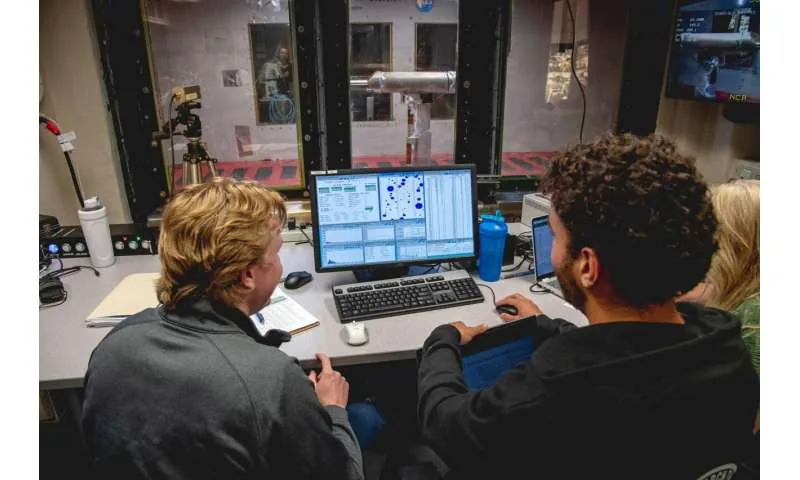
The brand new detection probes can detect drops larger than 45 microns and perform an automated real-time size analysis as individual water particles pass through optical sensor beams inside the high-speed refrigerated airflow. Older techniques required laborious manual post-processing of photographic frames. By pairing real-time optical data with post-processed image records, researchers can cross-check readings and identify calibration discrepancies with far greater confidence. Fast data processing allows engineers to adjust tunnel spray nozzles between test entries without wasting facility energy [1].
To capture every drop in the artificial cloud, NASA pairs data from the large-drop sensor with a second probe that measures droplets smaller than 45 microns. When technicians mate measurements from both optical instruments, they reveal the complete droplet size spectrum generated by the tunnel spray nozzles. Knowing the full particle spectrum confirms that experimental clouds in Cleveland match the dense moisture distributions pilots encounter in winter skies. Precise droplet calibration gives aircraft designers confidence in tunnel simulation data [2].
Upgrading the NASA Testing Facility in Cleveland
The Icing Research Tunnel at Glenn Research Center has operated for decades as a dependable ground test facility to evaluate flight safety hardware under simulated subfreezing atmospheric conditions. NASA is upgrading its cloud generation spray nozzles, refrigeration loops, and digital recording probes to simulate severe freezing clouds with consistency. Spray bars generate customized droplet sizes. Fine-tuning nozzle controls allows researchers to generate supercooled large droplets on demand [1].
Upgrading tunnel capabilities supports broader agency initiatives including the Subsonic Flight Demonstrator project under NASA’s Research and Technology Mission Directorate. This research effort, aligned with the Integrated Aviation Systems Program and ultra-efficient aviation goals, aims to lower aircraft emissions and refine aerodynamic efficiency on future passenger airliners. NASA applies similar high-standard experimental practices in different disciplines, as seen in separate agency aeronautics programs testing Mars helicopter designs in specialized chambers to evaluate aerodynamic lift under unusual atmospheric pressures. Ground tests reduce dangerous flight hazards [3].

Sarah Mann at NASA Glenn Research Center shared details about the ongoing instrumentation trials and said that detailed data analysis continues before results reach aerospace manufacturers. Once technicians finish post-processing image sequences and sensor logs, NASA will release full datasets to the aerospace community. Accessible test data helps companies improve icing certification models without repeating expensive tunnel campaigns [5].
What Aerospace Engineers Learn from Tunnel Data
Aerospace engineers use calibrated tunnel data to verify computer simulation codes that calculate droplet trajectory paths, particle impact points, and local ice accretion rates on complex airframe surfaces. In Notice Nearby, editor Dede Dinius documented how the June 8 to 11 test campaign gathered particle size distribution entries to refine aerospace modeling tools. Digital simulation saves years of design work. Accurate computational codes protect passenger aircraft [3].
Future airliners will feature thinner, lightweight composite wings and novel engine configurations that require accurate ice protection estimates. Because modern composite wing profiles respond differently to ice buildup than older aluminum structures, aircraft designers need empirical knowledge of how supercooled large droplets freeze onto carbon-fiber composite skins. Experimental cloud testing at Glenn Research Center gives aircraft designers the empirical data required to protect movable flight control surfaces. Ground testing keeps airliners safe during winter storms [1].
As winter weather patterns shift and international air routes expand, aviation safety depends on reliable ground test facilities that recreate the most challenging subfreezing atmospheric hazards. Tunnel tests connect cloud physics with flight engineering. By measuring drop sizes down to the micron and publishing findings for the global aerospace sector, researchers help make every winter flight safer for passengers and flight crews alike [4].
- PRESS RELEASE Mann, S. (2026, October 5). NASA testing aims at supercooled large droplet aviation safety. NASA. [Article Link]
- ONLINE NEWS Clark, G., & Egan, R. (2026, October 5). Tunnel tests track large supercooled water droplets that can reach beyond current aircraft ice protection. Tech Xplore. [Article Link]
- PRESS RELEASE Dinius, D. (Ed.). (2026, October 5). NASA testing aims at supercooled large droplet aviation safety. Notice Nearby. [Article Link]
- ONLINE NEWS Worldnewsdotcom. (2026, October 5). NASA testing aims at supercooled large droplet aviation safety. WN.com. [Article Link]
- ONLINE NEWS Mirage News. (2026, October 5). NASA tests aviation safety in supercooled droplets. Mirage News. [Article Link]
APA 7: TWs Editor. (2026, October 6). NASA Wind Tunnel Tests Target Supercooled Large Droplets. PerEXP Teamworks. https://perexpteamworks.com/en/supercooled-large-droplets-nasa-wind-tunnel/


