





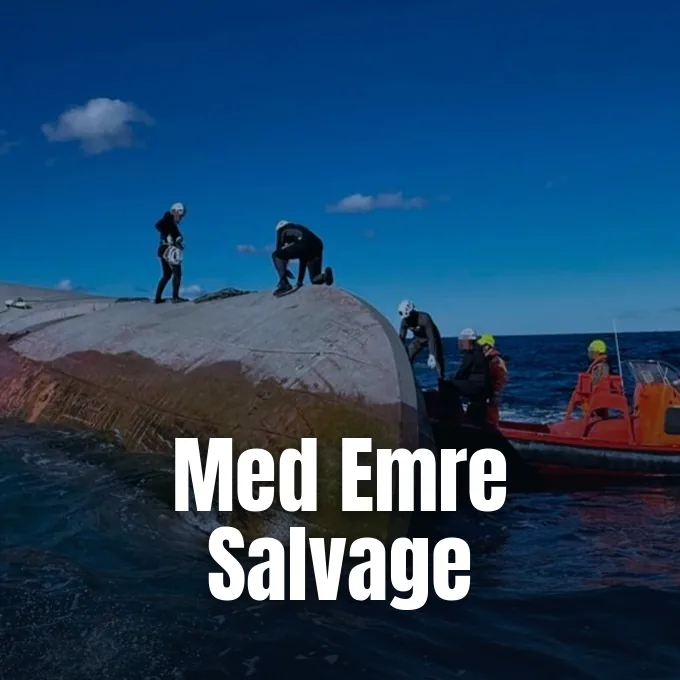
Spanish rescue teams prepared to tow the capsized tanker Med Emre to the port of Cartagena after the ship overturned in open waters off Ibiza while carrying up to 7,000 tonnes of diesel. The vessel ran into trouble early on Thursday while travelling from Algeciras near Gibraltar to Barcelona, prompting Spanish authorities to launch aerial and naval inspections to track possible environmental contamination [1]. Transport officials confirmed that the double-hulled vessel remained stable without leaks, and tugs took advantage of calm weather to begin moving the ship toward shelter before winter storms could increase the danger [2]. Divers found no structural cracks in the fuel tanks [1].
Structural Assessment of the Med Emre Hull
Rescuers in Valencia first received an emergency call late on Wednesday when crew members reported a water leak and stated that the vessel was leaning at a 90-degree angle. The ship capsized in the early hours of Thursday roughly 25 nautical miles (46 km; 29 miles) from the coastline of Ibiza and 57 nautical miles from Valencia. Emergency crews safely evacuated all 17 crew members from the sea, but the chief engineer died later in hospital while six others received treatment for minor injuries [1].
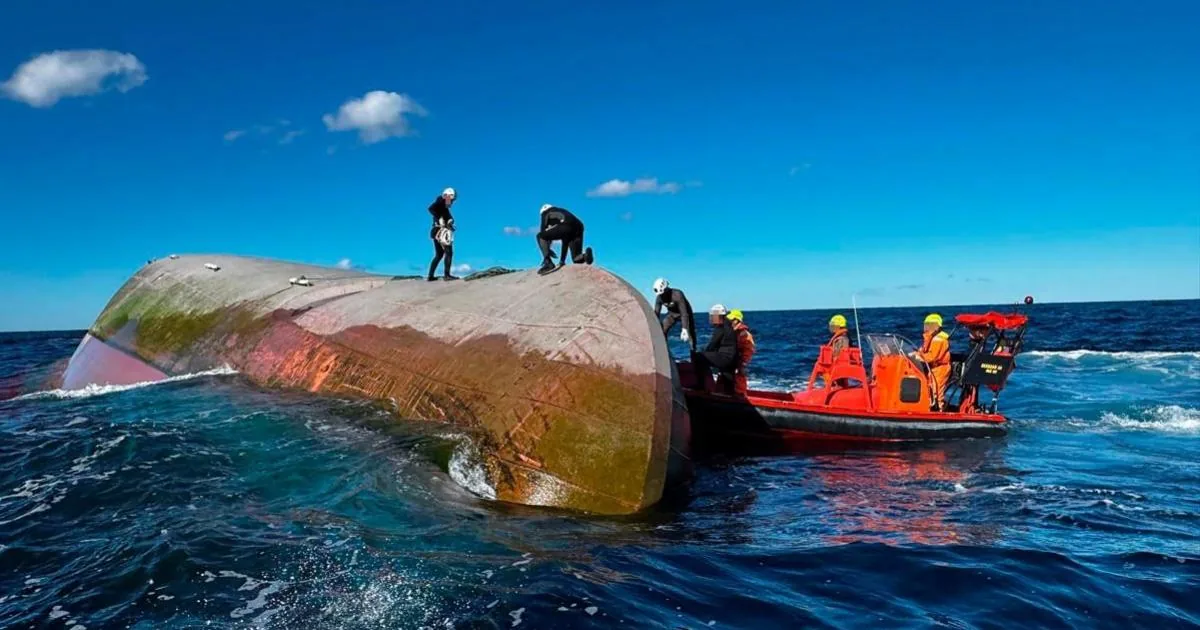
The vessel belongs to the Turkish shipping firm YMN Tankers, which confirmed the death of its chief engineer following the accident. An AFP reporter who approached the scene on Friday saw the overturned keel jutting above the waves while an orange rescue boat monitored nearby. The ship has a modern double hull that reduces spill risks [2].
Spain deployed the pollution control ship Clara Campoamor, operated by the national maritime rescue service, along with aircraft to check water quality around the hull. Elena Delgado, the maritime captain of the port of Valencia, told AFP that an early sheen on the water had disappeared without causing wider harm. “The situation is stabilised,” Delgado said, adding that inspectors would continue monitoring the Med Emre to ensure that the diesel cargo remained secure [1].
Why Cartagena Was Chosen for Salvage
The Spanish transport ministry announced that the Med Emre would be towed to Cartagena in the southeastern region of Murcia because it is the only facility equipped to handle cargo extraction from an overturned vessel. Officials explained that the port met necessary depth, channel size, and safety standards for unloading liquid fuels without exposing coastal communities to unnecessary hazards [2]. In an official statement released on Friday, the ministry said that the ship would be taken to Cartagena “as it is the only one [port] that meets the technical requirements to carry out cargo extraction and repair work” [1]. The port offers calm docks protected from winter storms [2].
Transport planners pointed out that open waters in the western Mediterranean grow turbulent during winter, which makes deep-sea salvage risky. In contrast to stormy conditions offshore, Cartagena provides a calm environment close to petrochemical facilities and anti-pollution tools. Removing the diesel and righting the hull will take “several weeks” once the ship arrives [2].
Spanish Prime Minister Pedro Sánchez spoke about the salvage operation during an interview with the Cadena SER radio network. Sánchez expressed hope that maritime teams could bring the vessel into port “in the coming hours, in the coming days”. The prime minister added that “The information suggests that, indeed… this leak is not happening,” reassuring coastal towns that surveillance flights detected no diesel spreading from the tanks. The vessel had been travelling from Algeciras toward Barcelona when the emergency began [1].
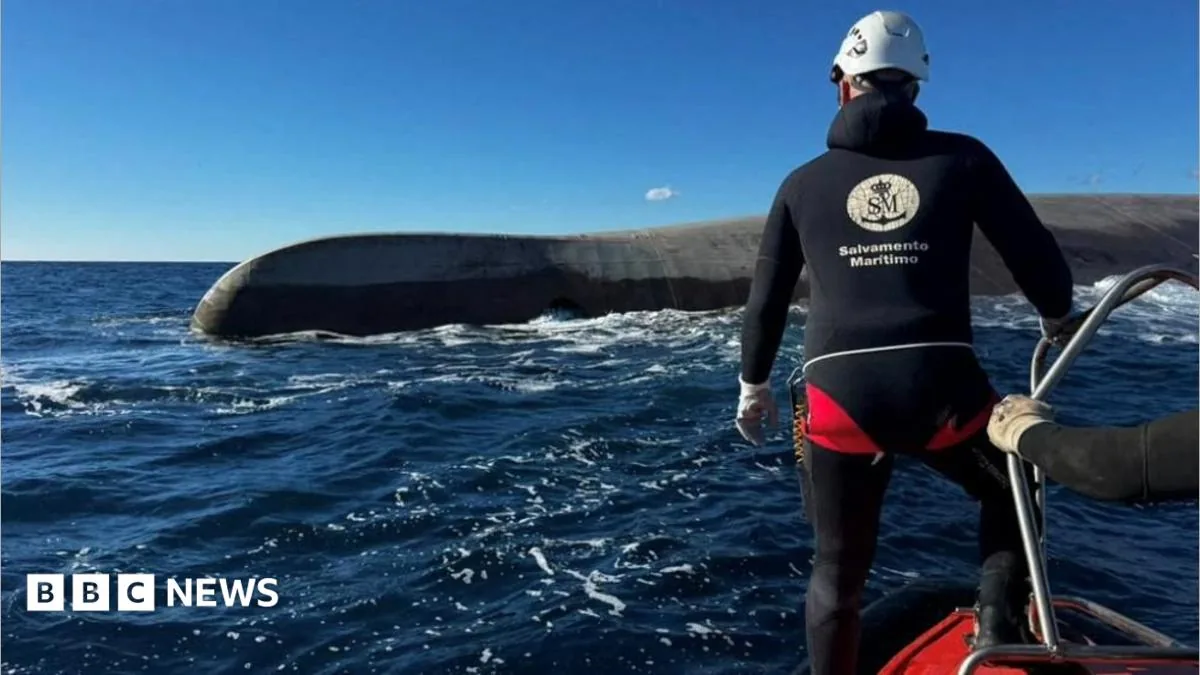
Stabilizing the Med Emre in Open Waters
Spanish officials warned that leaving the tanker offshore would create serious hazards if winter weather deteriorated. The transport ministry stated that keeping the vessel in open waters “would unacceptably raise the risk of a sinking and a spillage,” prompting teams to start the tow under favourable weather. Rescuers checked the seaworthiness of the Med Emre before attaching tow cables. Tugs move at low speed to maintain balance [2].
Conflicting reports surfaced early regarding the status of the vessel after the crew evacuated. Regional emergencies director Pablo Gárriz clarified that the tanker had not sunk to the seabed as early news reports stated. The ship remained partially submerged with its keel visible above the water [1].
Spanish authorities provided few details about how technicians will extract the diesel cargo once the vessel reaches Cartagena, but emergency workers have already tested containment systems around the hull. The transport convoy is scheduled to arrive at the industrial port on Monday after covering the distance under naval escort. Pollution control vessels accompany the tow to intervene if fuel seeps from vents during the voyage. The journey covers dozens of miles across open Mediterranean waters [1].
Posidonia Oceanica Meadows at Risk
The capsizing occurred near waters that hold exceptional ecological value for the entire Mediterranean basin. The marine environment surrounding Ibiza was added to the UNESCO World Heritage List in 1999 to protect its coastal habitats, cultural sites, and unique underwater biodiversity. In particular, these clear coastal waters host extensive underwater prairies of Posidonia oceanica, an endemic seagrass found only in Mediterranean waters that oxygenates the sea, prevents coastal erosion, and provides feeding grounds for fish and endangered marine species. A diesel spill would damage these delicate underwater meadows. The seagrass supports local fisheries and maintains natural coastal water clarity [1].
Environmental organisations warned that an accident involving 7,000 tonnes of fuel threatened local flora, fauna, and commercial fishing grounds. Diesel disperses through surface waters where plankton and fish larvae feed. Local fishermen depend on healthy coastal waters for their livelihoods. A spill would also disrupt maritime tourism [2].
Ibiza residents expressed deep concern over the accident, remembering past spills that harmed the local economy. Monica Castano, a 49-year-old resident of Ibiza, described the community’s anxiety when speaking with news reporters. “I’m particularly concerned about the issue of diesel. There could be a spill or something like that,” Castano said to AFP. Castano explained that island life depends on protecting the sea, adding: “Here we make our living from, apart from the environment and so on, tourism. Just imagine a disaster like that — it already happened a few years ago” [2].
Memories of the Don Pedro Sinking
The capsizing off Ibiza revived vivid memories of the cargo ship Don Pedro, which sank off the island in July 2007 after colliding with an islet. The wreck plunged to the seabed carrying approximately 200 tonnes of fuel oil and diesel. The resulting leak contaminated several kilometres of coastline, forcing authorities to close three popular beaches during the summer holiday season [2].
The 2007 accident triggered a major clean-up operation that disrupted tourism and alarmed coastal businesses throughout the island. Workers spent weeks clearing tar from rocky inlets and sandy beaches before the water became safe for swimming. The incident showed how even a relatively small fuel release can cause lasting economic disruption in a tourist destination that relies on clean waters [2].
In 2002, Spain experienced its worst environmental disaster when the oil tanker Prestige ran into trouble off Galicia’s coastline in the country’s north-west before splitting in two. More than 60,000 tonnes of heavy fuel oil spilled into the sea, damaging thousands of kilometres of Atlantic coastline and devastating fishing communities [1, 2]. The disaster transformed Spanish maritime emergency policy and highlighted the vulnerability of coastal habitats to massive tanker spills. Because the Med Emre was built with a modern double hull, maritime experts explained that it provides far greater safety against the kind of structural breakup that destroyed the Prestige [2].
Maritime Geography of Ibiza
Ibiza is a Spanish island situated in the Mediterranean Sea off the eastern coast of the Iberian Peninsula, located approximately 150 kilometres (93 miles) from the city of Valencia. As the third largest of the Balearic Islands in area and the second largest by population, it occupies a strategic position along Mediterranean shipping corridors. The highest point on the island is Sa Talaiassa, which rises 475 metres (1,558 feet) above sea level [3].
Ibiza and the nearby island of Formentera to the south are called the Pine Islands, or the Pityoûssai in Greek and Pitiüses in Catalan. The largest settlement on the island is Ibiza Town, known in Catalan as Vila d’Eivissa, alongside Santa Eulària des Riu and Sant Antoni de Portmany. While the island is famous for summer nightlife, authorities have worked to encourage family tourism [3].
The island has a maritime history dating back more than 2,500 years. In 654 BC, Phoenician settlers founded a port on Ibiza, calling it Ibossim due to the abundant aromatic plants found across the landscape. After Phoenicia declined, Ibiza came under Carthaginian control and developed into a major trading post producing dye, salt, wool, and fish sauce. During the Second Punic War, the Roman Scipio brothers attacked the island in 217 BC, yet Ibiza remained loyal to Carthage before negotiating a treaty that allowed it to preserve its institutions as a Roman municipality. The port later fell under Muslim rule in 902 [3].
- ONLINE NEWS Lukiv, J. (2026, November 27). Capsized tanker carrying 7,000 tonnes of diesel to be towed away from Ibiza. BBC News. [Article Link]
- ONLINE NEWS Agence France-Presse. (2026, November 27). Capsized Malta-flagged diesel ship to be towed to Spanish port of Cartagena. Times of Malta. [Article Link]
- WEBSITE Wikipedia contributors. (2026). Ibiza. Wikipedia. [Article Link]
APA 7: PerEXP Teamworks. (2026, November 28). Cartagena Port Prepares for Med Emre Tow After Tanker Capsizes. PerEXP Teamworks. https://perexpteamworks.com/en/med-emre-towed-cartagena/


