





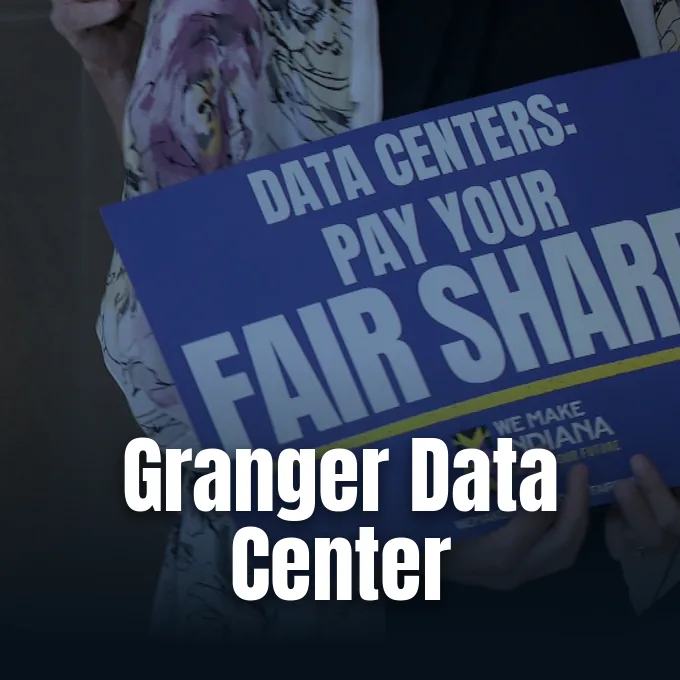
A pledge to build community-first infrastructure is facing an early test in northern Indiana. In May 2026, We Make Indiana, a grassroots coalition uniting 25 interfaith congregations, law enforcement associations, and healthcare non-profits, formally approached corporate representatives with an unprecedented request. The coalition asked for a binding commitment dedicating one cent on every dollar of construction costs from a planned $1 billion Microsoft data center near Granger. Four months later, company liaisons have offered no substantive response as groundbreaking approaches in fall 2026 [3].
Church Coalitions Seek Microsoft Data Center Agreement
The planned Microsoft data center facility sits across roughly 900 acres in St. Joseph County, situated within a proposed 4,000-acre economic development zone near the Michigan state line. Construction begins in fall 2026. Local operations could launch by 2029 if development continues without regulatory interruptions. During a Granger open house covered by local television station ABC57, corporate delegates presented early engineering drafts featuring an industrial closed-loop cooling system [3].
The proposal submitted by We Make Indiana, titled the Fair Share Agreement, diverges sharply from traditional corporate charity. Rather than requesting discretionary gifts, the alliance seeks a legally binding compact that recurs throughout the operational life of the facility. Under the group’s projection, allocating 1% of total project costs could generate between $30 million and $40 million annually for municipal services [3]. An independent community board would oversee disbursements.
Organizers established their priority roster around urgent regional gaps: child care, elder care, community health clinics, affordable housing, workforce training, and public transit. Those demands reflect acute local strain in neighboring South Bend, where more than 20 percent of residents live below the federal poverty line ($15,960 in annual income for an individual and $33,000 for a family of four). University of Notre Dame assistant professor Ryan Juskus explained that civic organizers turned toward technology developers because public coffers remain strained. ‘It’s kind of like asking Microsoft to help us solve our challenges when the state has abandoned us,’ Juskus told Ars Technica [1].
The coalition asked for one cent on every project dollar [3].

Local Activists Confront One-Time Grant Limits
In January, Microsoft President Brad Smith published an official essay outlining a five-point strategy for ‘building community-first AI infrastructure’ across the United States. Smith pledged that the company would pay its share to protect local electricity rates, expand domestic payrolls, and send designated representatives into host jurisdictions. ‘We will invest in your local nonprofit community,’ Smith wrote, underlining the sentence for emphasis. He added that contributions would begin by listening to regional civic leaders who know municipal priorities best [1].
When We Make Indiana met with corporate liaisons, organizers discovered strict institutional boundaries governing local philanthropy. Company representatives are authorized to distribute one-time grants from a fixed ceiling of $1 million for the entire area, with funds restricted strictly to non-profit entities rather than public utilities or municipal departments. Juskus characterized that discretionary budget as ‘minuscule, given the project’s scale’ [1]. Can voluntary corporate charity substitute for structural public investment?
Microsoft representatives maintain that investment frameworks remain preliminary while engagement with civic leadership proceeds. In public statements, the corporation stated that Granger discussions occur within an ongoing community-listening phase, making binding financial settlements premature. The company highlights voluntary regional sponsorships encompassing digital-skills coursework, community-college partnerships, local hunger relief, and environmental land preservation. Available disclosures do not reveal total capital spent on those programs, nor do they satisfy the binding funding mechanisms demanded by resident groups [3].


Indiana Offers Decades of Tax Relief
The dispute in St. Joseph County unfolds against generous statutory subsidies. Under policies from the Indiana Economic Development Corporation, qualifying data centers receive sales- and use-tax exemptions on electricity and servers lasting 25 years below $750 million, and up to 50 years for larger commitments. An incentive review by the Indiana General Assembly found seven state projects qualifying for $20.8 billion in total investment. Exempt hardware purchases across those projects range from $2.2 billion to $13.2 billion. At Indiana’s 7% sales-tax rate, potential foregone revenue spans $150 million to $900 million statewide, according to reporting from Mirror Indy and WFYI. Separately, Microsoft obtained a 35-year tax incentive for a separate $1 billion Microsoft data center situated in La Porte in 2024 [3].
State commerce officials stress that these statutory exemptions remain performance-based, meaning developers must reach verified spending milestones before realizing tax relief. We Make Indiana contends that exempting billions in server purchases starves municipal budgets while shifting infrastructure maintenance onto ordinary utility customers [3]. When corporations save hundreds of millions in state taxes, civic leaders argue that a 1% civic reinvestment represents a modest concession. The state sales tax is 7%.
Local organizers in St. Joseph County are assessing regulatory levers, including public hearings for a proposed 4,000-acre tax-increment-financing district reported by the South Bend Tribune. That municipal scrutiny mirrors wider regional friction, as seen in communities organizing opposition against dozens of data center projects across the country to renegotiate zoning terms and energy concessions. If county officials condition infrastructure approvals on civic contributions, Granger could set a binding precedent for upcoming Midwestern developments [3].
How an AI Data Center Impacts Communities
Across the country, municipal skepticism over each new Microsoft data center campus is deepening as public audits reveal sharp fiscal imbalances. In Georgia, an audit cited by reporter Ronan Farrow showed the state surrendered $474 million in sales-tax exemptions in one year, while the industry returned only $41 million. State analysts determined that 70% of those data centers would have been constructed anyway without tax incentives. While Microsoft matched $229 million in employee giving across 29,000 non-profits in 2024, critics observe that 38 states provide long-term tax waivers with little guaranteed return [4].
Resource burdens have prompted regulatory intervention in Oregon. Tech developers saved over $450 million annually through tax breaks reported by the Corvallis Advocate, yet data centers consume 25% of all retail electricity sold statewide (reported by Hoodline). In The Dalles, a Google facility uses 40% of municipal water supplies, with annual consumption surging 316% between 2012 and 2024 to 434 million gallons. Oregon passed the POWER Act (HB 3546) to raise heavy user rates, and HB 4084 instituted a temporary tax moratorium. Hillsboro and Woodburn enacted local 120-day pauses [4].
Legislative pressure is spreading across state capitols. In Pennsylvania, state Senator Lindsey M. Williams proposed requiring developers to contribute at least 10% of project costs toward binding community funds for infrastructure and safety. That figure dwarfs the 1% sought by Indiana congregations. While tech firms investigate flexible data center architectures backed by major operators to reduce power spikes, hardware adjustments cannot address community tax deficits [3].
Granger Project Sets Precedent for Tech Expansions
The confrontation in Granger arrives amid unprecedented global capital outlays. Investment bank UBS projects that hyperscale operators—including Microsoft, Alphabet, Amazon, Meta, Oracle, SpaceX, CoreWeave, and Nebius—will disburse approximately $4.1 trillion in capital expenditures between 2026 and 2028. Microsoft alone accounts for an estimated $672 billion of that global total. In 2026, the three largest cloud providers are spending roughly 102% of their cloud revenues on infrastructure, and Microsoft committed more than $10 billion toward Gulf region infrastructure through 2030, according to Simply Wall St [4].
For St. Joseph County officials and civic advocates, those macro spending projections contrast starkly with the quiet response to grassroots requests. Organizers are weighing whether forthcoming county negotiations surrounding the Granger Microsoft data center project can compel corporate executives to provide enforceable equity agreements. The outcome in northern Indiana will signal whether local jurisdictions can secure enforceable equity agreements or whether voluntary corporate benevolence remains the standard industry response [3].
We Make Indiana leaders maintain that grassroots mobilization will intensify as site work approaches. Juskus confirmed that organizers will continue marshaling elected officials and residents to establish binding terms before ground disturbance begins in St. Joseph County. ‘In a fast-changing local and national environment, we will continue to organize our community and elected leaders to use every piece of leverage we have to bring Microsoft to the table for real conversation and negotiation,’ Juskus stated to Ars Technica, adding that while the corporation claims to seek good neighbor status, ‘the jury is still out’ [1].
- ONLINE NEWS Wilkins, J. (2026, September 28). Microsoft shrivels when asked if its ‘good neighbor’ data center policy will involve actually supporting community groups. Futurism. [Article Link]
- ONLINE NEWS Ars Technica. (2026, September 28). Microsoft goes quiet after church groups ask for 1% of data center costs. Ars Technica. [Article Link]
- ONLINE NEWS Barrientos, A. (2026, September 28). Microsoft silent after church groups seek 1% of data center costs. Gadget Review. [Article Link]
- ONLINE NEWS Equipo Ecosistema Startup. (2026, September 28). Microsoft silencia pedido del 1% de iglesias en data centers. El Ecosistema Startup. [Article Link]
- WEBSITE Coaio Limited. (2026, September 28). Microsoft’s silence on church groups’ 1% data center demand sparks AI infrastructure debate. Coaio. [Article Link]
- ONLINE NEWS Guavy AI Editorial Team. (2026, September 28). Microsoft silent on ‘fair share’ proposal from struggling community. Guavy. [Article Link]


