





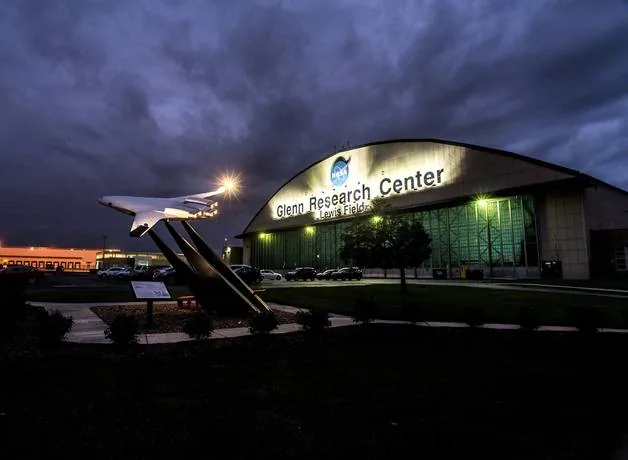
Power grids on Earth rely on atmospheric cooling and steady weather, but equipment operating on the lunar surface must survive wide temperature swings and hard vacuum without backup lines. NASA Glenn Research Center in Cleveland is seeking Phase 1 proposals to design and build the Aerospace Power Systems Laboratory to advance power research. The facility will provide new test spaces to help the agency meet current and future space exploration goals. Interested teams must submit project proposals by 1 p.m. EST on Oct. 30, 2026 [1].
What Does NASA Glenn Research Center Do?
NASA Glenn Research Center develops and tests aeronautics systems and space flight hardware, focusing on power generation, electric propulsion, and materials that withstand difficult operational environments [1, 2]. Glenn’s expertise in power systems is central to the Artemis program, the planned Moon Base, and future exploration of Mars and deep space. Teams in Cleveland evaluate how electrical grids perform when spacecraft travel far beyond Earth, measuring energy efficiency before flight hardware leaves the factory floor [1].
Researchers at the center test high-voltage distribution networks, power converters, and battery storage units designed for crewed surface habitats. Unlike private booster catalog efforts that focus on rocket flights, NASA Glenn Research Center concentrates on internal spacecraft systems, high-temperature cabling, and electrical power architectures. Engineers use simulation bays to confirm that electrical components keep running during extended lunar surface operations, examining how hardware behaves under radiation and severe thermal stress [1].
Glenn also shares agency expertise with external contractors through competitive awards and technical evaluations [1, 2]. While recent coverage of commercial launch catalog expansions highlights heavy-lift rockets like New Glenn, NASA’s Cleveland center focuses on research hardware rather than private launch vehicles. The facility provides testing environments that private builders cannot easily construct on their own, supporting government flights and broader aerospace partnerships [1].
Why Does NASA Glenn Seek Laboratory Proposals?
NASA Glenn seeks proposals to construct a dedicated building for evaluating aerospace power hardware, complete with supporting utilities, civil groundwork, and integrated flight-simulation systems. The main goal behind the procurement is providing researchers with modern test rigs to strengthen energy studies and support future agency flight goals. Current agency plans demand high-power surface systems, robotic landers, and transit spacecraft that need dependable power distribution. The Aerospace Power Systems Laboratory will replace older test cells with upgraded infrastructure [1].
Testing power hardware in ground facilities prevents costly equipment failures during deep space journeys. Spacecraft orbiting the Moon or resting on the lunar surface must endure extreme thermal shifts, intense solar exposure, and long periods of total darkness, and these harsh conditions can degrade power cells or short out delicate power electronics. By collecting accurate telemetry inside simulated space environments, researchers learn how power arrays supply electricity during peak operational demands. Contracting officer John Christel managed written questions about the facility requirements before vendors prepared their proposals. Ground evaluations protect astronaut crews on long voyages [1].
The new Aerospace Power Systems Laboratory will house testing rigs for fuel cells, solar power electronics, and power distribution cabling intended for permanent lunar encampments. Engineers will use the building to simulate the electrical demands of future lunar bases and surface vehicles, gathering experimental data on Earth before flight fabrication begins. Testing chambers let teams run power trials without risking flight hardware in space [1].

Contract Timelines and Small Business Standards
The agency is running the acquisition through full, unrestricted bidding under North American Industry Classification System (NAICS) code 236220, welcoming qualified design and construction firms. The small business size standard for this acquisition is $45 million, allowing qualified construction firms to participate. Bidders face a proposal deadline of Oct. 30, 2026, at 1 p.m. EST, giving evaluators time before NASA Glenn announces the contract award on Dec. 16, 2026 [1].
Contractors will split project duties between their own commercial offices and on-site spaces at NASA Glenn in Cleveland. Bidding packages must upload through the secure Enterprise File Sharing and Sync Box, known as the EFSS Box, which holds FedRAMP Moderate government certification. Contracting officer John Christel asked bidders to email inquiries to john.a.christel@nasa.gov by the Oct. 12, 2026 deadline, urging early submissions for timely agency review [1].
Public information and media inquiries regarding the procurement are coordinated by Kristen Parker at Glenn Research Center in Cleveland. Inquiries can reach Parker by telephone at 216-990-4386 or by email at kristen.m.parker@nasa.gov, while agency reporter Gary Daines released the formal procurement notice for industry. The notice provides guidance on submission formats and facility construction criteria for interested offerors [1].


What Happens at NASA Glenn Research Center?
At NASA Glenn Research Center, scientists and technicians conduct aviation safety studies, develop space communication systems, and test novel materials for spacecraft. Procurement records show solicitation 80GRC026R0008 opened with a formal synopsis on May 19, 2026, before staff posted a draft solicitation on June 29, 2026, outlining requirements for prospective industry partners. Glenn also selected Modulate Space Corporation to engineer foundational parts for an orbital 5G communications network. Microscope images also revealed a colorful crystal structure in a new material that could help astronauts pack lighter [2].
Glenn also conducts aeronautical trials to address aviation icing hazards using test tunnels, preparing NASA’s X-59 quiet supersonic research aircraft for significant flights in national airspace. Officials also held a ribbon-cutting on Sept. 10 to mark the complete rehabilitation of the Guam Remote Station. Decades of aerospace breakthroughs that began in Glenn laboratories were ultimately proven in the sky, demonstrating the value of continuous ground testing [2].
Workforce development and industry partnerships form an active part of daily operations across NASA Glenn Research Center in Cleveland. Glenn works with the U.S. Office of Personnel Management to run NASA Force, a talent track for hiring aerospace specialists, while selecting Plug Power, Inc., of Slingerlands, New York, and Air Products and Chemicals, Inc., of Allentown, Pennsylvania. Additional initiatives detailed in scientific computing series coordinate computing tools for astronomical analysis [2].
Evolution of Scientific Laboratories in Complex Research
Scientific laboratories offer sheltered workrooms where researchers run structured tests, record physical observations, and evaluate experimental hardware. Historical records trace the earliest documented experimentation space to Pythagoras of Samos, who examined musical acoustics and vibrating strings inside a domestic workroom. In Prague, an underground sixteenth-century alchemical laboratory called Speculum Alcemiae, linked to Holy Roman Emperor Rudolf II, was accidentally discovered in 2002. Early laboratories focused on metallurgy and medicine preparation [4].
Scientific research transformed during the nineteenth and twentieth centuries as solitary experimenters gave way to organized research teams. Artist Albert Edelfelt illustrated that experimental era in an 1885 canvas showing chemist Louis Pasteur observing bottled biological substances. The emergence of Big Science during World War II increased the physical size of laboratories, introducing massive equipment like particle accelerators and large vacuum chambers to support complex research programs. Testing complexes draw on that historical evolution when constructing advanced engineering bays [4].
Today, laboratories include creative workshop spaces such as Living Labs, Fab Labs, and Hackerspaces where people solve problems and build functional prototypes collaboratively using open innovation concepts. These facilities apply user-centred design concepts to translate theoretical ideas into working devices, a philosophy NASA adapts when bringing multi-disciplinary teams together for aerospace projects [1, 4]. Shared testing infrastructure allows specialists to evaluate power systems before flight integration [1].
Testing Energy Architectures for Future Lunar Outposts
The Aerospace Power Systems Laboratory will provide NASA Glenn Research Center with new test infrastructure for studying high-output space energy systems [1, 3]. Building reliable power systems is key to the Artemis program, the Moon Base, and the long-term exploration of Mars and beyond, where crews cannot tap existing utility grids. Lunar surface outposts require steady electrical power to run life support equipment and scientific experiments through freezing two-week lunar nights. The new facility will allow engineers to test high-voltage cables, power converters, and power management software [1].
Ground test chambers offer a practical way to evaluate space hardware before launch, revealing design flaws in vacuum and thermal bays before components ship to launch sites. Decades of aerospace breakthroughs that began in Glenn laboratories were ultimately proven in flight, and the new facility will continue that tradition for deep space missions [1, 2]. Careful testing prevents costly surprises in space [1].
As lunar exploration plans advance, dependable power infrastructure remains necessary for maintaining permanent scientific stations on the Moon. The Phase 1 procurement initiated by NASA Glenn Research Center marks an early step toward building the specialized test facilities required for long-duration space missions across the solar system. Delivering an advanced power laboratory helps ensure that future spacecraft possess the tested energy systems needed to explore distant worlds safely [1, 2]. Sound ground research builds the foundation for deep space travel [1].
- PRESS RELEASE Daines, G. (2026, October 6). NASA Glenn invites Phase 1 proposals for Aerospace Power Systems Laboratory. NASA. [Article Link]
- WEBSITE National Aeronautics and Space Administration. (2023, June 12). Glenn news and articles. NASA Glenn Research Center. [Article Link]
- ONLINE NEWS Worldnews. (2026, October 6). NASA Glenn invites Phase 1 proposals for Aerospace Power Systems Laboratory (Glenn Research Center). WN.com. [Article Link]
- WEBSITE Wikipedia contributors. (n.d.). Laboratory. Wikipedia, The Free Encyclopedia. [Article Link]
APA 7: PerEXP Teamworks. (2026). How NASA Glenn Research Center Invites Power Lab Bids. PerEXP Teamworks. https://perexpteamworks.com/en/nasa-glenn-research-center-proposals/


