




Electric vehicle maker Lucid and shared-mobility provider Bolt announced a joint initiative to deploy at least 25,000 autonomous vehicles across Europe. The partnership aims to place Lucid robotaxis onto European streets to expand automated urban ride-hailing services. Both companies confirmed that the planned fleet will rely on Lucid’s upcoming vehicle platform engineered specifically for Level 4 automated driving within designated operational boundaries across European cities. Bolt expects these self-driving cars to accelerate its broader campaign to operate 100,000 autonomous vehicles on its network by 2035 [2].
European Fleet Agreement and 25,000-Vehicle Target
Bolt operates as Europe’s largest shared-mobility network, maintaining active urban transit services in more than 50 countries and 850 cities [2]. The Estonian mobility company currently supports over 200 million customers with 4.5 million registered drivers and couriers navigating dense continental roads. Integrating automated vehicles represents a strategic pivot as regulators establish stricter standards for commercial services. Scale matters. Deploying 25,000 automated units provides Bolt with the physical capacity required to test commercial demand across major European population centers [1].
Bolt founder and chief executive officer Markus Villig described autonomous commercial mobility as an intricate systems challenge that cannot succeed through isolated vehicle engineering alone. Villig emphasized that deploying driverless services across diverse metropolitan areas in Europe requires data, software, vehicles, and operational logistics to function together as a unified system configured specifically for European traffic laws and municipal regulations. The joint venture allows Bolt to secure dedicated electric vehicle production directly from an established manufacturing partner rather than attempting to construct custom automotive assembly facilities internally. Securing 25,000 production vehicles marks an initial step toward Bolt’s stated objective of putting 100,000 autonomous vehicles into commercial service by 2035 [2].
Lucid views the multi-year European deployment as an essential commercial outlet for its proprietary automotive engineering. Hardware demand remains vital. Chief executive officer Silvio Napoli explained that shared autonomous mobility offers the company an opportunity to extend its powertrain and battery technologies beyond individual consumer vehicle sales. The arrangement enables the American automaker to project long-term assembly volume even as retail demand for high-end luxury electric cars fluctuates. Establishing fleet contracts provides predictable scale [2].
Lucid Robotaxis and the Midsize Platform
The planned European fleet will utilize Lucid’s forthcoming Midsize vehicle platform rather than the premium Air sedan or Gravity luxury utility vehicle that defined the automaker’s early market offerings. Engineering teams are designing the new platform to support SAE Level 4 automation (high driving automation operating without human intervention under defined geographic boundaries). Earlier this year, Lucid revealed a compact two-seater robotaxi prototype based on this midsized architecture to demonstrate how smaller physical footprints can dramatically reduce volume manufacturing and consumer pricing expenses [1]. The production vehicles will roll off assembly lines as ADS-ready units prepared for autonomous sensor integration [2].
To deliver the processing throughput required for self-driving computation, the vehicles are expected to incorporate NVIDIA Hyperion architecture. Hyperion functions as a standardized automotive reference stack that bundles high-performance computing hardware with an integrated suite of exterior sensors, including cameras, radar, and lidar. This modular hardware foundation eliminates the need for Lucid to design custom autonomy microchips from scratch [2]. However, NVIDIA Hyperion provides only the physical compute modules and sensor interfaces rather than the algorithmic self-driving intelligence itself. Software completes the package.

Who will supply the artificial intelligence that steers these Lucid robotaxis through congested European city centers? Neither partner has named an autonomous driving software provider. Lucid confirmed that the alliance plans to collaborate with third-party automated driving technology companies to develop the complete Level 4 software stack. Without an integrated self-driving operating system, the physical vehicles cannot perform commercial passenger pickups independently. The hardware remains ready, but the guiding driver has yet to be finalized [2].


Bolt Autonomous Driving Solutions Takes Operations
Bolt takes charge. Operational responsibility for the European deployment will rest entirely with Bolt rather than the vehicle manufacturer. The ride-hailing company created a dedicated operating division named Bolt Autonomous Driving Solutions to supervise all commercial driverless programs. This specialized unit will establish municipal partnerships, configure maintenance facilities, and secure local regulatory operating permits across diverse urban target markets governed by separate national transportation ministries. Bolt confirmed that it intends to own and operate the 25,000 electric vehicles directly within its commercial balance sheet [2].
Managing an autonomous fleet introduces immense logistical hurdles compared to operating an asset-light marketplace of independent contract drivers. Bolt Autonomous Driving Solutions must construct urban charging hubs, implement automated cleaning routines, and establish rapid roadside assistance protocols for disabled vehicles. In addition, European municipal authorities enforce strict liability mandates (legal accountability standards governing vehicle operating safety without human drivers on board) that differ widely between individual countries. Navigating these regional disparities requires localized validation testing before commercial ride hailing begins [2].
On the manufacturing side, Lucid organized its autonomy initiatives under an internal unit called Lucid Technologies. The division consolidates the company’s research into machine learning, advanced driver-assistance systems, and vehicle-level autonomous integration into a single engineering umbrella. By separating internal software development from standard vehicle assembly, Lucid intends to supply turnkey automotive hardware to fleet buyers while preserving internal engineering resources. Both organizations have established distinct functional boundaries to execute the program [2].
Manufacturing Reset and Vehicle Delivery Hurdles
Despite the ambitious scale of the agreement, neither company has published an official deployment timeline for the 25,000 vehicles [1]. The absence of concrete operational dates highlights significant industrial hurdles currently confronting Lucid’s assembly pipeline. The Midsize vehicle platform upon which the entire Bolt fleet depends has not yet reached active production. On August 4, 2026, Lucid announced an operational reset during its second-quarter corporate briefing that formally delayed development of its Midsize platform while restructuring broader capital expenditures across engineering divisions [2].
The midsize program delay reflects deeper financial and organizational stresses inside the electric automaker. Silvio Napoli assumed the permanent chief executive role on June 1, 2026, before guiding the enterprise through extensive restructuring measures designed to stabilize vehicle assembly operations and preserve operational cash. Later that month, Lucid eliminated 18 percent of its workforce (amounting to approximately 1,500 factory and corporate positions) to curb escalating cash expenditures. The automaker subsequently withdrew its 2026 production guidance after delivering just 3,953 vehicles across the entire second quarter [2]. Lucid also postponed the Cosmos utility vehicle, its debut production model scheduled on the midsized architecture, pushing customer deliveries into early 2027 following the factory restructuring program [1].
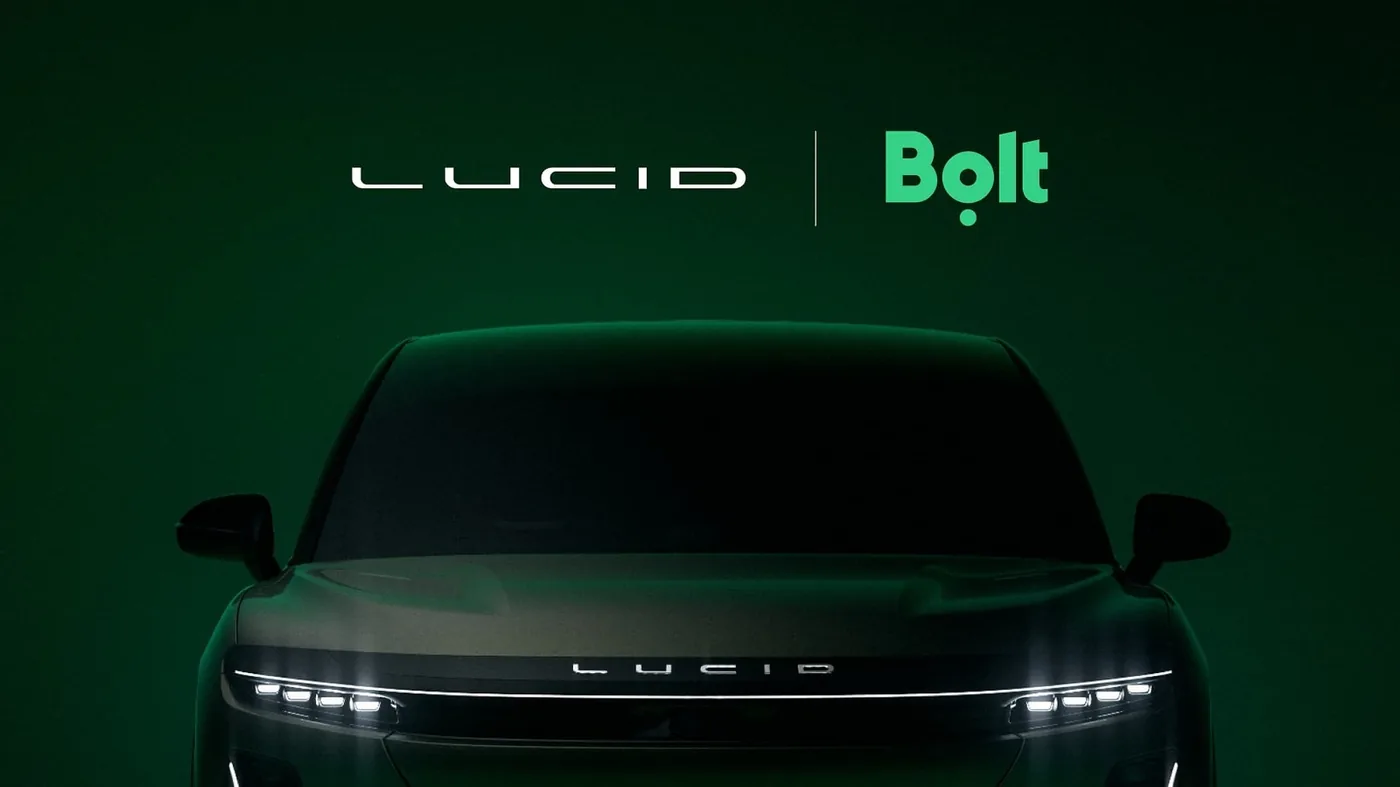
The platform remains unfinished. Commercial deployment of these Lucid robotaxis cannot occur until vehicle factories actually begin rolling out physical midsize chassis [2].
Global Rivalries and Uber Fleet Commitments
The Bolt arrangement represents Lucid’s second major commercial autonomous fleet contract within the past fourteen months. In July 2025, ride-hailing giant Uber committed to deploying 20,000 Lucid Gravity sport utility vehicles equipped with autonomous driving systems provided by Nuro as part of an expanded testing program. That American agreement accompanied a $300 million direct equity investment into the automaker. Uber bought in early. Uber subsequently expanded its equity ownership in Lucid to roughly 11.5 percent as part of an aggressive commercial strategy to establish fleet alternatives to the Waymo robotaxi service operating across American cities [2].
Public road testing is underway. Nuro has started testing autonomous Lucid Gravity vehicles with safety drivers behind the wheel in Houston and throughout the San Francisco Bay Area to validate real-world sensor performance across varied urban driving conditions. Uber plans to deploy up to 35,000 Lucid robotaxis in the United States (including both Gravity models and upcoming midsize vehicles) [1]. With Bolt’s European order, Lucid now holds paper commitments for 45,000 autonomous commercial vehicles across two continents. Can vehicle manufacturing keep pace with these expanding corporate commitments? Restructured factories face tests [2].
For both Lucid and Bolt, the European pact creates a long-term blueprint for metropolitan transportation rather than an immediate commercial service. Bolt gains a dedicated manufacturing pipeline toward its goal of 100,000 autonomous vehicles by 2035, while Lucid establishes high-volume demand for its future midsize architecture [2]. Both companies must now navigate unproven regulations, finalize driving software, and resolve manufacturing bottlenecks before passenger rides can begin [1].
Execution is critical. Autonomous ride-hailing demands massive compute, mature software, and steady factory execution. Until those elements converge on European asphalt, these planned Lucid robotaxis remain a distant corporate prospect [2].
- ONLINE NEWS Holt, K. (2026, September 17). Lucid and Bolt plan to deploy at least 25,000 robotaxis across Europe. Engadget. [Article Link]
- ONLINE NEWS Lambert, F. (2026, September 17). Lucid and Bolt to deploy 25,000 autonomous EVs across Europe. Electrek. [Article Link]
- ONLINE NEWS InsideEVs. (2026, September 17). Lucid and Bolt want to put 25,000+ robotaxis on European roads. InsideEVs. [Article Link]


