



NASA has published a set of classroom posters that explain the Sun twice: once through the agency’s own science, and once through Diné (Navajo) knowledge of the sky. “The Sun Through NASA and Navajo Ways of Knowing Poster Series,” released in 2026 by the NASA heliophysics education team known as NASA HEAT, consists of three free posters and an educator guide covering solar cycles, space weather and the Sun’s role in sustaining life [1].
NASA Heliophysics and Indigenous Astronomical Perspectives
NASA HEAT (the Heliophysics Education Activation Team) belongs to NASA’s Science Activation portfolio, which funds teams that turn mission science into learning materials. The series credits C. Hunt Estevez, C. Ng, M. Kirk, C. Milotte and L. A. Alegbeleye for NASA HEAT; N. Maryboy and D. Begay of Thunderbird Collaborations LLC; and H. Fischer, M. Storksdiek and V. Sellers of Oregon State University [1]. Maryboy and Begay are longtime collaborators on bringing Diné astronomy into science education, and their involvement is what gives the Navajo side of the posters its authority.
The educator guide is the heart of the set. According to NASA, it explores space science concepts and astronomical observations “with Navajo / Diné wisdom and observations to provide a holistic view of the Sun-Earth system” [1]. Diné is the Navajo people’s name for themselves. Reading the sky through more than one tradition is an old habit, as Iris goddess stories that span solar science and ancient myth show; what is unusual here is a NASA heliophysics product that puts both views on the same classroom wall.
All three posters and the guide are free English-language PDFs on NASA’s website [1].
Solar Cycles in the Broader Universe
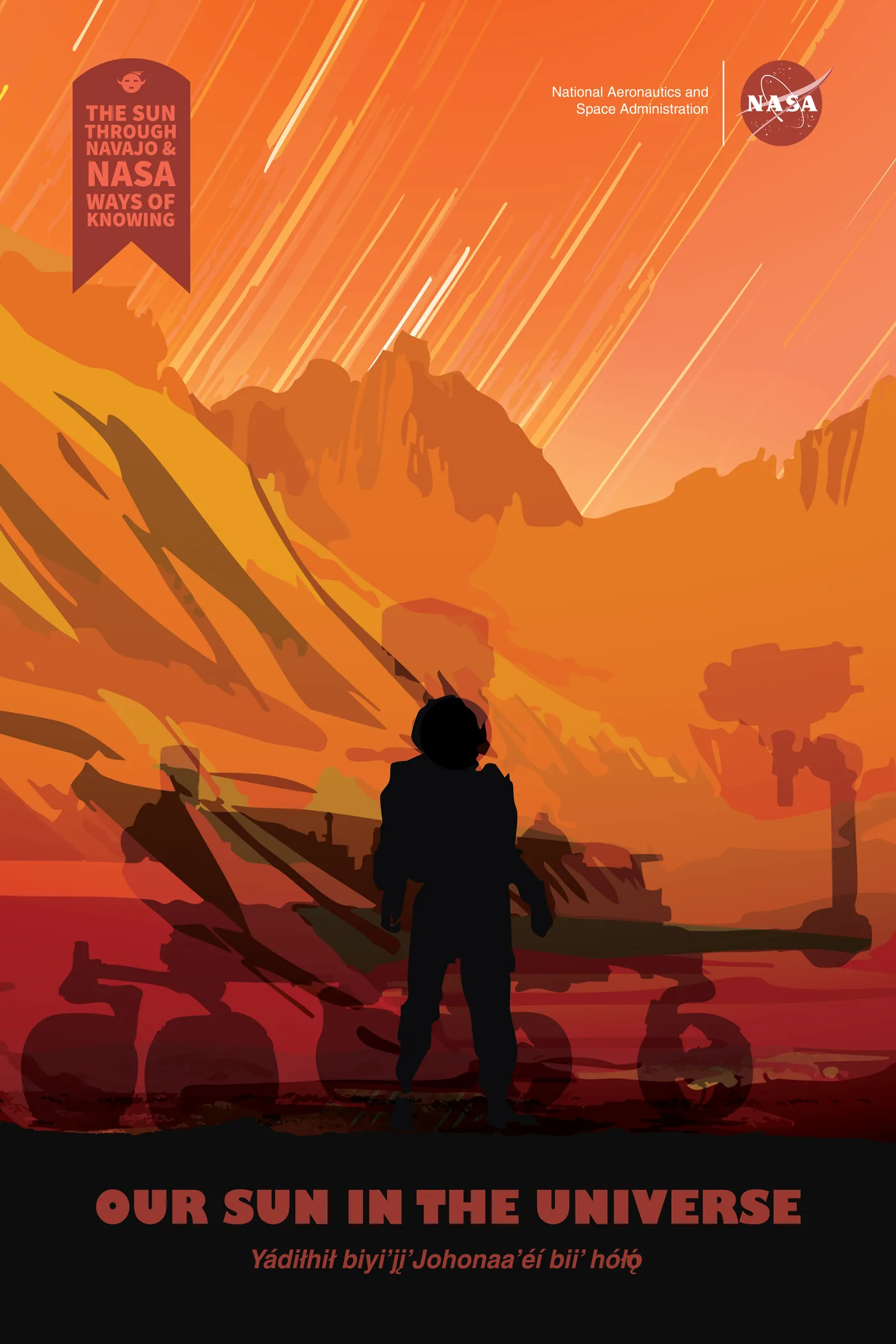
The first poster, “Our Sun in the Universe,” covers the Sun’s 11-year solar cycle, its magnetic fields and the gravity that keeps the planets in orbit. It uses sunspots, coronal mass ejections and the electromagnetic spectrum to show the Sun as “a massive ball of churning plasma” [4]. The timing is good for the subject. In October 2024, NASA and NOAA announced that the Sun had reached the maximum period of Solar Cycle 25, the most active stretch of that 11-year rhythm.
The same poster looks at how solar energy and gravity shaped the formation and environments of rocky planets like Earth and Mars. Its larger point, in NASA’s own words, is that NASA heliophysics “encompasses much more than just the study of our Sun” [4]. The field covers everything the Sun touches, from the planets’ upper atmospheres out to the edge of the heliosphere, a boundary Voyager 1 only crossed in 2012, more than 120 times farther from the Sun than Earth is.

Planetary Shields Against Solar Wind
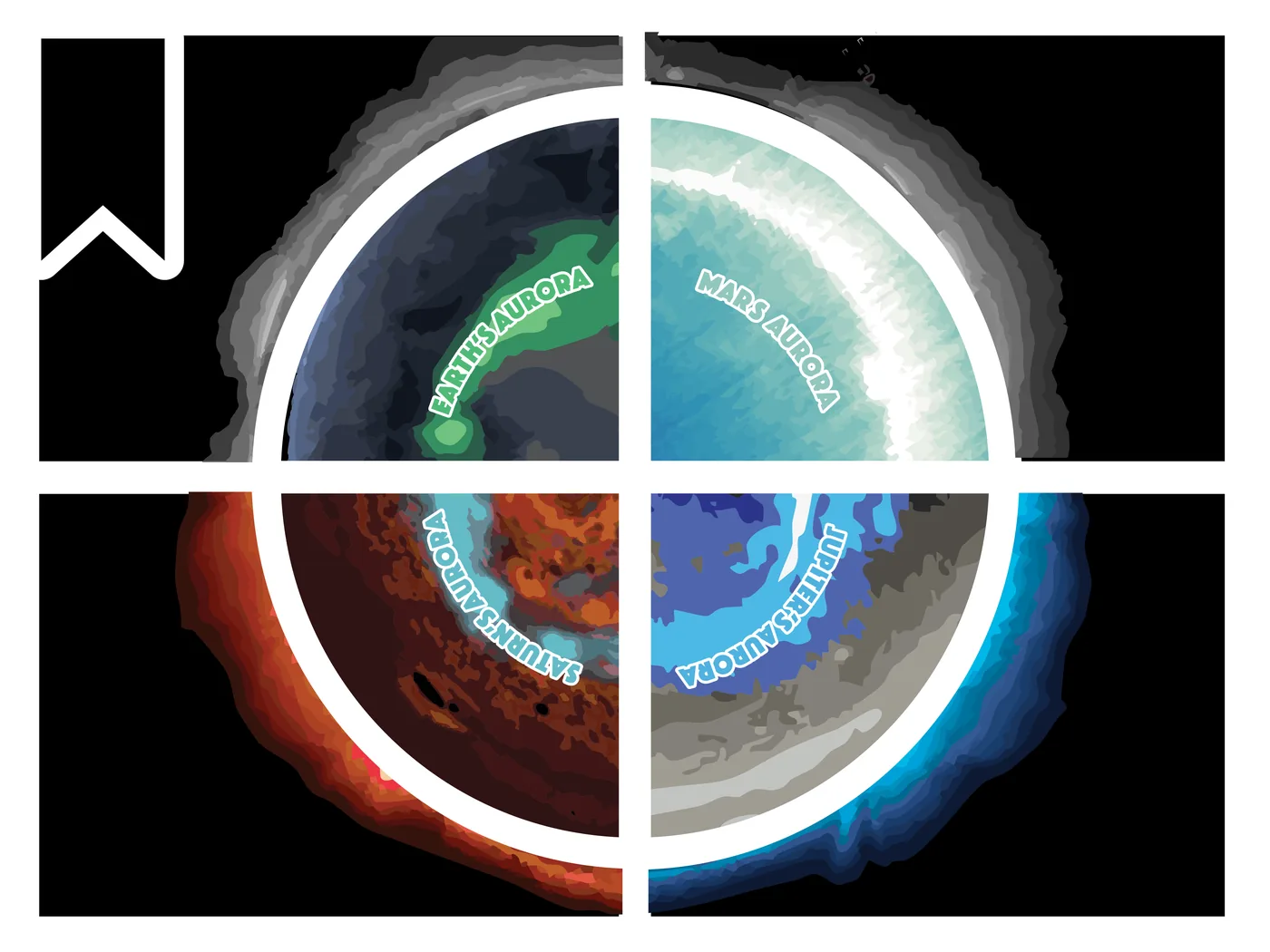
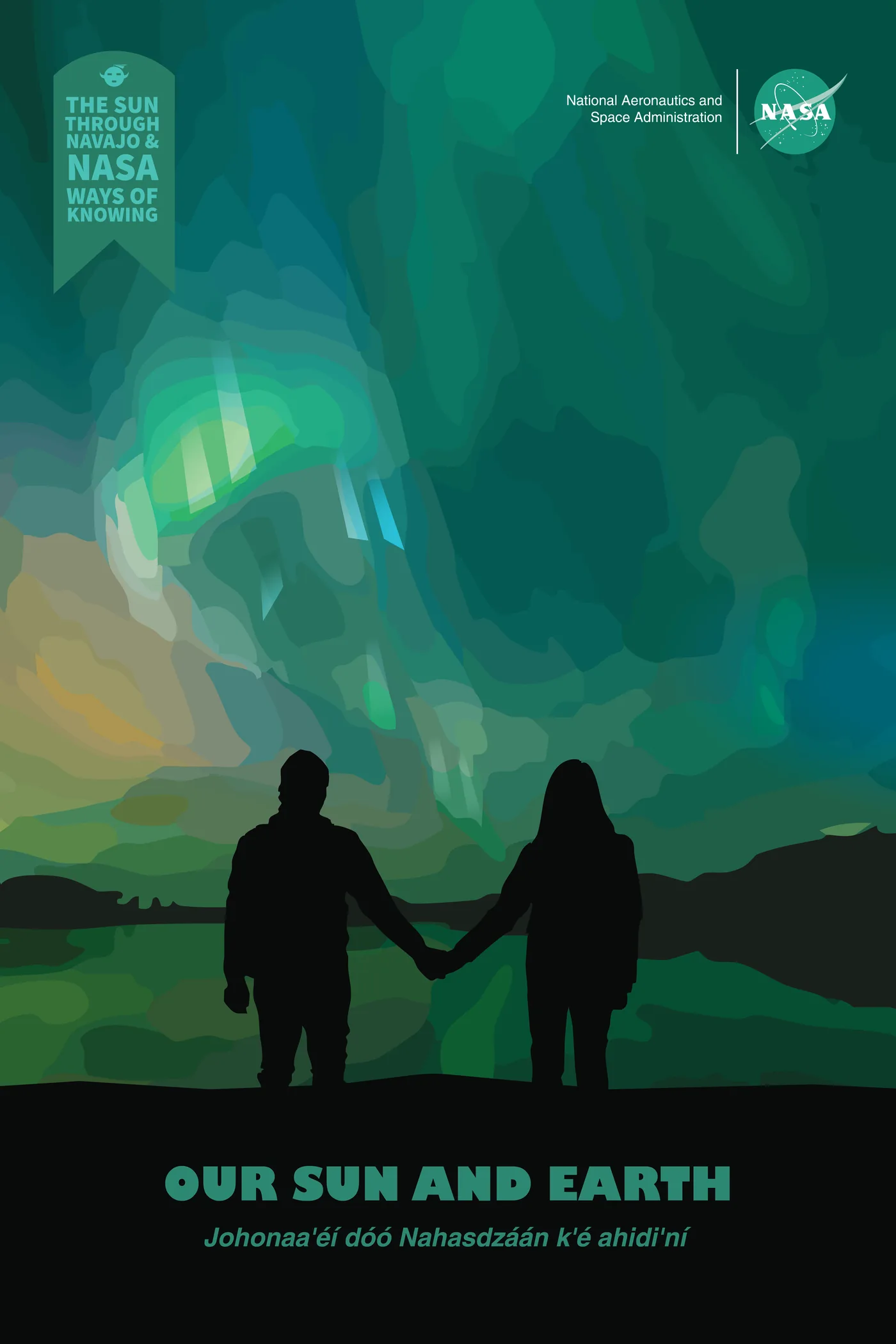
The second poster, “Our Sun and Earth,” is about space weather: how the solar wind and magnetic fields create auroras [3]. The solar wind is a constant outflow of charged particles through the heliosphere (the bubble the Sun’s wind inflates around the solar system). When it meets a planet’s magnetic field, some of those particles are steered toward the poles, where they make the upper atmosphere glow. During the severe geomagnetic storm of May 2024, the strongest in two decades, people saw that glow far outside the usual aurora zones. Jupiter and Saturn have auroras too, far more powerful than Earth’s and best seen in ultraviolet light.
The poster compares Earth, Mars, Jupiter and Saturn to show how electromagnetic shields protect planetary atmospheres from solar radiation [3]. Earth’s magnetic field turns most of the solar wind aside. Jupiter’s magnetosphere is the largest planetary structure in the solar system, big enough to swallow the Sun many times over. Mars is the cautionary case: it lost its global magnetic field billions of years ago, and NASA’s MAVEN orbiter has since measured how the solar wind strips its atmosphere away.
Mars also makes a good classroom example because it is so well documented from the ground, where rovers like Curiosity chronicle the Martian day from sunrise to sunset under an atmosphere far too thin to offer Earth-like protection.


Cosmic Forces and Navajo Concepts of Balance
What sets this poster apart is the pairing. It connects NASA heliophysics research on the heliosphere and charged particles with Navajo concepts of balance, “showing how these dynamic cosmic forces interact” [3]. In Diné thought, balance and harmony are often summed up in the word hózhó. The physics offers an obvious parallel, since the solar wind pushes, a magnetic field pushes back, and a planet keeps its air as long as the two stay in equilibrium. NASA’s summary does not spell out how the guide itself frames these teachings; that is left to the posters and to Maryboy and Begay’s text [3].
Diné knowledge of the Sun is not abstract. In Navajo tradition the Sun is Jóhonaaʼéí, the Sun Bearer, and the sky’s cycles are tied to seasons and ceremonies. Solar eclipses, for instance, are traditionally a time for quiet reflection indoors rather than for watching the Sun, which is why Navajo Nation tribal parks closed during the October 2023 annular eclipse. The guide treats that kind of knowledge as observation in its own right, next to satellite data [1].
Solar Radiation Sustaining Terrestrial Life Systems
The third poster, “Sun, Earth, and Life Relationships,” follows solar radiation into Earth’s climate, its weather and the biological processes that sustain life [2]. It explains how the ozone layer shields the surface from ultraviolet light and how the atmosphere traps greenhouse gases, the two effects that make the planet livable under a star this powerful [2].
It combines NASA’s atmospheric monitoring of thermal energy and weather events such as hurricanes with Navajo ways of knowing, exploring what NASA calls “the deep scientific connections to our primary energy source” [2]. The same balance of energy in and energy out is what astronomers try to read on distant worlds, where carbon-lite atmospheres can hint at water and life on other planets.
Classroom Posters for Holistic Science Education
For teachers, the practical appeal is coverage. One free set spans the standard heliophysics topics, from the solar cycle and auroras to ozone and the greenhouse effect, while giving Navajo students, and everyone else, a version of the subject in which Diné knowledge sits beside the physics instead of in a footnote [1]. Schools on and near the Navajo Nation are the obvious first audience, but nothing in the materials limits them to it.
By NASA standards it is a small release: three posters and a guide. But it says something about how the NASA HEAT team wants the Sun taught, as a star that can be measured from orbit and as one that people were watching closely, and making sense of, long before any satellite existed [1].
- WEBSITE Hunt Estevez, C., Ng, C., Kirk, M., Milotte, C., Alegbeleye, L. A., Maryboy, N., Begay, D., Fischer, H., Storksdiek, M., & Sellers, V. (2026). Ways of knowing: Heliophysics poster series. NASA Science. [Article Link]
- WEBSITE Hunt Estevez, C., Ng, C., Kirk, M., Milotte, C., Alegbeleye, L. A., Maryboy, N., Begay, D., Fischer, H., Storksdiek, M., & Sellers, V. (2026). Ways of knowing: Sun, Earth, and life relationships poster. NASA Science. [Article Link]
- WEBSITE Hunt Estevez, C., Ng, C., Kirk, M., Milotte, C., Alegbeleye, L. A., Maryboy, N., Begay, D., Fischer, H., Storksdiek, M., & Sellers, V. (2026). Ways of knowing: Our Sun and Earth poster. NASA Science. [Article Link]
- WEBSITE Hunt Estevez, C., Ng, C., Kirk, M., Milotte, C., Alegbeleye, L. A., Maryboy, N., Begay, D., Fischer, H., Storksdiek, M., & Sellers, V. (2026). Ways of knowing: Our Sun in the universe poster. NASA Science. [Article Link]
APA 7: PerEXP Teamworks. (2026, September 22). NASA Heliophysics Posters Blend Solar Science and Navajo Wisdom. https://perexpteamworks.com/en/nasa-heliophysics-navajo-posters/


