






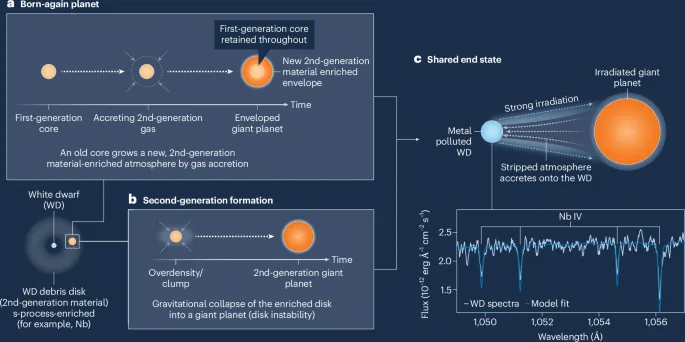
How does a dying stellar core end up contaminated by its own material? In observational astrophysics, white dwarf pollution occurs when heavy elements contaminate the outer atmosphere of a cooling stellar remnant [1]. White dwarfs typically maintain clean hydrogen or helium surfaces because intense gravity pulls heavier atoms downward into the stellar interior within days [2]. When astronomers detected niobium in a polluted white dwarf, spectroscopic analysis indicated that the infalling debris originated from stellar ashes shed during the star’s own death [1].
What Triggers White Dwarf Pollution?
White dwarf pollution is triggered when outer gravitational disturbances deflect surviving asteroids, comets, or planetesimals toward the dense stellar core, where intense tidal forces shred the debris before it accretes onto the stellar atmosphere [1]. For decades, astronomers believed that all polluting debris consisted of ancient first-generation rocky bodies formed together with the star billions of years earlier [2].
Because white dwarfs possess immense surface gravity, heavy elements like iron, silicon, and magnesium sink beneath the outer photosphere at rapid settling rates [2]. Settling times for metals in hydrogen-dominated atmospheres range from days to weeks, meaning any observed metals arrived recently. In 2026, researchers analyzing white dwarf spectra identified chemical traces that challenged established debris accretion models [1].
In an investigation published in Nature Astronomy, astronomer Zifan Lin examined the peculiar detection of niobium in the atmosphere of a cooling stellar remnant. Niobium (a transition metal element produced by neutron capture reactions in dying stars) does not appear in high abundance in ordinary rocky meteorites or terrestrial planets. Lin found that the measured abundances differed sharply from the chemical profile of any rocky body in the Solar System, pointing toward material forged during late-stage stellar nucleosynthesis. The data showed that the star was accreting debris formed directly from its own expelled envelope rather than pre-existing asteroids [1].
Why Are White Dwarfs Dense?
White dwarfs are dense because they compress roughly the mass of the Sun into a spherical volume no larger than Earth, supported against gravitational collapse solely by electron degeneracy pressure [2]. When a star exhausts its central nuclear fuel, gravity pulls the core inward until electrons pack together as tightly as quantum mechanical laws allow. This degenerate state generates an outward pressure that does not depend on temperature, allowing the dead core to remain stable for trillions of years as it slowly radiates its residual thermal heat into space [1]. The resulting density exceeds one million grams per cubic centimeter [2].
This high density produces a gravitational field tens of thousands of times stronger than the gravity found on Earth [2]. Such intense gravity forces all heavy elements to settle toward the center of the star, leaving a clean outer atmosphere of hydrogen or helium. The star functions like a natural cosmic laboratory, where trace contamination reveals foreign matter entering from orbit [1].
In nascent star systems, astronomers observe protoplanetary disks giving rise to first-generation worlds, such as the youngest known planet discovered around Elias 2-24 during early stellar evolution [2]. While newborn planets orbit young stars surrounded by primordial gas, white dwarfs interact with shredded debris left behind long after stellar death. The contrasting physics illustrates how planetary material evolves across billions of years of cosmic history [1].
Debris Accretion Around a Polluted White Dwarf
Studies of debris accretion show that roughly one-quarter to one-half of all observable white dwarfs host heavy elements in their outer layers, demonstrating that planetary remnants commonly survive past their stars’ main-sequence lives. Foundational research by astronomers Koester, Gänsicke, and Farihi (2014) established that accreting material often matches the bulk composition of rocky asteroids. Work by researchers Doyle, Young, Klein, Zuckerman, and Schlichting in Science (2019) confirmed that this rocky debris exhibits iron fractions similar to terrestrial rocks in the Solar System. In nearly all cataloged systems, the falling debris represents fragments of ancient planetesimals formed in the star’s original circumstellar disk [1].
The white dwarf analyzed by Lin breaks this standard geochemical paradigm by displaying a prominent chemical signature of niobium. Niobium is a refractory element produced inside massive stars or dredged up during the asymptotic giant branch phase of low-mass stars. In his paper, Zifan Lin explained: “The detection of niobium in a white dwarf reveals a pollutant unlike any Solar System body, pointing to a ‘second-generation’ giant planet candidate built from debris shed during its host star’s death” [1].
This observation indicates that the accreting body did not form during the birth of the original star system. While juvenile stellar systems display debris disks around young stars shaped by planetary collisions during primordial planet formation, white dwarfs can capture secondary debris created during stellar death. The white dwarf is essentially consuming its own expelled material [1].


Why Do White Dwarfs Form?
White dwarfs form when stars with masses up to eight times that of the Sun burn through their core hydrogen and helium supplies, shed their outer envelopes, and leave behind an inert core composed of carbon and oxygen [1]. During the main sequence, outward radiation pressure balances gravity. Once core fuel is exhausted, the balance breaks down [2].
The core contracts, the outer layers expand into a red giant, and thermal pulses eventually eject the star’s outer envelope into the surrounding interstellar medium. Convection brings heavy elements created by slow neutron capture from the deep interior up into the expanding envelope. When the star expels these outer layers, the expanding gas cools as it disperses into space [1].
A 2026 research paper published in Nature Astronomy by lead author Williams and colleagues documented this process under the title “Discovery of a second-generation planet candidate accreting onto a white dwarf”. Co-authors including Gänsicke, Stone, Koester, Davies, Tong, Wilson, Sahu, Swan, Beatty, Ramírez, Cunningham, and Long tracked the dynamics of this second-generation body as it interacted with the white dwarf. Their work confirmed that planetary accretion around white dwarfs is not limited to primordial debris, opening new avenues for post-main-sequence planet formation models [2].

Stellar Ash Model for Second-Generation Planet Candidates
The concept of planets assembling from the ashes of a dead star has historical precedent in high-energy astrophysics. In 1994, researchers Phillips and Thorsett published a review in Astrophysics and Space Science examining planets around pulsars. That review showed that planetary bodies could assemble from fallback material following late-stage stellar transformations [3].
The white dwarf system demonstrates that an analogous second-generation assembly process can happen around cooling degenerate stars without requiring a supernova explosion [1, 2]. Theoretical models indicate that when a red giant sheds its envelope, a fraction of the expelled mass can remain bound in circumstellar orbits. Dynamic studies by researchers including O’Connor, Liu, and Lai (2021), as well as van Lieshout, Kral, Charnoz, Wyatt, and Shannon (2018), showed how post-main-sequence debris disks interact gravitationally with surviving outer companions. Over millions of years, these gravitational perturbations can send newly formed bodies into eccentric orbits diving toward the white dwarf [1].
When such a body approaches the white dwarf, tidal stresses tear it into a stream of rocky or metallic fragments [1]. This tidal disruption process mirrors the dust generation mechanisms studied in younger systems, such as the dusty debris structures observed in the Beta Pictoris system, but unfolds on a much more compact spatial scale [5]. The debris gradually accretes onto the stellar surface, leaving behind the distinctive spectroscopic signature of niobium [1].
Transit Surveys and White Dwarf Pollution Studies
Detecting exoplanets and infalling debris around white dwarfs offers unique advantages because of the compact physical dimensions of the host star. A typical white dwarf has a radius similar to Earth, meaning an orbiting body crossing in front of the star blocks a large fraction of the stellar light. Photometric surveys provide direct opportunities to detect these occultations [4].
In an arXiv preprint that has not undergone peer review, Lund, Pepper, Shporer, and Stassun (2018) modeled how large-scale optical transit surveys could identify planets orbiting white dwarfs. Lund and colleagues calculated transit probabilities and demonstrated that high-cadence time-domain photometry can detect planetary candidates despite the small target size of degenerate stars. When combined with spectroscopic surveys that track white dwarf pollution, transit observations allow astronomers to track both intact planets and disintegrating debris [1, 4]. Related observational discoveries, including giant planet candidates identified around white dwarfs by Vanderburg and colleagues (2020) and Blackman and colleagues (2021), show that diverse planetary architectures can survive or reform after stellar evolution [1].
As ground-based observatories and space telescopes expand their spectroscopic coverage, identifying additional polluted white dwarfs will determine whether niobium pollution represents a rare anomaly or a standard outcome of post-main-sequence planetary evolution. Studies by Kaltenegger, MacDonald, Seager, Ranjan, and Kozakis (2021, 2022) have also examined atmospheric modeling of planets around white dwarfs to assess how these remnants illuminate orbiting material. By deciphering the chemical fingerprints left behind on white dwarf surfaces, astronomers continue to uncover how planetary systems transform as their host stars die [1].
- ACADEMIC JOURNAL Lin, Z. (2026). A white dwarf polluted by its own ashes. Nature Astronomy. [Article Link]
- ACADEMIC JOURNAL Williams, J. T., Gänsicke, B. T., Stone, N. C., Koester, D., Davies, B. D. R., Tong, C., Wilson, D. J., Sahu, S., Swan, A., Beatty, T. G., Ramírez, S. H., Cunningham, T., & Long, K. S. (2026). Discovery of a second-generation planet candidate accreting onto a white dwarf. Nature Astronomy. [Article Link]
- ACADEMIC JOURNAL Phillips, J. A., & Thorsett, S. E. (1994). Planets around pulsars: A review. Astrophysics and Space Science, 212(1-2), 91-106. [Article Link]
- PREPRINT Lund, M. B., Pepper, J. A., Shporer, A., & Stassun, K. G. (2018). Transiting Planets with LSST IV: Detecting Planets around White Dwarfs. arXiv (Cornell University). [Article Link]
- ONLINE NEWS Interesting Engineering. (2026, October 5). Space Archives. Interesting Engineering. [Article Link]
Cover image: NOIRLab/NSF/AURA/J. da Silva Image processing: M. Zamani and / Wikimedia Commons, CC BY 4.0
APA 7: PerEXP Teamworks. (2026, October 6). Niobium Discovery Uncovers White Dwarf Pollution from Stellar Ashes. PerEXP Teamworks.


