





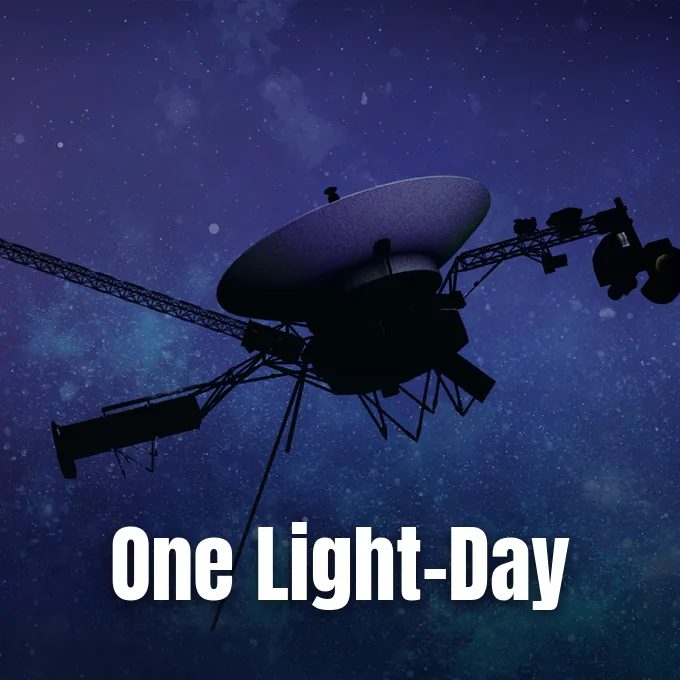
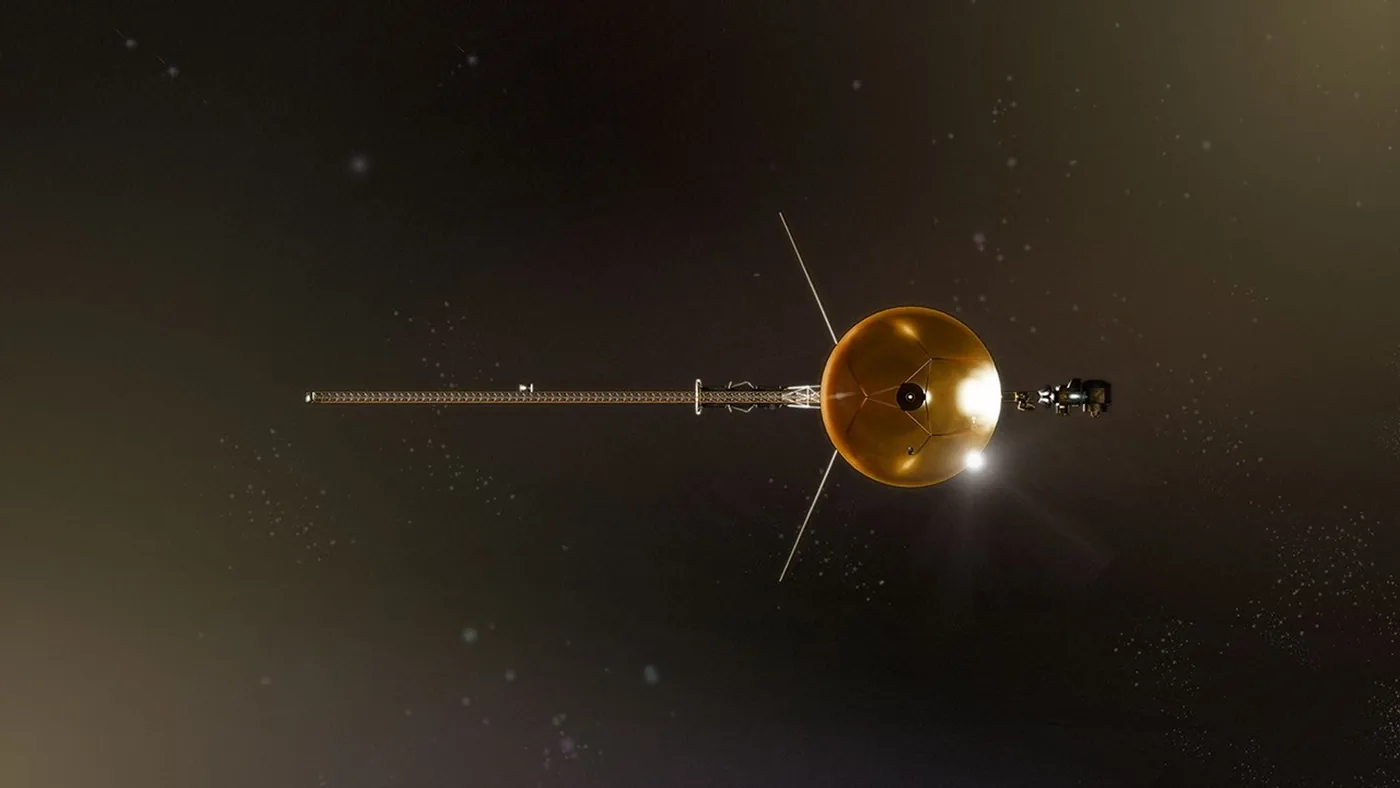
NASA announced that Voyager 1 will reach an unusual deep space boundary on November 18, 2026, traveling beyond 16 billion miles, or roughly 25.9 billion kilometers, from Earth. Managed by Caltech in Pasadena, California, the robotic probe has spent nearly five decades exploring the cosmos under funding from the NASA Heliophysics Division in Washington. Light from our planet takes 24 hours to reach the spacecraft at this distance, meaning that commands sent by flight controllers in Southern California face a 48-hour round-trip delay. This Voyager 1 light day crossing marks the farthest separation between Earth and any human-made object in history [1].
Voyager 1 Light Day Distance
Voyager 1 reaches one light-day on November 18 at 5:16 a.m. ET after traveling for nearly five decades. Light moves through space at roughly 186,282 miles per second, meaning that any radio command transmitted by flight controllers in Southern California requires an entire 24-hour day to bridge the vast distance to the probe. Walking that same distance at 3 mph would take a human 612,015 years. The spacecraft moves much faster at 37,763 mph, maintaining that cruising speed after gravity assists from Jupiter and Saturn propelled it along its path in 1979 and 1980 [3].
The robotic explorer first became the farthest human-made object in 1998, breaking records with every passing hour. Crossing this threshold does not change the surrounding interstellar environment, but it shows the enduring stamina of hardware built during the 1970s. Flight teams at NASA JPL in Pasadena still communicate with the probe through the giant antennas of the Deep Space Network [1].

Even with quiet space conditions, the Voyager 1 light day milestone creates practical communication hurdles for mission controllers. When engineers send a routine command to the spacecraft, they must wait two full days to confirm that the computers executed it properly. As Suzanne Dodd, Voyager project manager at the Jet Propulsion Laboratory, explained about daily operations, “If you want to say ‘hello’ to Voyager, you send your message and then you go home and you wait two days before you finally get a response” [5].
Scale of the Journey
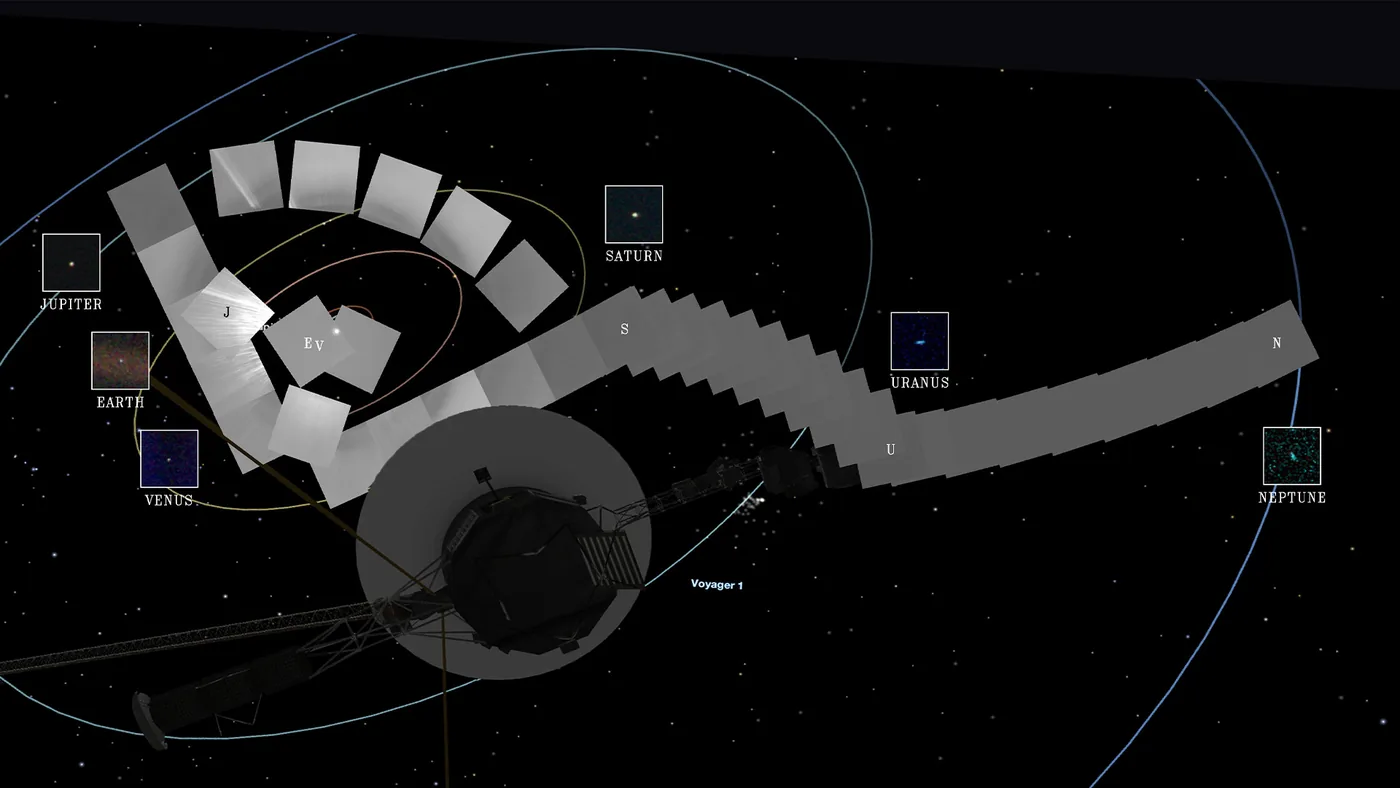
Tracking this distant explorer demands extreme patience from astronomers on Earth. The probe now travels 16.09 billion miles away from our planet, a separation translating to 25.89 billion kilometers that places the robotic explorer vastly beyond the orbit of Pluto and well outside the realm of ordinary planetary missions. Both Voyager probes launched together back in 1977. NASA engineers timed the launches to capitalize on a planetary alignment occurring once every 176 years, allowing both probes to sweep across the outer solar system using minimal onboard propellant [1]. Voyager 2 launched first, lifting off 16 days ahead of its twin, but Voyager 1 flew along a faster trajectory that ultimately overtook the sibling spacecraft while robotic orbiters studied planetary cycles like the Mars New Year calendar cycle [5].
Voyager 1 officially crossed the outer boundary of the heliosphere in 2012, leaving behind the bubble of solar wind blown by the Sun. Voyager 2 crossed into interstellar space along a different route in 2018. Because no other operating spacecraft has ever reached this distant region, these two probes provide the only direct observations of interstellar matter outside our solar system [1].
Power Loss and the Big Bang
Surviving in the freezing cold of deep space requires careful management of dwindling power supplies. Voyager 1 runs on three radioisotope thermoelectric generators that convert heat from decaying plutonium-238 into electricity. When the mission left Earth in 1977, those nuclear generators produced about 470 watts of power. Because plutonium decays over time, the electrical system loses about 4 watts each year, leaving the probe with only about 215 watts of usable power today [3].
To prevent total electrical failure as radioactive energy levels drop, NASA engineers at the Jet Propulsion Laboratory have progressively turned off instruments that are no longer strictly needed for deep space research. The probe carried 10 instruments at launch. Engineers have since shut down eight of those packages. In early September 2026, the team completed a delicate power reorganization known as The Big Bang, shutting down an older trio of devices while activating three low-power alternatives to preserve heat distribution throughout the hull [5]. The operation succeeded without disturbing sensitive onboard electronic systems.
Without that September adjustment, flight directors at NASA JPL faced the prospect of turning off another science instrument as early as summer 2027. Voyager 1 now relies on just two active instruments to sample interstellar magnetic fields and cosmic rays. A similar procedure was carried out on Voyager 2 about six weeks earlier to protect science gathering [5].

Thruster Faults in Deep Space
Mechanical issues can still threaten the mission without warning. On October 18 and 19, NASA temporarily lost contact with Voyager 1 when Deep Space Network antennas failed to detect its radio carrier during two scheduled communication sessions. The silence lasted roughly 48 hours, causing concern among flight controllers at JPL while the probe drifted 16 billion miles away. The radio carrier unexpectedly reappeared on October 20, allowing mission engineers to begin investigating what happened [5].
Controllers discovered that one set of thrusters had stopped firing, prompting flight software to switch automatically to backup thrusters. This protective step was initiated by the spacecraft’s built-in fault protection routines, which safeties the probe when hardware anomalies occur. Kareem Badaruddin, Voyager mission manager at NASA JPL, said, “This is the first time we’ve seen the spacecraft do something like this, but we are also at a point in the mission where we have to expect the unexpected” [5].
Public Events for the Voyager 1 Light Day
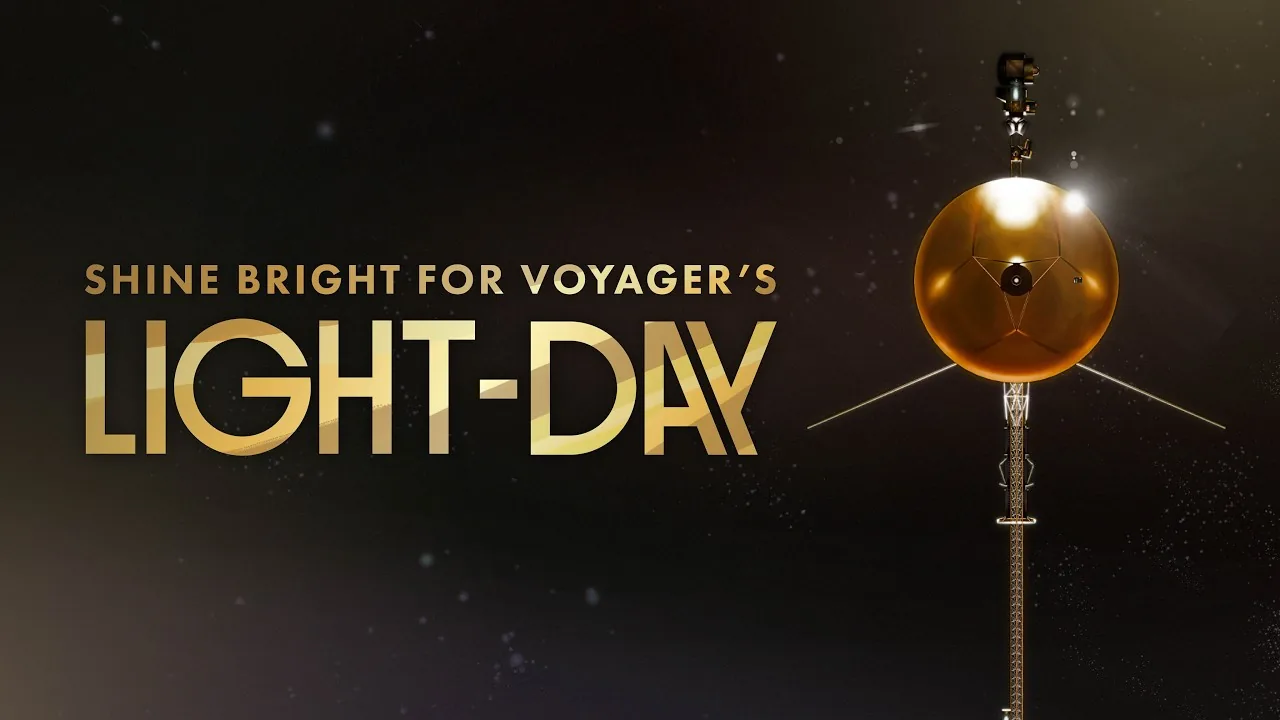
NASA leadership is inviting observers worldwide to take part in public activities honoring this milestone. On Tuesday, November 17, after sunset, the agency hosts a global event called “Shine Bright for Voyager’s Light-Day” to encircle Earth with symbolic light. Observers can point flashlights or mobile screens skyward to flash the letters V-G-R in Morse code, representing the craft’s call sign [1].
Participants can use a web application built by NASA that blinks the code automatically on smartphone screens. The signal consists of three short bursts and one long burst for V, two long bursts and one short burst for G, and a short, long, short sequence for R. The spacecraft already carries Morse code on the Golden Record mounted to its side. That famous gold-plated record bears the Latin inscription “Ad astra per aspera,” translating to “through struggle to the stars” [4].
On Thursday, November 19, at 12 p.m. EST, NASA JPL will host a panel discussion in Pasadena’s von Kármán Auditorium. Panelists include Nicky Fox from the Science Mission Directorate, JPL chief scientist Jonathan Lunine, Suzanne Dodd, Kareem Badaruddin, and Jamie Rankin from Princeton University. Media coordinator Josh Smooha and NASA spokesperson Abbey Interrante organized accreditation for journalists attending the session, which also previews an upcoming NASA+ documentary slated for the 50th anniversary in 2027 [1].
The Final Decade Before Silence
How long can Voyager 1 continue operating as it drifts further through interstellar space? NASA estimates that the probe will shut down its last science instrument in the 2030s as electrical output drops below functional levels. By 2036, electrical power will likely fall too low for the spacecraft to transmit radio signals back to Earth. Even after silent drifting begins, the probe will coast along at 38,000 mph toward the Oort Cloud, reaching that icy comet boundary in roughly 300 years. While long-term projects detailed in NASA cosmic origins mission planning prepare next-generation observatories, Voyager 1 will drift perpetually through the galaxy [3].
Voyager 2 faces a matching fate as it travels outward at a slightly slower speed. Because of its lower velocity, Voyager 2 will not cross its own one light-day distance until after its transmitters have permanently gone silent. Both spacecraft will travel through deep space for millions of years, carrying their golden records as enduring artifacts of human curiosity [3].
- PRESS RELEASE Dodson, G. Q. (2026, November 10). NASA Invites Media, Public to Join Voyager 1 One-Light Day Activities. NASA. [Article Link]
- ONLINE NEWS Paul, A. (2026, November 10). Join NASA’s worldwide Voyager 1 celebration on Tuesday, November 17. Popular Science. [Article Link]
- ONLINE NEWS Hindy, J. (2026, November 9). NASA’s Voyager 1 to Cross Historic One Light-Day Milestone on Nov. 18. CNET. [Article Link]
- WEBSITE Carney, S. (2026, November 4). Shine Bright for Voyager’s Light‑Day. NASA Science. [Article Link]
- ONLINE NEWS ScienceDaily. (2026, November 9). NASA’s Voyager 1 is about to reach a historic one-light-day milestone. ScienceDaily. [Article Link]
- ONLINE NEWS La Primera en Línea. (2026, November 10). NASA Invites Media, Public to Join Voyager 1 One-Light Day Activities. [Article Link]
- ONLINE NEWS PressBee. (2026, November 10). NASA Invites Media, Public to Join Voyager 1 One-Light Day Activities.Middle East. PressBee. [Article Link]
APA 7: PerEXP Teamworks. (2026, November 11). NASA Marks Voyager 1 Light Day Crossing in Deep Space. PerEXP Teamworks. https://perexpteamworks.com/en/voyager-1-light-day-distance-record/


