





Perplexity launched its new tool called the Perplexity Monitor API, designed to turn standard web search into an ongoing watchdog for software agents. Instead of answering one question at a time, the service runs regular web searches on a set schedule and notifies client apps through webhooks whenever it detects notable shifts online. The release arrives as AI companies work to shift user interactions toward smart agents that need fresh real-time signals without constant manual prompting [1].
Perplexity Monitor API Modes and Operations
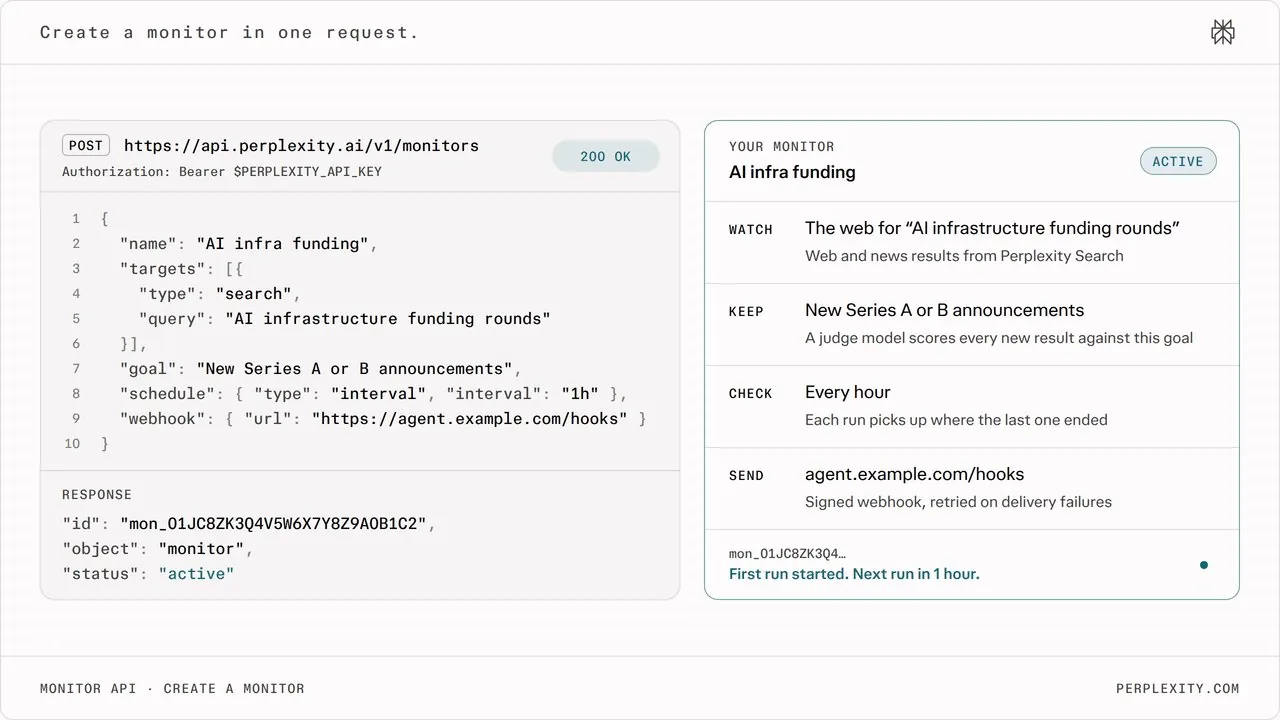
Software teams running agent jobs have often built custom polling scripts to pull search results and purge repeat entries by hand, but Perplexity said that this manual approach becomes “nearly impossible to maintain across hundreds of topics and pages” once tracking tasks expand in production environments [1]. The Perplexity Monitor API replaces those fragile scrapers with a single endpoint, reducing initial setup to minutes.
The system runs in two separate modes tailored for different data tasks on the open web. The first option, named web monitors, directs queries into Perplexity Web Search and Perplexity News Search on regular intervals to surface fresh industry news, such as new funding rounds among AI infrastructure businesses [1]. Scheduled queries let client apps track active market trends as they happen, so engineers do not have to submit individual queries each morning.
Page monitors track up to 10 pages at once. They follow company pricing tables, product changelogs, and legal terms by storing an initial baseline snapshot during the first run and generating a clean text diff of any alterations found on later checks [1]. This diffing method alerts teams to price hikes or rewritten terms without forcing their systems to download and parse entire web documents repeatedly, which saves bandwidth and keeps data pipelines clean.
Filtering Results With the Decision Model
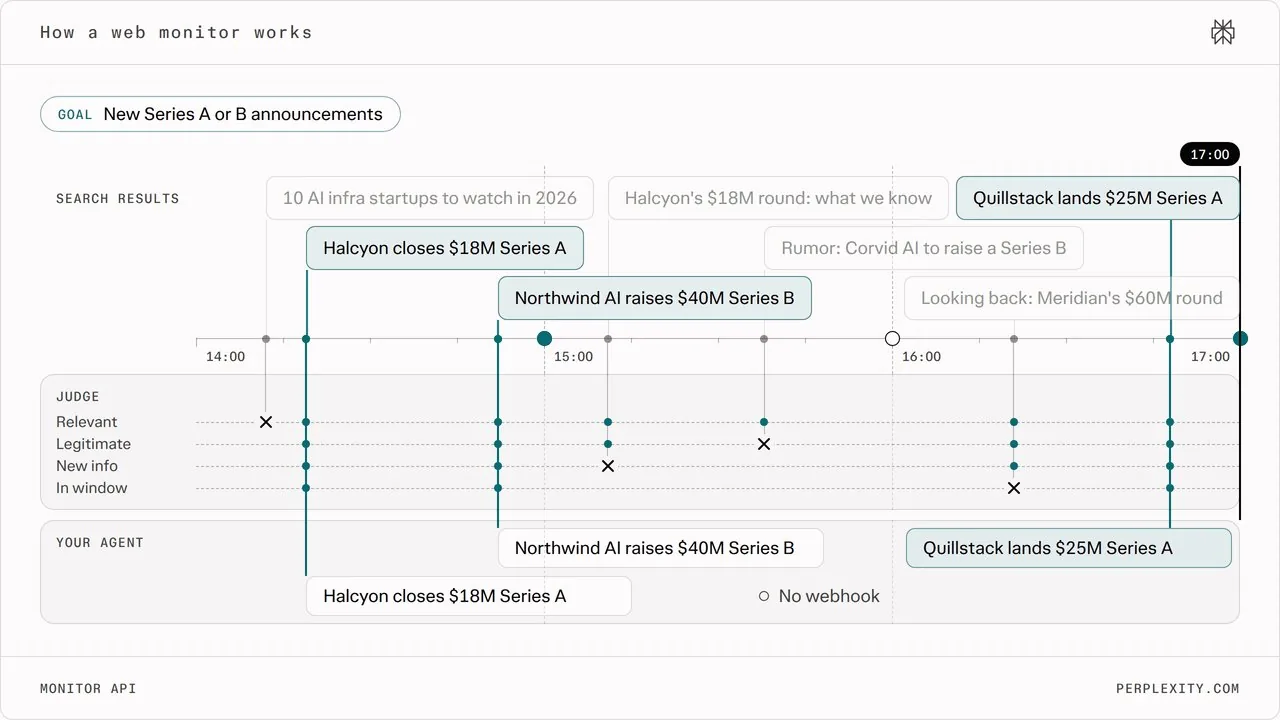
Raw web searches often return noisy snippets, press release mirrors, and marketing spam that can overwhelm agent workflows. To prevent unnecessary alerts, Perplexity evaluates every potential update with a built-in decision model before dispatching any webhook payload [1]. Jonathan Kemper reported in The Decoder that Perplexity built this review step to prevent agents from waking up over trivial web edits.
The review process applies four specific checks to incoming web results before approving an outbound notification. Candidate pages must clear set criteria for relevance, source credibility, novelty, and timeliness so that external agents do not act on recycled rumors or outdated blog posts. Page monitors undergo a similar review process that judges whether detected text diffs truly matter to the stated goal, discarding minor layout tweaks, tracking pixels, or routine timestamp updates [1]. Builders define that tracking goal in plain English sentences to guide the review model.
Perplexity attaches a numerical confidence score to qualifying alerts and sends notifications only when every specified threshold is met. Teams can adjust sensitivity limits for each check through monitor settings without rebuilding their monitors, or rewrite their natural language goal at any time as their priorities shift [1].


Delivery Options and Scheduling Controls
The API gives engineering teams broad latitude over how often their monitors scan the open web for fresh data. Monitored tasks can run on recurring intervals ranging from every 15 minutes to weekly, depending on how fast a specific topic tends to produce meaningful updates. Teams that need precise execution windows can also set custom cron schedules to align data collection with existing internal batch jobs. Each scheduled scan resumes exactly where the previous run stopped, so the system doesn’t reprocess old articles or deliver repeated payloads to downstream apps, keeping data flows tidy [1].
Perplexity also signs all outgoing webhooks with cryptographic keys, allowing receiving servers to verify that incoming payloads originated from legitimate endpoints. When an external receiver experiences temporary downtime, the service automatically retries delivery so that urgent alerts do not get lost during minor server glitches [1].
Engineers retain direct control over monitor lifecycles through both programmatic API calls and the browser-based Perplexity API Console. Active monitors can be paused during system downtime, resumed when ready, or triggered manually on demand whenever an engineer wants an immediate check. Both methods let coders test notification logic in real time before letting their client agents run unattended on dozens of live topics [1].
Perplexity Monitor API Performance Against Rival Services
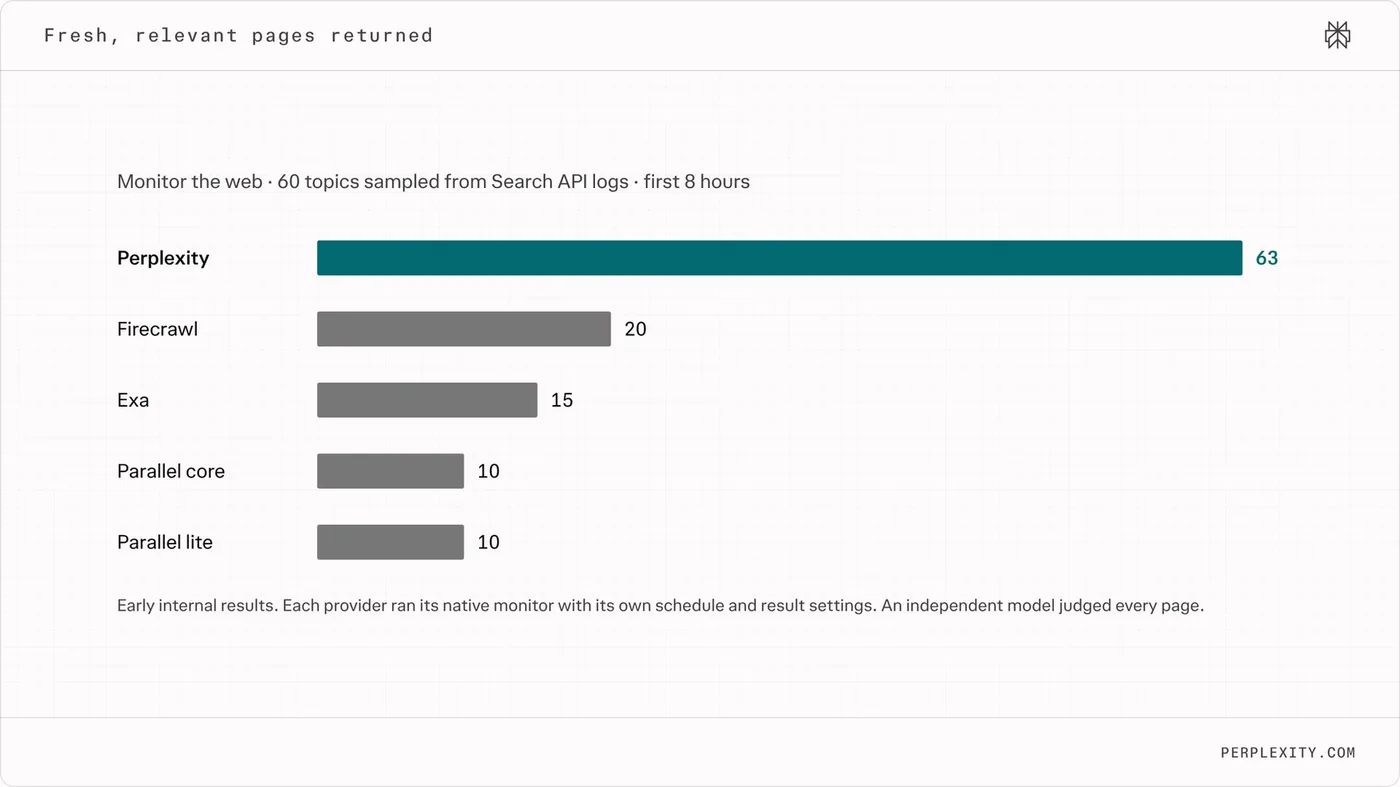
To test the Perplexity Monitor API against rival tools, Perplexity ran internal comparative evaluations against alternative search services. The benchmark measured data freshness and relevance against Firecrawl, Exa, Parallel Core, and Parallel Lite across 60 real topics drawn from Perplexity Search API query logs [1]. Test topics spanned company news, tech releases, and regulation.
Each provider ran with its own schedules and settings, while a separate model scored each result on relevance and recency. In the first eight hours of testing, Perplexity reported that its system delivered 63 fresh, relevant pages, topping the alternative services by a wide margin. Firecrawl delivered 20 qualifying pages during that same period, while Exa returned 15 pages. Parallel Core and Parallel Lite each retrieved 10 pages in the benchmark [1]. Perplexity described those figures as early internal results, showing that its web crawler picked up newly published stories faster than rival tools. None of the rival tools matched that early collection pace.
Earlier in August, Artificial Analysis ranked those three competing retrieval services ahead of other developer tools, though Perplexity sat out of that agent evaluation. Perplexity points to several practical use cases for its system, such as sales teams tracking funding rounds, analysts watching quarterly earnings, and compliance teams monitoring regulatory rule changes [1].
Pricing and Commercial Strategy
The Monitor API is available now through the API and the Perplexity API Console, using the same key as the Perplexity Search API, Perplexity Context API, and Perplexity Agent API. Web monitors cost $1 per 1,000 successful runs, while page monitors cost $1 per 1,000 fetched URLs from monitored destinations [1].
While Perplexity pioneered conversational web lookup, rivals like ChatGPT, Claude, and Gemini now bundle live internet access into their base chat interfaces. In August, The Information reported that Nvidia entered talks for an investment at a valuation of more than $30 billion. A valuation above $30 billion pressures Perplexity to build profitable business models that generate steady software revenue beyond consumer subscriptions. Selling backend data feeds directly to engineering teams gives the company a practical path toward commercial growth, especially as independent AI agents begin executing routine enterprise tasks on set schedules without human help [1]. Enterprise builders make up an attractive audience for paid web search services.
To expand its enterprise reach, Perplexity is betting on agent tools like its always-on Teammates and coding utilities like Search as Code. The company previously advanced its local software offerings when Perplexity updated Computer to run fully locally on Mac devices. With the Perplexity Monitor API, the company aims to embed its search index into enterprise workflows where digital agents work continuously in the background without needing human guidance [1]. Live tracking turns web search into an ongoing utility.
- ONLINE NEWS Kemper, J. (2026, November 22). Perplexity’s new Monitor API turns web search from a one-off query into a nonstop watchdog. The Decoder. [Article Link]


