




Can global society maintain stability once the core environmental thresholds that support human civilization begin to collapse? Scientists tracking the nine planetary boundaries (scientifically calibrated environmental thresholds) warn that Earth is moving rapidly outside the safe operating envelope that has sustained modern societies for over 10,000 years. The annual Planetary Health Check released by researchers at the Potsdam Institute for Climate Impact Research reveals that seven of these nine vital life-support systems have now crossed into dangerous territory, with ocean acidification marking the newest systemic breach [1].
- Planetary Boundaries and Earth’s Escalating Vulnerability
- Ocean Acidification Enters the High-Risk Zone
- Atmospheric Carbon and Radiative Forcing Thresholds
- Biosphere Degradation Across Land and Hydrological Cycles
- Ozone Recovery Highlights the Power of Policy
- Planetary Boundaries Framework in Policy and Finance
Planetary Boundaries and Earth’s Escalating Vulnerability
Researchers at the Potsdam Institute for Climate Impact Research in Germany established that human industrial activity has pushed global ecological systems into unprecedented territory. Lead author Boris Sakschewski stressed that environmental pressures are accelerating across every single metric located outside the safe operating space. The evaluation indicates that the likelihood of persistent, large-scale, and irreversible ecological transformation is rising steadily while corrective timelines dwindle. Human actions continue to destabilize atmospheric chemistry, biological diversity, and vital geochemical flows simultaneously [1].
Katherine Richardson, an Earth systems scientist at the University of Copenhagen and primary investigator of the 2023 Science Advances assessment, explained that exceeding these numerical limits functions similarly to human blood pressure. Elevated measurements do not guarantee immediate catastrophe on a specific morning. Instead, surpassing these baselines dramatically elevates systemic risk across interdependent biospheric functions compared to the preindustrial reference period (the period before widespread coal burning) [7].
Johan Rockström, director of the Potsdam Institute for Climate Impact Research, warned that humanity is actively undermining the planetary life-support systems that enabled agriculture and complex civilization to expand. Global environmental parameters remained unusually balanced throughout the past 10,000 years of the Holocene epoch. Pressure is accelerating everywhere. Understanding how modern shifts deviate from the foundational geological stability of Planet Earth underscores the sheer scale of current biophysical disruption [2].

Ocean Acidification Enters the High-Risk Zone
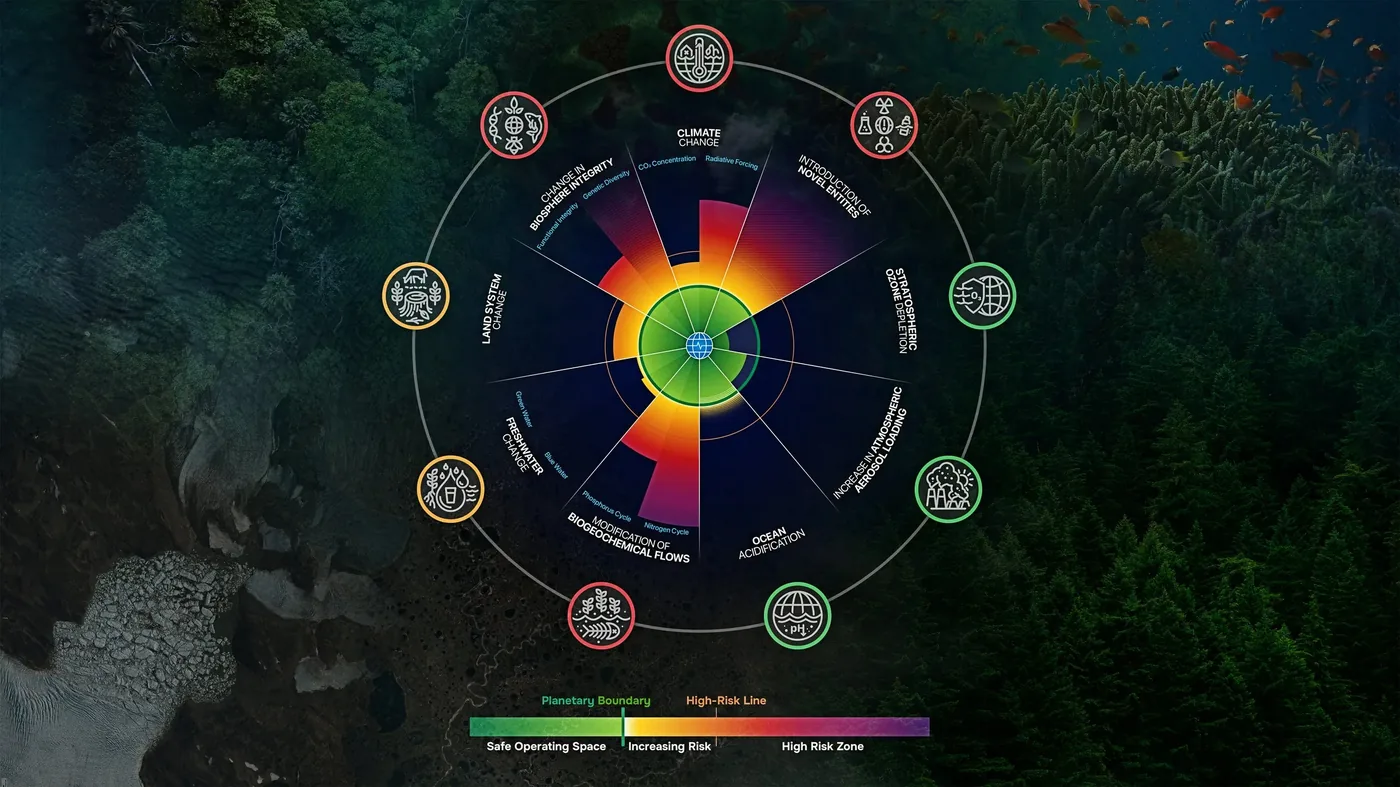
Ocean waters absorb substantial fractions of anthropogenically produced carbon dioxide, which directly drives down marine pH levels through carbonic acid formation. The 2025 Planetary Health Check revealed that the ocean acidification boundary has been officially transgressed for the first time in recorded history. Global surface seawater pH has declined by roughly 0.1 units since the beginning of industrialization, representing an estimated 30 to 40 percent surge in oceanic acidity. Furthermore, the global mean aragonite saturation state (a measure of calcium carbonate availability) dropped to 2.84 Ω, crossing below the designated safety limit of 2.86 Ω [3].
Marine calcifiers face immediate disruption from corrosive waters. Tiny sea snails known as pteropods already exhibit thinning shells, threatening oceanic food webs [3].
Sylvia Earle, an oceanographer and member of the Planetary Guardians coalition, emphasized that oceans serve as the primary thermal and biological buffer of the biosphere. How resilient can coastal economies remain when foundational marine food webs begin dissolving? Levke Caesar, co-lead of the Planetary Boundaries Science Lab, observed that intensifying acidity combined with declining oxygen levels and marine heatwaves strains vital fisheries. A historical study by the National Oceanic and Atmospheric Administration highlighted that unchecked ocean acidification threatens billions of dollars in commercial marine assets [1].
Atmospheric Carbon and Radiative Forcing Thresholds
Atmospheric concentrations of carbon dioxide reached an unprecedented 426 parts per million, far outstripping the preindustrial baseline of 280 ppm documented prior to modern fossil fuel combustion. Climate researchers consider 350 ppm the maximum safe boundary for atmospheric carbon stability. Humanity crossed that line in 1987. Data collected by GLOBAÏA demonstrates that net anthropogenic radiative forcing has climbed to +2.97 watts per square meter, nearly triple the safe limit of +1.0 W/m² [5].
Delegates at the United Nations acknowledged that warming trajectories will surpass the ambitious 1.5 degrees Celsius (2.7 degrees Fahrenheit) guardrail established within the Paris Agreement. Record-breaking summer heat across Europe and North America demonstrated how planetary heating fuels compound extreme weather disasters. Projections regarding rising temperatures rendering regions uninhabitable for humans emphasize that climate overshoot creates acute physiological risks across vulnerable tropical and subtropical populations [1].
Ecological feedbacks link rising global temperatures directly to biospheric instability. The buffer is breaking. A potential Amazon rainforest tipping point could trigger large-scale forest dieback, converting expansive tropical moisture basins into dry degraded savannahs. Such an irreversible ecosystem collapse would release massive stores of sequestered carbon into the atmosphere while permanently impairing regional rainfall regimes across South America [2].


Biosphere Degradation Across Land and Hydrological Cycles
Extinction rates among global species currently exceed 100 extinctions per million species-years (E/MSY), far higher than the proposed planetary boundary of 10 E/MSY. Writing in Science, Will Steffen and co-authors documented that human appropriation of net primary production reached approximately 30 percent, triple the conservative 10 percent threshold. Genetic diversity and functional ecosystem stability continue to erode as native flora and fauna lose critical habitats to intensive agricultural expansion [2].
Deforestation and agricultural expansion drive widespread disruptions across continental water cycles and regional nutrient balances. Global forest cover has declined to 59 percent of original extent against the 75 percent planetary boundary, losing approximately 10 million hectares annually as land conversion approaches the 54 percent high-risk threshold. Simultaneously, freshwater systems exhibit severe destabilization, with flow deviations affecting 22.6 percent of blue water bodies against a 12.9 percent limit, while green water soil moisture deviations reach 22.0 percent against a 12.4 percent boundary. Industrial disruption of biogeochemical flows compounds these stresses, as human nitrogen fixation reaches 165 teragrams annually compared to the 62 Tg safe boundary, while regional phosphorus applications hit 18.2 Tg per year, tripling the 6.2 Tg limit and causing widespread aquatic dead zones [5].
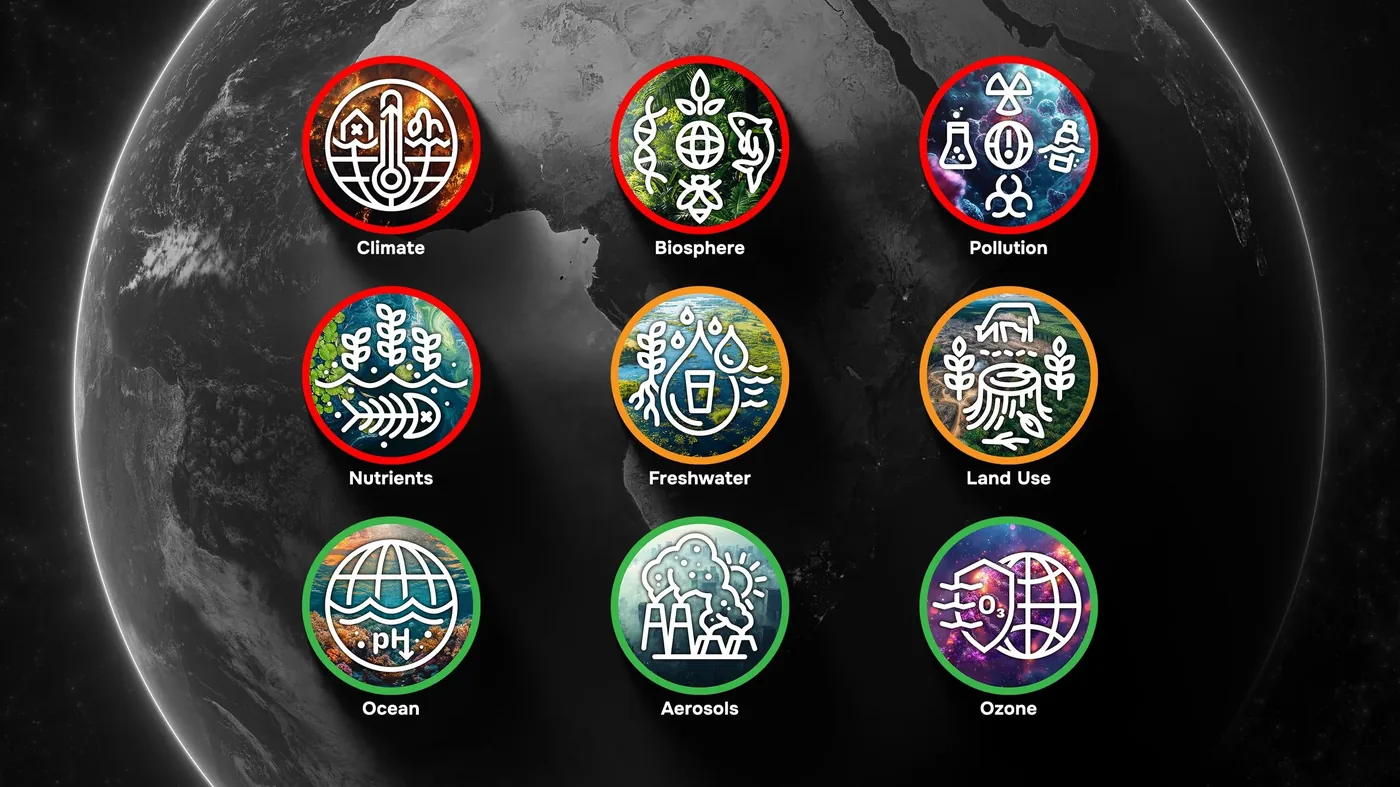
Industrial production has introduced hundreds of thousands of synthetic substances into ecosystems without systematic toxicological evaluation. Linn Persson and colleagues reported in Environmental Science & Technology that the novel entities boundary was breached due to massive chemical releases. Over 350,000 synthetic compounds circulate globally, while cumulative plastic output exceeds 8.3 billion metric tons. Persistent organic pollutants, including perfluoroalkyl substances (PFAS) and legacy pesticides such as dichlorodiphenyltrichloroethane (DDT), bioaccumulate continuously throughout terrestrial and marine trophic chains [1].
Ozone Recovery Highlights the Power of Policy
Stratospheric ozone concentrations present a compelling historical example of multilateral environmental governance successfully reversing biophysical degradation. The 1987 Montreal Protocol mandated the global phaseout of chlorofluorocarbons and related halogenated ozone-depleting gases. Global stratospheric ozone currently measures approximately 285.7 Dobson Units (DU), remaining comfortably within safe levels compared to the preindustrial baseline of 276 DU. Coordinated global action works. Sustained diplomatic compliance has allowed the protective ozone layer to recover, shielding planetary life from harmful ultraviolet radiation [1].
Fine aerosol particles suspended in the lower atmosphere represent the second boundary that remains globally within the safe operating space. Worldwide aerosol loading currently registers an interhemispheric optical depth disparity of 0.063, comfortably below the established 0.1 threshold. International regulations curbing sulfur content in commercial maritime shipping fuels contributed directly to this downward global trajectory [5].

Regional pollution disparities demonstrate that aggregate global safety metrics can obscure dangerous localized health burdens. Atmospheric aerosol loading remains perilously high across East Asia, South Asia, and sectors of Africa and Latin America, where intense combustion particles cause chronic respiratory illnesses. Scientists note that reducing particulate aerosols also unmasks additional solar heating, creating complex trade-offs between immediate public health gains and atmospheric temperature stabilization [3].
Planetary Boundaries Framework in Policy and Finance
Municipal leaders and urban planners increasingly adopt the planetary boundaries framework to guide operational resource decisions. Tiina Häyhä and Albert Norström of the Stockholm Resilience Centre highlighted that Amsterdam implemented a municipal City Portrait utilizing Kate Raworth’s doughnut economics model to balance social foundations with ecological limits. At national governance scales, New Zealand and multiple European administrations assess environmental trade-offs by downscaling boundary concepts into actionable domestic targets [4].
Corporate sustainability teams and asset managers face growing regulatory pressure to audit environmental footprints across complex global supply chains. The Taskforce on Nature-related Financial Disclosures pushes commercial institutions to disclose their reliance on freshwater, biological diversity, and intact land systems. The Earth Commission expands this framework by defining safe and just boundaries that protect human communities from severe environmental harm while safeguarding vital natural capital [6].
Integrated environmental assessment models indicate that even aggressive mitigation pathways will leave multiple systems transgressed through 2050. System inertia delays rapid recovery. Research utilizing the IMAGE modeling framework underscores that biological restoration requires decades of sustained intervention across food production, renewable energy, and chemical manufacturing. Johan Rockström reiterated that surpassing environmental guardrails does not make catastrophic failure inevitable, but remaining within safe margins demands decisive structural reform [4]. Failure remains a deliberate choice.
- ONLINE NEWS Thompson, A. (2026, September 21). 9 ‘boundaries’ keep Earth livable. We’ve breached 7 of them. Scientific American. [Article Link]
- ONLINE NEWS Milman, O. (2026, September 21). ‘Planetary boundaries’ necessary for flourishing of life have been massively breached, scientists warn. The Guardian. [Article Link]
- PRESS RELEASE Potsdam Institute for Climate Impact Research. (2026, June 9). Seven of nine planetary boundaries now breached – ocean acidification joins the danger zone. Potsdam Institute for Climate Impact Research. [Article Link]
- WEBSITE Stockholm Resilience Centre. (2025, September 24). Seven of nine planetary boundaries now breached. Stockholm Resilience Centre. [Article Link]
- WEBSITE Pharand-Deschênes, F. (2026, June 15). Planetary Boundaries: Earth’s 9 Safe Operating Limits. GLOBAÏA. [Article Link]
- WEBSITE Earth Commission. (2025, September 24). Planetary Health Check: 7 of 9 boundaries breached. Earth Commission. [Article Link]
- ACADEMIC JOURNAL Richardson, K., Steffen, W., Lucht, W., Bendtsen, J., Cornell, S. E., Donges, J. F., Drüke, M., Fetzer, I., Bala, G., von Bloh, W., Feulner, G., Fiedler, S., Gerten, D., Gleeson, T., Hofmann, M., Huiskamp, W., Kummu, M., Mohan, C., Nogués-Bravo, D.,. Tobian, A. (2023). Earth beyond six of nine planetary boundaries. Science Advances, 9(37). [Article Link]
APA 7: PerEXP Teamworks. (2026, September 22). Planetary Boundaries Breached as Seven Earth Systems Fail. PerEXP Teamworks. https://perexpteamworks.com/en/planetary-boundaries-breach-seven-earth-systems/


