






Gliese 12b is an Earth-sized world orbiting a quiet red dwarf star located 39.7 light-years from Earth in the constellation Pisces. Discovered in 2024 through independent studies combining NASA space assets with ground observatories, the planet completes one revolution every 12.76 days. It receives modest stellar irradiation, maintaining an estimated equilibrium temperature near 315 Kelvin [6]. Because its host star exhibits low magnetic activity, the system gives astronomers a rare opportunity to study whether rocky planets around cool dwarfs can keep their atmospheres.
A Temperate World in Pisces
Gliese 12b is a temperate rocky exoplanet with a radius roughly matching Earth, orbiting inside the inner edge of its star’s habitable zone. Two separate research groups confirmed the world in May 2024. Masayuki Kuzuhara, A. Fukui, and J. H. Livingston led an international team reporting observations in The Astrophysical Journal Letters, while Shishir Dholakia and Larissa Palethorpe headed a parallel team in Europe [1]. The planet receives an insolation flux between the levels of Earth and Venus, producing an equilibrium temperature of 315 Kelvin, or 42 degrees Celsius, if one assumes zero surface reflection [6]. Researchers comparing the body to inner Solar System analogues have evaluated a Venus-like exoplanet with earthly temperatures to understand atmospheric survival under stellar irradiation. That thermal balance makes it one of the coolest transiting worlds known near our Solar System.
Unlike many worlds orbiting red dwarfs that endure relentless stellar winds and volatile stripping, this planet circles a host whose unusually calm magnetic output spares surrounding space from severe coronal ejections. That quiet stellar output shields surrounding space from severe coronal ejections [2]. If an atmosphere remains, surface temperatures would climb significantly higher because of greenhouse gases, providing researchers a clean laboratory to test how terrestrial climates evolve around M dwarfs [1].
Astronomers classify Gliese 12b as an exo-Venus candidate because its size and incident energy mirror Venus far more closely than modern Earth. Its radius measures between 0.90 and 1.0 Earth radii across published discovery papers. While Earth receives cooler solar heating, Venus underwent catastrophic runaway greenhouse warming that boiled off surface oceans. Did Gliese 12b follow that scorching trajectory? Scientists led by Alexander Venner and Thomas G. Wilson seek to determine whether the planet retained volatile inventory under its milder stellar wind [2].
How TESS Detected Gliese 12b
NASA’s Transiting Exoplanet Survey Satellite initially recorded three distinct dimming events across sectors 42, 43, and 57, though observational gaps between the runs left the orbital period uncertain. Follow-up tracking by the CHEOPS space telescope and sector 70 data from TESS later resolved the timing puzzle in Monthly Notices of the Royal Astronomical Society, confirming a repeating 12.76144-day cycle [2].
Ground observatories worldwide joined the validation campaign to rule out false signals from background binary stars. Masayuki Kuzuhara and J. A. Caballero organized multicolor photometry with MuSCAT2 and MuSCAT3 to observe transit depth consistency across optical filters. High-contrast adaptive optics imaging from the NIRI camera on Gemini North and NIRC2 on the Keck II telescope confirmed that no companion star contaminated the photometric aperture [1]. Additional transit light curves came from MINERVA-Australis, SPECULOOS, and the Purple Mountain Observatory, whose ground telescopes tracked the target across multiple continents [2].
Spectrographs then measured the minute reflex motion of the parent star to confirm the planetary nature of the signal. Radial velocity observations from the InfraRed Doppler instrument on the 8.2-meter Subaru telescope and CARMENES on the 3.5-meter telescope at CAHA verified that the transits belonged to a genuine orbiting planet. Multi-wavelength data confirmed the planetary signal [1].

The Host Star
The host star Gliese 12, also cataloged as GJ 12 and TOI-6251, is a cool red dwarf star located 12.162 parsecs from our Solar System in Pisces. It has an apparent visual magnitude of 12.6, which makes it invisible to the unaided eye, though in near-infrared bands its magnitude reaches 7.8 [2]. Caltech archival records and photometric catalogs indicate the star has about 24% of the Sun’s mass, 26% of the solar radius, and an effective temperature near 3,296 Kelvin [6]. Gaia measurements documented in the NASA Exoplanet Archive record a total proper motion of 700 milliarcseconds per year [4].
What makes this red dwarf exceptional among nearby M dwarfs is its remarkably quiet magnetic behavior. Most red dwarf stars generate frequent superflares and powerful coronal mass ejections that strip gaseous atmospheres from orbiting worlds within hundreds of millions of years. Gliese 12 shows one of the lowest activity levels ever documented for an M dwarf, showing an X-ray output compared to bolometric emission of log Lx/Lbol near -5.7 with the XMM-Newton space observatory [1]. Chromospheric indicators like Ca II log R’HK measure between -5.2 and -5.7, while rotational analysis indicates the star spins slowly with a rotation period of roughly 85 days [4].
Stellar models from NASA Exoplanet Archive compilations estimate the star’s age at roughly 7.0 billion years, proving it has outlived early red dwarf flare activity. Planets circling Gliese 12 have experienced billions of years of stable, quiescent stellar radiation [4]. If volatile layers survived its youth, they face gentle conditions today [1].
Orbital Architecture
Gliese 12b orbits its host star at an average distance of 0.067 astronomical units, completing one circuit every 12.76144 days [2]. Because the host red dwarf emits less than 1% of the Sun’s bolometric luminosity, this tight orbit does not bake the planet into a molten wasteland. That separation places the world at roughly 7% of Earth’s distance from the Sun [4]. Instead, the world receives an incident flux roughly 1.6 times Earth’s solar irradiance, placing it between Earth and Venus insolation levels [2].
The transit geometry appears nearly edge-on from Earth’s vantage point, displaying an orbital inclination of 89.20 degrees. That alignment causes the planet to cross the stellar disc along a direct path lasting approximately 1.2 hours per transit [4]. Astronomers contrasting temperate targets with hotter worlds have examined the airless and sweltering sub-Earth Gliese 367 b to trace how close-in radiation strips volatile envelopes. Here, Gliese 12b remains situated much further out in relative stellar flux.
Orbital eccentricity remains low, with radial velocity solutions placing an upper limit below 0.50 and best-fit estimates around 0.24 [4]. That trajectory prevents destructive tidal heating cycles during periastron passage [3]. Planetary orbits stay predictable over cosmic epochs [4].


Gliese 12b Atmospheric Clues
Atmospheric study depends on how much starlight filters through the planetary atmosphere during transit events, a technique called transmission spectroscopy. Masayuki Kuzuhara and colleagues calculated that the Transmission Spectroscopy Metric for the planet approaches values documented for the famous TRAPPIST-1 system. Because Gliese 12 is brighter in near-infrared wavelengths than the ultra-cool host TRAPPIST-1, capturing clear spectra requires fewer transit visits with the James Webb Space Telescope [1]. Chelsea X. Huang and Ken Rice highlighted that this brightness provides an efficient target to detect molecular signatures like carbon dioxide, water vapor, and methane [2].
Theoretical equilibrium temperatures depend on cloud reflectivity. If the surface possesses zero albedo, its equilibrium temperature reaches 315 Kelvin (42 degrees Celsius) [1]. However, if the planet developed reflective clouds like Venus, its equilibrium temperature drops to 218 Kelvin, or minus 55 degrees Celsius. Surface temperatures would climb if a dense greenhouse atmosphere traps heat [6].
Whether Gliese 12b holds a primary hydrogen envelope, a secondary volcanic atmosphere, or a bare rocky crust remains unanswered [6]. If the planet formed with a light hydrogen envelope, stellar radiation might have driven it off early, leaving an exposed core. Alternatively, volcanic outgassing over 7.0 billion years could maintain a dense carbon dioxide atmosphere [4].
Mass Measurements and Density
Constraining planetary mass required months of radial velocity monitoring with high-precision spectrographs. Initial reports from TESS and ground transit photometry could only establish that the planet’s mass did not exceed 3.9 times Earth’s mass at three standard deviations [1]. A team led by Daisy A. Turner, Annelies Mortier, and Thomas G. Wilson employed the HARPS-N, ESPRESSO, and CARMENES spectrographs at Calar Alto to measure the host star’s gravitational wobble. J. A. Caballero and S. Dreizler contributed cross-dispersed echelle data that tracked stellar reflex velocity down to fractions of a meter per second [3].
Their analysis determined that Gliese 12b possesses a mass of 0.95 Earth masses and a radius of 0.93 Earth radii. Those values indicate a bulk density between 6.4 and 7.0 grams per cubic centimeter, which exceeds Earth’s average density of 5.5 grams per cubic centimeter. Such high density argues strongly against a puffy sub-Neptune and demonstrates a rocky composition with a substantial iron core [3].
Alternative fits using radius values of 0.958 Earth radii suggest lower bulk densities, leaving room for volatile-rich mantle layers [6]. Vincent Van Eylen and Ryan Cloutier noted that precise mass measurements provide the empirical bedrock for modeling whether Gliese 12b resembles Earth’s interior or an iron-poor mantle [2]. The planet is undeniably terrestrial [1].
Comparing Gliese 12b With Gliese 414
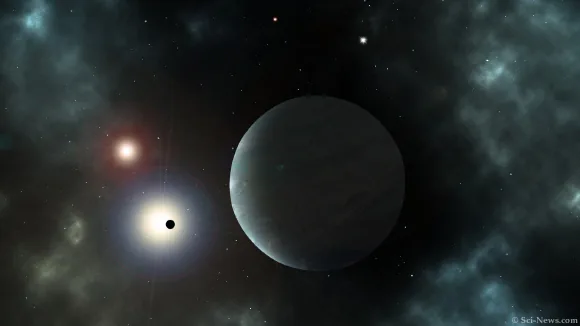
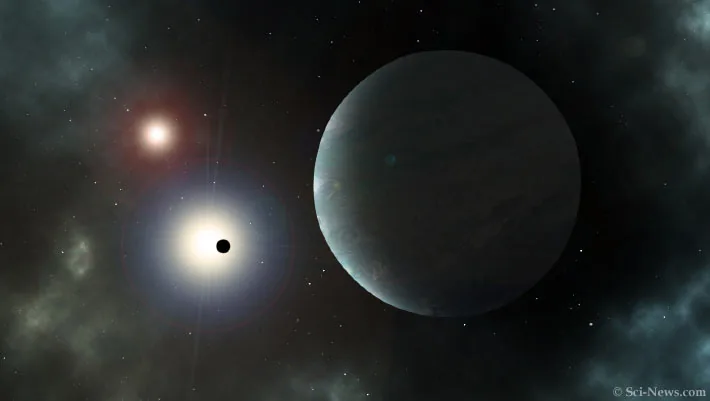
Understanding Gliese 12b benefits from comparisons with nearby systems like Gliese 414, located 38.8 light-years away in Ursa Major [7]. Gliese 414 is a binary configuration combining an orange dwarf primary with an M-type red companion separated by 408 astronomical units. Its primary star, Gliese 414A, is an active K7V dwarf with an estimated age of 12.4 billion years [5]. The neighboring star CW Ursae Majoris lies 5.3 light-years away from the binary system [7].
Unlike the solitary rocky planet circling Gliese 12, the Gliese 414 system hosts two massive gas planets discovered in 2020 by Cayla Dedrick and colleagues using the HIRES spectrograph on the Keck I telescope at W.M. Keck Observatory and the Automated Planet Finder at Lick Observatory. Additional photometric verification came from the KELT-North telescope at Winer Observatory. The inner planet, Gliese 414Ab, is a sub-Neptune with 2.95 times Earth’s radius and 8.8 times Earth’s mass in a 50.8-day orbit, maintaining a temperature near 31 degrees Celsius (88 degrees Fahrenheit). As Cayla Dedrick and Pennsylvania State University colleagues reported, “Gliese 414Ac resides near the inner edge of the star’s habitable zone, but its minimum mass is large enough that it likely possesses a substantial volatile-rich envelope”. Gliese 414Ac orbits further out at 1.4 AU with 56.3 Earth masses and a temperature of minus 150 degrees Celsius [5].
These nearby architectures demonstrate the diverse outcomes of planetary assembly around cool stars [5]. Gliese 414 gathered volatile gases into massive envelopes, while Gliese 12 formed a compact terrestrial planet [1]. Contrasting these systems helps astronomers build comprehensive models of low-mass stellar systems across the solar neighborhood [2].
Next Steps for Space Telescopes
With its confirmed mass, transit alignment, and quiet host star, Gliese 12b stands as a top priority for atmospheric study. The James Webb Space Telescope has targeted several rocky worlds, but stellar activity often contaminates spectra with starspots. Gliese 12 avoids that complication because its quiet photosphere produces minimal magnetic noise. Astronomers using transmission spectroscopy can search for molecular absorptions without battling stellar flare interference. Masayuki Kuzuhara and Shishir Dholakia pointed to future JWST observing cycles as the ideal path forward [1].
Scientists want to know if water survives. By analyzing atmospheric scale heights across infrared wavelengths, space-based transit spectroscopy can distinguish between a steam-rich envelope, a carbon dioxide blanket, or a bare airless crust. Comparing these spectra with data from LHS 1140 b and the TRAPPIST-1 worlds will show where the boundary lies between airless terrestrial cores and worlds that maintain volatile atmospheres into late stellar maturity [6].
Ground observatories and space satellites will continue monitoring radial velocities to test for outer planets in the Gliese 12 system [3]. As data accumulate from teams worldwide, this nearby world will reveal whether Earth-sized planets orbiting cool red dwarf stars can sustain temperate surface conditions or whether they inevitably succumb to a barren fate [2]. The search has only begun.
- ACADEMIC JOURNAL Kuzuhara, M., Fukui, A., Livingston, J. H., Caballero, J. A., de Leon, J. P., Hirano, T., Kasagi, Y., Murgas, F., Narita, N., Omiya, M., Orell-Miquel, J., Palle, E., Changeat, Q., Esparza-Borges, E., Harakawa, H., Hellier, C., Hori, Y., Ikuta, K., Ishikawa, H. T.,. Nagel, E. (2024). Gliese 12 b: A Temperate Earth-sized Planet at 12 pc Ideal for Atmospheric Transmission Spectroscopy. The Astrophysical Journal Letters, 967(2), L21. [Article Link]
- ACADEMIC JOURNAL Dholakia, S., Palethorpe, L., Venner, A., Mortier, A., Wilson, T. G., Huang, C. X., Rice, K., Van Eylen, V., Nabbie, E., Cloutier, R., Boschin, W., Ciardi, D. R., Delrez, L., Dransfield, G., Ducrot, E., Essack, Z., Everett, M. E., Gillon, M., Hooton, M. J.,. McDermott, S. (2024). Gliese 12 b, a temperate Earth-sized planet at 12 parsecs discovered with TESS and CHEOPS. Monthly Notices of the Royal Astronomical Society, 531(1), 1276-1293. [Article Link]
- ACADEMIC JOURNAL Turner, D. A., Eschen, Y. N. E., Murgas, F., Mortier, A., Wilson, T. G., Fernández, J. F., Gromek, N., Morello, G., Tabernero, H. M., Egger, J. A., Vissapragada, S., Caballero, J. A., Dreizler, S., Freckelton, A. V., Hatzes, A. P., Lakeland, B. S., Nagel, E., Naponiello, L., Vanaverbeke, S.,. Buchhave, L. A. (2025). The mass of the exo-Venus Gliese 12 b, as revealed by HARPS-N, ESPRESSO, and CARMENES. Monthly Notices of the Royal Astronomical Society, 545(1). [Article Link]
- WEBSITE NASA Exoplanet Science Institute. (2026). Gliese 12 Overview. NASA Exoplanet Archive, IPAC, Caltech. [Article Link]
- ONLINE NEWS Anderson, N. (2020). Astronomers Find Two Massive Exoplanets in Nearby Binary System. Sci.News. [Article Link]
- WEBSITE Wikipedia contributors. (2024). Gliese 12. Wikipedia, The Free Encyclopedia. [Article Link]
- WEBSITE Wikipedia contributors. (2024). Gliese 414. Wikipedia, The Free Encyclopedia. [Article Link]


