





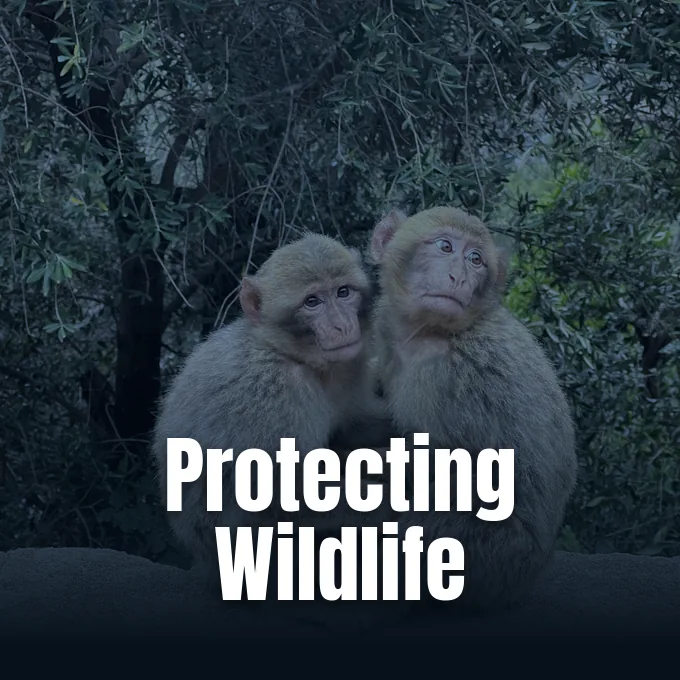
How can conservation projects protect rare wildlife when animal territories overlap with human communities? When wild animals share land with rural towns, protecting endangered species cannot succeed by guarding animals alone while ignoring local farmers who lose crops to foraging runs [3]. The Barbary macaque (Macaca sylvanus), an endangered primate native to North Africa, shows how acute this friction becomes when hungry troops forage on private mountain crops and damage irrigation systems [1]. Survey data from 94 northern Algerian farms revealed that frequent foraging forced families to abandon one-third of their cultivated fields [3].
- Why Protect Endangered Species Near Human Settlements?
- Crop Raids and Rural Burdens in Northern Algeria
- Why Protecting Endangered Species Means Restoring Natural Habitats?
- Global Coexistence Mapping Identifies Pressured Ecosystems
- Why Protecting Endangered Animals Calls for Multi-Criteria Priorities?
- Community Incentives and Legal Frameworks Drive Coexistence
Why Protect Endangered Species Near Human Settlements?
Protecting endangered species near human settlements prevents economic collapse for rural households while curbing retaliatory violence that drives rare wildlife toward extinction when wildlife ranges overlap with expanding farms [1]. When predators like wolves kill sheep or large primates feed in orchards, rural growers bear high economic burdens. Without formal compensation or protective fencing, frustrated growers may turn to poison or guns [3].
Lead author Rassim Khelifa, supported by the Natural Sciences and Engineering Research Council of Canada with a Tier 2 Canada Research Chair at Concordia University, documented these dynamics in an early 2026 preprint that has not yet been peer-reviewed [2]. Khelifa and Mohammed Khalil Mellal, at the Agrifood Technologies Research Center in Béjaïa, analyzed these rural dynamics in Scientific Reports, and Khelifa said: “Protecting the Barbary macaque requires more than protecting the animals themselves”. Algerian law shields the Barbary macaque with fines and prison sentences, but penalties cannot stop hungry primates from seeking fruit [3]. Saving endangered species demands pragmatic tools that keep wildlife away from village orchards without wrecking community food security [5]. While earlier ecological inquiries examined human-insect interactions where species shifts create subtle environmental ripples, encounters with large or intelligent mammals cause immediate financial friction for farming families living on mountain slopes [1].
Conflict spans many continents [3]. Expanding roads and farm borders push people into territory that animals have inhabited for centuries [6]. When elephants flatten homes in Asia or bears hunt livestock in eastern Europe, rural communities face steep bills [1]. Conservation works best when local people see economic benefits from living beside wild populations. Mutual survival needs practical cooperation [5].
Crop Raids and Rural Burdens in Northern Algeria
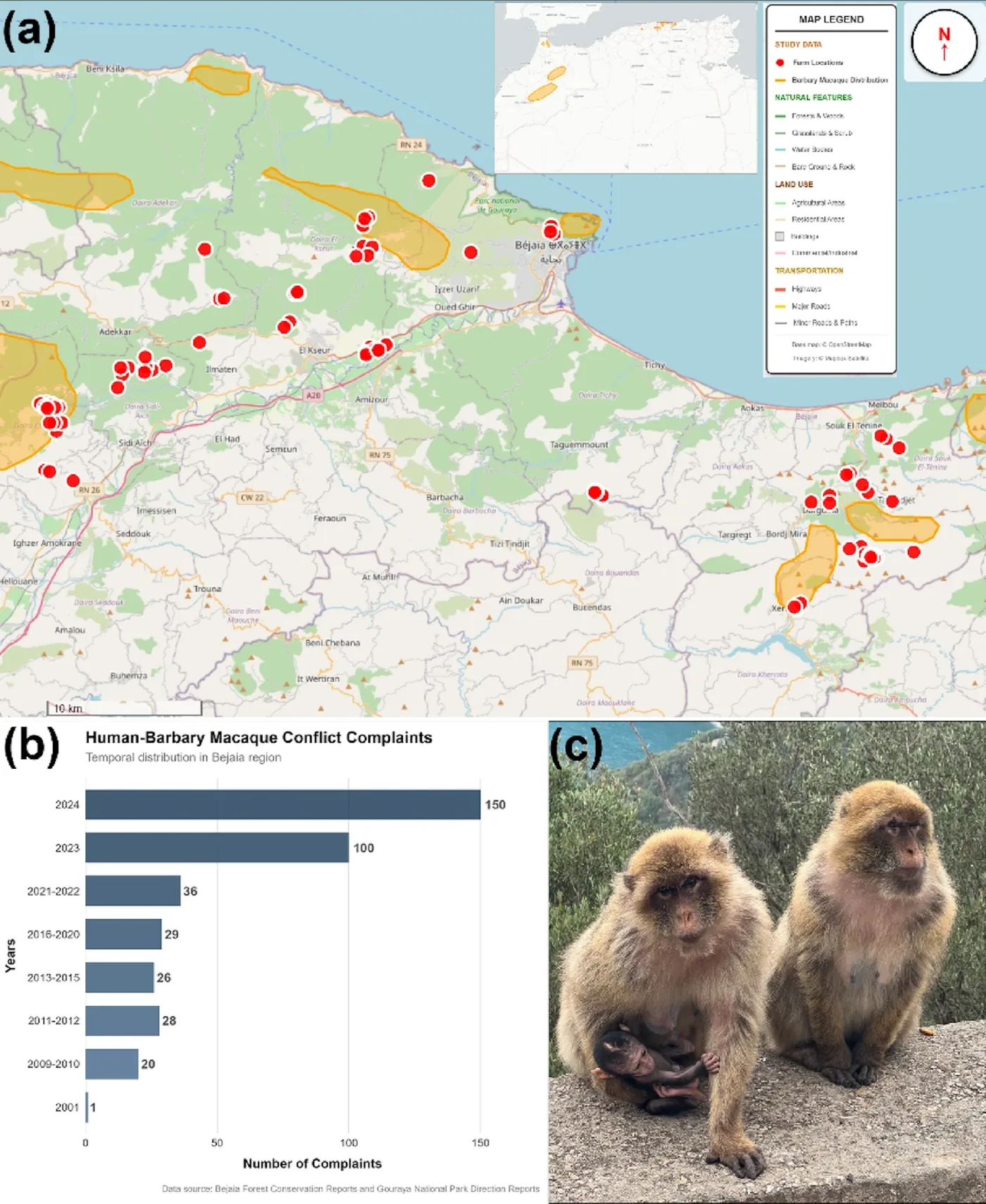
In Béjaïa province, small-scale farming provides roughly 35 per cent of household income on average, and for several families it represents their only source of revenue [3]. When Barbary macaques raid these steep mountain plots, crop losses threaten basic food security [1]. Field interviews on 94 farms revealed that 68 per cent experienced daily foraging runs during conflict periods [3]. The primates also broke drip-irrigation pipes and tore roofing materials on more than half the properties [1]. None of the farmers reported physical attacks or disease transmission. Raids remain financial, not violent [3].
Raids follow harvest cycles [1]. Macaques targeted high-value orchards of figs, apples, pears, grapes, and tree nuts, consuming whole fruits rather than sampling small pieces as troops moved systematically through private groves [3]. Crop foraging peaked from July to September when sweet figs ripen in the valleys [1]. Incursions dropped during late fall and winter as wild acorns became plentiful inside oak forests [3]. Troops struck most often at dawn and dusk, slipping onto farmland when human activity was low [1].
Growers tried guarding plots with dogs, raising wire fences, and firing slingshots, but these deterrents failed to halt daily losses [3]. Mellal and Khelifa found that using more deterrent methods did not reduce incursion rates, showing that clever primates quickly learn to circumvent barriers through persistent trial and error [1]. Larger farms faced higher raid frequencies, whereas village proximity and altitude showed little protective effect [3]. Harassment cannot stop hungry troops [1].
Why Protecting Endangered Species Means Restoring Natural Habitats?
Protecting endangered species means restoring natural habitats because wildlife enters human farmland primarily when wild food and forest cover collapse on mountain slopes [1]. Between 2001 and 2023, Béjaïa province lost roughly 50,400 hectares of tree canopy, representing about 40 per cent of its baseline forest cover following repeated outbreaks of destructive summer fires [3]. Deadly wildfires in 2023 caused the sharpest annual loss, destroying oak stands and scrub that provide wild acorns and roots [1]. Satellite records showed no agricultural expansion between 2014 and 2021, proving that fire rather than new farming drove the loss of tree cover [3].
When natural forage vanishes, hungry animals turn to irrigated crops out of nutritional necessity [1]. Deforestation worldwide accounts for roughly 13 per cent of greenhouse gas emissions and fragments natural wildlife migration paths [5]. In North America, the National Wildlife Federation notes that habitat loss, invasive pests, and bad weather imperil one-third of all wildlife species [10]. Protecting endangered species calls for reviving wild foraging grounds so animals do not depend on human gardens for survival. Planting oak corridors connects isolated groves while keeping troops away from village orchards [3].
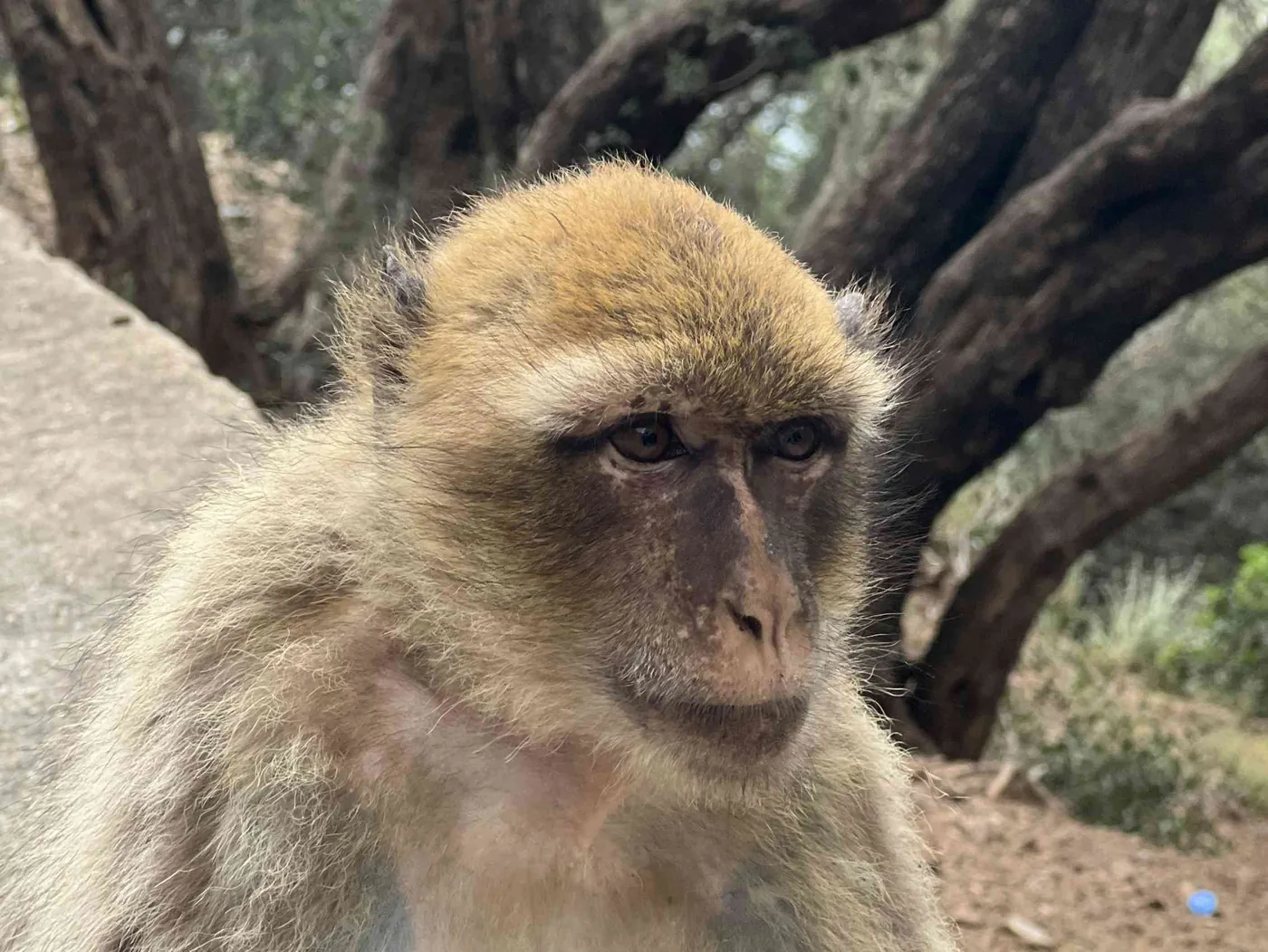
Forest recovery also creates living buffers that separate animal troops from private orchards [3]. Planting unpalatable citrus groves along forest edges gives farmers a cash crop that macaques rarely touch, forming a protective deterrent zone [1]. Broad international pacts like the Ramsar Convention, signed in 1971 to shield critical wetlands, prove that legal habitat protection can stabilize fragile borders [5]. Preserving natural wetland vegetation maintains freshwater quality and wildlife diversity [8].


Global Coexistence Mapping Identifies Pressured Ecosystems
To understand where human growth clashes with wildlife, World Bank researchers developed the Human Coexistence Indicators (HCI) framework. Led by Brian Blankespoor, Susmita Dasgupta, and David Wheeler, the project aggregated spatial indicators of population density, agricultural production, road networks, and pollution into 0.25-degree grid cells. By calculating the geometric mean of these indicators for terrestrial, freshwater, and marine environments, the team created a composite index that normalizes human impact on a scale from 1 to 100. This design prevents extreme single values from distorting overall assessments [6].
The World Bank team overlaid this composite indicator with species counts from its Global Biodiversity Database, which draws occurrence records from the Global Biodiversity Information Facility (GBIF) covering nearly 600,000 species of vertebrates, invertebrates, and plants. Their spatial maps revealed clear geographic patterns: terrestrial human pressure is high in China, India, and France, while rural Algeria and central Australia show comparatively low scores. In freshwater systems, China, Italy, and South Africa exhibit high impact, whereas Mongolia and Russia maintain low scores. The Intergovernmental Science-Policy Platform on Biodiversity and Ecosystem Services (IPBES) warns that nearly one million species face extinction if these pressures go unmanaged [6].

Mapping human pressure helps conservation agencies identify high-risk overlap zones. Rather than relying on rigid national boundaries, planners can evaluate specific ecoregions using World Bank Policy Research Working Paper 10821 [6]. Spatial data guides practical investments into wildlife corridors, fencing subsidies, and sustainable agriculture. Data guides targeted landscape investments [5].
Why Protecting Endangered Animals Calls for Multi-Criteria Priorities?
Protecting endangered animals calls for multi-criteria priorities because counting species richness alone fails to preserve unique evolutionary lineages and key functional roles within complex ecosystems. Biologists at the Environmental Studies (EVS) Institute explain that picking conservation zones solely by headcounts can protect duplicate species while leaving unique lineages exposed to extinction [7]. Endemic wildlife that evolved in isolation, such as the unique lemurs of Madagascar where approximately 80 per cent of plant and animal species live nowhere else on Earth, carry irreplaceable evolutionary history [9]. A framework in Nature Ecology & Evolution shows that shielding evolutionary lineages preserves the capacity for species to adapt [7].
To capture these dimensions, researchers use the EDGE (Evolutionarily Distinct and Globally Endangered) framework developed by the Zoological Society of London. This metric pairs evolutionary distinctiveness with IUCN threat ratings to score conservation priority. Research published in Biological Conservation shows that high species counts seldom match zones rich in evolutionary heritage or key ecological roles. Ecologists examining the legacy of Earth’s giant mammals note that large animals need expansive ranges that cross human land boundaries [7]. A balanced strategy must weigh taxonomic counts, evolutionary history, and ecological roles [5].
Conservation planners also rely on gap analysis, a spatial method created during the 1980s by J. Michael Scott at the University of Idaho. The U.S. Geological Survey gap program tracks representation gaps where species lack protected reserves, ecological gaps where reserves fail to cover life needs, and management gaps where designations lack active oversight. In New Guinea, researchers integrated plant trait data across a 100,000 square kilometer landscape to build predictive models. Early analysis keeps common species common [7].
Community Incentives and Legal Frameworks Drive Coexistence
Field lessons from Algeria show that legal bans against killing wildlife remain ineffective unless governments support rural households facing crop damage [1]. Almost none of the 94 farmers surveyed by Mellal and Khelifa had received conflict management training [3]. Algeria’s conservation strategy for the Barbary macaque outlines financial compensation for crop losses, but authorities have not implemented relief in Béjaïa [1]. Direct relief funds would remove incentives for retaliatory poison baits or guns [3].
Global treaties set legal standards for species recovery, yet local execution determines real-world results. The Convention on International Trade in Endangered Species (CITES) bars commercial trafficking in vulnerable fauna, while the Convention on Biological Diversity (CBD), adopted by over 190 countries in 1992, guides broad habitat preservation across member nations [5]. The Strategic Plan for Biodiversity 2011-2020 set 20 Aichi Biodiversity Targets, including Aichi Target 11 conserving 17 per cent of land. In 2022, the Kunming-Montreal Global Biodiversity Framework updated these targets to protect 30 per cent of land and ocean by 2030 [7].
Grassroots initiatives prove that financial incentives turn local residents into dedicated conservation partners. In Kenya, the Masai Wilderness Conservation Trust manages community rangelands, reducing livestock predation while generating eco-tourism revenue for pastoralists. In Nepal, community management around the Annapurna Conservation Area has protected over 1,500 species of plants and animals since 1986, including iconic threatened wildlife like the snow leopard [5]. In the United States, the Recovering America’s Wildlife Act seeks funding for State Wildlife Action Plans to protect over 1,600 listed species [10]. When rural communities gain economic stability with habitat restoration, protecting endangered species becomes shared prosperity [3].
- ACADEMIC JOURNAL Mellal, M. K., Chelli, A., Boutekrabt, R., Turner, S. E., Weladji, R. B., & Khelifa, R. (2026). Conflict between farmers and Barbary macaques (Macaca sylvanus) in Northern Algeria: threats and conservation implications. Scientific Reports, 16(1). [Article Link]
- PREPRINT Khelifa, R. (2026). Protecting endangered species must include supporting habitats and nearby human settlements. [Preprint]. [Article Link]
- ONLINE NEWS Khelifa, R. (2026, October 4). Protecting endangered species must include supporting habitats and nearby human settlements. The Conversation. [Article Link]
- ONLINE NEWS Khelifa, R., & Concordia University. (2026, October 4). Protecting endangered species must include supporting habitats and nearby human settlements. Yahoo News Canada. [Article Link]
- WEBSITE Greene, M. (2026, January 8). Protect Endangered Species Habitats with Effective Conservation Strategies. The Eco Shift. [Article Link]
- WEBSITE Blankespoor, B., Dasgupta, S., & Wheeler, D. (2025, January 9). Fostering human-wildlife coexistence to protect biodiversity: introducing the Human Coexistence Indicators (HCI). World Bank Blogs. [Article Link]
- WEBSITE Kumar, P., & Environmental Studies Institute. (2025, November 29). Prioritizing Habitats and Species for Conservation: Methods and Challenges. Environmental Studies (EVS) Institute. [Article Link]
- ONLINE NEWS Bhamra, S. (2024, July 19). Protecting Endangered Species and Habitats: Strategies and Consequences. EnvironBuzz™ Magazine. [Article Link]
- WEBSITE Greene, M. (2026, January 7). Protecting Endangered Species Habitats is Crucial for a Sustainable Future. The Eco Shift. [Article Link]
- WEBSITE National Wildlife Federation. (2018, March 29). Protecting Endangered Species. National Wildlife Federation. [Article Link]
APA 7: PerEXP Teamworks. (2026, October 5). Why Protecting Endangered Species Needs Rural Community Aid. PerEXP Teamworks.


