




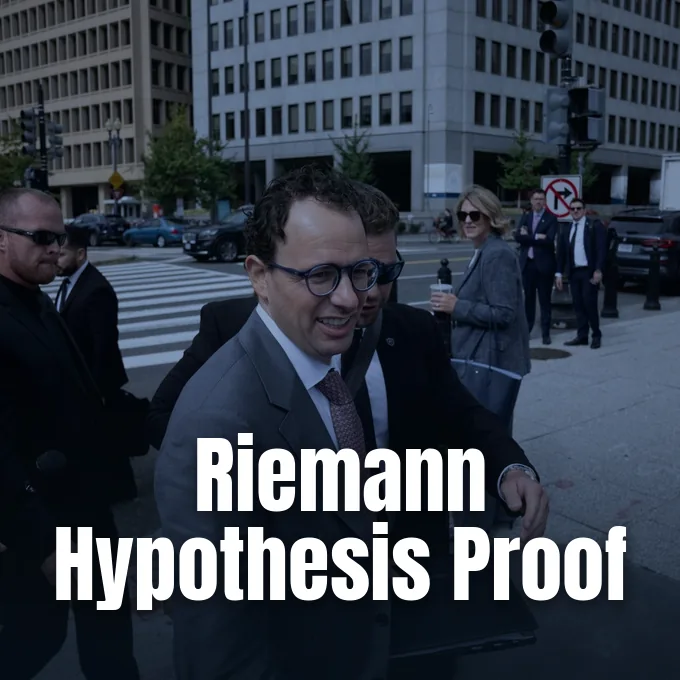
Anthropic mathematician Levent Alpöge announced that he discovered a proof of the Riemann hypothesis using the artificial intelligence assistant Claude. Alpöge, who also conducts mathematical research at Harvard University, posted his findings on November 20 after developing machine-checked scripts in the programming language Lean. The announcement tackles a mathematical problem that has puzzled scholars since 1859, though the purported proof has not yet received independent peer verification or formal acceptance from academic institutes [1], [2].
A Purported Riemann Hypothesis Solution
The Riemann hypothesis stands as one of the central unsolved problems in number theory. German mathematician Bernhard Riemann first proposed the concept in 1859 to explain how prime numbers distribute themselves along the number line and how zeroes of a related zeta function behave. In his statement, Alpöge reflected on how these mathematical principles have shaped the broader discipline over generations: “The Riemann Hypothesis is the classic problem in number theory. It asks for optimal control on the count of prime numbers of a given size. Its shadows have guided mathematicians for 150 years, and its many rhymes and reflections, even reaching physics, taught us the unity of our fields” [1].
Alpöge explained that his work with Claude went beyond the classical conjecture. He stated: “I believe I have, working with Claude, discovered a proof of the Riemann Hypothesis. In fact, the method easily extends much further, resolving the so-called Generalized Riemann Hypothesis, and I expect, with more time, the Extended Riemann Hypothesis too.” He said he messaged Anthropic CEO Dario Amodei late Sunday night before waiting until after the company completed its initial public offering on Thursday to release his findings [2].
Anthropic did not participate in the announcement or confirm the findings. The company offered no immediate comment when reporters asked about the claim. Back in August, Anthropic stated that it was exploring the problem with Claude, but the company noted: “We don’t expect that the techniques Claude used will lead to proving the Riemann hypothesis.” Alpöge chose to publish the material independently on his website [2].
Code in Lean Replaces a Formal Paper
Alpöge did not release a standard academic preprint; instead, he published millions of lines of code written in Lean. Lean serves as an interactive theorem prover that verifies logical mathematical reasoning through functional code. Alpöge explained that writing out a conventional narrative paper for the entire argument produced with Claude would span more than 250,000 pages. Because human checking of a manuscript that massive is practically impossible, he argued that computer-checked formal code offers a reliable route to inspect every deduction without hidden assumptions [1].
This isn’t the first time Alpöge used Claude to tackle open problems. In July, he reported that he solved the Jacobean conjecture using the same AI assistant [2].

Mathematicians must now execute the Lean code to test whether the logical chain holds together. The Lean community relies on software checkers to verify that every deduction follows from fundamental mathematical axioms. If the software encounters a single missing step or circular definition, the entire proof collapses. Independent researchers haven’t finished this computational review yet, so the claim remains an unverified hypothesis in mathematics [1].

Verification Rules for the Millennium Prize
The Riemann hypothesis is one of seven Millennium Prize problems designated in 2000 by the Clay Mathematics Institute. The institute established a $1 million bounty for a valid solution to each of the seven challenges. These questions represent some of the steepest intellectual barriers in mathematics, spanning geometry, fluid mechanics, and algorithmic complexity. Alpöge’s claim brings fresh attention to the problem, but securing official recognition requires satisfying rigorous institutional guidelines [2].
Under the rules of the Clay Mathematics Institute, a proposed solution can’t simply appear on a personal blog or online repository. The author must publish the proof in a qualifying mathematics journal and allow it to withstand two full years of scrutiny by the worldwide research community [2].
In the quarter-century since the Millennium Prize was founded, only one problem has received official recognition as solved. Mathematicians verified a proof for the Poincaré conjecture, a topological puzzle concerning three-dimensional spheres. That rare outcome showed how cautious mathematicians remain when evaluating major claims, and every other Millennium challenge has resisted decades of human attempts [2].

Past OpenAI Disputes and Shared Work
OpenAI sparked a similar debate in September when it announced that an AI system had helped solve the Navier-Stokes problem. That challenge, which also belongs to the Millennium Prize list, governs the physical laws behind fluid flow. OpenAI deployed 10,000 agents and spent millions of dollars on the effort after learning that rival teams were closing in on a solution [2].
The Navier-Stokes announcement quickly ignited tensions over intellectual property and research credit. New York University mathematics professor Tristan Buckmaster had been studying the problem with Alpöge using both Claude and OpenAI Codex. Buckmaster said OpenAI produced its result by following the research pathway he and Alpöge had developed [2]. OpenAI strongly denied any wrongdoing, but the episode echoed debates where mathematicians confronted AI in mathematics after unverified corporate research claims surfaced.
Scholars raised concerns that tech firms might use research shared through AI interfaces to claim discoveries ahead of academic authors. Alpöge chose a different approach by releasing his Lean code openly under his own name [1], [2].
Reactions to the Riemann Hypothesis Claim
The mathematics community has greeted Alpöge’s announcement with mixed emotions. Researchers describe feeling a blend of excitement, curiosity, and sadness as automated tools begin tackling the deepest questions in pure mathematics. For generations, scholars treated these problems as lifelong intellectual quests that defined human ingenuity. Seeing an AI system generate thousands of pages of logical deductions shifts how mathematicians view their own role in discovery [1].
Alpöge addressed these mixed reactions in his published statement. He spoke candidly about the strange sorrow of solving a question that has guided researchers for more than a century: “It is natural to feel that this is an end, in my case a loss of a principal guiding light. But what I saw during the course of progress so amazed me that I believe it is one dawn across science of something far greater.” Many mathematicians now wonder whether automated provers will diminish human creativity or simply serve as tireless assistants that help scholars crack difficult puzzles once thought unsolvable [1].
The true test of the claim will unfold over the coming years as independent experts dissect the millions of lines of Lean code. Until peer reviewers finish their audit and the Clay Mathematics Institute evaluates the proof, the Riemann hypothesis remains an open challenge. If the proof survives this two-year scrutiny, it will stand as clear evidence that artificial intelligence can solve humanity’s hardest mathematical puzzles [2].
- ONLINE NEWS Dupré, M. H. (2026, November 20). Anthropic Mathematician Claims He’s Solved the Riemann Hypothesis Using Claude. Futurism. [Article Link]
- ONLINE NEWS Hart, R., & Roth, E. (2026, November 20). Anthropic mathematician claims to have solved prestigious Millennium Prize problem with Claude. The Verge. [Article Link]


