




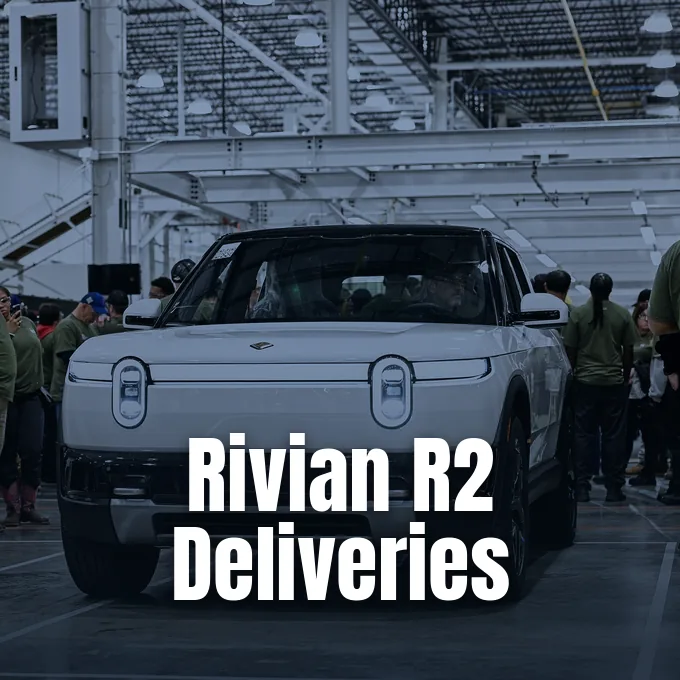
Rivian announced on Thursday that its new Rivian R2 SUV became its best-selling vehicle by volume during the third quarter of 2026. The direct-to-consumer automaker lifted overall customer shipments after expanding shift schedules at its assembly plant in Normal, Illinois. While the company didn’t disclose the exact number of R2 models that reached buyers over the three-month period, the pace of shipments pushed overall deliveries up 45 percent compared to the same period last year. Rivian revealed that the compact SUV drove much of that volume growth as production ramped up through late summer [1].
Early Rivian R2 Demand
Rivian designed the compact Rivian R2 electric SUV from the ground up to serve as a higher-volume offering, and third-quarter earnings confirmed that the model outsold the rest of the brand’s vehicle lineup for the first time, as reported by The Verge automotive editor Andrew J Hawkins. The R2 outsold every older model in the catalog. Handovers surpassed the R1T pickup, the R1S full-size SUV, and the Electric Delivery Van built for commercial fleet partners. Deliveries serve as sales proxies. Because Rivian sells directly to consumers without franchised dealerships, quarterly handovers reflect actual market demand across North America rather than dealer inventory. “We had great results with R2 becoming our best selling vehicle by volume in the third quarter,” Rivian CEO RJ Scaringe said in a statement, adding that customer feedback had been exceptional [2].
Customer interest gained momentum even though buyers could no longer claim the $7,500 federal electric vehicle tax credit that expired last year, according to TechCrunch reporter Sean O’Kane. Policy changes under the Trump administration that altered clean energy incentives led competing legacy automakers to scale back electric vehicle commitments and redirect capital toward hybrid systems and gasoline-powered trucks. Rivian saw that retreat as an opening for pure-electric manufacturers like Tesla and Rivian. In a letter sent to shareholders on Thursday, the automaker explained how the new model fits that shifting landscape. “In a U.S. automotive marketplace starved for high-quality EV choice, R2 is an attractively priced option for everyday adventures that is resonating with a broad set of consumers and we expect will be a game changer for Rivian’s long-term growth and profitability,” the company said [1].
Delivery Guidance Raised for Wall Street
Steady retail uptake during the summer prompted management to raise delivery expectations for institutional investors tracking the company on Wall Street. Rivian had previously forecast full-year deliveries of between 65,000 and 70,000 electric vehicles for 2026, but executive teams lifted the baseline floor of that target range to 67,000 vehicles on Thursday. It was the second time this year that the automaker raised its annual delivery guidance as factory build rates improved [1].
The higher floor breaks a prolonged three-year period where annual shipments hovered below 50,000 units. Official third-quarter production figures confirmed that the Illinois facility built 19,751 vehicles and delivered 19,248 to customers, representing an 85 percent surge in vehicle assembly and a 45 percent increase in deliveries compared to the same period in 2025 [1, 2]. Deliveries jumped substantially compared to the previous quarter. During the second quarter of 2026, factory teams in Normal assembled 12,613 vehicles and delivered 12,194, with management attributing much of the subsequent volume increase directly to the arrival of the Rivian R2 [1].
Buyers accepted early higher-specification launch builds after the SUV reached the market in June, generating steady cash receipts through late summer as assembly stabilized. The regular flow of finished vehicles eased logistical pressures for regional distribution hubs in the Midwest [1].


Manufacturing Expansion in Normal
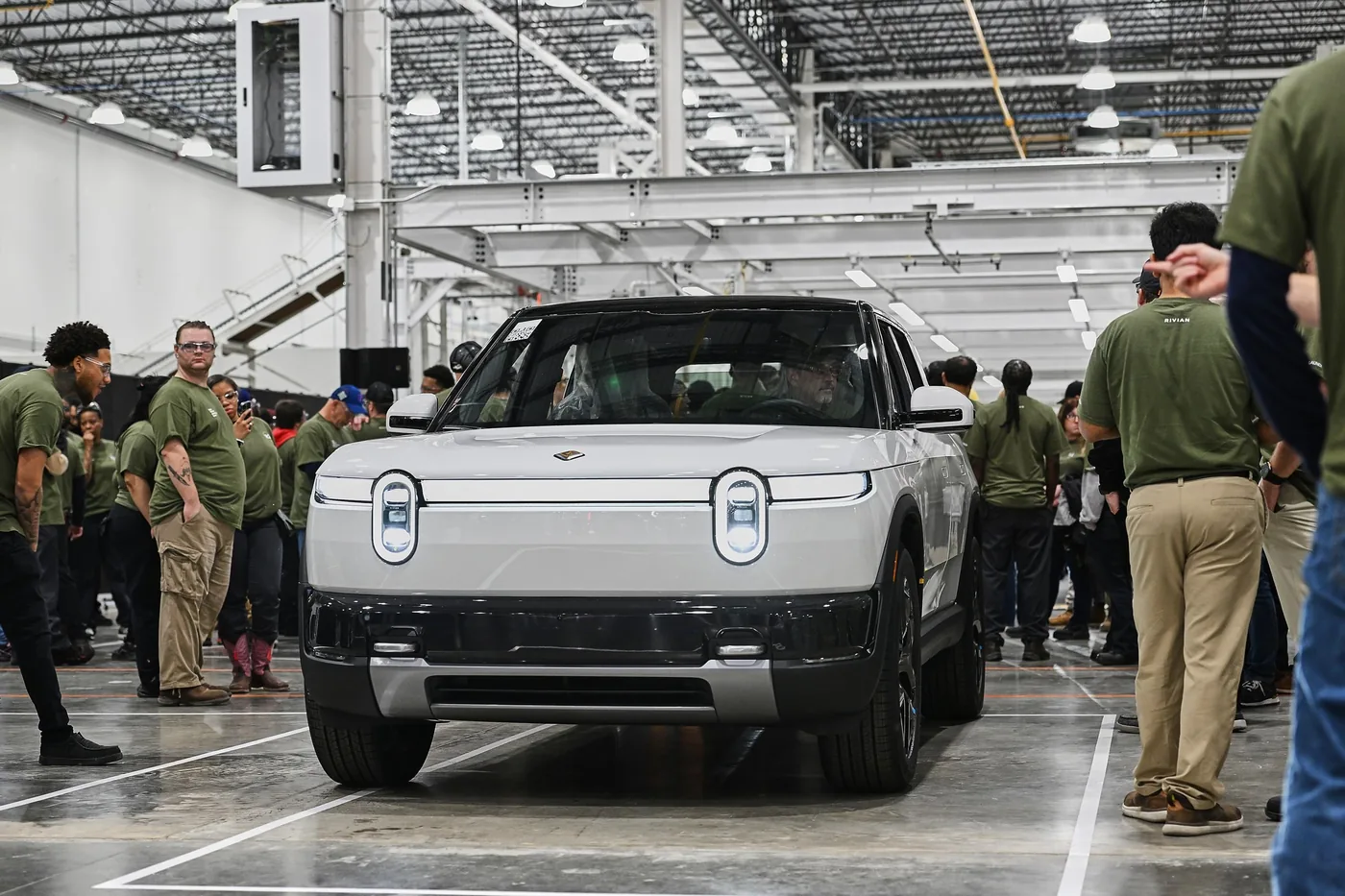
Output gains at the main manufacturing complex in Normal, Illinois stemmed largely from the introduction of a second production shift, letting plant managers run assembly lines longer each week to support higher build rates [1]. Line teams in Normal adapted to the faster tempo while balancing consumer SUV assembly with commercial electric delivery vans [2].
Assembly adjustments laid the groundwork for this output surge earlier in the year as tooling for the Rivian R2 took shape. The delivery increase built on earlier production momentum after Rivian sales numbers climbed 45 percent during initial assembly expansion at the Illinois plant. Retooling on the chassis line cleared logistical bottlenecks, allowing parts to flow into welding stations without the parts shortages that slowed earlier launch schedules.
The Illinois factory now tests Rivian’s high-volume manufacturing strategy. Running parallel assembly lines for three separate vehicle architectures tests supplier networks, but plant leadership kept finished vehicle lots moving to delivery centers nationwide. Building nearly twenty thousand units in three months proved that the Normal assembly facility could sustain the pace required to hit the raised annual guidance targets [1].
Software Licensing and Financial Health
While customer deliveries expanded, Rivian’s overall financial standing relied heavily on software sales and its strategic partnership with Volkswagen, generating total quarterly revenue of $2.155 billion. Revenue climbed by 38 percent from the $1.558 billion posted in third-quarter 2025. Automotive operations contributed $1.55 billion of that total revenue figure, up 36 percent year over year [2].
Software and subscription services brought in $605 million in revenue, up 45 percent year over year. The software division generated $256 million in profit, up $102 million from last year while achieving a 42 percent profit margin. Licensing vehicle software to the Volkswagen Group provided the largest portion of those software receipts, coupled with customer subscriptions for the Autonomy Plus automated driving suite. Those high-margin digital streams helped support cash reserves as the company absorbed heavy upfront costs tied to launching its newer product line [2].
Bottom-line losses narrowed during the quarter. Rivian posted a net loss of $913 million, showing improvement from the $1.2 billion net deficit recorded during the same three months of 2025 [1]. Automotive gross losses fell to $80 million from $130 million a year earlier. Gross profit reached $176 million overall. Company earnings benefited from a $152 million improvement over 2025, supported by sales of regulatory pollution credits to competing automakers and a tariff refund from the federal government [2].
Rivian R2 Pricing and Trims
Rivian introduced initial shipments of the mid-size SUV in higher-priced trim configurations that started just under $60,000 [1]. Those well-equipped launch editions helped sustain automotive cash flow while factory technicians smoothed early production runs. Though the vehicle didn’t bring in the bulk of overall corporate revenue during the quarter, its long-term role centers on capturing mainstream buyers through lower price points [2].
More affordable build options are scheduled to enter the market over the coming months. A Premium trim priced at $53,990—listed as $55,485 in detailed consumer pricing—is scheduled to become available before the end of 2026 [2]. Expanding availability to this mid-tier configuration opens the order pipeline for drivers who found the initial launch edition beyond their target budget [1].
The lowest price points will follow in 2027 to complete the model lineup. Rivian plans to release a Standard Long-Range variant starting at $49,985 early in 2027, followed by an entry-level Standard trim later that year starting at $44,990, or $46,495 depending on final equipment packages. Can lower pricing sustain this sales momentum into the coming year? Rivian leadership believes that offering multiple price tiers will allow the Rivian R2 to maintain high assembly volume at the Illinois plant as consumer adoption expands [2].
- ONLINE NEWS O’Kane, S. (2026, October 29). The R2 SUV is already Rivian’s best-selling vehicle. TechCrunch. [Article Link]
- ONLINE NEWS Hawkins, A. J. (2026, October 29). Rivian’s R2 is officially its best-selling vehicle. The Verge. [Article Link]


