






The new Strava Gemini integration launched on October 28, 2026, allowing subscribers to query their personal workout history through conversational prompts. The feature lets athletes ask questions about pacing trends, recovery heart rates, and race splits instead of scrolling through charts [4]. While the tool is currently limited to the United States, it marks Strava’s latest effort to bring artificial intelligence into everyday training routines [3].
Capabilities of the Strava Gemini Integration
Strava, based in San Francisco with over 200 million users in more than 185 countries, built the new feature to help athletes interpret accumulated fitness logs. The Strava Gemini integration allows subscribers to link their profile to Google’s assistant and query recorded workouts in plain language [4].
Once connected, subscribers can ask whether they are getting faster at the same heart rate or request a detailed analysis of their last race effort [4]. The assistant breaks down performance mile by mile, showing how pace shifted as fatigue set in during a half marathon or full 26.2-mile run [1]. Strava said the tool also helps multi-sport athletes evaluate how strength sessions influence their running pace over several months. Instead of scrolling through dozens of separate workout entries, runners can ask Gemini to synthesize patterns across their volume, consistency, and mix of sports [4].
Weather analysis is another key part of the conversational tool [3]. Gemini can evaluate temperature, humidity, and wind conditions recorded during a workout to help runners understand sluggish splits [4]. Instead of guessing whether tired legs or summer heat caused a slow time, users can see how weather shaped their cardiovascular strain [3].
Setup Steps and Account Permissions
Access to the tool is currently restricted to subscribers located in the United States, with no confirmed launch date for runners in international markets. Strava confirmed that the connection works across all Gemini service tiers, meaning athletes don’t need a paid Google One subscription to use the feature [3]. However, an active paid Strava subscription is still required, leaving free-tier members on the standard mobile dashboard [8]. Eligible athletes can link their accounts on mobile devices or through web browsers without paying extra fees to Google [5].
Connecting the two platforms takes place inside the Google Gemini application. Users open Personal Intelligence within Gemini settings, find Strava under connected apps, sign in with their Strava login credentials, and authorize access [5]. The connection is optional and read-only, meaning the assistant can’t alter stored activities [4].
The authorization screen outlines the specific categories of personal data shared during setup. Gemini requests access to workout activities, performance metrics, training plans, gear records, club memberships, and basic profile details. The consent agreement notes that parts of user conversations, along with user names and email addresses, may be shared with Strava and handled according to its Privacy Policy [7]. Athletes can disconnect the integration at any time through their settings [3].


Query Options for Workout Logs
The conversational system supports several comparisons that simplify searching through large activity archives [8]. Subscribers can ask Gemini to compare their fastest 10K of the current year against their all-time personal best, showing the exact dates and runs behind each mark [4].
This side-by-side view lets athletes see how their current training fitness compares to past seasons without manually digging through older calendar entries [8]. Athletes can also track consistency through running streaks. A user can ask Gemini to calculate their longest sequence of consecutive running days on Strava or check their current streak across individual sports. The assistant calculates when an active streak began, giving runners a fast way to check their 10K personal record and daily habits before the day ends [4].
Because Gemini relies on metrics recorded by wearable sensors, the usefulness of its feedback depends on the data captured during each workout. Pacing comparisons require consistent satellite tracking, while cardiovascular queries require an optical sensor or chest strap. Strava noted that while the assistant can identify statistical trends, those relationships don’t prove direct causation [8].

Hands-On Pacing and Streak Testing
Early evaluations of the Strava Gemini integration showed that while the assistant pulls workout records quickly, its guidance requires careful interpretation by the runner. Testers Meredith Dietz, Gina Trapani, and Jordan Calhoun reviewed the tool for Lifehacker, examining how Gemini processed marathon logs and pacing questions. When asked whether a runner was getting faster at a steady heart rate, Gemini confirmed efficiency gains but initially overlooked environmental conditions. Only after testers steered the conversation toward weather did the assistant point out that mid-September long runs took place in 75–84°F temperatures with high humidity, whereas cooler October weather made identical cardiovascular efforts look noticeably faster [7].
The testers also discovered pagination limits when querying older marathon performances. When asked for an analysis of every marathon-distance race since 2019, Gemini initially stated that the runner had logged only one race, citing the Marine Corps Marathon from October 25, 2026, despite eight completed races in the profile [7].
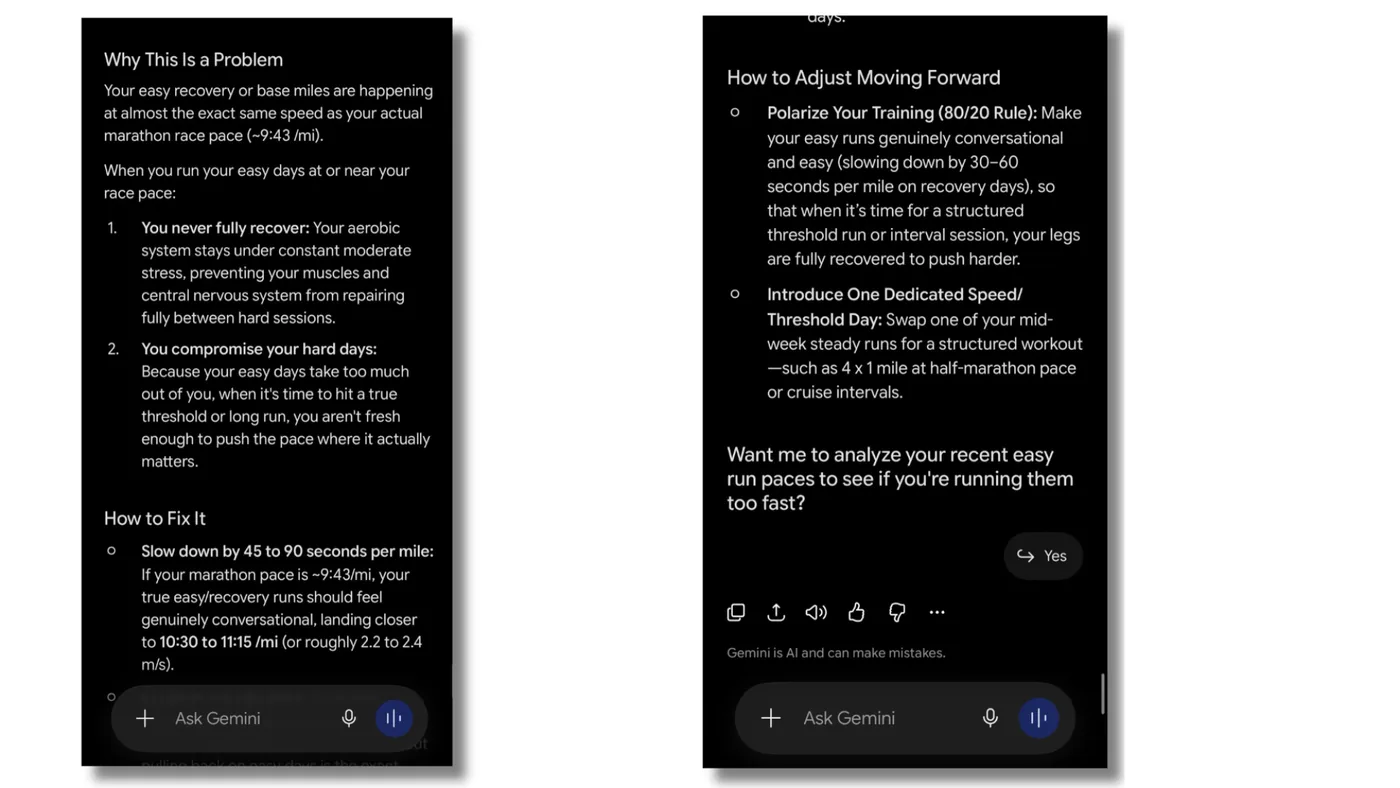
The assistant explained that its default query window was limited to recent history from summer 2026 onward. However, when testers supplied exact dates, Gemini successfully retrieved records from the 2025 NYC Marathon and a 2024 Philadelphia race. Gemini offered more practical value when calculating pacing zones for recovery runs. The tool observed that easy workouts were being run at approximately 9:43 per mile, which was nearly identical to marathon pace. It suggested slowing down easy training runs by 45–90 seconds per mile, bringing recovery efforts down to an easier 10:30–11:15 range. Dietz concluded that while the assistant speeds up data retrieval, athletes should treat its output as a fast calculation rather than a replacement for human coaching [7].
Context Behind the Strava Gemini Integration
The Strava Gemini integration marks the latest stage in Strava’s growing use of machine learning tools. About a year and a half ago, the company introduced Athlete Intelligence, an automated feature that spent four and a half months in beta testing before generating summaries for non-GPS workouts like indoor cycling and treadmill sessions [1].
Strava later introduced AI Performance Predictions, which estimates finish times for 5K, 10K, half marathon, and full marathon events after a subscriber catalogs at least 20 tracked activities [1]. The Gemini update also builds on an earlier integration that Strava launched in June with Anthropic’s Claude assistant [5]. That connection used the Model Context Protocol (MCP), an open framework developed by Anthropic and later donated to the Linux Foundation’s Agentic AI Foundation [2]. By adding Google Gemini to join Claude, Strava gives subscribers multiple ways to query their athletic history using artificial intelligence [6].
The rollout arrives as Google broadens its connected assistant services across consumer and enterprise products [6]. Google recently rolled out Gemini business tools for small firms to integrate conversational intelligence into office workflows. Meanwhile, Strava has not scheduled rollout dates for subscribers in Kenya or other countries outside the United States, keeping the tool focused on American users for now [8].
- ONLINE NEWS Diaz, N. (2026, October 30). Gemini delivers a Connected Apps update with Strava for running insights. Android Central. [Article Link]
- ONLINE NEWS Mendes, M. (2026, October 29). Strava adds Google Gemini integration with personalized workout insights. 9to5Mac. [Article Link]
- ONLINE NEWS Sharma, A. (2026, October 30). Gemini’s latest integration can tell you if you’re getting faster, one run at a time. Android Authority. [Article Link]
- PRESS RELEASE Strava. (2026, October 28). Strava Now Integrated As A Connected App in Google Gemini, Enabling Users to Get More Personalized Training Insights. Strava Press. [Article Link]
- ONLINE NEWS Sagar. (2026, October 30). Strava subscribers can now connect directly to Google Gemini for personalized workout insights. GSMArena.com. [Article Link]
- ONLINE NEWS Szanyi, M. (2026, October 31). Strava Now Connects to Google Gemini for Workout Insights. MegaMobileContent. [Article Link]
- ONLINE NEWS Dietz, M., Trapani, G., & Calhoun, J. (2026, October 29). I Tested Strava’s New Integration With Gemini, and I Have Thoughts. Lifehacker. [Article Link]
- ONLINE NEWS Nyongesa Sande Editorial Staff. (2026, October 30). Strava Adds Google Gemini Integration for Workout Insights. Nyongesa Sande. [Article Link]


